Category: Applications and Essays

  • USC Supplemental Essays 2026/27: Prompts and How to Answer Them


    USC requires a 250-word essay on your academic interests and why you want to explore them at USC, plus ten short answers: three words for the first, and up to 100 characters for each of the other nine. There is also an optional 250-word disagreement response and an optional response for applicants who had a gap in enrollment during a fall or spring term after starting high school. Some programs add writing questions or require portfolios or auditions. The universitywide required responses total under 600 words; program-specific requirements can add more.

    What is USC’s acceptance rate?

    USC’s overall acceptance rate was 12.6% for the Class of 2030, according to its 2026–27 First-Year Student Profile. USC reports Early Decision (ED) and Early Action (EA) together: 3,840 admits from 41,202 applicants, a combined admit rate of 9.3%. It does not report separate ED and EA rates. USC’s published profile does not give acceptance rates by school. Some programs have additional application requirements, such as portfolios or auditions.

    • Overall: 12.6%
    • ED & EA combined: 9.3%
    • SAT 25th percentile: 1470
    • SAT 50th percentile: 1510
    • SAT 75th percentile: 1540

    What SAT score do you need for USC?

    USC is test optional for 2026/27 application cycle. The middle 50 percent of enrolled students scored 1470 to 1540. A score in that range helps put your application in the pile to be read. It does not get you in. USC describes its review as holistic; the essays and short answers help it understand your interests and perspective.


    When are USC’s application deadlines?

    Early Decision and Early Action: November 1. Early Decision is binding; Early Action is nonbinding and nonrestrictive. Regular Decision is December 1 for majors in the Kaufman School of Dance, School of Dramatic Arts and Thornton School of Music, and January 10 for most other majors. For merit scholarship consideration, apply by November 1 for most majors or December 1 for those performing arts majors. Some programs have separate application materials and deadlines.


    Does USC have a “Why USC” essay in 2026/27?

    Yes, combined with the “why major”. The required essay asks how you plan to pursue your academic interests and why you want to explore them at USC specifically, and invites you to address your first and second choice majors. Two questions, one essay, 250 words. Guidance is below.


    USC supplemental essay prompts 2026/27 and how to answer them

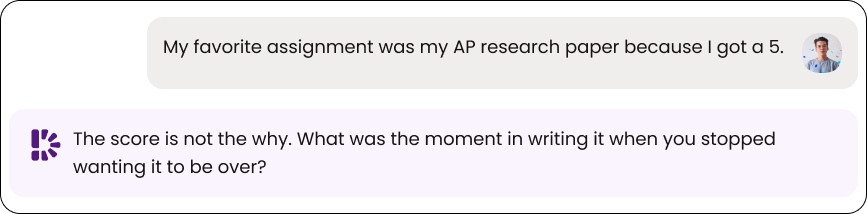
    Prompts are quoted from USC’s Common App supplement for 2026/27 as reproduced by sources quoting it, linked at the bottom. The academic essay and the ten short answers are required. The disagreement essay is marked optional. Write it. At a school this selective, a blank optional essay tells the reader you had nothing to say about engaging with people who disagree with you, which is the quality the prompt was written to find.

    1. Your academic interests and “why USC” (250 words, required)

    The prompt. Describe how you plan to pursue your academic interests and why you want to explore them at USC specifically. Please feel free to address your first- and second-choice major selections.

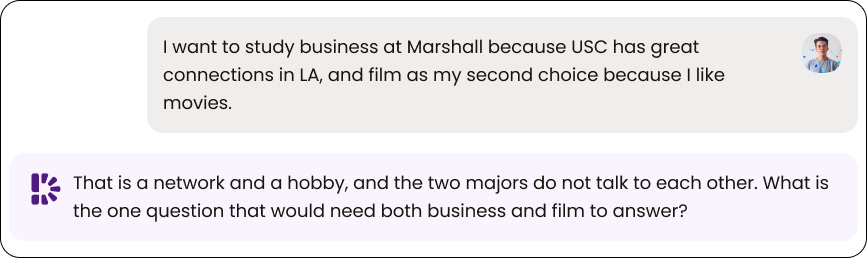
    What USC is testing. Whether your academic interest is real and whether you have looked at how USC teaches it. Two halves, in order. The reader also checks whether your first and second choice majors make sense together. If they are far apart, the essay has to show the question that connects them.

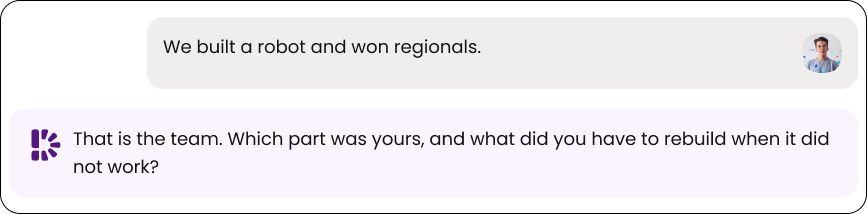
    How to answer. Open with where the interest became real, from your high school years, not your childhood, with something you did: a question you chased, a thing you built or measured. About 120 words. Then USC: one or two specific features of the school or program you are applying to, a course, a lab, a center, an interdisciplinary option, and what you would do with each. If you named two majors, one sentence on what connects them. Keep the second half specific to USC. An answer that could go to UCLA fails the word “specifically.”

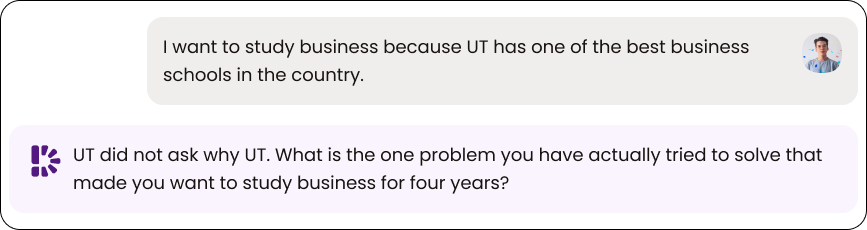
    Avoid. The childhood origin story. Los Angeles as the reason. The ranking. And two unrelated majors with no connection, which reads as a hedge.

    2. A disagreement with someone you know (250 words, optional but expected)

    The prompt. The USC Student Commitment charges Trojans to “value honest, open communication and robust debate,” and to “champion ideological diversity and embrace freedom of expression.” Describe a time when you disagreed with someone you know about something important to you. Did you change your mind or reach common ground?

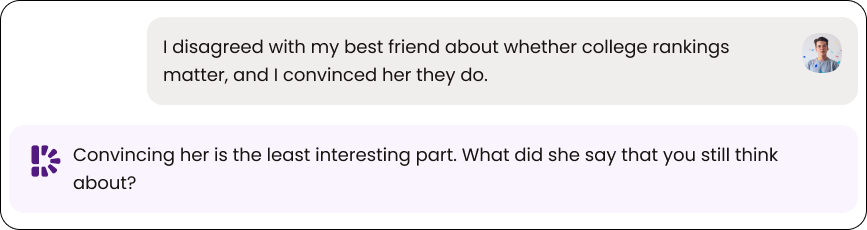
    What USC is testing. How you handle disagreement with someone whose relationship you keep. “Someone you know” rules out strangers online. The closing question, did you change your mind or reach common ground, assumes something moved. The reader is watching the listening, not the winning.

    How to answer. State the disagreement in one sentence and why it mattered to you. Then the exchange: what the other person said, what you said back, the moment it got uncomfortable. End with what moved, which can be small. You still disagree, but you understand why a reasonable person holds the other view. Then one sentence on how you have carried it since.

    Avoid. A position paper on the issue. A disagreement where the other side was simply wrong, or bigoted, which gives you nothing to learn. A disagreement you won cleanly. And leaving it blank.
    Short answers: how the ten work together

    USC’s short answers look like throwaways. They are not. Readers scan all ten in a minute and check them against your essays and activities for one consistent person. Each should hold a concrete noun, and wherever the 100 characters leave room for a reason, use it. The reason is where you show how you think. Spread them across different parts of your life. One warning: readers can tell when an answer was chosen to seem impressive or clever rather than because it is true of you. A plain true answer beats a curated one.


    3. Describe yourself in three words (3 words)

    Three words that a friend would recognize as yours, not three adjectives every applicant reaches for. Specific beats flattering. If one of the three surprises the reader, good.


    4. What is your favorite snack? (100 characters)

    A snack with a story: a dish from home, a regional thing outsiders do not know, a ritual food tied to a person or place. The reader should learn something about where you come from.


    5. Best movie of all time (100 characters)

    The film matters less than the reason. Pick one that changed how you see something and say what the film changed in the way you see something. Skip the canonical pick with no reason, and skip anything provocative enough to become the story.


    6. Dream job (100 characters)

    The natural destination of everything else in your file. If it arrives out of nowhere, the reader doubts the rest. If it feels inevitable given your essays and activities, it proves the story is real.


    7. If your life had a theme song, what would it be? (100 characters)

    A song that maps onto your life, with the reason if there is room. An older or unexpected track signals range. Avoid lyrics that could pull focus.


    8. Dream trip (100 characters)

    A destination with a purpose: a question you want to answer, a history you want to stand inside, roots you want to trace. An expensive itinerary with no reason reads as privilege.


    9. What TV show will you binge watch next? (100 characters)

    Same rule as the movie. A show that extends a real thread of yours, with the reason explicit. The why is the only part that reveals anything.


    10. Which well known person or fictional character would be your ideal roommate? (100 characters)

    Your pick answers who you want to learn from. The household names fall flat. Someone less obvious, with a word on what living beside them would teach you.


    11. Favorite book (100 characters)

    Not a book assigned in tenth grade, not one written for younger readers, not one you first met as a film. A book you found on your own that changed how you think, with what it changed.


    12. If you could teach a class on any topic, what would it be? (100 characters)

    A subject you know deeply enough that only you could teach it. Give it a title with a point of view and, if characters remain, a hint of what the class explores.


    School specific prompts

    Applicants to the Viterbi School of Engineering answer two additional prompts, and applicants to Dornsife answer one, inside the USC supplement. Several arts schools, including Cinematic Arts, Roski, Thornton and Dramatic Arts, require portfolios, auditions or separate supplements with earlier dates. Treat each as its own essay with its own evidence, not a rerun of the academic essay. Additional writing questions may appear in the Common App after you select your major. USC identifies Dornsife, Viterbi and the World Bachelor in Business program as having additional questions. This guide covers USC’s university-wide prompts; check your application for the exact program-specific questions.

    Optional: gap year or interrupted education (250 words)

    If you took a gap year or your education was interrupted, USC asks what you did during that time. Factual and brief. Summer breaks do not count and the prompt says so.


    Before you write: map the whole application

    Your personal statement, activities list, the two essays and the ten short answers are read as one file, and USC reads the short answers for consistency with the rest. Each piece should add something the others do not. Repeating an interest is fine. Repeating the same evidence wastes space. Think of the reader as someone who has already read everything else in your file before they reach the USC questions, and who will notice if the dream job does not match the essays.

    Write down what the reader already knows about you from the Common App. Then give each USC answer one thing that list is missing.

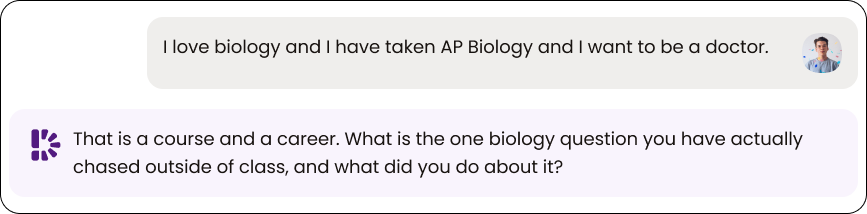
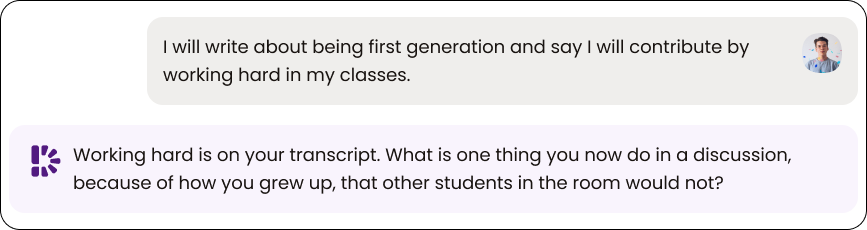
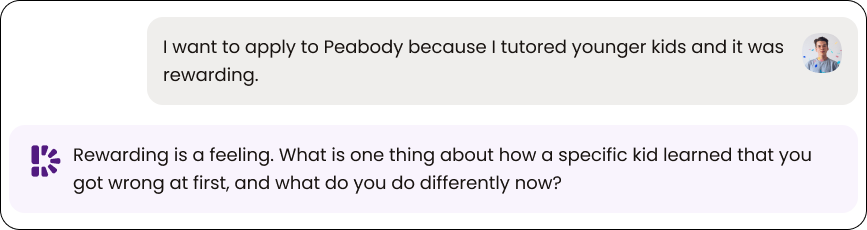
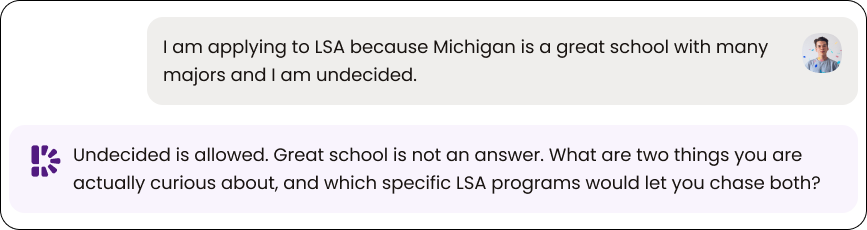
    Want help connecting the pieces? Dakota, in College CoPilot’s Application Coach, uses what you have already shared to spot repetition and ask the question you have not answered. The writing stays yours. USC allows thoughtful AI use for brainstorming or improving a sentence, but says the ideas and words you submit should be yours. It says AI should not draft or rewrite your essays. Read USC’s AI guidance before using a tool.
    Official USC Sources

  • UNC Chapel Hill Supplemental Essays 2026/27: What Changed and What UNC Reads Instead


    UNC Chapel Hill asks for no supplemental essays in 2026/27. It removed both of its 250 word short answers, and now reads only the Common App personal essay. That is a change from every recent cycle, and a student who finds last year’s guide will be writing two essays UNC no longer collects. The one piece of UNC specific writing left is a short response for Honors Carolina applicants. This page explains what UNC reads now, how the personal essay and activities list carry the weight the short answers used to, and what Honors Carolina asks.

    What is UNC Chapel Hill’s acceptance rate?

    UNC’s overall acceptance rate was 16.7% for the Class of 2029, according to its 2025–26 Common Data Set. UNC does not report separate Early Action (EA) or Regular Decision (RD) acceptance rates in the CDS. The number hides the real split. North Carolina law requires that at least 82 percent of each entering class come from in state, so out of state applicants compete for the rest, and the out of state rate is far lower than the overall figure.

    • Overall: 16.7%
    • In-state: 37.0%
    • Out-of-state: 9.6%
    • EA: Not Reported
    • RD: Not Reported
    • SAT 25th percentile: 1400
    • SAT 50th percentile: 1470
    • SAT 75th percentile: 1530

    What SAT score do you need for UNC Chapel Hill?

    UNC-Chapel Hill’s current undergraduate testing policy is test-optional for students with a weighted high school GPA of 2.8 or above (on a 4.0 scale), while students with a weighted GPA below 2.8 are required to submit an ACT score of 17 or higher or an SAT score of 930 or higher. The middle 50 percent of enrolled students scored 1400 to 1530. A score in that range helps put your application in the pile to be read. It does not get you in. For out of state applicants in particular, the pool is dense with strong transcripts, and with no supplement the personal essay and the activities list are the only places UNC hears from you in your own words.


    When are UNC Chapel Hill’s application deadlines?

    Early Action: October 15th. Regular Decision: January 15th. Early Action is not binding. UNC’s Early Action date falls in mid October, earlier than most peers, and has already passed for this cycle. Honors Carolina and most merit scholarships draw from the Early Action pool, so the date matters more than it looks.


    Does UNC Chapel Hill have a “Why UNC” essay in 2026/27?

    No, and it no longer has any supplemental essay. UNC’s admissions office announced the removal of both short answer questions in June 2026, saying it wanted to simplify the application. There is nowhere on the application to explain why Carolina, and the Common App personal essay is not the place to try. It goes to every school on your list.


    What UNC reads in 2026/27 and how to use it

    The Common App personal essay, 250 to 650 words on one of the Common App prompts, is the only required essay. Beyond it, UNC reads your activities list, your transcript, your recommendations and, if you submit them, your test scores. Honors Carolina applicants add one short response.

    The Common App personal essay (250 to 650 words)

    What UNC is testing. Who you are apart from grades and scores. UNC’s old short answers asked about community and about an academic interest, which tells you what its readers were trained to look for. The personal essay now has to carry that on its own, without mentioning UNC.

    How to use it. Answer the Common App prompt you chose. The strongest essays for a school like this show a person in a community or in pursuit of a question: a responsibility you carried, a thing you built outside class, a problem you worked on that had no textbook answer. If your essay already does that, do not rewrite it to mention Chapel Hill.

    Avoid. A “Why UNC” essay in disguise. A “why major” essay in disguise. And a résumé in paragraph form, which the activities list already holds.


    The activities list

    With no supplement, the ten activity entries do the work a school specific essay would do elsewhere. Each gets 150 characters. Use them for what you did and what came of it, not for the organization’s mission. UNC’s retired community prompt was its signal that it reads for contribution. Put the entries that show you changing something first.


    Honors Carolina short response (about 100 to 250 words)

    What it is. Students who indicate interest in Honors Carolina complete one additional short response on intellectual curiosity or community impact. It is the only UNC specific writing left in the application.

    How to answer. One question you have chased or one thing you changed in a community, shown in a scene, with what came of it. Treat it as its own essay with its own evidence, not a rerun of the personal statement. The Honors reader has already seen that.

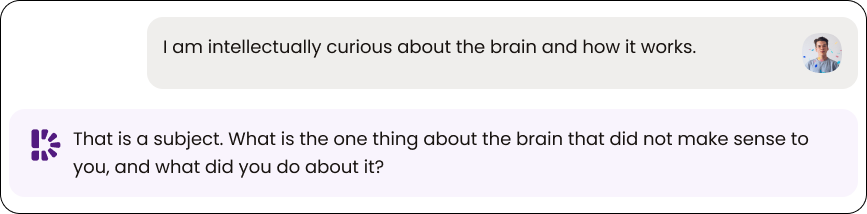
    Avoid. “I am intellectually curious.” A list of activities. And repeating the Common App essay’s story.


    Before you write: map the whole application

    UNC reads your personal essay, your activities list and your recommendations as one file, and for most applicants there is nothing else in your own words. The personal essay has to show who you are without help from a supplement. The activities list has to show contribution without an essay to explain it. Think of the reader as someone who will know you only through those two things, in a pool of more than 65,000.

    Write down what the reader will see in your activities list. Then make sure the personal essay shows something that list cannot.

    Remember to keep your writing in your own voice and make sure it reflects your own experiences and thinking.

    Want help connecting the pieces? Dakota, in College CoPilot’s Application Coach, uses what you have already shared to spot repetition between your personal essay and your activities and to ask the question you have not answered. The writing stays yours. 


    Official UNC Sources

  • UC Personal Insight Questions 2026/27: All Eight Prompts and How to Answer Them


    The University of California does not ask for a personal statement and does not have supplemental essays. It runs its own application, not the Common App, and one application covers all nine undergraduate campuses: UC Berkeley, UC Davis, UC Irvine, UCLA, UC Merced, UC Riverside, UC San Diego, UC Santa Barbara and UC Santa Cruz.

    Every first year applicant answers four of eight Personal Insight Questions, called PIQs, at 350 words each, and the same four answers go to every campus you select. There is no “Why UCLA” essay and no “Why Berkeley” essay anywhere in the application. UC is also test blind, so the PIQs, your activities and your transcript are the whole case. This page gives all eight questions, how to choose four, and how to answer each one.

    What is the UC acceptance rate?

    UC admission rates are set by campus, not by the system, and UC publishes them on its first year admit data page. UCLA’s overall rate is 9.4% and Berkeley’s is 11.4%. Merced, Riverside and Santa Cruz admit the majority of applicants. Admission rates vary by campus and residency, and selectivity can also vary by major. Across the UC system, 78% of California-resident first-year applicants were admitted to at least one campus for Fall 2026.

    • UC Berkeley overall: 10.5%
    • UCLA overall: 10.8%
    • UC San Diego overall: 27.2%
    • UC Irvine overall: 30.3%
    • UC Santa Barbara overall: 44.0%
    • UC Davis overall: 45.8%
    • UC Santa Cruz overall: 82.1%
    • UC Riverside overall: 88.2%
    • UC Merced overall: 94.7%

    What SAT score do you need for the UCs?

    Each campus reviews your four PIQs alongside your academic record, activities and awards, and the rest of your application. The PIQs are one part of comprehensive review, not the whole case. Think of the reader as someone at each campus considering how the pieces fit together. Some programs require additional materials.


    When is the UC application due?

    The application opens August 1st and must be submitted between October 1st and November 30th for fall 2027 admission. There is no early round at any UC campus. You select campuses inside one application, pay a fee per campus, and each campus reviews the same file independently.


    Does UCLA or Berkeley have supplemental essays?

    No UC campus has a supplemental essay or a “Why Us” prompt. UCLA, Berkeley and the other seven campuses all read the same four PIQ answers you submit once. Students who search for UCLA supplemental essays are looking for something that does not exist. What exists is the PIQ set below, and campus readers apply their own weight to it. UCLA’s admission page says it reads the PIQs for intellectual curiosity and interest in personal development. Berkeley reads them inside its holistic review alongside the activities section.


    What are the UC Personal Insight Questions?

    All eight are quoted from UC’s personal insight questions page, linked at the bottom. UC’s rules: choose any four, 350 words maximum each, all questions weighted equally, no advantage to any particular set. UC also provides an additional comments field for unusual circumstances, which is not an essay and should not be used as a fifth answer.


    Which four should you choose?

    Choose by evidence, not by which questions sound strongest. The right four are the ones where you can write a specific scene, with a thing you did and a result. Then check the set: four answers should show four different sides of you, drawn from different parts of your life. If two answers would use the same activity, swap one. UC readers see all four together and are looking for range as much as depth. A useful order: pick the one question where your best material lives, then pick three that cover what it leaves out.

    Two structural notes. PIQ 8 is the open question, and it is the one most applicants waste by repeating something already in the application. Use it only if something real is missing. PIQ 5, the challenge question, is the one most likely to draw a hardship story told for its own sake. UCLA’s own guidance says an answer is not effective simply because it chronicles difficult circumstances. Both can be strong. Neither is required.


    UC Personal Insight Questions and how to answer them

    PIQ 1. Leadership (350 words)

    The prompt. Describe an example of your leadership experience in which you have positively influenced others, helped resolve disputes or contributed to group efforts over time.

    What UC is testing. What you did when a group needed something, not what title you held. UC’s own guidance says leadership can mean mentoring, running one task, organizing an event, or taking care of your family. The phrase “over time” asks for something sustained, and “resolve disputes” invites a story about a group that was not working.

    How to answer. One group, one moment it needed something, what you did, what happened. Spend about 200 words on the scene and 150 on what you learned about leading, stated as something specific you now do differently. A family responsibility counts. UC says so.

    Avoid. The list of titles. A story where you were in charge but nothing happened. And the word “leadership” doing the work the scene should do.


    PIQ 2. Creativity (350 words)

    The prompt. Every person has a creative side, and it can be expressed in many ways: problem solving, original and innovative thinking, and artistically, to name a few. Describe how you express your creative side.

    What UC is testing. How you make or solve things, in any field. The prompt names problem solving first on purpose. Creativity here is not limited to art. A workaround you built, an argument you constructed, a system you designed all count.

    How to answer. One creative act, shown in enough detail that the reader can see the problem and the solution. Then what it says about how you think. If your creativity connects to your major, say so in a sentence, not as the thesis.

    Avoid. “I am a creative person.” A list of art forms. And describing a finished product with no process.


    PIQ 3. Greatest talent or skill (350 words)

    The prompt. What would you say is your greatest talent or skill? How have you developed and demonstrated that talent over time?

    What UC is testing. Whether you have worked at something. The second sentence is the question: developed and demonstrated over time. UC says the talent does not need an award. A skill with no trophy and a clear history of practice answers this better than a prize with no story.

    How to answer. Name the skill in the first sentence. Then the history: where it started, the point where you were bad at it, what you did about that, and one moment where it showed. End with why it matters to you.

    Avoid. Choosing the most impressive skill over the one with the best history. Repeating PIQ 2 or PIQ 6 with a different label. And “I have always been good at.”


    PIQ 4. An educational opportunity or barrier (350 words)

    The prompt. Describe how you have taken advantage of a significant educational opportunity or worked to overcome an educational barrier you have faced.

    What UC is testing. What you did with what you were given, or what you did when you were given less. This is two questions and you answer one. The opportunity version is about an honors program, a summer course, an academy, advanced classes. The barrier version is about a school that did not offer what you needed and what you did about it.

    How to answer. Name the opportunity or barrier in the first sentence. Spend the middle on what you did, not on what the program was. End with what changed in how you learn. For the barrier version, UC asks what characteristics or skills you called on. Name them through the actions, not as adjectives.

    Avoid. A description of the program with no evidence you used it. A barrier told as hardship with no action. And a story that belongs in PIQ 5.


    PIQ 5. The most significant challenge (350 words)

    The prompt. Describe the most significant challenge you have faced and the steps you have taken to overcome this challenge. How has this challenge affected your academic achievement?

    What UC is testing. How you act under difficulty and whether it explains anything in your record. The prompt asks three things: the challenge, the steps, and the effect on your academics. The steps are the answer. UC says the challenge can be personal or something in your community or school, and that you can still be working through it.

    How to answer. State the challenge in two sentences. Spend most of the words on what you did, including what did not work. Answer the academic question directly, even if the answer is that your grades held and it cost you something else. End with where you are now.

    Avoid. A hardship chronicle with no steps. Choosing the biggest challenge you can think of because it seems expected. And skipping the academic question, which UC placed in the prompt on purpose.


    PIQ 6. An academic subject that inspires you (350 words)

    The prompt. Think about an academic subject that inspires you. Describe how you have furthered this interest inside and/or outside of the classroom.

    What UC is testing. Whether your interest has a history of action. “Furthered” is the word. UC lists what counts: coursework at a higher level, volunteer work, internships, employment, summer programs, clubs. UC’s guidance also asks whether you would pursue the subject at UC and how, which is the only place in the application that invites a sentence about your academic plan.

    How to answer. Name the subject and one specific question inside it that caught you. Then two or three things you did to chase it, with what each taught you. End with how you would pursue it at UC, in one or two sentences that hold for any campus, since the same answer goes to all of them.

    Avoid. “I have always loved science.” A list of courses. And naming one campus’s program, since your other campuses read the same answer.


    PIQ 7. Making your school or community better (350 words)

    The prompt. What have you done to make your school or your community a better place?

    What UC is testing. Whether something is different because you were there. UC says community can be a group, a team, a school, a hometown or a home, and asks about your role. The reader wants a problem, an action and a result, at any scale.

    How to answer. One community, one problem, what you did, what changed. Say why you acted. If you worked with others, say what part was yours. Small and specific beats large and vague.

    Avoid. The service hours count. Changing the world. And a community so large that no individual could have changed it.


    PIQ 8. What makes you a strong candidate (350 words)

    The prompt. Beyond what has already been shared in your application, what do you believe makes you a strong candidate for admissions to the University of California?

    What UC is testing. Whether there is something real that fits nowhere else. The phrase is “beyond what has already been shared.” UC’s guidance says to use it for a skill, talent, challenge or opportunity that did not fit another question, and adds that you should not be afraid to brag a little. The reader has already seen three answers and your activities list.

    How to answer. Only pick this if something is missing from the other three answers and the activities section. One thing, shown, with one example. Then say plainly why it makes you a strong candidate.

    Avoid. A summary of your other answers. A second activities list. And choosing this question because it seems open when the other seven ask for the same material more directly.


    Before you write: map the whole application

    UC reads your four PIQs, your activities and awards section and your transcript as one file, at every campus you select, and nothing else. There is no personal statement to carry your story and no scores to carry your numbers. The four answers together have to show a whole person. Think of the reader as someone at each campus who will know you only through those four answers and twenty activity entries.

    UC says your PIQs should reflect your own ideas and words. It equates a fully AI-generated response with academic dishonesty and says an AI-generated PIQ with unattributed sources could lead to disqualification. Keep the ideas and writing yours.

    Write down what the reader will see in your activities section. Then choose the four questions that show what that list cannot, and make sure each answer uses a different part of your life.

    Want help choosing the four and connecting them? Dakota, in College CoPilot’s Application Coach, uses what you have already shared to spot repetition across your answers and ask the question you have not answered. The writing stays yours. UC says your answers must be your own ideas, written by you alone, and names plagiarism from any source as disqualifying. Read its writing tips before you use any tool.


    Official UC sources

  • Vanderbilt Supplemental Essays 2026/27: Prompts by School and How to Answer Them


    Vanderbilt asks for one supplemental essay of about 250 words, built on its motto, and no “Why Vanderbilt” essay. The prompt is the same for every applicant, but you choose one of five schools on the application, you stay in that school for your first year, and the essay’s contribution clause is read against it. Blair School of Music applicants also complete a separate Blair application with pre screening and an audition. This page gives the prompt, then a section for each school on how the same essay should be answered for it.

    What is Vanderbilt’s acceptance rate?

    Vanderbilt’s overall acceptance rate was 4.6% for the Class of 2030. Its combined Early Decision (ED) I and II admit rate was 11.9%, and its Regular Decision (RD) admit rate was 2.8%. Vanderbilt does not publish rates by school. Blair admits on audition and is a different pool.

    • Overall: 4.6%
    • ED: 11.90%
    • RD: 2.8%
    • SAT 25th percentile: 1510
    • SAT 50th percentile: 1530
    • SAT 75th percentile: 1560

    What SAT score do you need for Vanderbilt?

    Vanderbilt is test optional for 2026/27 and has announced it will require the SAT or ACT for students entering in fall 2029. If you submit, the middle 50 percent of enrolled students scored 1510 to 1560. A score in that range gets your essay read. It does not get you in. More applicants have perfect scores than Vanderbilt has places. That is “why” the essay matters here.


    When are Vanderbilt’s application deadlines?

    Early Decision I: November 1st. Early Decision II and Regular Decision: January 1st. Both Early Decision rounds are binding. If you are admitted, you withdraw your other applications and enroll. Blair applicants submit both Vanderbilt and Blair materials by their chosen plan’s deadline. The Blair deadline is November 1 for ED I. ED II and Regular Decision applicants have a December 1 priority deadline and a January 1 final deadline; applicants who pass prescreening are invited to audition. Vanderbilt fills a large share of its class through Early Decision.


    Does Vanderbilt have a “Why Vanderbilt” essay in 2026/27?

    Not as such. The single prompt ends by asking how your growth will contribute to the campus community as you dare to grow at Vanderbilt. That is a contribution clause, not a “Why Vanderbilt” essay. Naming Vanderbilt programs does not answer it. Naming what you would do in a room in your school does. The school sections below say what that room looks like for each.


    The prompt, same for every school

    The prompt is quoted from Vanderbilt’s personal essay and short answer prompts page, linked at the bottom. It is required of all first year applicants.

    Crescere aude: dare to grow (about 250 words)

    The prompt. Vanderbilt University’s motto, Crescere aude, is Latin for “dare to grow.” In your response, reflect on how one or more aspects of your identity, culture, or background has played a role in your personal growth, and how it will contribute to our campus community as you dare to grow at Vanderbilt.

    What Vanderbilt is testing. Two things, both required. First, how a part of who you are drove your growth. The operative word is growth, not description. Second, what that growth lets you bring to the people around you. Most drafts do the first half well and wave at the second in a sentence. The reader works for the school you chose, so the second half should land in that school.

    How to answer. Pick one aspect, not three. Spend about 100 words on a specific moment where that aspect pushed you to change: a thing you did that you could not have done before. Spend about 70 on the growth, stated as something you now do or believe. Spend the last 80 on the contribution, in plain words: what you would bring to a seminar, a lab group, a classroom placement or a rehearsal because of it. Make the contribution a behavior, not a promise.

    Avoid. Quoting Crescere aude or dare to grow back to Vanderbilt. The identity label with no growth underneath. Hardship as a credential. And a contribution that is a list of Vanderbilt clubs.


    Vanderbilt’s essay by school

    College of Arts and Science

    What it is. The largest school, home to the humanities, social sciences and natural sciences, and the usual choice for undecided and pre med applicants. Readers want evidence that you would use a broad curriculum well and bring something to discussion based classes.

    The contribution clause for Arts and Science. Land it in a classroom or a research setting: what you would say in a seminar where people disagree, how you would approach a question in a lab, what you would notice that others might not. If the growth in your essay is about how you think, this is the school where that pays off.

    Avoid. A pre med essay with Arts and Science as the wrapper. A contribution that could be made at any college. And naming Engineering or Peabody settings, which tells the reader you wanted a different school.


    School of Engineering

    What it is. A smaller engineering school inside a liberal arts university, with a first year common curriculum before majors. Readers want evidence you have built something and that you would work well in teams.

    The contribution clause for Engineering. Land it in a project team or a lab: what you would bring to a group that is stuck, how you handle a design that failed, what role you take when nobody assigns one. If the growth in your essay is about persistence, iteration or working with people unlike you, point it there.

    Avoid. “I have loved math since I was five.” An essay that never shows a thing you made. And a contribution that is about leadership titles rather than what you do in a room.


    Peabody College

    What it is. A school with majors in education, human and organizational development, child studies, cognitive studies and special education. Readers want a specific problem in how people learn, develop or work together, and evidence you have engaged with it.

    The contribution clause for Peabody. Land it in a field placement, a classroom, a community partnership or a research group: what you would bring to a room of children, families or coworkers because of how you grew. If the growth in your essay is about understanding people, teaching, or watching a system work or fail, this is where it belongs.

    Avoid. “I want to help people” or “make a difference in education.” Choosing Peabody as a less competitive route into Vanderbilt, which readers see often. And a contribution with no setting in it.


    Blair School of Music

    What it is. Vanderbilt’s music school, admitting on pre screening and audition alongside the academic review. All Blair applicants submit the Vanderbilt application, then the Blair application through the MyAppVU portal with a music résumé and pre screening recordings, by the application deadline. Applicants who pass pre screening are invited to audition. Pre screening requirements depend on instrument, voice, composition or jazz, not on intended major.

    The contribution clause for Blair. Land it in a studio, an ensemble or a rehearsal: what you bring to a group of musicians because of how you grew. If the growth in your essay is about practice, performance under pressure, or learning from a teacher, point it there. The essay supports the audition. It does not replace it.

    Avoid. An essay about loving music with no practice in it. Treating the Vanderbilt essay as the Blair application, which is separate. And missing the pre screening deadline, which is the same date as the application.


    College of Connected Computing

    What it is. Vanderbilt’s newest undergraduate school will welcome its first class in fall 2027. Its undergraduate programs include computer science, data science, and AI Design and Practice, connecting computing with other fields.
    The contribution clause for Connected Computing. Picture the room where your perspective would matter: a team deciding how to build a tool, a classroom weighing who benefits from it, or a research group bringing technical and human questions together. Connect that contribution to the experience that shaped you.
    Avoid. Listing technology interests without showing what you would bring to the work, or promising to build “technology for good” without naming a problem you’ve explored.


    Choosing the school

    You stay in your school for your first year, and switching later requires meeting that school’s requirements and is not guaranteed. Choose by where your evidence lives, not by where the odds seem better. An essay whose contribution clause lands in the wrong school tells the reader you chose for the wrong reason.


    Before you write: map the whole application

    Your personal statement, activities list and this one Vanderbilt essay are read as one file by readers for the school you chose. With only one supplement, it has to add something the personal statement does not. If your Common App essay is already about your background, this essay needs a different aspect or a different moment. Think of the reader as someone who works for your school and is deciding whether you belong in it.

    Write down what the reader already knows about you from the Common App. Then give the Vanderbilt essay the one thing that list is missing, and make the contribution land in your school.

    Want help connecting the pieces? Dakota, in College CoPilot’s Application Coach, uses what you have already shared to spot repetition and ask the question you have not answered. The writing stays yours. Follow Vanderbilt’s current rules on AI assistance.


    Official Vanderbilt Sources

  • University of Michigan Supplemental Essays 2026/27: Prompts by School and How to Answer Them


    Michigan asks for two required essays: 100 to 300 words on how you are prepared to contribute as a leader and citizen, and 100 to 550 words on why the specific school or college you are applying to. The second essay names your school in the prompt, so it cannot be written without knowing which one you chose and what it teaches. Michigan admits to a first year school or college, not to the university, and several units add their own materials. This page gives both prompts, then a section for each first year admitting unit on how to write the school essay for it.

    What is Michigan’s acceptance rate?

    Michigan’s overall acceptance rate was 16.1% for the Class of 2030, according to the University of Michigan’s Fall 2026 First-Year Profile. Michigan has not published acceptance rates by application round for that class. Rates differ sharply for Michigan residents and out of state applicants, and by school. Ross, Engineering, Stamps, SMTD and Taubman are each more selective than the university figure.

    • Overall: 16.1%
    • EA: Not Reported
    • ED: Not Reported
    • SAT 25th percentile: 1370
    • SAT 50th percentile: 1470
    • SAT 75th percentile: 1530

    What SAT score do you need for Michigan?

    Michigan is test optional for the 2026–27 application cycle. Among Fall 2025 first-year students who submitted SAT scores, the middle 50 percent scored 1370 to 1530. A score in that range helps put your application in the pile to be read. It does not get you in. Michigan receives more applications than almost any university in the country, and the school essay is where it separates applicants with the same numbers.


    When are Michigan’s application deadlines?

    Early Action: November 1st. Regular Decision: February 1st. Michigan’s Early Action plan is nonbinding, so admitted students can consider offers from other colleges before deciding. Early Decision, introduced in the 2025–26 application cycle, is also available for 2026–27. Traditional dual-degree and Preferred Admission applicants must apply Early Action or Regular Decision; Michigan IBE applicants may apply Early Decision. Taubman applicants may apply Early Action or Regular Decision SMTD applicants can apply only Regular Decision, with a December 1 deadline. Stamps and Taubman applicants must submit portfolios, and SMTD applicants must audition. Marsal EPP and LEAPS applicants must submit an asynchronous video interview. Check each program’s requirements for materials deadlines.


    Does Michigan have a “Why Michigan” essay in 2026/27?

    Yes, and it is the longer of the two. The second prompt asks what attracts you to the specific school or college you are applying to and how its curriculum would support your interests. Michigan’s own advice says to highlight faculty, courses, research opportunities and affiliated programs. It is one of the few selective schools that asks for that research out loud, and it gives you 550 words to do it. The sections below explain what to research for each school or college. 


    The prompts, same for every school

    Prompts are quoted from Michigan’s essay questions page, linked at the bottom. Both are required of all first year applicants.

    Essay 1. How you are prepared to contribute as a leader and citizen (100 to 300 words)

    The prompt. At the University of Michigan, we are focused on developing leaders and citizens who will challenge the present and enrich the future. In your essay, share with us how you are prepared to contribute to these goals. This could include the people, places, experiences, or aspirations that have shaped your journey and future plans.

    What Michigan is testing. Whether you have done something that shows you would act, not just attend. The words are “prepared to contribute.” The reader wants one or two sources from the list, shown, and a plain statement of what they prepared you to do. This essay is the same for every school.

    How to answer. One experience or one person. Spend about 150 words on a scene where you took on something: a responsibility, a problem, a position nobody asked you to take. Spend the rest on what it prepared you to do, stated as a specific way you would act in a community.

    Avoid. The leadership résumé. “Challenge the present” quoted back. A list of three experiences at 100 words each. And an essay about the future with nothing you have already done in it.


    Essay 2. Why your specific school or college (100 to 550 words)

    The prompt. Describe the unique qualities that attract you to the specific undergraduate college or school (including preferred admission and dual degree programs) to which you are applying at the University of Michigan. How would that curriculum support your interests?

    What Michigan is testing. Whether you know which school you applied to and what its curriculum looks like. “Unique qualities” means what distinguishes your school from the others at Michigan and from peers elsewhere. The curriculum question is the core. If you applied for preferred admission to an upper level unit, the prompt tells you to address that too.

    How to answer. Open with the interest, shown with evidence, about 150 words. Then spend the bulk, about 300 words, on the school: two or three specific features of its curriculum, named, with what you would do with each and why it fits. If you applied for preferred admission, give that program its own paragraph and integrate it with your first year unit. End with what you want to be able to do by graduation.

    Avoid. Writing about the University of Michigan when the prompt asks about your school. Ann Arbor and football as reasons. A list of ten courses with no reason attached. And an essay that would work for another Big Ten school with the names swapped.


    Michigan’s school essay by first year admitting unit

    College of Literature, Science, and the Arts (LSA)

    What LSA is. The largest unit, home to most humanities, social science and natural science majors, and the usual choice for undecided and pre-med applicants. LSA readers do not need a declared major. They need evidence that you would use a broad curriculum well.

    The school essay for LSA. Name two or three LSA departments or programs and the question that connects them. Unique qualities to research: the Honors Program, the Residential College, the Michigan Research Community, specific interdisciplinary majors, undergraduate research through UROP. Tie each to something you already do.

    Avoid. A pre med essay with LSA as the wrapper. “Lots of options” as the reason. And naming Engineering or Ross features, which tells the reader you wanted a different unit.


    College of Engineering

    What Engineering is. A large engineering college with its own first year curriculum and more than a dozen majors. Readers want evidence you have built something and know which discipline you are heading toward. Preferred admission to Ross through Engineering is no longer offered; the new Michigan IBE program replaces it.

    The school essay for Engineering. Start with one thing you built, fixed or measured and what happened when it did not work. Then name the discipline and two or three specific features: a lab, a project team, the Multidisciplinary Design Program, a research center. Say what you would do in each.

    Avoid. The robotics club résumé. “I have loved math since I was five.” And a major chosen because it sounds impressive.


    Ross School of Business and the Michigan IBE Program

    What Ross is. A direct admit BBA program with a separate admissions review, and new this cycle, the Michigan Integrated Business and Engineering program, which you apply to directly on the first year application. Ross requires an admissions portfolio in addition to the two Michigan essays. Ross says the school essay should focus on your first year unit, with business integrated if you are seeking preferred admission from Stamps, SMTD or Kinesiology Sport Management.

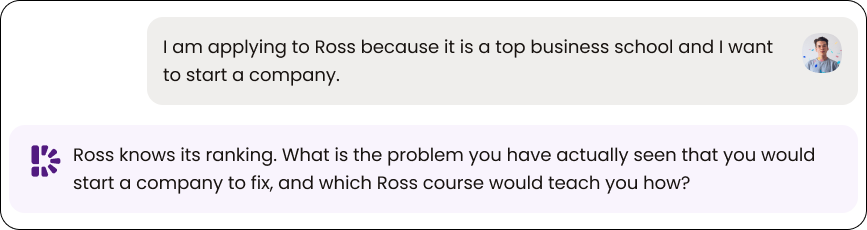
    The school essay for Ross. Open with a problem you have seen that business methods would help solve, not a career plan. Then name specific Ross features: the action based learning model, a specific course sequence, a center or institute, the BBA structure. For IBE, show both the engineering problem and the business question inside it. Keep the ranking out.

    The Ross portfolio. Ross reviews a separate portfolio with its own prompt, which changes by cycle and is on the Ross admissions page. Treat it as its own essay with its own evidence. Do not repeat the school essay.

    Avoid. “I want to be an entrepreneur” with no problem attached. Treating Ross as a brand. And forgetting the portfolio, which Ross requires.


    Stamps School of Art and Design

    What Stamps is. An art and design school that admits on portfolio alongside the academic review. Stamps requires a portfolio and an artistic statement through its own process, with earlier dates. Stamps applicants may also seek preferred admission to Ross.

    The school essay for Stamps. Name the kind of work you make and one or two Stamps features: the studio structure, the international experience requirement, a specific area of practice, the dual degree options. Connect each to work in your portfolio. The essay supports the portfolio. It does not replace it.

    Avoid. An essay about loving art with no practice in it. Describing your portfolio piece by piece, which the reviewer can see. And missing the portfolio deadline.


    School of Music, Theatre and Dance (SMTD)

    What SMTD is. A conservatory level school with majors across music, theatre and dance, admitting on audition or portfolio alongside the academic review. SMTD has its own application and earlier dates. SMTD applicants may also seek preferred admission to Ross.

    The school essay for SMTD. Name your discipline and degree track, and one or two SMTD features: a studio, an ensemble, a specific program, the dual degree options with LSA or Engineering. Show practice, not admiration. If you are seeking a dual degree, name the second unit’s setting too.

    Avoid. An essay about loving music or theatre with no performance in it. Leaving the discipline unnamed. And missing the audition dates.


    Taubman College of Architecture and Urban Planning

    What Taubman is. Architecture is a first year admitting program at Taubman, with a required portfolio. Urban technology is also offered at the undergraduate level. Taubman architecture applicants may pair the application with a dual degree application to Art and Design, LSA or Engineering.

    The school essay for Taubman. Name one building, place or design problem you have actually examined and what it taught you. Then name Taubman features: the studio sequence, a specific research area, the dual degree path. Connect to a project in your portfolio.

    Avoid. Loving buildings with no project in it. A famous building chosen for its fame. And a career essay with no evidence you have started.


    School of Nursing

    What Nursing is. A direct admit BSN program. Readers want nursing rather than medicine, and evidence of care given or received.

    The school essay for Nursing. One experience with care, in detail, then what it taught you about what nurses do. Then one or two Nursing features: the clinical placement structure, a specific track, research opportunities. Say why nursing is the role.

    Avoid. A medicine essay with the word nursing substituted. “I want to help people.” And skipping the question of why nursing specifically.


    School of Kinesiology

    What Kinesiology is. A direct admit school with majors in movement science, applied exercise science, athletic training and sport management. Sport Management applicants may seek preferred admission to Ross.

    The school essay for Kinesiology. Name the major and one experience that led to it: an injury, a job, a team, a measurement you took. Then one or two Kinesiology features: a lab, a specific research area, the sport management curriculum. If you are seeking Ross preferred admission, integrate the business question.

    Avoid. An essay about loving sports. Choosing Kinesiology as a back door to Ross. And leaving the major unnamed.


    Marsal Family School of Education

    What Marsal is. Two undergraduate programs admit first years directly, with their own requirements, and teacher certification programs offer preferred admission. Readers want a specific problem in how people learn and evidence you have worked on it.

    The school essay for Marsal. One experience where you taught, tutored or watched learning work or fail. Then the Marsal program by name and one or two features: a field placement, a research center, a specific course sequence.

    Avoid. “I want to make a difference in education.” A social justice essay with no classroom in it. And leaving the program unnamed.


    College of Pharmacy: Pharmaceutical Sciences

    First-year applicants can apply directly to the College of Pharmacy’s Bachelor of Science in Pharmaceutical Sciences (BSPS). In your school-specific essay, explain what draws you to pharmaceutical sciences and how the BSPS curriculum supports your interests. The BSPS is a bachelor’s program; Preferred Admission to the PharmD program is a separate path.


    Preferred admission programs

    Students can request Preferred Admission as part of their first-year application. They must first be admitted to an eligible first-year school or college and selected for Preferred Admission. If selected, they’re guaranteed a place in the program after meeting its requirements.

    Options include Taubman Architecture, the School of Information, Preferred Admission to the School of Public Health through LSA (new for fall 2027 applicants), the Ross BBA for eligible applicants from Stamps, SMTD, and Kinesiology Sport Management, and the College of Pharmacy’s PharmD program. In your school essay, explain how your first-year school and the Preferred Admission program fit together. Ross advises applicants to focus on their first-year school and integrate business into that plan if they’re applying for Ross Preferred Admission. Check Michigan’s Preferred Admission page for program-specific eligibility.


    Before you write: map the whole application

    Your personal statement, activities list and the two Michigan essays are read as one file by readers for the unit you chose. Each piece should add something the others do not. The first essay should show a side of you; the activities list only names. The second should show research the rest of the application cannot, specific to your school. Think of the reader as someone who works for that school and is deciding whether you belong in it.

    Write down what the reader already knows about you from the Common App. Then make sure the school-specific essay shows something that list cannot.

    Michigan says AI tools can help with brainstorming, outlining and proofreading, and that the application must reflect your own ideas and voice with no pasted AI text.

    Want help connecting the pieces? Dakota, in College CoPilot’s Application Coach, uses what you have already shared to spot repetition and ask the question you have not answered. The writing stays yours. 


    Official Michigan Sources

  • Northwestern Supplemental Essays 2026/27: Prompts by School and How to Answer Them


    Northwestern asks for one required essay of 300 words about how your background shapes the way you would engage on campus, plus one or two short answers of under 200 words chosen from five prompts. It no longer requires the Common App personal essay. The prompts are the same for every applicant, but you apply directly to one of six undergraduate schools, and the required essay is read against that school. Choose the school that fits your interests and preparation; your school choice should make sense alongside your essays. This page gives the prompts, then a section for each school on how the same questions should be answered for it.

    What is Northwestern’s acceptance rate?

    Northwestern’s overall acceptance rate was approximately 7% for the Class of 2030. It has not published a Class of 2030 Early Decision acceptance rate. Northwestern does not publish rates by school. Medill and the School of Communication’s theatre programs are widely understood to be more selective than the university figure, and Bienen School of Music admits on audition.

    • Overall: 7.0%
    • ED: Not Reported
    • SAT 25th percentile: 1520
    • SAT 50th percentile: 1540
    • SAT 75th percentile: 1560

    What SAT score do you need for Northwestern?

    Northwestern is test optional for 2026/27. Among Fall 2025 enrollees who submitted SAT scores, the middle 50 percent scored 1520 to 1560. A score in that range helps put your application in the pile to be read. It does not get you in. More applicants have perfect scores than Northwestern has places, and because the personal essay is optional, the required supplement may be the only writing the committee reads from you.


    When are Northwestern’s application deadlines?

    Early Decision: November 1st. Regular Decision: January 4th. Early Decision is binding. If you are admitted, you withdraw your other applications and enroll. Bienen applicants have earlier audition and portfolio dates. Northwestern no longer offers alumni interviews and accepts an optional 60 to 90 second Glimpse video with no disadvantage for skipping it.


    Does Northwestern have a “Why Northwestern” essay in 2026/27?

    Yes, rebuilt. The required essay asks how your background has shaped the way you see yourself engaging in Northwestern’s community. That is a “Why Northwestern” essay with your background as the engine and your school as the setting. The payoff is the second half: what you would actually do on campus, in the school you chose. Northwestern’s own advice on fit says it plainly: fit is a story you tell about how you see yourself thriving on campus.


    The prompts, same for every school

    Prompts are quoted from Northwestern’s application requirements page, headed Northwestern 2026 to 27 First Year Writing Supplements, linked at the bottom. The required essay is required for Common App and Coalition applicants and optional for QuestBridge applicants. You may answer zero, one, or two of the five optional questions. Northwestern encourages at least one, but says answering more does not carry extra weight.

    Required essay (300 words)

    The prompt. We want to be sure we’re considering your application in the context of your personal experiences: What aspects of your background (your identity, your school setting, your community, your household, etc.) have most shaped how you see yourself engaging in Northwestern’s community, be it academically, extracurricularly, culturally, politically, socially, or otherwise?

    What Northwestern is testing. Where your point of view comes from and what you will actually do at Northwestern because of it. The list of backgrounds is wide on purpose. The list of ways to engage is also wide. Pick one or two of each. The reader works for the school you applied to, so the engagement half should name settings that exist in that school.

    How to answer. One aspect of your background, shown in a specific habit it gave you, about 120 words. Then get to Northwestern by the middle and spend the rest on engagement: one academic setting in your school and one activity where that habit shows up, named and specific. A third of the words, at least, on Northwestern. The school sections below say what to name.

    Avoid. Answering engaging with a list of clubs. The identity label with no habit underneath. Spending the whole essay on background and arriving at Northwestern in the last sentence. And naming settings that belong to a different school from the one you chose.


    Short answers: choose one or two, under 200 words each

    2A. Painting The Rock is a tradition at Northwestern that invites all forms of expression. What would you paint on The Rock, and why?

    2B. Northwestern fosters a distinctively interdisciplinary culture. If you could dream up an undergraduate class, research project, or creative effort, what would it be? Who might be some ideal classmates or collaborators?

    2C. Community and belonging matter at Northwestern. Tell us about one or more communities, networks, or student groups you see yourself connecting with on campus.

    2D. Northwestern’s location is special: on the shore of Lake Michigan, steps from downtown Evanston, just a few miles from Chicago. What aspects of our location are most compelling to you, and why?

    2E. Northwestern is a place where people with diverse backgrounds from all over the world can study, live, and talk with one another. How might your individual background contribute to this diversity of perspectives in Northwestern’s classrooms and around our campus?

    Each short answer should cover ground the required essay does not. 2B lets you show how your academic or creative interests could connect with other fields. Answer both parts: what you would create and who you would want as collaborators. 2E repeats the required essay’s angle, so choose it only with a second, different source of perspective. The full prompt wording is on Northwestern’s requirements page.


    Northwestern supplemental essays by school

    Weinberg College of Arts and Sciences

    What Weinberg is. The largest school, home to most majors in the humanities, social sciences and natural sciences, and the default for undecided applicants. Readers expect breadth and a willingness to connect fields.

    Required essay for Weinberg. The engagement half should name one or two Weinberg settings: a department, an interdisciplinary program, a research opportunity, a first year seminar. If you are undecided, name two or three areas and the question that connects them. Weinberg readers do not need a declared major. They need evidence that you would use an open curriculum well.

    Best short answer for Weinberg. 2B. A dream class that combines two Weinberg fields, with collaborators named by discipline, is the strongest signal of fit for this school.

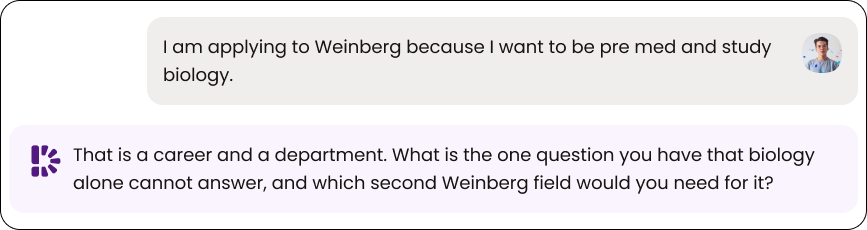
    Avoid. A single subject essay. A pre med essay with Weinberg as the wrapper. And naming Medill or Communication settings, which tells the reader you wanted a different school.


    McCormick School of Engineering and Applied Science

    What McCormick is. Northwestern’s engineering school, with a whole brain engineering philosophy that pairs technical depth with design, communication and the liberal arts. McCormick has the strongest recommended math preparation of the six schools, and its readers want evidence you have built something. Northwestern recommends 3.5–4 years of math for McCormick and says calculus is preferred.

    Required essay for McCormick. The habit from your background should connect to how you solve problems, and the engagement half should name a McCormick setting: a design course, a lab, a project team, a specific engineering discipline. Show one thing you built, fixed or measured, and what happened when it did not work.

    Best short answer for McCormick. 2B. A research project or prototype, with the collaborators named by role, including at least one from outside engineering. That is what whole brain engineering means in practice.

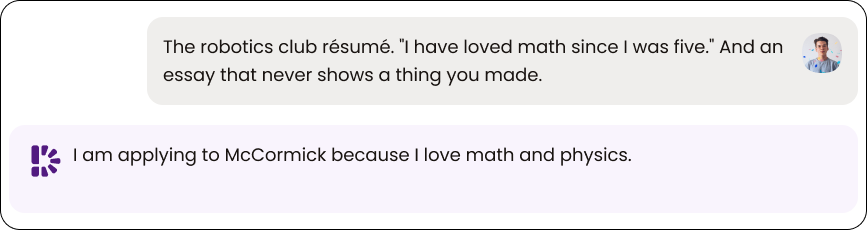
    Avoid. The robotics club résumé. “I have loved math since I was five.” And an essay that never shows a thing you made.


    Medill School of Journalism, Media, Integrated Marketing Communications

    What Medill is. One of the most selective undergraduate journalism programs in the country, with majors in journalism and integrated marketing communications. Medill readers want evidence that you already report, write or make media, not that you admire it.

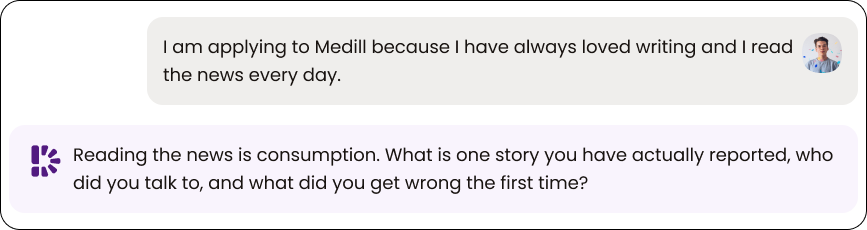
    Required essay for Medill. The habit from your background should be about noticing, asking or telling. The engagement half should name a Medill setting: a specific program, a student publication, a reporting opportunity, the Medill Justice Project. Show one thing you have reported, written or produced and what it taught you.

    Best short answer for Medill. 2A or 2B. The Rock, because it asks what you would say in public and why. Or a dream reporting project with collaborators from other schools.

    Avoid. Admiration for journalism with no evidence you do it. Choosing Medill because it sounds more distinctive than Weinberg. Medill readers can tell, and switching into Medill after enrollment is not guaranteed.


    School of Communication

    What Communication is. A broad school that covers theatre, performance studies, radio, television and film, communication studies, and communication sciences and disorders. The theatre and film programs are highly competitive. Readers want to see practice: a production, a film, a performance, a study of how people communicate.

    Required essay for Communication. The habit from your background should connect to making, performing or studying communication. The engagement half should name the specific Communication major and a setting inside it: a theatre company, a film program, a lab in communication sciences. Name the major. The school is too broad for a general answer.

    Best short answer for Communication. 2B. A creative effort, a performance, a film, a podcast, with collaborators from other schools. The prompt literally invites it.

    Avoid. An essay that could be sent to Medill unchanged. A theatre essay with no production in it. And leaving the major unnamed.


    School of Education and Social Policy (SESP)

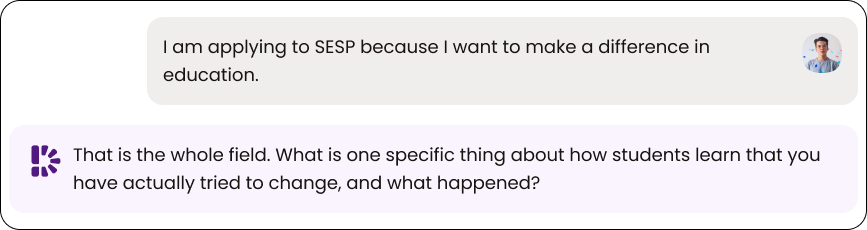
    What SESP is. A small school with majors in learning sciences, human development, social policy and secondary teaching. SESP readers want a specific problem in how people learn or how policy affects them, and evidence you have worked on it.

    Required essay for SESP. The habit from your background should connect to learning, teaching or a policy that shaped your life. The engagement half should name a SESP major and a setting: a practicum, a research group, the SESP Leadership Institute. Show one experience where you taught, tutored, organized or watched a policy work or fail.

    Best short answer for SESP. 2C or 2B. A community you would connect with that matches work you already do, or a research project on a learning or policy question with collaborators from other schools.

    Avoid. “I want to help people.” A social justice essay with no specific policy or classroom in it. And choosing SESP as a less competitive route into Northwestern, which readers see often.


    Bienen School of Music

    What Bienen is. Northwestern’s conservatory level music school. Admission requires a separate Bienen application, a pre screening recording or portfolio, and an audition, with dates earlier than the general application deadlines. Bienen also offers five year dual degree programs with Weinberg, McCormick and Communication, which require applying to both schools.

    Required essay for Bienen. The habit from your background should connect to practice, performance or study of music. The engagement half should name a Bienen setting: a studio, an ensemble, a specific degree track such as performance, composition or music education, and if you are applying for a dual degree, the second school’s setting too. The essay supports the audition. It does not replace it.

    Best short answer for Bienen. 2B. A creative effort or performance project with collaborators, or 2D, the location, if a specific Chicago music institution is part of your plan.

    Avoid. An essay about loving music with no practice in it. Missing the audition dates. And assuming a dual degree happens by default. You apply to both schools.


    Programs with extra supplements

    ISP and MMSS applicants submit separate program applications. Communication Theatre applicants interested in the Music Theatre Certificate may submit an optional supplemental portfolio. Bienen applicants complete a separate music application. If you apply to one of these, treat the extra prompt as its own essay with its own evidence, not a rerun of the required essay.


    Before you write: map the whole application

    Northwestern reads your activities list, your required essay and your one or two short answers as one file, and your Common App personal essay only if you choose to send it. The school you chose frames all of it. Each piece should add something the others do not. If your personal statement carries your best story, Northwestern invites you to repurpose it, but only you may adapt it. Northwestern’s AI guidance names using a tool to rework an essay from one school for another as a problematic use.

    Write down what the reader in your school will see in your activities list. Then give the required essay and each short answer one thing that list is missing.

    Northwestern describes brainstorming and proofreading as constructive uses of AI, but using it to write or rework your essays as problematic. Read its AI guidance before using a tool.
    Want help connecting the pieces? Dakota, in College CoPilot’s Application Coach, uses what you have already shared to spot repetition and ask the question you have not answered. The writing stays yours.


    Official Northwestern Sources

  • Rice Supplemental Essays 2026/27: Prompts and How to Answer Them


    For Common App applicants, Rice requires two 150-word short answers and one 500-word community essay, for up to 800 words of writing. QuestBridge applicants may submit the 500-word essay optionally. Architecture applicants answer two additional 250-word prompts. Rice also asks for one image, The Box, which is not an essay but is read like one. Rice says it is not used for evaluation. For each prompt below, we offer expert guidance on what the question is really testing and how to answer it.


    What is Rice’s acceptance rate?

    Rice’s overall acceptance rate was 7.7% for the Class of 2030. Rice has not reported Early Decision (ED) or Regular Decision (RD) acceptance rates for that class.

    • Overall: 7.7%
    • ED: Not Reported
    • SAT 25th percentile: 1510
    • SAT 50th percentile: 1540
    • SAT 75th percentile: 1560

    What SAT score do you need for Rice?

    Rice is test-recommended for 2026/27 and brings back the SAT or ACT requirement for 2027/28. The middle 50 percent of enrolled students scored 1510 to 1560. A score in that range helps put your application in the pile to be read. It does not get you in. More applicants have perfect scores than Rice has places. That is why the essays matter here.


    When are Rice’s application deadlines?

    Early Decision I: November 1st. Early Decision II: January 4th. Regular Decision: January 4th. Both Early Decision rounds are binding. If you are admitted, you withdraw your other applications and enroll. You select academic areas of interest on the application, and the first short answer asks about them directly.


    Does Rice have a “Why Rice” essay in 2026/27?

    Yes, split across the two 150 word answers. The first asks what draws you to the academic areas you selected and how you would explore them at Rice. The second asks what elements of the Rice experience appeal to you, based on your exploration of Rice. Rice says the supplement is your chance to tell it why you are interested in Rice and what you would pursue there. Keep the academic reasons in the first answer and the rest in the second. Guidance for both is below.

    Try College CoPilot’s Application Coach →


    Rice supplemental essay prompts 2026/27 and how to answer them

    Prompts are quoted from Rice’s first year applicants page, linked at the bottom. The two short answers and the 500 word essay are required for Common App applicants. The 500 word essay is optional for QuestBridge applicants. Architecture applicants answer two more.

    1. What draws you to your academic areas and how you would explore them at Rice (150 words)

    The prompt. Please explain what draws you to the academic areas you selected above and how you hope to explore them at Rice University.

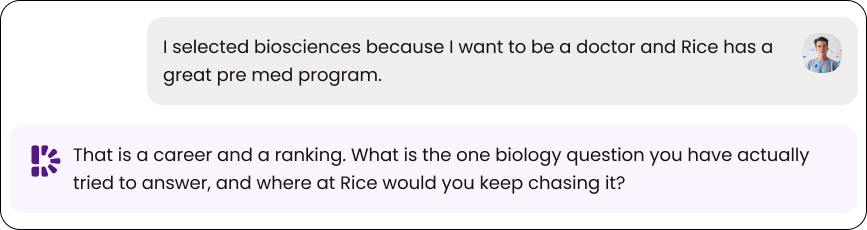
    What Rice is testing. Whether your academic interest is real and whether you have looked at how Rice teaches it. Two questions in 150 words: what draws you, and how at Rice. Most answers spend all 150 on the first. The reader wants one piece of evidence that the interest exists and one or two specific Rice features that fit it.

    How to answer. One sentence naming the question you want to pursue, with evidence from something you did. About 70 words. Then Rice: one program, one lab, one way the department works, connected to that question. About 80 words. If you selected two areas, say what question connects them.

    Avoid. The origin story that uses all 150 words on how you got interested. A list of three departments. And “Rice is a top ranked school for this,” which is not about you.


    2. What elements of the Rice experience appeal to you (150 words)

    The prompt. Based upon your exploration of Rice University, what elements of the Rice experience appeal to you?

    What Rice is testing. Whether you have looked at Rice beyond the name. “Based upon your exploration” is the instruction. The reader wants one or two things about how Rice works, named, tied to something you already do, with the academic reasons left in answer one.

    How to answer. Pick one or two elements you have actually examined: the residential college system, a specific program or tradition, a way student life is organized. For each, say what you already do that connects to it and what you would do with it. About 75 words each.

    Avoid. Houston as the whole answer. Repeating answer one. The residential colleges described back to Rice with no connection to you. And a list of five things with no reason attached.


    3. The community essay: choose one of two (500 words)

    Both prompts ask what you will bring to the Rice community. The first frames it through the residential college system and asks for life experiences and perspectives you look forward to sharing. The second frames it through change agents and asks what perspectives from your background inspire you to join. Choose by evidence: pick the prompt where you can write a scene, not the one that sounds better.

    3A. What you will share in the residential college system

    The prompt. The Residential College System is at the heart of Rice student life and is heavily influenced by the particular cultural traditions and unique life experiences each student brings. What life experiences and/or unique perspectives are you looking forward to sharing with fellow Owls in the residential college system?

    What Rice is testing. What you would be like to live with, and what you would bring to a group of a few hundred people who eat, govern and celebrate together for four years. The residential college is not a dorm. It is a community with its own traditions, and Rice is asking what you would add to one.

    How to answer. One or two life experiences, shown in scenes, about 300 words. Then the sharing, in plain words, about 150: what you would actually do in a college, a habit, a skill, a tradition of your own you would bring. Make it a behavior, not a promise. End with what you would want to learn from the people there.

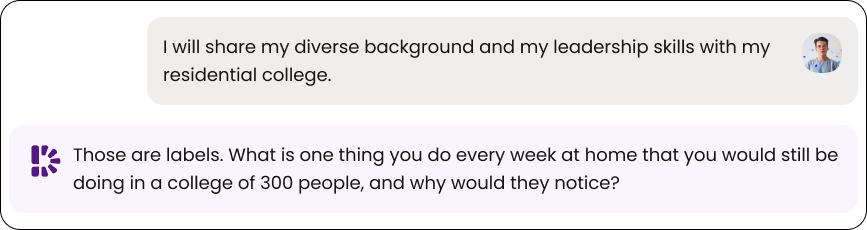
    Avoid. The list of identities with no scene underneath. Describing the residential college system back to Rice. And “I would bring a unique perspective,” which is the prompt handed back.


    3B. Perspectives that inspire you to join a community of change agents

    The prompt. Rice is strengthened by its diverse community of learning and discovery that produces leaders and change agents across the spectrum of human endeavor. What perspectives shaped by your background, experiences, upbringing, and/or cultural identity inspire you to join our community of change agents at Rice?

    What Rice is testing. Where your point of view comes from and what you want to change because of it. “Change agents” is Rice’s phrase for people who do something. The reader wants one perspective, shown through where it came from, and one thing it makes you want to work on.

    How to answer. One aspect of your background, in a scene, about 250 words. Then the perspective it gave you, stated as something specific you now see or believe. Then what you want to change, as narrowly as you can say it, and one thing you have already done about it. The last part is what makes this a change agent essay rather than a background essay.

    Avoid. Changing the world. The identity label with no perspective underneath. And an essay that is all background and no agency.

    The Box

    Rice also asks every applicant to upload one image of something that appeals to them. It is not an essay, there is no caption, and Rice says the image is not used for evaluation. Choose something you actually look at, not something chosen to impress, and not something that repeats an essay. A photo you took beats a photo you found.


    School of Architecture applicants: two more essays (250 words each)

    Prompt 1. Why are you determined to study architecture? Please explain your motivation and describe how your past experiences have led you to apply to the Rice School of Architecture in particular. Have you had an opportunity outside of school—such as an internship, building project, architecture summer program or other experience—that strengthened your interest in the field? If so, please describe how the experience further compels you to pursue a career in architecture.

    Prompt 2. Describe a building, place, or city that you have encountered and found especially compelling. What specifically captured your attention, and why? In your response, reflect on how this experience has shaped your understanding of architecture and the built environment.

    What Rice is testing. Whether you have done any architecture, and whether you look at buildings the way an architect does. The first asks for experience outside school, in plain words, and why Rice’s school in particular. The second asks for one place and what it taught you about the built environment. Both reward specificity over admiration.

    How to answer. Prompt 1: one experience outside school, what it taught you, then why Rice’s program specifically. Prompt 2: one building or place, one thing about it that caught your attention, and what you understand about architecture now that you did not before. Keep the place small enough to describe in detail.

    Avoid. Loving buildings with no project or experience in it. A famous building chosen for its fame. And a career essay with no evidence that you have started.


    Before you write: map the whole application

    Your personal statement, activities list, the Rice answers and The Box are read as one file. Each piece should add something the others do not. Repeating an interest is fine. Repeating the same evidence wastes space. Think of the reader as someone who has already read everything else in your file before they reach the Rice questions. If your personal statement is about your background, choose the residential college prompt and a different experience.

    Write down what the reader already knows about you from the Common App. Then give each Rice answer one thing that list is missing.

    Rice allows AI for brainstorming or organizing ideas, but says it should not create content for your application. Keep the ideas and voice your own.

    Want help connecting the pieces? Dakota, in College CoPilot’s Application Coach, uses what you have already shared to spot repetition and ask the question you have not answered. The writing stays yours.


    Official Rice Sources

  • Wake Forest Supplemental Essays 2026/27: Prompts and How to Answer Them


    Wake Forest asks for a “Why Wake” answer of up to 100 words, which it calls required, plus one response chosen from four prompts, which its pages call optional. The four range from a list of five books to a 300 word essay on a Maya Angelou quote. The change this cycle is that you pick one, not several. Wake reads for intellectual curiosity and says so on its own pages, so every answer should show how you think. For each prompt below, we offer expert guidance on what the question is really testing and how to answer it.


    What is Wake Forest’s acceptance rate?

    Wake Forest’s overall acceptance rate was 19% for the Class of 2030. Wake Forest has not reported Early Decision (ED) or Early Action (EA) acceptance rates for that class.

    • Overall: 19%
    • ED: Not Reported
    • EA: Not Reported
    • SAT 25th percentile: 1420
    • SAT 50th percentile: 1450
    • SAT 75th percentile: 1490

    What SAT score do you need for Wake Forest?

    Wake Forest has been test optional since 2008 and considers scores only if you ask it to. If you submit, the middle 50 percent of enrolled students scored 1420 to 1490. A score in that range helps put your application in the pile to be read. It does not get you in. Wake Forest says it looks at your life outside the classroom. The optional written response, video and interview let you share more about yourself, but Wake says none is required, expected or gives an admissions advantage.


    When are Wake Forest’s application deadlines?

    Early Decision I and Early Action: November 15th. Early Decision II and Regular Decision: January 1st. Early Action at Wake Forest is only for first generation college students. Both Early Decision rounds are binding. If you are admitted, you withdraw your other applications and enroll. Wake Forest does not admit by major, requires one recommendation letter, and offers an optional video and an optional virtual interview with their own deadlines shortly after each application date. Request a virtual interview or submit a video within five days of applying.


    Does Wake Forest have a “Why Wake” essay in 2026/27?

    Yes, at 100 words, and Wake Forest’s admissions blog calls it required. It now sits in the supplemental questions section of the application. Wake’s print application words it as why you decided to apply and what has made you interested in the institution. 100 words is room for two concrete reasons and one sentence connecting them to you. Guidance is below.


    Wake Forest supplemental essay prompts 2026/27 and how to answer them

    Prompts are quoted from Wake Forest’s July 22, 2026 admissions blog post announcing the 2026/27 application, linked at the bottom. The same questions apply on the Common App and the Coalition Application. Wake’s blog calls “Why Wake” required. Its checklist, its How to Apply page and its print application all call the pick one section optional and say none of the options gives an applicant an advantage. Treat “Why Wake” as required. Treat the pick one as optional and worth writing.

    1. “Why Wake” (up to 100 words, required)

    The prompt. Why have you decided to apply to Wake Forest? Share with us anything that has made you interested in our institution. Wake’s blog describes this as the “Why Wake” prompt, up to 100 words; read the exact wording inside your application.

    What Wake Forest is testing. Whether you know something specific about Wake Forest and whether it connects to you. At 100 words, the reader wants two things you would do at Wake that you would not do the same way elsewhere, and one fact about you that explains why they matter.

    How to answer. Name the thing, not the category: a first year seminar format, a particular major or minor, Wake Downtown, a study abroad program, a club you would join. Then attach one fact about you to each. Two reasons, one sentence of fit, done.

    Avoid. “A small school with big school resources,” which every mid-sized research university says about itself. The ranking. And anything that would be as true of another school in the region.


    2. Choose one of four (optional, worth writing)

    Pick the prompt where you have the most specific material. Wake’s pages say none of the four gives an advantage, which means the choice is about which one lets you show how you think. The list options look easier and are not. They have to make sense with no explanation.

    2A. Five books that intrigued you (150 characters per title)

    The prompt. List five books you’ve read that have intrigued you.

    What Wake Forest is testing. Whether you read, and what the list says about you as one piece. Five airport bestsellers say one thing. Five books assigned in English class say another. A spread that shows range with one surprising pick shows a reader. Wake’s print application also asks whether each was required reading, so be ready to say which ones you chose yourself.

    How to answer. Five titles, with room for a short phrase after each but not a review. Only list books you could discuss in an interview. Let the five together form a portrait.

    Avoid. Books chosen to impress. Five books from one genre. And any book you have not finished.


    2B. What piques your intellectual curiosity (150 words)

    The prompt. Tell us what piques your intellectual curiosity or has helped you understand the world’s complexity. This can include a work you’ve read, a project you’ve completed for a class, and even co-curricular activities in which you have been involved.

    What Wake Forest is testing. What you think about when nobody is grading it. This is the prompt closest to what Wake says it screens for. The reader wants one moment where something did not make sense to you and what you did to figure it out.

    How to answer. Name the thing in the first sentence. Then the question inside it, the one you could not answer. Then what you did: what you read, built, asked, tested. End with what you still do not know.

    Avoid. A big topic with no question inside it. “I have always been curious.” And a list of interests.


    2C. A Maya Angelou quote (300 words)

    The prompt. Dr. Maya Angelou, renowned author, poet, civil-rights activist, and former Wake Forest University Reynolds Professor of American Studies, inspired others to celebrate their identities and to honor each person’s dignity. Choose one of Dr. Angelou’s powerful quotes. How does this quote relate to your lived experience or reflect how you plan to contribute to the Wake Forest community?

    What Wake Forest is testing. Whether you can connect an idea to your own life and to what you would do at Wake. The prompt offers a choice, lived experience or planned contribution. Strong answers do both, briefly, in that order. This is the longest option and the hardest to do well.

    How to answer. One or two sentences on the quote. Then your own story, in a scene, about 200 words. Then what you changed because of it and how that shows up in what you would do at Wake, about 60 words. Choose a quote that fits a story you already have, and one you can trace to Angelou’s actual books, poems or recorded interviews. Several lines circulate under her name that she did not say.

    Avoid. Writing about Angelou instead of about you. A quote chosen because it sounds impressive. And a misattributed quote, which readers at Wake will recognize.


    2D. Your Top Ten List (100 characters per line)

    The prompt. Give us your Top Ten List. (The choice of theme is yours.)

    What Wake Forest is testing. Whether you can be specific and revealing with no room to explain. The theme is the essay. Top ten foods is a list. Top ten things I learned working the register at my aunt’s bakery is a portrait.

    How to answer. Pick a theme from your actual life. Make each line funny, specific or revealing, and let the order build toward something. The list has to make sense on its own.

    Avoid. A generic theme. Lines that need explanation. And ten versions of the same joke.

    The optional video

    Separately, Wake Forest invites a two to three minute selfie-style video answering one of three prompts: a problem in the world you would solve and why, what the motto Pro Humanitate means to you and how you would act on it, or something important about you that is not already in your application. Wake says the video gives no advantage and explains why it offers it: it wants to know as much about you as possible. If you record one, take the third prompt at its word and show something new. Submit within five days of applying. The final deadline is November 20 for Early Decision I and Early Action, and January 9 for Early Decision II and Regular Decision.


    Before you write: map the whole application

    Your personal statement, activities list, the “Why Wake” answer and your pick one response are read as one file, along with the video and the interview if you use them. Each piece should add something the others do not. Think of the reader as someone who has already read everything else in your file before they reach the Wake questions. Choose a pick one prompt that shows a different side of you from the personal statement.

    Write down what the reader already knows about you from the Common App. Then give each Wake answer one thing that list is missing.

    As you brainstorm and revise, keep your writing in your own voice and make sure it reflects your own experiences and thinking.

    Want help connecting the pieces? Dakota, in College CoPilot’s Application Coach, uses what you have already shared to spot repetition and ask the question you have not answered. The writing stays yours.


    Official Wake Forest Sources

  • UT Austin Supplemental Essays 2026/27: Prompts and How to Answer Them


    UT Austin asks for one essay, which your Common App personal essay satisfies, plus two required short answers of 250 to 300 words and one optional short answer. The two required answers are about your first choice major and the activity you are proudest of. That is down from one essay plus four short answers in past cycles, and the “Why UT” and “Change the World” prompts you may have seen are gone. For each prompt below, we offer expert guidance on what the question is really testing and how to answer it.


    What is UT Austin’s acceptance rate?

    UT Austin’s overall acceptance rate was 22.2% for the Class of 2029, according to its 2025–26 Common Data Set. The overall rate hides a wide gap by residency. UT’s admit rate was 35.9% for Texas residents and 7.5% for out-of-state applicants. UT does not report separate Early Action (EA) or Regular Decision (RD) rates. For Summer/Fall 2027 applicants, eligible Texas high school students in the top 5% of their class qualify for automatic admission. That guarantees admission to the university, not to a specific major.

    • Overall: 22.2%
    • EA: Not Reported
    • SAT 25th percentile: 1200
    • SAT 50th percentile: Not Reported
    • SAT 75th percentile: 1470

    What SAT score do you need for UT Austin?

    UT Austin requires the SAT or ACT, sent as an official score report rather than self reported. The middle 50 percent of enrolled students scored 1200 to 1470. A score in that range gets your file read. It does not get you into your major. Admission to UT and admission to a competitive major are two different decisions, and the first short answer is where the second one gets made.


    When are UT Austin’s application deadlines?

    Early Action: October 15th, with supplemental materials by October 22nd. Regular deadline: December 1st, with supplemental materials by December 10th. Honors applications: December 1st. UT Austin’s deadlines run earlier than most selective schools, and the Early Action date is in mid October. UT accepts the Common App and ApplyTexas with identical requirements and tells applicants not to file both.


    Does UT Austin have a “Why UT” essay in 2026/27?

    No. UT removed it. The first short answer asks why your first-choice major interests you. Use it to explain the experiences and questions that led you to that major. Austin, football and UT’s ranking do not answer that question. Think of the reader as someone in the department you named, deciding whether you belong in it. The Common App personal essay satisfies UT’s essay requirement, so you do not need to submit an additional Common App essay.


    UT Austin supplemental essay prompts 2026/27 and how to answer them

    Prompts are quoted from UT Austin’s essays and short answers page, linked at the bottom. UT describes the short answer length as no more than 40 lines, or about 250 to 300 words, typically one paragraph, and says the short answers must be completed to submit the application. Applicants to majors with honors programs answer that program’s own prompts as well.

    The essay (500 to 650 words, satisfied by your Common App essay)

    The prompt. Share an essay on any topic of your choice. It can be one you’ve already written, one that responds to a different prompt or one of your own design.

    What UT is testing. Nothing new. UT says the Common App personal essay completes this requirement. Do not write a second essay for Texas. Get the Common App essay right once and spend your UT time on the short answers.

    1. Why your first choice major (250 to 300 words, required)

    The prompt. Why are you interested in the major you indicated as your first-choice major?

    What UT is testing. Whether you have a reason for this major that goes further than liking it. This answer matters more at UT than a major essay does at most universities, because UT admits to majors and competitive programs read it against their own demand. The question is about your first choice major only. Your second choice gets no prompt.

    How to answer. Name where the interest started, in one sentence. Then show what you did with it: a course you took on purpose, a project, a job, a problem you kept coming back to. About 180 words on that. End with what you want to do inside the major, concretely enough that a reader can picture it. One real story and one forward looking claim is the right shape for 250 to 300 words.

    Avoid. Turning it into a “Why UT” or writing about both majors. “I have always loved” with no evidence. And a career title in place of a direction.


    2. The activity you are most proud of (250 to 300 words, required)

    The prompt. Think of all the activities — both in and outside of school — that you have been involved with during high school. Which one are you most proud of and why? UT adds that this can include an extracurricular activity, a club or organization, volunteer activity, work or a family responsibility.

    What UT is testing. What you value and what you actually did. “Most proud of” asks for a choice that shows judgment, and “and why” is where the answer lives. UT’s note widens the field on purpose. Work and family responsibilities count equally with clubs, and UT says so in the prompt.

    How to answer. Pick the activity with the best why, not the most impressive title. Name one moment inside it and what you did there. Then say why it matters to you more than the others. If you spent three years picking up siblings and cooking dinner so a parent could keep a night shift, that can be the right answer, and UT’s wording tells you so.

    Avoid. The résumé in paragraph form. UT accepts an optional résumé and asks for detail there. This answer covers depth and the reason you are proud. And choosing the biggest trophy over the thing that changed you.


    3. Optional: circumstances that affected your academic performance (250 to 300 words)

    The prompt. Please share background on events or special circumstances that you feel may have impacted your high school academic performance.

    What UT is testing. Whether there is context the transcript cannot explain. This is the additional information section under another name.

    How to answer. Only if something actually affected your grades: an illness, a move, a family crisis, caregiving or work hours. State what happened and when, point to where it shows in your record, and say what changed afterward if that is true. Factual and brief.

    Avoid. Using it for a third activity essay. A blank answer costs you nothing.


    Honors program applicants

    Some honors programs require separate essays or materials; requirements differ by program. Check your program’s instructions and deadline. Check UT’s honors application page, linked below. For example, Canfield Business Honors asks applicants to describe how an experience on their résumé reflects teamwork and community, and how they would bring those values to the program. The response limit is 300 words. Treat each honors response as a separate essay, with evidence chosen for that prompt.


    Before you write: map the whole application

    Your Common App essay, your activities list or résumé, and the two UT short answers are read as one file, and UT says it reviews only what is required. Each piece should add something the others do not. The Common App essay is the person. Short answer one is the major. Short answer two is the activity with the best why. Think of the reader as someone in the department you named, deciding whether you belong in it. Write down what the reader already knows about you from the Common App. Then give each UT answer one thing that list is missing.

    Remember to write in your own voice and make sure the essays reflect your own experiences and thinking.

    Want help connecting the pieces? Dakota, in College CoPilot’s Application Coach, uses what you have already shared to spot repetition and ask the question you have not answered. The writing stays yours.


    Official UT Austin Sources

  • Tufts Supplemental Essays 2026/27: Prompts and How to Answer Them


    Tufts rebuilt its supplement this cycle. Every applicant answers two short responses: 75 to 150 words on how you learned about and engaged with Tufts, and 100 to 200 words on a prompt set by the school you apply to. The whole supplement is about 350 words, which is less work than most peer schools ask for and means a weak answer has nowhere to hide. Both limits include a minimum, which is unusual. For each prompt below, we offer expert guidance on what the question is really testing and how to answer it.


    What is Tufts’ acceptance rate?

    Tufts’ overall acceptance rate was 10% for the Class of 2030. Tufts has not reported Early Decision (ED) or Regular Decision (RD) acceptance rates for that class.

    • Overall: 10%
    • ED: Not Reported
    • SAT 25th percentile: 1460
    • SAT 50th percentile: 1500
    • SAT 75th percentile: 1520

    What SAT score do you need for Tufts?

    Tufts is test optional for 2026/27 and brings back the SAT or ACT requirement for 2027/28. The middle 50 percent of enrolled students scored 1460 to 1520. A score in that range gets your answers read. It does not get you in. More applicants have perfect scores than Tufts has places. That is why the short answers matter here.


    When are Tufts’ application deadlines?

    Early Decision I: November 2nd. Early Decision II and Regular Decision: January 4th. Both Early Decision rounds are binding. If you are admitted, you withdraw your other applications and enroll. You apply to one school, Arts and Sciences, Engineering, the BFA at SMFA, or the Combined Degree, and Tufts considers you only for that school. Tufts weighs demonstrated interest more than most of its peers, and the first short answer is where it measures it.


    Does Tufts have a “Why Tufts” essay in 2026/27?

    Not by name. The first short answer asks how you learned about and engaged with Tufts. Describe what you did and what you learned. It’s a demonstrated-interest question, not a request to explain why you admire Tufts. Tufts suggests ways to learn about the school, including its website, admissions events, Jumbo Magazine, student blogs and Instagram. None requires an in-person visit. Guidance is below.


    Tufts supplemental essay prompts 2026/27 and how to answer them

    Prompts are quoted from Tufts’ short answer questions page, headed Short Answer Prompts for the Class of 2031, linked at the bottom. Both answers are required. There are no optional essays. Tufts states on the same page that it strongly discourages the use of generative AI for essays and short answers, because it produces formulaic writing, and that the committee expects your original ideas in your own words.

    1. How you learned about and engaged with Tufts (75 to 150 words, all applicants)

    The prompt. Please describe how you have learned about and engaged with Tufts during your college search process.

    What Tufts is testing. Whether you actually looked. “Learned about” and “engaged with” are verbs that describe actions: a tour, an information session, a conversation, a class you sat in on, a student blog you kept reading. The reader wants a short story about your search, not a list of facts about Tufts. If you could not visit, say what you did instead, and be specific.

    How to answer. One or two moments of engagement, in order, and what each one taught you. What first caught your attention, what you looked into next, what you found out that moved Tufts onto your list. Every sentence should contain something you did. 75 to 150 words is four to seven sentences.

    Avoid. Facts about Tufts, which do not answer the question. Admiration with no action behind it. And a generic sentence of any kind. At this length it is impossible to hide.


    2. The school specific short answer (100 to 200 words)

    The second prompt varies by school. Arts and Sciences applicants write about a favorite school assignment from the past two years. Engineering applicants describe a recent engineering or science project and their role in it. BFA applicants discuss a portfolio piece and the ideas behind it. Combined Degree applicants explain how a portfolio piece connects to an academic course, project or interest.

    School of Arts and Sciences: a favorite assignment

    The prompt. Tell us about one of your favorite school assignments in the past two years. What was the assignment and why did you enjoy it?

    What Tufts is testing. How you think and what kind of work you like. The limit to the past two years is deliberate. Most of your words should go to the why. What does enjoying this assignment say about how you like to work?

    How to answer. Name the assignment in one sentence. Spend the rest on why: the moment it got interesting, what you did that the rubric did not require, what you still think about. Choose one you enjoyed, not one that won an award. A quiet assignment you can explain vividly beats a prize winning project you can only summarize.

    Avoid. The assignment with the best grade. A summary of the topic instead of your experience of it. And turning it into a why major essay.


    School of Engineering: a project and your role

    The prompt. Tell us about an engineering or science-related project that you have helped build, design, create, or iterate in the past two years. What was the project and what was your role?

    What Tufts is testing. Whether you have done any engineering and what you personally did. “Helped” and “your role” tell you Tufts expects team projects and wants to know your part. “Iterate” tells you a failed first version you fixed is good material. The project can come from a class, a club or your garage.

    How to answer. Name the project in one sentence. Spend most of the words on your role, in the first person singular: what you built, what broke, what you changed. End with what you would do differently.

    Avoid. “We” throughout with no “I.” A polished result with no process. And the team’s achievements standing in for yours.


    BFA at SMFA: a piece in your portfolio

    The prompt. Tell us more about a specific piece in your portfolio. What were the ideas you intended to explore, and how did those ideas inform the process of making the piece?

    What Tufts is testing. Whether you can talk about your work as ideas and process, not only as an object. The reader can see the piece. Your answer explains what it does not show.

    How to answer. One piece. The idea you set out to explore, then how that idea changed what you did while making it: the material you chose, the thing you cut, the point where the piece stopped doing what you planned.

    Avoid. Describing the finished object. Listing media. And an artist statement about your whole practice instead of one piece.


    Combined Degree: a piece and an academic connection

    The prompt. Tell us more about a specific piece in your portfolio. How did an academic course, project, or interest inspire the ideas that you explored in this piece? Or, how did making this piece influence your academic interests?

    What Tufts is testing. Whether the two halves of a combined degree are real for you. The prompt runs in either direction: academics into art, or art into academics. Pick the direction that is true.

    How to answer. One piece, one course or interest, and the specific way one shaped the other. Process, not the finished object.

    Avoid. Claiming both directions in 200 words. A connection asserted but not shown. And the piece described without the academic half.


    Before you write: map the whole application

    Your personal statement, activities list and the two Tufts answers are read as one file. The second answer should show a different part of your life from the personal statement. If your Common App essay is about the robotics team, use a different project here, or a later version of the same one. Think of the reader as someone who has already read everything else in your file before they reach the Tufts questions.

    Write down what the reader already knows about you from the Common App. Then give the second Tufts answer the one thing that list is missing. The first answer is about your search and belongs to Tufts alone.

    As a reminder, Tufts strongly discourages generative AI use in for essays and short answers.

    Want help connecting the pieces? Dakota, in College CoPilot’s Application Coach, uses what you have already shared to spot repetition and ask the question you have not answered. The writing stays yours.


    Official Tufts Sources