Category: Applications and Essays

  • Dartmouth Supplemental Essays 2026/27: Prompts and How to Answer Them


    Dartmouth asks for three answers: a 100 word “Why Dartmouth,” one 250 word essay chosen from two prompts, and one 250 word essay chosen from six. The whole supplement is 600 words. Short means every sentence has to work, and choosing well matters as much as writing well. For each prompt below, we offer expert guidance on what each question is really testing and how to answer them.


    What is Dartmouth’s acceptance rate?

    Dartmouth’s overall acceptance rate was 5.84% for the Class of 2030. Its latest published Early Decision (ED) acceptance rate was 21.62%.

    • Overall: 5.84%
    • ED: 21.62%
    • SAT 25th percentile: 1440
    • SAT 50th percentile: 1520
    • SAT 75th percentile: 1550

    What SAT score do you need for Dartmouth?

    Dartmouth requires the SAT or ACT. The middle 50 percent of admitted students scored 1440 to 1550. A score in that range gives your application a solid chance of getting read. It does not get you in. More applicants have perfect scores than Dartmouth has places. That is why the essays matter here.


    When are Dartmouth’s application deadlines?

    Early Decision: November 1st. Regular Decision: January 1st. Early Decision at Dartmouth is binding. If you are admitted, you withdraw your other applications and enroll. Dartmouth also strongly encourages a peer recommendation from a friend, teammate, sibling or classmate, which is accepted after the deadline; Dartmouth says it is most helpful if received within ten days.


    Does Dartmouth have a “Why Dartmouth” essay in 2026/27?

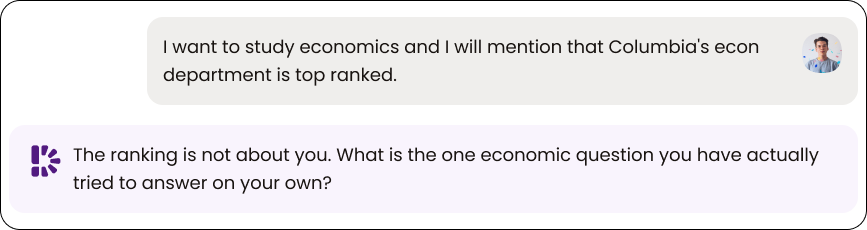
    Yes, and it is the shortest in the Ivy League at 100 words. The prompt asks two things: what attracts you, and how Dartmouth is a good fit for you. At that length you cannot answer either with a list. Everything else in the supplement is about you. Guidance is below.


    Dartmouth supplemental essay prompts 2026/27 and how to answer them

    Prompts are quoted from Dartmouth’s writing supplement page, linked at the bottom. All three answers are required. Dartmouth’s own FAQ says the essays should show the intangibles a résumé cannot, and that it reads every word.

    1. “Why Dartmouth” (100 words)

    The prompt. As you seek admission to Dartmouth’s Class of 2031, what aspects of the college’s academic program, community, and/or campus environment attract your interest? How is Dartmouth a good fit for you?

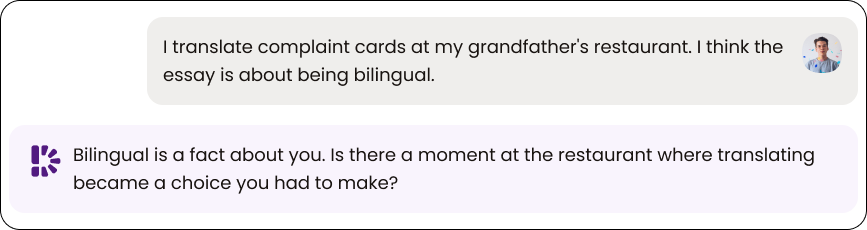
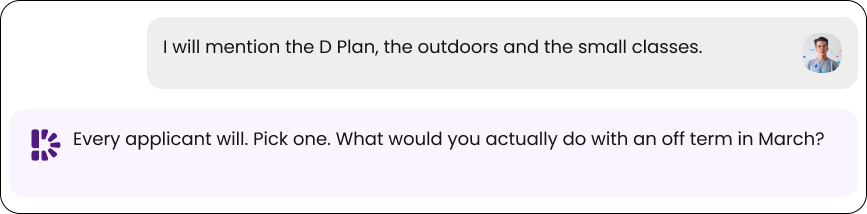
    What Dartmouth is testing. Whether you know something true about Dartmouth and whether it matches something true about you. The second question, how is Dartmouth a good fit for you, is the one most students skip. The reader has seen the D Plan, the outdoors and the small size named a thousand times. Named without a connection to you, they are half an answer.

    How to answer. One or two features, each tied to something you already do. If it is the D Plan, say what you would do with an off term that you could not do elsewhere. If it is the size, say what you do in small rooms that you cannot do in big ones. End with one sentence of fit in your own voice. 100 words is four or five sentences. Test every one: if it would be just as true of any rural college, cut it.

    Avoid. A list of three things with no reason attached. Prestige and the ranking. And anything Dartmouth already knows about itself. Most applicants spend a third of this space on that.

    2. Choose one: Let your life speak, or Introduce yourself (250 words)

    Treat prompts 2 and 3 as one decision. Start with your Common App essay and ask what it already covers. If it is about your background, choose 2B here. If it is about an activity or achievement, 2A is open. Whatever you pick, the two 250 word answers should show two different sides of you.

    2A. Let your life speak

    The prompt. There is a Quaker saying: Let your life speak. Describe the environment in which you were raised and the impact it has had on the person you are today.

    What Dartmouth is testing. Where you come from and what it did to you. “Environment” can mean a place, a household, a language, a set of responsibilities or a community. The second half, the impact on who you are today, is the question. A description of your town with no effect on you answers only half of it.

    How to answer. Pick one aspect of the environment, not the whole childhood. Spend about 120 words on a scene from it. Spend the rest on the impact, stated as something specific you now do or believe. The reader learns about your background through you, not through a history of it.

    Avoid. Repeating your personal essay. Hardship as a credential. And a tour of your hometown that could have been written by anyone who lives there.

    2B. Introduce yourself

    The prompt. “Be yourself,” Oscar Wilde advised. “Everyone else is taken.” Introduce yourself.

    What Dartmouth is testing. Whether you can show who you are without listing what you have done. This is the most open prompt in the set, which means it gives you the least help. Dartmouth’s FAQ says it wants your sense of humor, your passion, your curiosity, your self awareness or your social awareness. Pick one or two and show them.

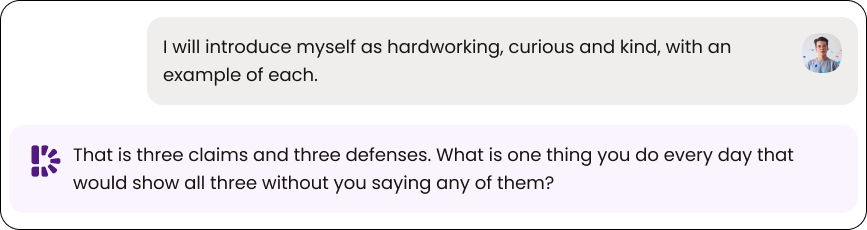
    How to answer. One strong format: a single habit, object or routine that reveals several traits without naming them. The way you organize your desk, the thing you always cook, the argument you always start at dinner. Let the reader draw the conclusions. 250 words is one scene and a short reflection.

    Avoid. The résumé in paragraph form. Three adjectives followed by proof of each. And an introduction that sounds like it was written for a job interview.

    3. Choose one of six (250 words)

    Six options, one answer. The choice is itself an answer: Dartmouth sees which one you picked. Choose the prompt where you have the most specific material, not the one that sounds most impressive. If you chose 2A above, avoid 3F unless the two cover clearly different ground.

    3A. What excites you?

    The prompt. What excites you?

    What Dartmouth is testing. Intellectual curiosity, in the broadest frame Dartmouth offers. Three words give you no stakes, so you have to supply them. The reader wants to see what you chase when nobody assigns it and how far you have chased it.

    How to answer. One thing, named in the first sentence. Then show the chasing: what you read, built, tried or argued about, and what you still do not understand. Academic interests fit well. So does anything else, as long as the excitement is visible in what you have done about it.

    Avoid. A respectable topic you chose because it sounds right. The reader can tell the difference between interest and enthusiasm. And a “why major” essay with the word “excites” added.

    3B. Making an impact

    The prompt. Labor leader and civil rights activist Dolores Huerta recommended a life of purpose. “We must use our lives to make the world a better place to live, not just to acquire things,” she said. “That is what we are put on the earth for.” In what ways do you hope to make—or are you already making—an impact? Why? How?

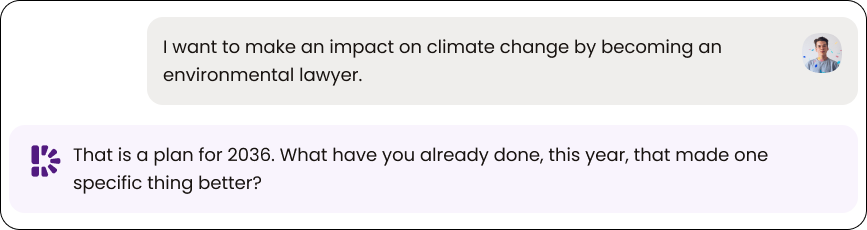
    What Dartmouth is testing. Whether you have done anything yet, and whether you can explain why. The prompt asks three questions, why and how and whether you are already doing it, and present tense evidence is what separates the strong answers. Scale does not matter. A small impact you can explain beats a large one you only assert.

    How to answer. One impact, real and specific. Say what you did, who it reached, and what it cost you. Then answer why in a sentence that could not be said by everyone. Then how, which means the mechanism, not the mission.

    Avoid. The service hours list. Changing the world. And writing about an impact you hope to make with no evidence that you have started.

    3C. Insight from reading

    The prompt. In an Instagram post, best-selling British author Matt Haig cheered the impact of reading. “A good novel is the best invention humans have ever created for imagining other lives,” he wrote. How have you experienced such insight from reading? What did you read and how did it alter the way you understand yourself and others?

    What Dartmouth is testing. Whether a book has actually changed you. The prompt asks what you read and how it altered your understanding of yourself and others. Both halves count. A plot summary answers neither.

    How to answer. Name the book in the first sentence. Go straight to one moment in it, a scene or a line, and the thing it made you see differently. Spend most of the words on the change in you, with a specific example of how you now see someone or something differently. The book is the door, not the room.

    Avoid. Picking a book for its reputation. Summarizing the plot. And writing a book report with “I” attached to the end.


    3D. A difficult conversation

    The prompt. The social and family interactions of wild chimpanzees have been the focus of Dame Jane Goodall’s research for decades. Her understanding of animal behavior prompted the English primatologist to see a lesson for human communities as well: “Change happens by listening and then starting a dialogue with the people who are doing something you don’t believe is right.” Channel Dame Goodall: Tell us about a moment when you engaged in a difficult conversation or encountered someone with an opinion or perspective that was different from your own. How did you find common ground?

    What Dartmouth is testing. How you handle disagreement, not whether you won. The last sentence, how did you find common ground, assumes you did. Partial common ground is fine, but the essay has to show the listening, which is the word the quote leads with.

    How to answer. State the tension or difference in perspective in one sentence. Then describe the exchange: what the other person said, what you said back, the moment it got uncomfortable. End with the common ground you found, even if it was only a shared concern or value. You can still disagree, but show what you came to understand about the other person. That counts.

    Avoid. A story where you were right and the other person came around. Readers can tell when the other side is a straw man. And a position paper on the issue, which is not what was asked.


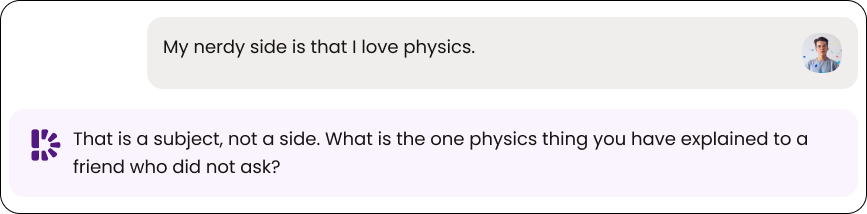
    3E. Celebrate your nerdy side

    The prompt. Celebrate your nerdy side.

    What Dartmouth is testing. Enthusiasm and detail. The thing you explain too long at dinner, the rabbit hole you went down at 2am, the obscure fact you cannot stop sharing. This is the sister prompt to 3A with the stakes set to joy. The trap is thinking that naming a nerdy subject is enough. The reader wants to see the nerdiness in action.

    How to answer. One obsession. Show it in a specific episode: the thing you built, the argument you had, the spreadsheet you keep. Let the reader feel how far down the hole you went. Write it so a reader who knows nothing about the subject can follow, because the admissions officer is not an expert in it.

    Avoid. “I am a nerd about science.” Jargon that shuts the reader out. And choosing a subject to impress rather than the one you actually love.

    3F. How difference has been part of your life

    The prompt. “It’s not easy being green…” was the frequent refrain of Kermit the Frog. How has difference been a part of your life, and how have you embraced it as part of your identity, outlook, or sense of purpose?

    What Dartmouth is testing. Whether you can turn difference into something you use. The prompt asks two things: how difference has been part of your life, and how you embraced it. The second half is where the essay lives. A description of being different, with no account of what you did with it, answers only half the prompt.

    How to answer. One way you are different, shown in a specific moment where it mattered. Then the embracing: what you now do, see or want because of it, stated as behavior rather than feeling. If you chose 2A, make sure this tells a clearly different story.

    Avoid. The identity label with no scene underneath. Difference as hardship only. And writing the same story twice across 2A and 3F.


    Before you write: map the whole application

    Your personal statement, activities list and the three Dartmouth answers are read as one file. Each piece should add something the others do not. Repeating an interest is fine. Repeating the same evidence wastes space. Think of the reader as someone who has already read everything else in your file before they reach the Dartmouth questions. Dartmouth’s own dean puts it as one question: who do I want the admission officer to meet?

    Write down what the reader already knows about you from the Common App. Then choose the two 250 word prompts that cover what that list is missing.

    As you plan and draft, remember to keep your essays in your own voice.

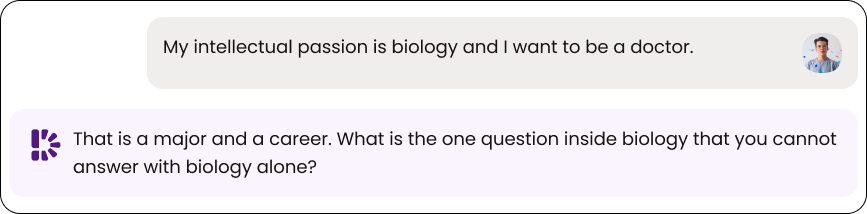
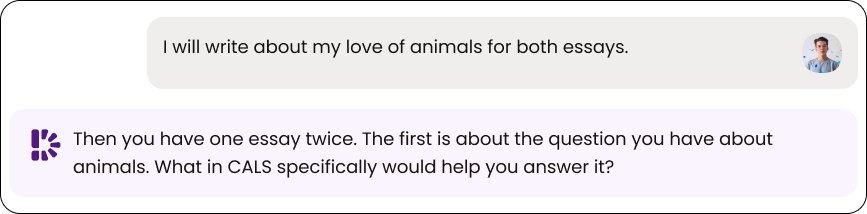
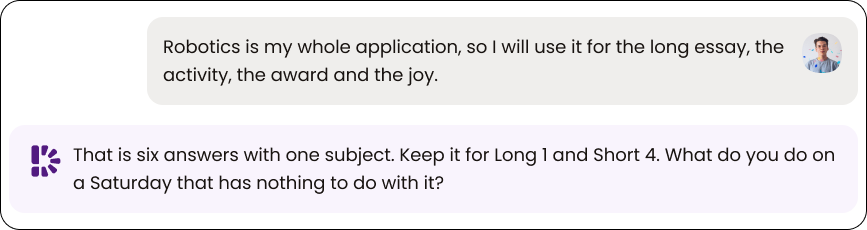
    Want help connecting the pieces? Dakota, in College CoPilot’s Application Coach, uses what you have already shared to spot repetition and ask the question you have not answered. The writing stays yours.
    Official Dartmouth Sources

  • Cornell Supplemental Essays 2026/27: Prompts by College and How to Answer Them


    Cornell has no university-wide supplement; applicants answer only the prompt or prompts for their chosen undergraduate college. Most colleges set one essay of 550 to 650 words. CALS sets two of 350. Engineering sets two of 200 and four of 100. You apply to one college and you answer only its prompt. For each college below, we offer expert guidance on what the question is really testing and how to answer it.


    What is Cornell’s acceptance rate?

    Cornell’s overall acceptance rate was 9.2% for the Class of 2030, and its Early Decision (ED) acceptance rate was 20.9%, according to Cornell’s First-Year Admissions Factbook. 

    • Overall: 9.2%
    • ED: 20.9%
    • SAT 25th percentile: 1490
    • SAT 50th percentile: 1530
    • SAT 75th percentile: 1550

    What SAT score do you need for Cornell?

    Cornell requires the SAT or ACT. The middle 50 percent of admitted students scored 1490 to 1550. A score in that range gives your application a solid chance of getting read. It does not get you in. More applicants have perfect scores than Cornell has places. That is why the essay matters here, and at Cornell it matters more than at most Ivies because it is the only one you write.


    When are Cornell’s application deadlines?

    Early Decision: November 1st. Regular Decision: January 2nd. Early Decision at Cornell is binding. If you are admitted, you withdraw your other applications and enroll. Some majors in AAP, CALS and Human Ecology require a portfolio or design supplement with its own deadline.


    Does Cornell have a “Why Cornell” essay in 2026/27?

    Yes, but it is a “Why This College” essay, not a “Why Cornell” essay. Cornell dropped its university wide community essay this cycle. Every remaining prompt asks about your fit with one of Cornell’s undergraduate colleges and its curriculum. Cornell admits you to a college, not to the university, and each college’s readers list “your reasons for choosing” that college among the things they look for. A general “Why Cornell” essay that mentions Ithaca and the gorges answers a question nobody asked. Name your college, not the university, wherever you can.


    Cornell supplemental essay prompts 2026/27 by college and how to answer them

    Prompts are quoted from each college’s first year applicant page on Cornell’s admissions site, linked at the bottom. Find the college your major sits in, then read that section. The prompts differ by college. Some ask about an academic interest and college fit; others ask about a project, a personal experience, or what matters to you. Read the section for your college and answer each prompt on its own terms.

    College of Arts and Sciences (650 words)

    The prompt. At the College of Arts and Sciences, your education is yours to shape. Describe an intellectual passion, question, or idea that has captured your attention—whether it emerges from your studies or extends beyond your coursework. What specific aspects of our liberal arts curriculum would you draw on to explore and connect your varied interests?

    What A&S is testing. Whether your curiosity is specific and whether you would use a liberal arts curriculum to connect subjects rather than to study one. The prompt says “question or idea,” then “varied interests,” then “connect.” A single subject essay misses on purpose. The reader wants one question you keep returning to and two or three departments you would use to chase it.

    How to answer. Name the question in the first paragraph, with evidence that it is real: something you read, built, measured or argued about that left you with a better question. Spend about 300 words on that. Then spend about 300 on the curriculum: which named A&S courses or departments you would draw on, and how they connect to each other through your question. End with what you do not know yet, because the prompt is about an education you would shape, not one you have finished.

    Avoid. A why major essay. A list of ten courses. Paragraphs about Ithaca, which tell an A&S reader nothing about fit with its curriculum. And the origin story, where half the words explain how you first got interested.


    College of Agriculture and Life Sciences (two essays, 350 words each)

    Prompt 1. What interests you about the major you selected? Tell us about experiences (both in and outside of the classroom), questions, and goals that influenced your choice.

    Prompt 2. What draws you to Cornell’s College of Agriculture and Life Sciences (CALS)? Reflect on the learning, community, or impact opportunities that matter most to you, and share how they align with Cornell CALS (as you understand it currently).

    What CALS is testing. Two things, kept separate on purpose: why this major, and why CALS. You apply directly to one of CALS’s 20 majors, so the first essay is about the major and the second is about the college. CALS says it is normal to have trouble choosing a major, and the second prompt adds “as you understand it currently,” which openly allows an incomplete picture.

    How to answer. Essay 1 follows a path: a first experience, the question it raised, the goal it points to. Use an experience from outside the classroom if you have one, because the prompt asks for both. Essay 2 names two or three things at CALS, a program, a lab, a community, and ties each one back to the question in essay 1. Essay 2 should build on the major interest from essay 1 without retelling it.

    Avoid. Repeating material across the two essays. If essay 2 describes your major again, you have written one essay twice. And “purpose driven science” quoted back to CALS, which is its phrase, not yours.


    College of Engineering (two long answers of 200 words, four short answers of 100 words)

    Long 1. Fundamentally, engineering is the application of math, science, and technology to solve complex problems. Why do you want to study engineering?

    Long 2. Why do you think you would love to study at Duffield Engineering?

    Short 1. What brings you joy?

    Short 2. What do you believe you will contribute to the Duffield Engineering community beyond what you’ve already detailed in your application? What unique voice will you bring?

    Short 3. What is one activity, club, team, organization, work/volunteer experience or family responsibility that is especially meaningful to you? Please briefly tell us about its significance for you.

    Short 4. What is one award you have received or achievement you have attained that has meant the most to you? Please briefly describe its importance to you.

    What Engineering is testing. Whether you can cover six different sides of yourself in 800 words. Engineering is the only Cornell college that splits its supplement this way, and the structure is the test. Long 1 is why engineering, shown in something you have built or fixed. Long 2 is why this school, which means its curriculum and its project teams, not Cornell in general. The four shorts each want new material. Short 2 says “beyond what you’ve already detailed,” so it has to be something not in your activities list.

    How to answer. Give each answer its own piece of your life. Long 1: one problem you tried to solve and what happened when it did not work. Long 2: one or two named things at Duffield that match how you work. Short 1: a small real moment, not an engineering win. Short 2: a habit or perspective not already detailed elsewhere in your application. Short 3: one commitment, your role, why it matters. Short 4: one achievement and what it cost you, not what it earned you.

    Avoid. Using the same robotics team in four answers. A joy answer that is also an achievement. And Long 2 written about Cornell when the prompt names Duffield Engineering.


    Cornell SC Johnson College of Business: Dyson and Nolan (650 words)

    The prompt. What kind of business student are you? Using your personal, academic, or volunteer/work experiences, describe the topics or issues that you care about and why they are important to you. Your response should convey how your interests align with the school to which you are applying within the Cornell SC Johnson College of Business (Dyson or Nolan).

    What SC Johnson is testing. Whether you have a problem you care about and whether you know which school fits it. Dyson is applied economics and management with a strong public purpose. Nolan is hotel administration and the broader hospitality and service economy. The prompt names them and expects you to name one. “What kind of business student” is asking for a stance, not a résumé. A résumé is also required separately.

    How to answer. Open with the issue, as narrowly as you can state it. Spend about 300 words on where it came from in your experience, including the part that is unresolved. Spend the rest on the school: why Dyson or Nolan specifically, which part of its curriculum, and what you would do with it. The word “business” should appear as a method, not as a goal.

    Avoid. “I want to be an entrepreneur” with no problem attached. Failing to name Dyson or Nolan. And forgetting the résumé, which SC Johnson requires.


    College of Human Ecology (550 words)

    The prompt. Think about an extracurricular/community engagement/work experience that most closely connects you to the CHE mission and your intended choice of major. Tell us what that experience taught you about your broader community and its needs, and the impact you can make. How will your intended CHE major help you make that impact?

    What CHE is testing. Three things, in order: one experience, what it taught you about a community’s needs, and how your CHE major lets you act on that. The third question deserves at least a third of the essay. CHE’s own tips say to take a college specific approach and not to reuse a general essay.

    How to answer. Choose a job, service role or responsibility where you saw a need up close. Spend about 200 words on it, including a specific moment. Spend 150 on what it taught you about the community, stated as something you now understand that you did not before. Spend the last 200 on the major: which CHE major, which parts of it, and what impact it would let you make that you cannot make now.

    Avoid. A community service story with the major added at the end. The hours count. And the mission statement quoted back to CHE.


    Brooks School of Public Policy (650 words, plus 350 for DC Start)

    The prompt. Discuss your interest in pursuing a major in policy at the Cornell Jeb E. Brooks School of Public Policy and what draws you to this field of study. You are encouraged to consider including details related to your personal experiences, values, academic influences, or extracurricular activities that have shaped your perspective and future goals.

    DC Start only. Please describe why you are interested in being considered for the Brooks School DC Start program.

    What Brooks is testing. Whether your interest in policy is attached to a specific problem and whether you know what studying policy, as opposed to politics or law, actually involves. The prompt lists four sources of evidence: experiences, values, academic influences, activities. The reader wants to see at least two of them pointing at the same problem.

    How to answer. Name the policy problem in the first paragraph, as narrowly as you can. Spend about 300 words on how you came to it, with specifics from the list in the prompt. Spend the rest on Brooks: what about the major and its approach fits the problem, and what you would want to be able to do by graduation. If you are applying for DC Start, the 350 word essay should be about the program, not a repeat of the main essay.

    Avoid. A political opinion dressed as a policy interest. “I want to make a difference.” And problems so large that nothing specific can be said about them.


    School of Industrial and Labor Relations (650 words)

    The prompt. Using your personal, academic, or volunteer/work experiences, describe the topics or issues that you care about and why they are important to you. Your response should show us that your interests align with the ILR School.

    What ILR is testing. Whether you understand what ILR is and whether your interests fit it. ILR studies work, workers and workplaces, through economics, law, history, psychology and sociology. Its page says no activity matters more than another because every experience requires you to work with people. The reader wants an issue about work, broadly defined, that you have seen up close.

    How to answer. Start with the issue and the experience it came from: a job, a family business, a team, a dispute you watched. Spend about 350 words on that. Spend the rest on ILR: which parts of its curriculum fit the issue and what you would do with them. The essay should make clear you know ILR is not a business school and not a law school.

    Avoid. Writing about business and swapping in the word labor. Ignoring the second sentence of the prompt. And an essay that could be sent to any social science program unchanged.


    College of Architecture, Art, and Planning (650 words, by major)

    B.Arch. Describe how your interests connect to architecture. Include an example of a creative project, design experience, or personal passion that sparked your interest in pursuing a 5-year professional degree in architecture. Reflect on how this experience shaped your understanding of the field and your motivation to study architecture.

    BFA. Submit an artist statement describing your creative interests and practice. Address how your work reflects your artistic voice, influences, and process, and how studying art at Cornell AAP would support and expand your practice.

    URS. Describe your interest in urban and regional studies. Discuss experiences, ideas, or issues that have shaped your interest in cities, communities, and regional systems, and explain how URS at Cornell aligns with your academic and career goals.

    What AAP is testing. Three different things for three majors. B.Arch wants one creative project and what it taught you about the field, because a five year professional degree is a commitment. BFA wants an artist statement, which is a specific form: your practice, your influences, your process, and what AAP would add. URS wants a question about cities and the experiences behind it. All three are read alongside a portfolio where one is required.

    How to answer. B.Arch: one project, described in enough detail that the reader can see it, then what you understand about architecture now that you did not before. BFA: write it as an artist statement, in the first person, about the work itself, then AAP. URS: one urban issue you have seen, the question it raised, and how URS fits it. In every case, spend the last third on AAP specifically.

    Avoid. Writing about Cornell when the prompt asks about AAP. A B.Arch essay about loving buildings with no project in it. A BFA statement that is a list of media. And a URS essay about wanting to help cities with no city in it.


    Before you write: map the whole application

    Your personal statement, activities list and the Cornell supplement are read as one file. Each piece should add something the others do not. Repeating an interest is fine. Repeating the same evidence wastes space. Think of the reader as someone who has already read everything else in your file before they reach the Cornell essay. At Cornell the reader works for one college, so the file is read against that college’s mission.

    Write down what the reader already knows about you from the Common App. Then give the Cornell essay the one thing that list is missing.

    As you plan and draft, read Cornell’s guidance on what application help is acceptable, including its rules on AI.

    Want help connecting the pieces? Dakota, in College CoPilot’s Application Coach, uses what you have already shared to spot repetition and ask the question you have not answered. The writing stays yours.

    Official Cornell Sources

  • Columbia Supplemental Essays 2026/27: Prompts and How to Answer Them


    Columbia asks for one 100 word list and five short answers of 150 words each. Two of the short answers focus on Columbia: one asks why you want to attend, and the other asks about your academic interests at Columbia College or Columbia Engineering. The whole supplement has a maximum of 850 words. Short means every sentence has to work. For each prompt below, we offer expert guidance on what each question is really testing and how to answer them.


    What is Columbia’s acceptance rate?

    Columbia’s overall acceptance rate is 4.94%, per the Columbia Common Data Set, and its Early Decision (ED) rate is 13.96%. Both figures are for the Class of 2029, per the 2025-2026 Columbia Common Data Set.

    • Overall: 4.94%
    • ED: 13.96%
    • SAT 25th percentile: 1510
    • SAT 50th percentile: 1540
    • SAT 75th percentile: 1560

    What SAT score do you need for Columbia?

    Columbia is test optional for 2026/27 and has announced that the SAT or ACT will be required from 2027/28. If you submit, the middle 50 percent of enrolled students scored 1510 to 1560. A score in that range gives your application a solid chance of getting read. It does not get you in. More applicants have perfect scores than Columbia has places. That is why the essays matter here.


    When are Columbia’s application deadlines?

    Early Decision: November 1st. Regular Decision: January 1st. Early Decision at Columbia is binding. If you are admitted, you withdraw your other applications and enroll.


    Does Columbia have a “Why Columbia” essay in 2026/27?

    Yes, two. Question 5 asks why you want to attend Columbia University. Question 6 asks what attracts you to your area of study at Columbia College or Columbia Engineering. Treat them as separate questions: keep Question 5 focused on Columbia as a place to live and learn, and Question 6 on your subject and the school you’re applying to. Readers notice when both answers make the same point. Keep the city out of question 6 and the department out of question 5. Guidance for both is below.


    Columbia supplemental essay prompts 2026/27 and how to answer them

    Prompts are quoted from Columbia’s Columbia specific questions page, linked at the bottom. All six are required. Columbia says these answers are an essential part of its review and reads them as a set, so plan them together.

    1. Texts, resources and outlets that shaped you outside class (100 words, list format)

    The prompt. List the titles of texts, resources and outlets that have contributed to your intellectual development outside of academic courses, including but not limited to books, journals, websites, podcasts, essays, plays, presentations, videos, museums and other content that you enjoy. (100 words or fewer)

    What Columbia is testing. What you read, watch and listen to when nobody assigns it. Columbia’s instructions say to list titles only, separated by commas, with no author names and no explanation. That means the list has to speak for itself. A reader scans it in ten seconds and forms a picture of your mind. Columbia has asked a version of this question for years and treats it seriously.

    How to answer. Follow the format rules exactly: titles, commas, no commentary. Aim for 15 to 25 items. Mix the forms the prompt names, so a podcast and a museum sit next to a novel. Let the list show a few threads, a subject you keep returning to from different directions, rather than a random sample. Include things that are actually yours, including the ones that are not prestigious. A list that is all classics reads as a list someone else wrote.

    Avoid. Explaining any item. Padding with books you have not finished. And a list that only confirms what your transcript already shows. The point of “outside of academic courses” is the part of your mind school did not build.


    2. An aspect of your life and how it shapes how you will learn and contribute (150 words)

    The prompt. Tell us about an aspect of your life so far or your lived experience that is important to you, and describe how it has shaped the way you would learn from and contribute to Columbia’s multidimensional and collaborative environment. (150 words or fewer)

    What Columbia is testing. Whether you can connect one experience to one specific way of learning and one specific contribution. The prompt asks for both, learn from and contribute to, and most answers only do the second. “Multidimensional and collaborative” is Columbia’s description of itself. The reader wants to know what you will take from people unlike you as much as what you will give.

    How to answer. One experience, not a summary of your identity. Spend about 60 words on a scene from it, 45 on what it changed in how you learn, and 45 on what it lets you contribute. Say both parts in plain words. Do not leave either for the reader to infer.

    Avoid. The list of identities with no scene underneath. Hardship as a credential. And the phrase “diverse perspective,” which is the prompt handed back to the reader.


    3. A time you did not agree with someone (150 words)

    The prompt. At Columbia, students representing a wide range of perspectives are invited to live and learn together. In such a community, questions and debates naturally arise. Please describe a time when you did not agree with someone and discuss how you engaged with them and what you took away from the interaction. (150 words or fewer)

    What Columbia is testing. How you handle disagreement, not whether you won. The prompt asks three things: what the disagreement was, how you engaged, and what you took away. In 150 words the first one gets a sentence and the other two get everything else. Columbia frames this through living and learning together, so a disagreement with a roommate, a teammate or a family member fits as well as a political one.

    How to answer. State the disagreement in one sentence. Then describe the exchange: what the other person said, what you said back, the moment it got uncomfortable. End with what you took away, which can be small. You still disagree, but you understand why a reasonable person holds the other view. That counts.

    Avoid. Turning it into a position paper on the issue. At 150 words the argument crowds out the engagement, and the engagement is what Columbia asked about. Hot political topics written as advocacy. And a disagreement you won cleanly, which teaches the reader nothing.


    4. Navigating adversity and how you changed (150 words)

    The prompt. In college/university, students are often challenged in ways that they could not anticipate. Please describe a situation in which you have navigated through adversity and discuss how you changed as a result. (150 words or fewer)

    What Columbia is testing. Whether you can handle a setback and whether you learned anything from it. The second half of the prompt is the one that matters: how you changed. Columbia is not grading the size of the adversity. A small setback with a clear change beats a large one with no reflection. The prompt also tells you why it is asking: college will challenge you in ways you cannot plan for.

    How to answer. One situation, stated in two sentences. Spend the middle on what you actually did while it was happening, including the part that did not work. Spend the last 50 words on the change, stated as something specific you now do differently. The word “navigated” asks for your actions, not your feelings.

    Avoid. Choosing the biggest hardship you can think of because it seems expected. A story where the adversity simply ended. And a change described as a trait, “I became more resilient,” instead of a behavior.


    5. “Why Columbia” University (150 words)

    The prompt. Why are you interested in attending Columbia University? We encourage you to consider the aspect(s) that you find unique and compelling about Columbia. (150 words or fewer)

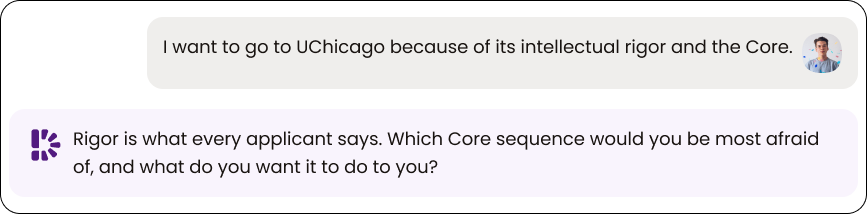
    What Columbia is testing. Whether you know what makes Columbia different from the schools it is usually compared to, and whether that difference matters to you specifically. Columbia says it in the prompt: unique and compelling. The reader has seen thousands of answers about New York City. The things that are actually unique are the Core Curriculum, which every Columbia College student takes and which is unlike the open curriculum at Brown or the distribution requirements at Yale, and the way the city is used in coursework rather than just nearby.

    How to answer. Pick one or two things about Columbia that you have actually examined, and for each one say why it fits something you already do. If it is the Core, name which part and what you expect it to do to you, not that it is prestigious. If it is the city, name the specific way you would use it that you could not do elsewhere. About 75 words per item.

    Avoid. A list of five things with no reason attached. New York City as the whole answer. Rankings, prestige and “world class.” And anything about your major, which belongs in question 6.


    6. Why your area of study at Columbia College or Columbia Engineering (150 words)

    The prompt. What attracts you to your preferred areas of study at Columbia College or Columbia Engineering? (150 words or fewer)

    What Columbia is testing. Whether your academic interest is real and whether you understand which school you are applying to. Columbia College and Columbia Engineering are separate applications with separate curricula. Engineering has its own technical core alongside part of the Core Curriculum. The reader wants to see a question you want to pursue and one thing about how Columbia teaches that subject that fits it.

    How to answer. Spend about 100 words on the curiosity, with evidence that it is real: a question you keep returning to, something you read or built or measured. Spend about 50 on the fit: one program, one research center, one way the department works. One thing, explained, beats five, listed. If you are undecided, say which two or three areas and what question connects them.

    Avoid. Naming a professor you have never read. The origin story, where most of the words explain how you first got interested. And repeating anything from question 5. The reader has both in front of them.


    Before you write: map the whole application

    Your personal statement, activities list and the six Columbia answers are read as one file. Each piece should add something the others do not. Repeating an interest is fine. Repeating the same evidence wastes space. Think of the reader as someone who has already read everything else in your file before they reach the Columbia questions.

    Write down what the reader already knows about you from the Common App. Then give each Columbia answer one thing that list is missing.

    As you plan and draft, remember to check Columbia’s guidance on AI and essays.

    Want help connecting the pieces? Dakota, in College CoPilot’s Application Coach, uses what you have already shared to spot repetition and ask the question you have not answered. The writing stays yours.

    Official Columbia Sources

  • UChicago Supplemental Essays 2026/27: Prompts and How to Answer Them


    UChicago asks for two essays: a “Why UChicago” answer and one extended essay chosen from six options, five of them new this year. Neither has a strict word limit. UChicago suggests about 300 to 600 words for the first and 500 to 700 for the second. The extended essay is UChicago’s most distinctive writing requirement. For each prompt below, we offer expert guidance on what the question is really testing and how to answer it.


    What is UChicago’s acceptance rate?

    UChicago’s overall acceptance rate was 4.50% for the Class of 2029, based on the latest Common Data Set.

    • Overall: 4.50%
    • ED: Not Reported
    • EA: Not Reported
    • SAT 25th percentile: 1500
    • SAT 50th percentile: 1540
    • SAT 75th percentile: 1560

    What SAT score do you need for UChicago?

    UChicago is test optional. If you submit, the middle 50 percent of enrolled students scored 1500 to 1560. A score in that range gives your application a better chance of getting a close read. It does not get you in. More applicants have perfect scores than UChicago has spots. That is why the essays matter here. The extended essay is UChicago’s most distinctive writing requirement. 


    When are UChicago’s application deadlines?

    Early Action and Early Decision I: November 2nd. Early Decision II and Regular Decision: January 4th. UChicago offers four plans. Early Action is not binding. Early Decision I and II are binding. UChicago does not interview but offers an optional two minute video profile it calls highly recommended, with its own upload date a few days after each deadline.


    Does UChicago have a “Why UChicago” essay in 2026/27?

    Yes, and it is required. It asks how UChicago satisfies your desire for a particular kind of learning, community and future. Three nouns, three answers, each tied to something specific at UChicago. The prompt says “with some specificity” and “as you know it now,” which tells you two things: generic praise of rigor fails on the prompt’s own terms, and you are allowed to be honest about what you have not yet seen. Guidance is below.


    UChicago supplemental essay prompts 2026/27 and how to answer them

    Prompts are quoted from UChicago’s essay questions page, linked at the bottom. UChicago says its questions can be approached with utter seriousness, complete fancy, or something in between, and that the best way to write the application is to be yourself in your own voice. Both essays are required.

    1. “Why UChicago” (about 300 to 600 words, required)

    The prompt. How does the University of Chicago, as you know it now, satisfy your desire for a particular kind of learning, community, and future? Please address with some specificity your own wishes and how they relate to UChicago.

    What UChicago is testing. Whether you have three real wishes and whether you know how UChicago answers each one. The prompt starts from your desire, not from the school. Learning, community and future are three separate questions. Most drafts write a strong academic paragraph and then wave at the other two in a sentence each. Three nouns means three answers.

    How to answer. Start with the kind of learning you want, in your own words, then the specific UChicago feature that answers it: a Core sequence, the structure of a major, a research setting. Do the same for community, which can be a house, a Hyde Park institution, a specific student culture you have read about. Do the same for the future, which means what you want to be able to do by graduation, not a job title. About 150 words on each. “As you know it now” gives you room to say what you expect rather than what you have confirmed.

    Avoid. Praising rigor, which every applicant does and the prompt explicitly rules out. Covering only learning. And naming UChicago features without connecting each to a wish of yours. Every UChicago reference in this essay should carry weight.


    2. The extended essay (about 500 to 700 words, required, choose one)

    This is the famous one. UChicago rewrites five of the six options every year and keeps the sixth. Readers are not grading the joke. They are watching how you think when nobody has told you what the right answer looks like. Every option is an invitation to play, and the play has to go somewhere. Choose the prompt where you have a real idea, not the one that sounds the most clever.

    Option 1. How do thoughts eat?

    The prompt. Food for thought: How do thoughts eat? (Inspired by Ernest Leong, Class of 2026)

    What UChicago is testing. Whether you can hold one sustained metaphor for 600 words without it collapsing. The shortest prompt on the list is the hardest to keep from drifting.

    How to answer. Decide what thoughts consume, how they digest it, what they discard, and follow that logic all the way through. Ground it in one real example of your own thinking, a problem you chewed on, so the metaphor has something underneath it. The essay should end somewhere you could not have predicted from the first paragraph.

    Avoid. A list of clever food puns. Explaining the joke and stopping. And abandoning the metaphor halfway to write a different essay.


    Option 2. An artistic practice as a solution to a problem

    The prompt. The James Webb Space Telescope, launched in 2021, utilized origami-inspired techniques to compactly store and deploy its sunshield in space. Choose an artistic practice and use its principles to propose an elegant solution to a problem. (Inspired by Akhil Korra, Class of 2028)

    What UChicago is testing. Whether you know a craft from the inside and can extract its principles. You need both halves: a practice you actually do, like knitting, choral arranging or bonsai, and a real problem. The principle does the solving, not the craft itself.

    How to answer. Spend the first third on the practice and the one principle inside it that matters. Spend the middle on the problem, stated specifically. Spend the last third applying the principle to the problem, step by step, with the places it might fail. Elegance in the prompt means economy, so show the solution doing a lot with a little.

    Avoid. Picking an art form you admire but have never done. A problem too large to solve in 600 words. And a solution that is really just “be more creative.”


    Option 3. Make up a mixed metaphor

    The prompt. Sometimes metaphors get mixed up. For one reason or another, one could say, “we’ll burn that bridge when we get there” or “the world is your china shop”. Make up your own mixed metaphor. Explain how it could make sense, be understood, or even applied. (Inspired by Julia Nieberg, Class of 2029)

    What UChicago is testing. Whether you can make a broken thing mean something. The key verb is “explain.” Making up the metaphor takes a minute. The essay is the explanation, and it has to arrive at a real idea about how people think or act.

    How to answer. Build the metaphor from two idioms you actually use. Then take the collision seriously: what would the world have to be like for it to make sense, who would say it, when would it be useful advice. Land on one situation from your own life where the mixed version is truer than either original.

    Avoid. A list of funny mix ups. A metaphor chosen for the pun rather than the meaning. And explaining the joke without applying it.


    Option 4. A mundane Olympic event

    The prompt. The Olympics have long celebrated the pinnacle of human athletic achievement. But what if they expanded to honor the mundane? Imagine a new Olympic event built around an everyday activity like speed dishwashing or competitive grocery bagging. How is it scored, officiated, and judged? Why is it a worthy addition? (Inspired by Ewan Smith, Class of 2028)

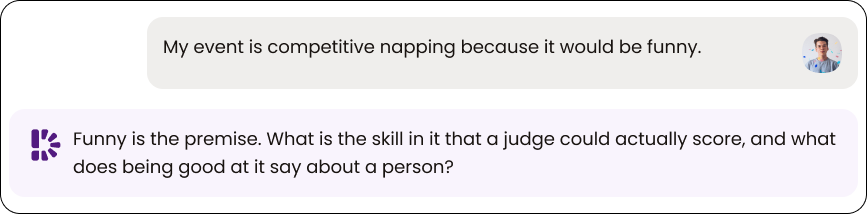
    What UChicago is testing. Whether you can take something ordinary seriously enough to find the skill in it. The prompt spells out four sub questions: scored, officiated, judged, and why worthy. The last one is where the essay has to say something about attention, labor or skill.

    How to answer. Pick an everyday activity you have actually done many times. Design the rules with real precision, because the precision is what proves you know the activity. Answer all four sub questions in order. Spend the final third on why it deserves a medal, and let that answer say something true about what the activity requires of a person.

    Avoid. An activity you chose because it sounds funny rather than because you know it. Skipping any of the four sub questions. And a last paragraph that says it is worthy because everyone does it, which is not an argument.


    Option 5. Mistaken Identity of Acronym

    The prompt. AI: Allen Iverson. NASA, or the North American Saxophone Alliance. Share a potentially confounding, comedic, or captivating example of MIA (Mistaken Identity of Acronym) and tell us its backstory. (Inspired by Jeeho Byun, Class of 2030)

    What UChicago is testing. Whether you can tell a story. The word “backstory” means narrative. The acronym is the hook. The essay is what you do with the collision between the two meanings.

    How to answer. One acronym, two meanings, one story where the mix up mattered or revealed something. Let the two meanings illuminate each other. The best version says something about how context changes what words mean, through a scene rather than a lecture.

    Avoid. A list of amusing acronym coincidences. An invented acronym with no backstory. And a story where nothing happens except the confusion.


    Option 6. Choose your own adventure

    The prompt. And, as always… the classic choose your own adventure option! In the spirit of adventurous inquiry, choose one of our past prompts (or create a question of your own). Be original, creative, thought provoking. Draw on your best qualities as a writer, thinker, visionary, social critic, sage, citizen of the world, or future citizen of the University of Chicago; take a little risk, and have fun!

    What UChicago is testing. Whether you have an idea strong enough to need its own question. Past prompts are on the same page. Choosing one because you have a real idea for it is fine. Choosing one to avoid this year’s options rarely helps, and readers can tell.

    How to answer. Only pick this if the essay already exists in your head and none of the five new prompts fits it. State the question you chose at the top. If you write your own, make it as specific and strange as UChicago’s. One past prompt, the map prompt, has its own rule: visual work needs a written key of at least 300 words.

    Avoid. Using this option to submit a personal essay in costume. A question so broad that any essay would answer it. And a past prompt chosen because a sample essay for it exists online.

    The extended essay, whichever option you pick

    Two traps apply to all six. The first is the personal essay in costume: using a playful prompt as a wrapper for your Common App story wastes the one place UChicago asked for something different. The second is pure whimsy with nothing of you in it, which reads as a stunt. The strong middle ground is an argument or exploration only you could have written, because it draws on what you actually know. Answer every sub question the prompt prints. Stay near the benchmark length unless you have a reason not to.


    Before you write: map the whole application

    Your personal statement, activities list and the two UChicago essays are read as one file. The personal statement already goes to UChicago, so neither supplement should repeat its story. Each piece should add something the others do not. Think of the reader as someone who has already read everything else in your file before they reach the UChicago questions.

    Write down what the reader already knows about you from the Common App. Then give the “Why UChicago” essay the wishes that list is missing, and give the extended essay an idea that appears nowhere else.

    As you plan and draft, keep your essays in your own voice and make sure they reflect your own experiences and thinking. 

    Want help connecting the pieces? Dakota, in College CoPilot’s Application Coach, uses what you have already shared to spot repetition and ask the question you have not answered. The writing stays yours.

    Official UChicago Sources

  • Carnegie Mellon Supplemental Essays 2026/27: Prompts and How to Answer Them


    Carnegie Mellon asks for three short answers of up to 300 words each, on why your major, how you define a successful college experience, and what you want to emphasize that the rest of your application has not shown. The whole supplement is up to 900 words, which is more than most peer schools ask for and more room to get it wrong. CMU has asked the same three questions for several cycles. For each prompt below, we offer expert guidance on what the question is really testing and how to answer it.


    What is Carnegie Mellon’s acceptance rate?

    Carnegie Mellon’s overall acceptance rate was 11.1% for the Class of 2029, according to its 2025–26 Common Data Set. Its Early Decision (ED) acceptance rate was 20.6%. Rates vary widely by college, and the School of Computer Science is far more selective than the university figure.

    • Overall: 11.1%
    • ED: 20.6%
    • SAT 25th percentile: 1500
    • SAT 50th percentile: 1540
    • SAT 75th percentile: 1560

    What SAT score do you need for Carnegie Mellon?

    CMU does not run one testing policy. The School of Computer Science requires the SAT or ACT. Engineering, Dietrich, Mellon College of Science, Tepper and Information Systems are test flexible, which means you must submit a score but may choose which test, including AP, IB or A Level results. The College of Fine Arts is test optional and requires portfolios or auditions instead. The middle 50 percent of enrolled students scored 1500 to 1560. A score in that range gives your application a better chance of getting a close read. It does not get you in. For Computer Science, more applicants have perfect math scores than there are places.


    When are Carnegie Mellon’s application deadlines?

    Early Decision: November 2nd. Regular Decision: January 4th. School of Drama and School of Music applicants have an earlier Regular Decision date of December 1st. Early Decision is binding. If you are admitted, you withdraw your other applications and enroll. Early Decision is not available for the School of Drama, BXA Design programs or the School of Music. You apply to a specific college or program, and the testing requirement, portfolio and audition rules follow from that choice.


    Does Carnegie Mellon have a Why CMU essay in 2026/27?

    Not by name. The first prompt asks what led you to your area of study; use it to connect your interests to the CMU college or program you’re applying to. The second asks how you define a successful college experience; use it to connect your approach to learning to specific CMU resources. Both give you room to explain fit.


    Carnegie Mellon supplemental essay prompts 2026/27 and how to answer them

    Prompts are quoted from CMU’s admission consideration page, linked at the bottom. All three are required of every first year applicant. CMU says it wants to understand your passions, goals, aspirations and experiences beyond a list of accomplishments. Read the three as a package before writing any of them. Three essays that make the same point tell CMU less than three that each add something.

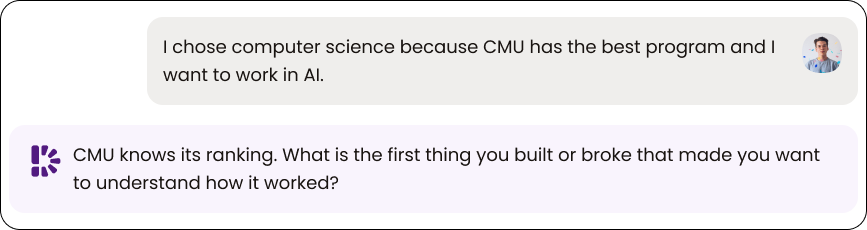
    1. The passion or inspiration behind your area of study (300 words)

    The prompt. Most students choose their intended major or area of study based on a passion or inspiration that’s developed over time, what passion or inspiration led you to choose this area of study?

    What CMU is testing. Whether your interest has a history and whether you have done anything with it. “Developed over time” is the hint. CMU wants the path, not a single moment of inspiration. The reader also checks whether the path leads to the specific program you named, because CMU asks you to apply directly to a college or school.

    How to answer. Open with one specific experience where the interest became real: something you built, measured, read or argued about that left you with a better question. Spend about 180 words on the path, with two or three specific points along it. Spend the last 100 on where it leads at CMU: one program, one course sequence, one research group, connected to the question you have. CMU research should be a third of the essay or less.

    Avoid. “I have loved computers since I was five.” A list of CMU rankings. The origin story that spends 250 words on how you got interested and 50 on what you are interested in. And a major chosen for how it sounds rather than for what you have done in it.


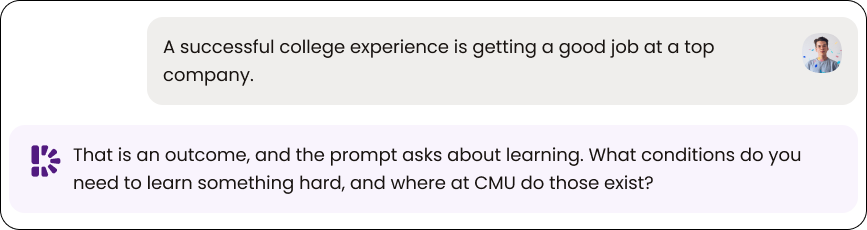
    2. How you define a successful college experience (300 words)

    The prompt. Many students pursue college for a specific degree, career opportunity or personal goal. Whichever it may be, learning will be critical to achieve your ultimate goal. As you think ahead to the process of learning during your college years, how will you define a successful college experience?

    What CMU is testing. Whether you have thought about how you learn, not just what you want to earn. The prompt steers you toward learning twice. A career plan does not answer it. The reader wants two or three things you need from a college in order to learn well, and evidence that CMU provides them.

    How to answer. Name your definition of success in the first sentence, in terms of learning rather than outcomes. Then pick two or three factors: the kind of problems you want to work on, the kind of classmates you need, the environment you do your best work in. For each, give one piece of evidence from your life and one specific CMU resource that matches it. End with what you would want to be able to do by graduation that you cannot do now.

    Avoid. A career or salary as the definition of success. A list of five things with no evidence. And a definition that would be true at any college. If CMU could be replaced by another school’s name, the essay is not finished.


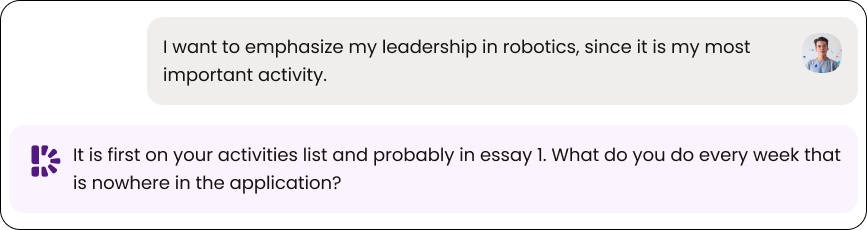
    3. What you want to emphasize that your application has not shown (300 words)

    The prompt. Consider your application as a whole. What do you personally want to emphasize about your application for the admission committee’s consideration? Highlight something that’s important to you or something you haven’t had a chance to share. Tell us, don’t show us (no websites please).

    What CMU is testing. Whether there is more to you than the file shows. This is the most open prompt and the one most students waste by repeating something already in the application. The reader has just read your personal statement, your activities and your first two essays. This box is for what those cannot show. “Tell us, don’t show us” is an instruction about form: say it plainly, no websites or external links.

    How to answer. List what the reader already knows from the rest of your application. Then find what’s missing: a responsibility at home, a skill with no award, a habit, or a part of your background that shaped how you work. Choose one. Explain it in plain words and give one example. Spend about 200 words on what it is and 100 on why it matters to the kind of student you’ll be at CMU.

    Avoid. Repeating the personal statement. Repeating essay 1 or 2. A second activities list. And choosing the most common thing about you. If many applicants could write the same essay, choose something else.


    Before you write: map the whole application

    Your personal statement, activities list and the three CMU essays are read as one file. The third prompt asks you to consider the application as a whole, which is the instruction for all three. Each piece should add something the others do not. Repeating an interest is fine. Repeating the same evidence wastes space. Think of the reader as someone who has already read everything else in your file before they reach the CMU questions.

    Write down what the reader already knows about you from the Common App. Then give each CMU essay one thing that list is missing.

    If you use AI while working on your essays, follow CMU’s guidance: it may help with grammar, spelling or structure, but your voice and ideas should remain your own.

    Want help connecting the pieces? Dakota, in College CoPilot’s Application Coach, uses what you have already shared to spot repetition and ask the question you have not answered. The writing stays yours.

    Official Carnegie Mellon Sources

  • Brown Supplemental Essays 2026/27: Prompts and How to Answer Them


    Brown asks for four essays: two of 150–250 words and two of 100–150 words. There’s no standalone Why Brown essay. The four required essays have a combined maximum of 800 words. Short means every sentence has to work. For each prompt below, we offer expert guidance on what each question is really testing and how to answer them.


    What is Brown’s acceptance rate?

    Brown’s overall acceptance rate for the class of 2030 was 5.6%, per the Brown Common Data Set. Early Decision (ED) for the class of 2030 was 16.4%.

    • Overall: 5.6%
    • ED: 16.4%
    • SAT 25th percentile: 1470
    • SAT 50th percentile: 1520
    • SAT 75th percentile: 1550

    What SAT score do you need for Brown?

    Brown requires the SAT or ACT and says it reads scores in context, with no minimum. The middle 50 percent of admitted students scored 1470 to 1550. A score in that range gives your application a better chance of getting a close read. It does not get you in. More applicants have perfect scores than Brown has places. That is why the essays matter here.


    When are Brown’s application deadlines?

    Early Decision: November 1st. Regular Decision: January 5th. Early Decision at Brown is binding. If you are admitted, you withdraw your other applications and enroll. Brown also encourages an optional video introduction of up to 90 seconds, with its own upload deadlines a few days after each application deadline.


    Does Brown have a “Why Brown” essay in 2026/27?

    Not by that name. Brown retired its one sentence “Why Brown” question this cycle. The Open Curriculum essay does the job instead, and it is the one answer only a Brown applicant could write. It asks how you would use a set of characteristics to shape your approach to a curriculum with no general requirements. That is a “Why Brown” question with a condition: it has to run through how you would choose what to learn, not through the campus or the ranking. Guidance is below.


    Brown supplemental essay prompts 2026/27 and how to answer them

    Prompts are quoted from Brown’s How to Apply page, linked at the bottom. All four are required. Two ask how you would learn and contribute at Brown. Two ask what you are like when nobody is setting the terms. Plan them together so they do not overlap.

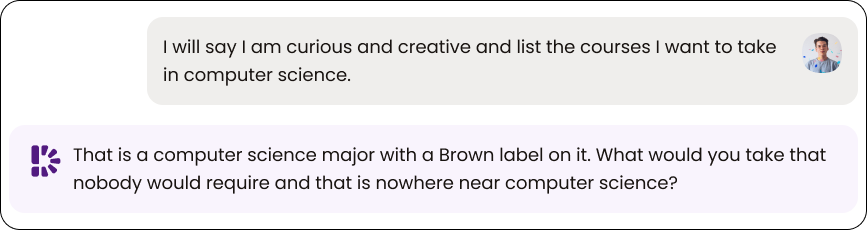
    1. The Open Curriculum (150 to 250 words)

    The prompt. There is something distinctive about Brown students. It is a blend of intellectual curiosity, creativity, and humility. A commitment to collaboration. An openness to new ideas and perspectives. A desire to make the world better. And it is resilience: the ability to recover and thrive after experiencing difficulties.” President Christina Paxson 2025 Convocation Address How will you use these characteristics or others to shape your approach to the Open Curriculum?

    What Brown is testing. How you would choose your courses when nobody tells you what to take. The Open Curriculum has no core and no distribution requirements. Brown is asking whether you can be trusted with that freedom. The quote gives you a list of traits and the phrase “or others,” which means you can name your own. The reader wants to see one or two of those traits already at work in how you learn, then turned into a plan.

    How to answer. Pick one or two traits from the quote. Show each one in something you already did: a subject you followed on your own, a class you tried and dropped, a time you were the weakest person in the room and stayed. Then turn it into a course plan: what you’d choose beyond requirements, how you’d pair subjects across departments, and how you’d adjust if a course or academic plan didn’t work out. About 120 words on the past, 100 on the plan. Name real Brown courses if you can, from more than one department.

    Avoid. Describing the Open Curriculum back to Brown, which already knows what it is. Listing traits with a course after each one. And a why major essay in disguise. If every course you name is in one department, you have not used the Open Curriculum.


    2. An aspect of growing up and what you would contribute (150 to 250 words)

    The prompt. Students entering Brown often find that making their home on College Hill naturally invites reflection on where they came from. Share how an aspect of your growing up has inspired or challenged you, and what unique contributions this might allow you to make to the Brown community.

    What Brown is testing. Where you come from and what that lets you give other people. The prompt has two halves, inspired or challenged you, and unique contributions, and most answers only do the first. The reader wants one specific aspect, not a childhood, and a specific thing you would bring to the people around you because of it.

    How to answer. Pick one aspect: a household routine, a family business, a language spoken at home, the economy of your town. Spend about 120 words on a scene from it and what it taught you, stated as something you now do or believe. Spend the last 80 on the contribution, in plain words: what you would bring to a seminar, a project group or a dorm because of it. Do not leave the contribution for the reader to infer.

    Avoid. Repeating your Common App essay. If that essay is about where you grew up, choose a different aspect here, or the reader gets the same story twice. Hardship as a credential. And the phrase “unique perspective,” which is the prompt handed back to the reader.


    3. A class you would teach (100 to 150 words)

    The prompt. If you could teach a class on any one thing, whether academic or otherwise, what would it be?

    What Brown is testing. What you know well enough to teach and how you think about teaching it. “Whether academic or otherwise” is a real invitation. The reader is not grading the subject. They are watching how you break something down for someone else.

    How to answer. Give the class a title, then show its logic in one or two details: what happens in the first session, one assignment, or what students can do at the end that they could not do before. A class on why bread fails or how to read a bus timetable can show more of your mind than a class on a famous theory. About 150 words is two short paragraphs.

    Avoid. Picking a subject for how impressive it sounds. At 150 words a big subject turns into a list of topics. And describing a class you would take rather than one you would teach. Brown asks for the teacher’s side.


    4. Something that brings you joy (100 to 150 words)

    The prompt. Brown students care deeply about their work and the world around them. Students find contentment, satisfaction, and meaning in daily interactions and major discoveries. Whether big or small, mundane or spectacular, tell us about something that brings you joy.

    What Brown is testing. What you are like when you are not trying to achieve anything. The prompt says “mundane or spectacular” on purpose. The reader has seen your accomplishments. This is the one question with no strategic answer.

    How to answer. Show what the enjoyment consists of. An ordinary ritual works. A larger experience works too, as long as the essay is about the enjoying and not the achieving. Pick one thing and spend the words on the specific moment inside it that you would miss if it were gone.

    Avoid. Substituting an achievement for the joy. Robotics can be your joy, but then the essay is about the part you enjoy doing, not the trophy. And anything already covered in your activities list, told the same way.


    PLME and Brown RISD Dual Degree applicants

    Applicants to the Program in Liberal Medical Education write three more essays of 250 words each: why medicine, why PLME, and something about yourself beyond medicine that will make you a good doctor. Brown RISD Dual Degree applicants write one essay of up to 650 words on how the two schools together would make an optimal education for you and how you would contribute to the dual degree community. Both programs ask the same underlying question as every Why Us essay: a specific reason and a specific plan, not a career. The full prompts are on Brown’s How to Apply page, linked here.


    Before you write: map the whole application

    Your personal statement, activities list and the four Brown essays are read as one file. Each piece should add something the others do not. Repeating an interest is fine. Repeating the same evidence wastes space. Think of the reader as someone who has already read everything else in your file before they reach the Brown questions.

    Write down what the reader already knows about you from the Common App. Then give each Brown essay one thing that list is missing.

    Want help connecting the pieces? Dakota, in College CoPilot’s Application Coach, uses what you have already shared to spot repetition and ask the question you have not answered. The writing stays yours.
    Brown’s rules on AI assistance are stricter than most: its Integrity page permits AI only for spelling and grammar review, and the content of every essay must be your own work. Read that page before you use any tool.


    Official Brown Sources

  • Princeton Supplemental Essays 2026/27: Prompts and How to Answer Them


    Princeton asks for one academic essay, two “Your Voice” essays, three 50 word answers, and a graded paper you have already written. The whole supplement is about 1,100 words. Short means every sentence has to work. For each prompt below, we offer expert guidance on what each question is really testing and how to answer them.


    What is Princeton’s acceptance rate?

    Princeton’s overall acceptance rate was 4.0% for the Class of 2029, according to its 2025–26 Common Data Set. Princeton has not released separate Single Choice Early Action (SCEA) or Regular Decision (RD) acceptance rates for the Class of 2029.

    • Overall: 4.0%
    • SCEA: Not Reported
    • SAT 25th percentile: 1490
    • SAT 50th percentile: 1530
    • SAT 75th percentile: 1580

    What SAT score do you need for Princeton?

    Princeton is test optional for 2026/27 and brings back the SAT or ACT requirement for 2027/28. If you submit, the middle 50 percent of enrolled students scored 1490 to 1580. A score in that range gets your essays read. It does not get you in. More applicants have perfect scores than Princeton has places. That is why the essays matter here.


    When are Princeton’s application deadlines?

    Single Choice Early Action: November 1st. Regular Decision: January 1st. Single Choice means no other private college early.


    Does Princeton have a “Why Princeton” essay in 2026/27?

    Not by that name, but yes. The academic essay asks how Princeton’s programs suit your interests. That is a “Why Princeton” essay with a condition attached: it has to run through your academic curiosity, not through the campus, the eating clubs or the ranking. Everything else in the supplement is about you. If you write the words “at Princeton” anywhere outside the academic essay, check that the sentence still answers the question asked.


    Princeton supplemental essay prompts 2026/27 and how to answer them

    Prompts are quoted from Princeton’s Princeton-specific questions page, linked at the bottom. You answer one of the two academic prompts depending on your degree, then everything else.

    1. Academic essay for A.B. or undecided applicants (250 words)

    The prompt. As a research institution that also prides itself on its liberal arts curriculum, Princeton allows students to explore areas across the humanities and the arts, the natural sciences, and the social sciences. What academic areas most pique your curiosity, and how do the programs offered at Princeton suit your particular interests? (Please respond in 250 words or fewer.)

    What Princeton is testing. Two things, and most students answer only one. The first half of the prompt asks what you are curious about. The second half asks whether you have looked at how Princeton actually works. A reader wants to see a specific question you want to pursue and a specific Princeton structure that lets you pursue it. Princeton’s structure is unusual: every A.B. student writes a senior thesis, does independent work as a junior, and learns in precepts, which are small discussion sections attached to lectures. Those are the things to connect to, not a department name.

    How to answer. Spend about 150 words on the curiosity, with evidence that it is real: a question you keep returning to, something you read or built or measured that left you with a better question. Then spend about 100 words on fit. Fit means naming one or two things about how Princeton teaches that match how you want to learn. The thesis is the obvious one. A certificate program or a specific department’s junior independent work is another. One or two, explained, beats five, listed.

    Avoid. Listing three departments with no question behind them. Praising world class faculty or the ranking, which the reader already knows. Naming a professor you have never read. And the origin story, where 200 of your 250 words explain how you first got interested in the subject. Princeton asks what piques your curiosity now.


    2. Academic essay for B.S.E. applicants (250 words)

    The prompt. Please describe why you are interested in studying engineering at Princeton. Include any of your experiences in or exposure to engineering, and how you think the programs offered at the University suit your particular interests. (Please respond in 250 words or fewer.)

    What Princeton is testing. Whether you have done any engineering, and whether you know what engineering at Princeton is. The prompt asks for your experiences in or exposure to engineering in plain words, and many applicants skip straight past it to say they love math. Princeton’s engineering school sits inside a liberal arts university. B.S.E. students take humanities and social science courses, and the school expects engineers who can write and argue. The reader is looking for a builder who also reads.

    How to answer. Start with a specific experience or exposure to engineering. You might describe something you built, fixed, measured or programmed, or something you observed or learned that shaped your interest. Then say what kind of problem you want to work on and which Princeton program or lab fits it. Keep the fit section to about 80 words. Name one thing, not a list.

    Avoid. The robotics club résumé. The sentence “I have loved math since I was five.” Generic praise for Princeton engineering that could be pasted into any application. And writing about engineering as a career plan rather than a thing you have done.


    3. Your Voice: how your lived experience has shaped you (400 to 500 words)

    The prompt. Princeton values community and encourages students, faculty, staff and leadership to engage in respectful conversations that can expand their perspectives and challenge their ideas and beliefs. As a prospective member of this community, reflect on how your lived experiences will impact the conversations you will have in the classroom, the dining hall or other campus spaces. What lessons have you learned in life thus far? What will your classmates learn from you? In short, how has your lived experience shaped you? (Please respond in 400-500 words.)

    What Princeton is testing. Whether you can turn an experience into something usable in a room full of people who did not have it. This is the longest essay in the supplement and the one Princeton weights most. The prompt asks three questions at once: what you learned, what your classmates will learn from you, and how the experience shaped you. It also names the setting, which is a conversation with people who disagree with you. The reader is not looking for a hardship. They are looking for a stance you now hold and can explain.

    How to answer. Pick one experience, not a life summary. Organize your response by spending roughly a third on a specific scene, a third on what it taught you, and a third on how that lesson shapes the conversations you’ll have with others. For the last part, describe a real moment where that lesson changed how you handled a disagreement, or an honest description of what you would say to a classmate who sees it differently. Answer “what will your classmates learn from you” in one or two plain sentences. Do not leave it for the reader to infer.

    Avoid. Repeating your Common App essay. Princeton reads both and has said so in past years. Treating an identity label as the whole answer, with no scene underneath it. Claiming to be open minded without showing a time you changed your mind. And ending with a promise to bring diverse perspectives to campus, which is the prompt’s wording handed back to the reader.


    4. Your Voice: service and civic engagement (250 words)

    The prompt. Princeton has a longstanding commitment to understanding our responsibility to society through service and civic engagement. How does your own story intersect with these ideals? (Please respond in 250 words or fewer.)

    What Princeton is testing. Whether service is something you have done or something you say. Princeton’s informal motto is “In the nation’s service and the service of humanity,” and this prompt is the direct descendant of it. Notice the words “responsibility to society.” That is wider than volunteering. Caring for a family member, holding a job that other people depend on, and showing up for a civic duty all count. The reader wants to see one responsibility you took on and what you understood afterward.

    How to answer. One obligation, one scene, one reflection. Say what you did, what it cost you, and what it taught you about responsibility that you did not know before. “Intersect with these ideals” means you should connect your story to the idea of service in one sentence, not build the essay around Princeton’s motto. 250 words is about 120 on the scene and 100 on what it changed.

    Avoid. The hours count. The mission trip told as a transformation. Service described as a line on a résumé rather than a thing with a cost. And any sentence about changing the world. The strongest versions of this essay are small and specific.

    More About You: three answers of 50 words each

    Princeton says there are no right or wrong answers here and tells you to be yourself. Take that literally. 50 words is two sentences. Princeton reads the three together, so they form a quick portrait of you whether you plan it or not. Plan it. Each answer should contain a concrete noun, something a reader can picture. Each should come from a different part of your life. Do not write a 50 word essay with a thesis. Answer the question and stop.

    One warning. Readers can tell when a detail was chosen to seem interesting rather than because it is true of you. A plain true answer beats a clever invented one every time.


    5. What is a new skill you would like to learn in college? (50 words)

    What Princeton is testing. Whether you see college as a place to become something, not just a place to get in. The best answers name a skill you cannot do today and why you want it, in a way that shows how you plan to use your four years.

    How to answer. Name the skill in the first sentence. Use the second to say why it is missing and what it would let you do. A skill can be practical, academic or social. “Reading a balance sheet” and “arguing with someone without getting quiet” are both real answers.


    6. What brings you joy? (50 words)

    What Princeton is testing. Whether you can be specific about something that is not an achievement. The reader has seen your accomplishments. This is the one question with no strategic answer.

    How to answer. The smallest true thing. A specific moment, a specific object, a specific person. “Music” is a category. “The ten seconds after my little brother finally lands a kickflip” is an answer.


    7. What song represents the soundtrack of your life at this moment? (50 words)

    What Princeton is testing. Not your taste. The reason. The phrase “at this moment” is the point. The reader wants to know what this season of your life feels like to you.

    How to answer. Name the song and the artist, then spend the rest on why it fits right now. Do not pick a song to seem impressive or deep. If your most played track this month is a pop song and the reason is real, that is the answer.

    The graded written paper

    Princeton also asks for a paper you already wrote for a class, with the teacher’s grade and comments on it. This is not an essay to write. It is a choice to make. Pick the paper that shows your thinking, which is not always the one with the highest grade. A paper with a real argument and a teacher’s comment that you answered in a later draft tells the reader more than a clean A on a summary. Princeton’s graded written paper page sets the rules on subject, length and recency, and it is linked below. Read it before you choose.


    Before you write: map the whole application

    Your personal statement, activities list and the Princeton pieces are read as one file. Each piece should add something the others do not. Repeating an interest is fine. Repeating the same evidence wastes space. Think of the reader as someone who has already read everything else in your file before they reach the Princeton questions.

    Write down what the reader already knows about you from the Common App. Then give each Princeton piece one thing that list is missing. As you plan and draft, remember to check Princeton’s guidance on AI and essays.

    Want help connecting the pieces? Dakota, in College CoPilot’s Application Coach, uses what you have already shared to spot repetition and ask the question you have not answered. The writing stays yours.

    Official Princeton Sources

  • How to Answer the “Why This College?” Essay


    The biggest mistake in a “Why us?” essay is not a lack of research. It is selling the school back to the school.

    Admissions already knows its economics department is excellent. It knows about the research center. 

    A strong essay shows what you would do there, and to a degree,  how that follows from what you have already done.

    The hard part happens before you write

    A great “Why This College?” essay can take hours of research before you write a single sentence.

    The problem isn’t finding information. It’s knowing what to look for.

    You can spend an evening on a college website and still miss the detail that makes your essay because it is rarely on the homepage. It is a first year research program. An odd interdisciplinary certificate. A lab that takes undergraduates. A professor whose current work overlaps with something you started in high school.

    Dakota help you research more deeply

    Dakota is trained on real CDS (Common Data Set) admissions data and expert guidance, and it starts with you, not the school.

    Instead of “What is special about Northwestern?” you ask: I want to study journalism, but I also build things with data. What at Northwestern connects those?

    Dakota goes to the school’s own programs and primary sources and brings back what is worth exploring. You evaluate the sources and research it more deeply.

    The difference between a fact and an essay

    Dakota finds the Knight Lab, where students work at the edge of media and technology. Now you have a useful fact to build your essay around. 

    The school supplied the opportunity. You have to supply the reason it matters.

  • Yale Supplemental Essays 2026/27: Prompts and How to Answer Them


    Yale asks for five short pieces and no “Why Yale” essay. The whole supplement is under 900 words. Short means every sentence has to work. For each prompt below, we offer expert guidance on what each question is really testing and how to answer it.


    What is Yale’s acceptance rate?

    Yale’s overall acceptance rate was 4.2% for the Class of 2030, according to the Yale Common Data Set, and its Single Choice Early Action (SCEA) acceptance rate was 10.9%.

    • Overall: 4.2%
    • SCEA: 10.9%
    • SAT 25th percentile: 1480
    • SAT 50th percentile: 1540
    • SAT 75th percentile: 1560

    What SAT score do you need for Yale?

    Yale requires the SAT or ACT for 2026 to 27. The middle 50 percent of admitted students scored 1480 to 1560. A score in that range helps put your application in the pile to be read. It does not get you in. More applicants have perfect scores than Yale has places. That is why the essays matter here.


    When are Yale’s application deadlines?

    Single Choice Early Action: November 1, 2026. Regular Decision: January 2, 2027. Single Choice means no other private college early.


    Does Yale have a “Why Yale” essay in 2026 to 27?

    No. Yale dropped it in the August 2026 application update and cut the short takes from four to three. Admissions officers said most “Why Yale” answers just repeated Yale’s website.

    So there is no prompt where listing Yale programs or professors earns anything. If you write the words “at Yale,” check that the sentence still answers the question.


    Yale supplemental essay prompts 2026/27 and how to answer them

    Prompts are quoted from Yale’s essay topics page, linked at the bottom. QuestBridge applicants answer only the first two.

    1. Academic areas (choose up to three)

    The prompt. Students at Yale have time to explore their academic interests before committing to one or more major fields of study. Many students either modify their original academic direction or change their minds entirely. As of this moment, what academic areas seem to fit your interests or goals most comfortably? Please indicate up to three from the list provided.

    What Yale is testing. Coherence, which just means that the parts of your application agree with each other. Your three picks sit right next to your transcript, your activities list and your 200 word answer, and the reader checks whether they match. A mismatch is not a disaster, but it is a question, and you have 200 words in the next box to answer it.

    How to answer. Pick the areas where your evidence already lives, in your classes and your activities, rather than the ones that sound serious. Two honest choices beat three padded ones. Do not choose a field because you think it is less competitive. Yale does not admit by major, and the reader has seen that move many times.


    2. A topic or idea that excites you (200 words)

    The prompt. Tell us about a topic or idea that excites you and is related to one or more academic areas you selected above. Why are you drawn to it? (200 words or fewer)

    What Yale is testing. Whether you can think about one specific thing in public. This is the most important piece of the whole supplement. It is the only place Yale gets to watch your mind at work rather than hear about it. The question is not what you like. It is how you think about it.

    The test for your topic. Can you state it as a question someone could disagree with? “Climate change” fails that test. “Why cheap carbon offsets almost never retire real emissions” passes it. The difference matters because a cause is something you support, a field is a subject you study, and an idea is one specific thing you are curious about and could turn out to be wrong about. Yale is asking for the third one.

    How to answer. Your first sentence names the idea. The middle of the answer shows what you have actually done with it: a dataset you pulled, an argument you lost, an experiment you ran on your kitchen table. The last two sentences say what you still do not know. Aim to spend about 120 of your 200 words on the idea itself and about 30 on how you found it. Most drafts get this backwards. They spend 150 words on how the student first got interested and 50 on the idea, and the result is an origin story. Yale does not need the origin story. It needs the idea.

    Avoid. Naming a Yale professor or a Yale course. The moment you do that, you have stopped writing about the idea and started writing a “Why Yale” essay, which is the one essay Yale just removed.

    Short takes (Common App and Coalition only): plan all three together

    200 characters is one sentence and a fragment, so there is no room to warm up. Yale reads the three short takes together, which means they form a portrait of you whether you plan it or not. Plan it. Each answer should contain a concrete noun, something a reader can picture: a bus route, a sourdough starter, your little brother’s math homework. Each should come from a different part of your life, so the three together show three sides of you rather than the same side three times. Do not start any of them with “I would” or “I hope to.” Those words spend characters and say nothing.

    One warning. Readers can tell when a detail was chosen to seem quirky rather than because it is true of you. A plain true detail about your actual life beats an invented odd one every time.


    3. A course, a book, or a piece of art (200 characters)

    The prompt. If you could teach any college course, write a book, or create an original piece of art of any kind, what would it be?

    What Yale is testing. Whether you have a thesis. A thesis is a point of view, and it is the difference between a topic and an argument about that topic. “A history of protest music” is a subject. “Why protest songs stop working once they get popular” is a course, because it makes a claim someone could argue with.

    How to answer. Give the title, then one clause that states the argument. If it connects to the academic areas you picked, good. If it deliberately does not, that is fine too, as long as it is something you actually think about. Count characters before you paste, and remember that spaces count.


    4. One aspect of yourself you hope to grow (200 characters)

    The prompt. What is one aspect of yourself that you hope to grow or develop during college?

    What Yale is testing. Whether you can see yourself clearly. This is not an invitation to be humble and it is not a place for a hidden boast. Yale wants to see that you can name something about yourself that is not finished yet, and say it plainly without turning it into an achievement.

    How to answer. Name a behavior, not a trait. “Confidence” is a trait and it tells the reader nothing. “Asking my question while the room is still full instead of in the hallway after” is a behavior, and naming that exact moment proves you have watched yourself do the other thing. Do not spend your characters explaining how you have already fixed it. The question is about college, which has not happened yet.


    5. Something not included anywhere else (200 characters)

    The prompt. What is something about you that is not included anywhere else in your application?

    What Yale is testing. Whether there is more to you than the application can hold. The reader already has your grades, your activities and your personal statement. This box is for what those cannot show. That is why a summary of your activities is the wrong answer by definition. Yale has already read that list.

    How to answer. Start by listing what the reader already knows about you from the rest of the application. Then look for the thing that never made it in because it has no hours, no title and no award: a responsibility at home, a skill you taught yourself, a habit your friends would name first if someone asked them to describe you. That is the answer, and it usually takes less than a minute to find once you know where to look.


    How to choose the 400 word essay

    Common App and Coalition only. Choose one of the three prompts below. 400 words or fewer.

    Choose by evidence, not by which prompt sounds most impressive. The right prompt is the one where you can write a scene: a real conversation, a real obligation, a real moment when something changed. A claim is a sentence like “I learned to listen.” A scene is the moment it happened, with who was there, what was said, and what you did next. If all you can write for a prompt is claims, pick a different one.

    Yale’s own guidance says the 400 word essay should not retell your Common App essay. The reader has both.

    Option A: a discussion with someone who held an opposing view

    The prompt. Reflect on a time you discussed an issue important to you with someone holding an opposing view. Why did you find the experience meaningful?

    What Yale is testing. How you handle disagreement, not whether you won. The reader is not grading your position on the issue. They are watching what you do when someone pushes back: whether you listen, whether you can repeat the other person’s argument fairly, and whether anything moved. You can lose the argument and still write a great essay.

    How to answer. Pick a disagreement that made you think more deeply about the issue. That could be your view, or it could be your understanding of why a reasonable person holds the other one. “Changed” can be small. Maybe you still disagree, but you stopped thinking the other person was foolish. Give the other side its best argument in their own words, not a weak version you can knock down. Include the moment you felt uncomfortable, because that is usually where the meaning is. You are allowed to end the essay still disagreeing.

    Avoid. Turning the essay into a position paper. A position paper argues that you are right about the issue. This essay is about what happened between two people. If most of your sentences are about the topic and not about the conversation, you have written the wrong essay and should start again. Be especially careful with hot political topics. Written as advocacy, they read as a speech, and the reader is not grading your politics.


    Option B: a community you feel connected to

    The prompt. Reflect on your membership in a community to which you feel connected. Why is this community meaningful to you? You may define community however you like.

    What Yale is testing. What belonging costs you and what it gives you. Yale says you can define community however you like, so take that seriously. A small community with real obligations beats a big one with a mission statement. A mission statement is how a group describes itself. An obligation is the specific thing people expect you to do, and that is what makes a community real on the page.

    How to answer. Pick one obligation you hold in that community, something the other members count on you for, and one moment when you met it or missed it. For example, you are the person who unlocks the pool at 5am for the swim team, and this is about the one morning you overslept. Build the essay around that single interaction rather than giving a tour of everything the group does. Make sure the reader sees what other people gave you, not only what you gave them. Belonging runs both ways.

    Avoid. Two traps. The first is the service record, where you list everything you did for the group. That tells the reader what you contributed and nothing about what the community is like from inside it. The second is making yourself the hero of everyone else’s story. If every other person in the essay exists to be helped by you, the reader learns about your ego, not your community.


    Option C: an element of your personal experience

    The prompt. Reflect on an element of your personal experience that you feel will enrich your college. How has it shaped you?

    What Yale is testing. Whether an experience actually changed how you see the world, or whether it is just something that happened to you. This is the broadest of the three prompts, which makes it the easiest to write badly. The strong version does not just tell the story. It tells the reader what you notice now that you did not notice before.

    How to answer. Start with a constraint or a responsibility rather than a trait: a job, translating for your family, a move, a role you did not choose. Then show one specific way it changed how you see things or how you make decisions. The question asks how it shaped you, so the essay has to show a before and an after. Save the “enrich your college” part for one sentence at the end, and make that sentence about what you now bring to a room, not about what you plan to do for Yale.

    Avoid. Big statements about who you are with no story underneath them. A sentence like “Being an immigrant taught me resilience” is a claim, and the reader cannot check it. The morning you handled the pharmacy call for your mother because nobody else in the house spoke English is a scene, and the reader can see it. Also avoid promising to transform the campus. Nobody believes it and it takes the focus off you.


    Before you write: map the whole application

    Your personal statement, activities list and the five Yale pieces are read as one file. Each piece should add something the others do not. Repeating an interest is fine. Repeating the same evidence wastes space. Think of the reader as someone who has already read everything else in your file before they reach the Yale questions.

    Write down what the reader already knows about you from the Common App. Then give each Yale piece one thing that list is missing. As you plan and draft, remember to check Yale’s AI policy.

    Want help connecting the pieces? Dakota, in College CoPilot’s Application Coach, uses what you have already shared to spot repetition and ask the question you have not answered. The writing stays yours. Follow Yale’s current rules on AI assistance.

    Official Yale Sources

  • How Yale Admissions Reads your Transcript

    Top 10 Insights from the Deans of Admissions at Yale, Dartmouth and Brandeis.

    The Admissions Beat


    1. Data is the starting point, not the decision-maker

    At Yale, admissions officers first use academic data to confirm a student’s ability to do the work. For most applicants, the answer is yes — data simply opens the door to deeper review.

    “At Yale we use data to essentially answer the preliminary question, ‘Is a student prepared to do the academic work at our institution?’ …for most students in our applicant pool, the answer to that question is yes, the student does have the preparation academically to do well at Yale. And then we turn to the rest of the application file.” — Jeremiah Quinlan, Yale


    2. Transcripts tell a story beyond GPA

    Committees read transcripts as narratives — focusing on course choices, rigor, and academic trajectory, rather than relying solely on a single GPA number.

    “At Yale we use data to essentially answer the preliminary question, ‘Is a student prepared to do the academic work at our institution?’ …for most students in our applicant pool, the answer to that question is yes, the student does have the preparation academically to do well at Yale. And then we turn to the rest of the application file.” — Jeremiah Quinlan, Yale


    3. Academic challenge matters more than perfection

    Officers look for students who have stretched themselves, especially in their junior and senior years, rather than those who have stayed within their comfort zones.

    “We’re looking for students who have challenged themselves in high school through rigorous courses…We’re not looking for perfection. We don’t have a rubric.” — Jeremiah Quinlan, Yale

    “I wouldn’t be completely worried about a very difficult ninth grade year. We understand that students sometimes have a tough transition to high school and we are looking more closely at more recent grades.” — Jeremiah Quinlan, Yale

    “I want to assure everyone that we admit plenty of students with Bs on their transcripts.” — Jeremiah Quinlan, Yale


    4. College-level or advanced coursework demonstrates readiness

    Evidence of engaging in college-level or honors courses signals that a student has tested their limits and is ready for university-level rigor.

    “Part of the evidence I think is seeing that a student has at least dabbled, if not more than dabbled, in some rigorous work that might be a proxy for college level work. So maybe that’s an honors level, maybe that’s a dual-enrollment course. Maybe that’s taking a course at a community college over the summer, maybe it’s AP or IB.” — Emily Roper-Doten, Brandeis

    “We hear very loudly and clearly from our faculty that the performance in some of these AP and IB classes is incredibly predictive of how students do at Yale, particularly in introductory math courses.” — Jeremiah Quinlan, Yale


    5. Regional familiarity adds fairness

    Each admissions officer knows their assigned high schools and reads files with an understanding of the local curriculum, grading culture, and available opportunities.

    “We actually organize the world into different geographic portfolios…it’s their job to understand the high schools in their admissions territory and in their context.” — Jeremiah Quinlan, Yale

    “There is someone responsible for reviewing the applications from the state of Michigan, and that individual understands the different context of a student applying from the Upper Peninsula or the suburbs of Detroit or East Lansing.” — Jeremiah Quinlan, Yale


    6. School profiles provide essential context

    Admissions teams rely on school-provided profiles to contextualize a student’s achievements — such as available APs, grading policies, or average test ranges.

    “The school provides us a pretty good amount of detail in the school profile for what courses are offered, what the average GPA is at the school, the average number of APs is at the school. Sometimes school will offer us the average standardized test score for the school so that we can put that in context.” — Jeremiah Quinlan, Yale


    7. Subject preparation should align with intended major

    For example, engineering applicants are expected to show readiness through strong coursework in math and physics.

    “For my time at Olin, we were really looking for evidence of calculus. We wanted to see calculus in the high school experience because our curriculum sort of made an assumption that there was calculus there…We also were looking for physics. That’s one of the core sciences that engineering is built on.” — Emily Roper-Doten, Brandeis


    8. Standardized tests can strengthen academic evidence

    While holistic review dominates, strong test scores can reinforce the story told by grades and coursework.

    “If the testing is there, it has the potential for it to reinforce what we’re seeing. Maybe it backs up the type of preparation that we’re seeing in the classroom. Maybe it helps give context to something.” — Emily Roper-Doten, Brandeis

    “You should take the tests. You would be keeping your options open by taking the SAT or the ACT…You won’t have the data you need to make a decision about submitting testing if you actually don’t have the scores.” — Jeremiah Quinlan, Yale


    9. The SAT remains a reliable predictor of performance

    Yale’s data continues to show that SAT scores correlate most strongly with academic success in their classrooms.

    “Turns out actually that the SAT or the ACT is the single best predictor of a student’s academic performance at Yale. And particularly the math SAT in persistence and some of our science majors.” — Jeremiah Quinlan, Yale

    “If the testing is there, it is equally important as the transcript…But it does not tell the same story as the transcript can tell us.” — Jeremiah Quinlan, Yale


    10. Context defines strength, not numbers alone

    A 30 ACT may sit below Yale’s median, but if it’s 10 points higher than anyone from that student’s high school in years, it becomes an exceptional achievement in context.

    “Students could look at our testing profile and say, ‘Okay, I’ve got a 30 ACT that is not above the median score that students at Yale will admit,’ but actually for the admissions committee…that 30 ACT could be 10 points higher than anyone has scored in that high school in years, and that score is actually transcendent.” — Jeremiah Quinlan, Yale

    “We ground everything we do in context. Just like we review the transcripts with a contextual lens, we view the standardized testing with a contextual lens.” — Jeremiah Quinlan, Yale


    The Personal Statement 

    From the Dartmouth Admissions Team 

    Link to Podcast 


    Showing admissions you are a fit

    From the Dartmouth Admissions Team 

    Link to Podcast 


    How decisions are made 

    From the Dartmouth Admissions Team 

    Link to Podcast 


    How not to get in

    From the Dartmouth Admissions Team 

    Link to Podcast