UChicago asks for two essays: a “Why UChicago” answer and one extended essay chosen from six options, five of them new this year. Neither has a strict word limit. UChicago suggests about 300 to 600 words for the first and 500 to 700 for the second. The extended essay is UChicago’s most distinctive writing requirement. For each prompt below, we offer expert guidance on what the question is really testing and how to answer it.
What is UChicago’s acceptance rate?
UChicago’s overall acceptance rate was 4.50% for the Class of 2029, based on the latest Common Data Set.
- Overall: 4.50%
- ED: Not Reported
- EA: Not Reported
- SAT 25th percentile: 1500
- SAT 50th percentile: 1540
- SAT 75th percentile: 1560
What SAT score do you need for UChicago?
UChicago is test optional. If you submit, the middle 50 percent of enrolled students scored 1500 to 1560. A score in that range gives your application a better chance of getting a close read. It does not get you in. More applicants have perfect scores than UChicago has spots. That is why the essays matter here. The extended essay is UChicago’s most distinctive writing requirement.
When are UChicago’s application deadlines?
Early Action and Early Decision I: November 2nd. Early Decision II and Regular Decision: January 4th. UChicago offers four plans. Early Action is not binding. Early Decision I and II are binding. UChicago does not interview but offers an optional two minute video profile it calls highly recommended, with its own upload date a few days after each deadline.
Does UChicago have a “Why UChicago” essay in 2026/27?
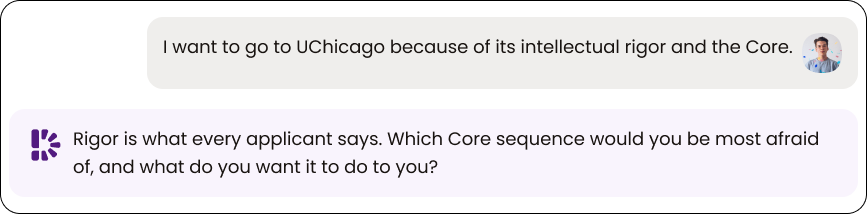
Yes, and it is required. It asks how UChicago satisfies your desire for a particular kind of learning, community and future. Three nouns, three answers, each tied to something specific at UChicago. The prompt says “with some specificity” and “as you know it now,” which tells you two things: generic praise of rigor fails on the prompt’s own terms, and you are allowed to be honest about what you have not yet seen. Guidance is below.
UChicago supplemental essay prompts 2026/27 and how to answer them
Prompts are quoted from UChicago’s essay questions page, linked at the bottom. UChicago says its questions can be approached with utter seriousness, complete fancy, or something in between, and that the best way to write the application is to be yourself in your own voice. Both essays are required.
1. “Why UChicago” (about 300 to 600 words, required)
The prompt. How does the University of Chicago, as you know it now, satisfy your desire for a particular kind of learning, community, and future? Please address with some specificity your own wishes and how they relate to UChicago.
What UChicago is testing. Whether you have three real wishes and whether you know how UChicago answers each one. The prompt starts from your desire, not from the school. Learning, community and future are three separate questions. Most drafts write a strong academic paragraph and then wave at the other two in a sentence each. Three nouns means three answers.
How to answer. Start with the kind of learning you want, in your own words, then the specific UChicago feature that answers it: a Core sequence, the structure of a major, a research setting. Do the same for community, which can be a house, a Hyde Park institution, a specific student culture you have read about. Do the same for the future, which means what you want to be able to do by graduation, not a job title. About 150 words on each. “As you know it now” gives you room to say what you expect rather than what you have confirmed.
Avoid. Praising rigor, which every applicant does and the prompt explicitly rules out. Covering only learning. And naming UChicago features without connecting each to a wish of yours. Every UChicago reference in this essay should carry weight.
2. The extended essay (about 500 to 700 words, required, choose one)
This is the famous one. UChicago rewrites five of the six options every year and keeps the sixth. Readers are not grading the joke. They are watching how you think when nobody has told you what the right answer looks like. Every option is an invitation to play, and the play has to go somewhere. Choose the prompt where you have a real idea, not the one that sounds the most clever.
Option 1. How do thoughts eat?
The prompt. Food for thought: How do thoughts eat? (Inspired by Ernest Leong, Class of 2026)
What UChicago is testing. Whether you can hold one sustained metaphor for 600 words without it collapsing. The shortest prompt on the list is the hardest to keep from drifting.
How to answer. Decide what thoughts consume, how they digest it, what they discard, and follow that logic all the way through. Ground it in one real example of your own thinking, a problem you chewed on, so the metaphor has something underneath it. The essay should end somewhere you could not have predicted from the first paragraph.
Avoid. A list of clever food puns. Explaining the joke and stopping. And abandoning the metaphor halfway to write a different essay.
Option 2. An artistic practice as a solution to a problem
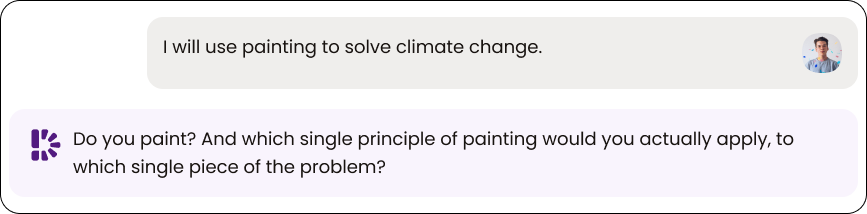
The prompt. The James Webb Space Telescope, launched in 2021, utilized origami-inspired techniques to compactly store and deploy its sunshield in space. Choose an artistic practice and use its principles to propose an elegant solution to a problem. (Inspired by Akhil Korra, Class of 2028)
What UChicago is testing. Whether you know a craft from the inside and can extract its principles. You need both halves: a practice you actually do, like knitting, choral arranging or bonsai, and a real problem. The principle does the solving, not the craft itself.
How to answer. Spend the first third on the practice and the one principle inside it that matters. Spend the middle on the problem, stated specifically. Spend the last third applying the principle to the problem, step by step, with the places it might fail. Elegance in the prompt means economy, so show the solution doing a lot with a little.
Avoid. Picking an art form you admire but have never done. A problem too large to solve in 600 words. And a solution that is really just “be more creative.”
Option 3. Make up a mixed metaphor
The prompt. Sometimes metaphors get mixed up. For one reason or another, one could say, “we’ll burn that bridge when we get there” or “the world is your china shop”. Make up your own mixed metaphor. Explain how it could make sense, be understood, or even applied. (Inspired by Julia Nieberg, Class of 2029)
What UChicago is testing. Whether you can make a broken thing mean something. The key verb is “explain.” Making up the metaphor takes a minute. The essay is the explanation, and it has to arrive at a real idea about how people think or act.
How to answer. Build the metaphor from two idioms you actually use. Then take the collision seriously: what would the world have to be like for it to make sense, who would say it, when would it be useful advice. Land on one situation from your own life where the mixed version is truer than either original.
Avoid. A list of funny mix ups. A metaphor chosen for the pun rather than the meaning. And explaining the joke without applying it.
Option 4. A mundane Olympic event
The prompt. The Olympics have long celebrated the pinnacle of human athletic achievement. But what if they expanded to honor the mundane? Imagine a new Olympic event built around an everyday activity like speed dishwashing or competitive grocery bagging. How is it scored, officiated, and judged? Why is it a worthy addition? (Inspired by Ewan Smith, Class of 2028)
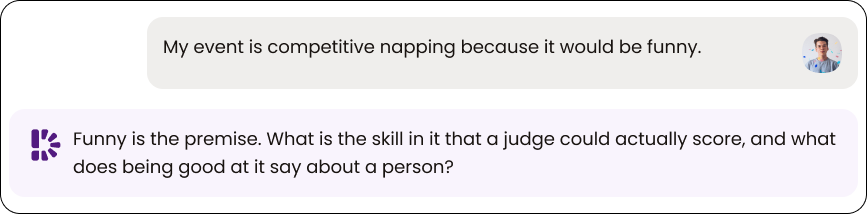
What UChicago is testing. Whether you can take something ordinary seriously enough to find the skill in it. The prompt spells out four sub questions: scored, officiated, judged, and why worthy. The last one is where the essay has to say something about attention, labor or skill.
How to answer. Pick an everyday activity you have actually done many times. Design the rules with real precision, because the precision is what proves you know the activity. Answer all four sub questions in order. Spend the final third on why it deserves a medal, and let that answer say something true about what the activity requires of a person.
Avoid. An activity you chose because it sounds funny rather than because you know it. Skipping any of the four sub questions. And a last paragraph that says it is worthy because everyone does it, which is not an argument.
Option 5. Mistaken Identity of Acronym
The prompt. AI: Allen Iverson. NASA, or the North American Saxophone Alliance. Share a potentially confounding, comedic, or captivating example of MIA (Mistaken Identity of Acronym) and tell us its backstory. (Inspired by Jeeho Byun, Class of 2030)
What UChicago is testing. Whether you can tell a story. The word “backstory” means narrative. The acronym is the hook. The essay is what you do with the collision between the two meanings.
How to answer. One acronym, two meanings, one story where the mix up mattered or revealed something. Let the two meanings illuminate each other. The best version says something about how context changes what words mean, through a scene rather than a lecture.
Avoid. A list of amusing acronym coincidences. An invented acronym with no backstory. And a story where nothing happens except the confusion.
Option 6. Choose your own adventure
The prompt. And, as always… the classic choose your own adventure option! In the spirit of adventurous inquiry, choose one of our past prompts (or create a question of your own). Be original, creative, thought provoking. Draw on your best qualities as a writer, thinker, visionary, social critic, sage, citizen of the world, or future citizen of the University of Chicago; take a little risk, and have fun!
What UChicago is testing. Whether you have an idea strong enough to need its own question. Past prompts are on the same page. Choosing one because you have a real idea for it is fine. Choosing one to avoid this year’s options rarely helps, and readers can tell.
How to answer. Only pick this if the essay already exists in your head and none of the five new prompts fits it. State the question you chose at the top. If you write your own, make it as specific and strange as UChicago’s. One past prompt, the map prompt, has its own rule: visual work needs a written key of at least 300 words.
Avoid. Using this option to submit a personal essay in costume. A question so broad that any essay would answer it. And a past prompt chosen because a sample essay for it exists online.
The extended essay, whichever option you pick
Two traps apply to all six. The first is the personal essay in costume: using a playful prompt as a wrapper for your Common App story wastes the one place UChicago asked for something different. The second is pure whimsy with nothing of you in it, which reads as a stunt. The strong middle ground is an argument or exploration only you could have written, because it draws on what you actually know. Answer every sub question the prompt prints. Stay near the benchmark length unless you have a reason not to.
Before you write: map the whole application
Your personal statement, activities list and the two UChicago essays are read as one file. The personal statement already goes to UChicago, so neither supplement should repeat its story. Each piece should add something the others do not. Think of the reader as someone who has already read everything else in your file before they reach the UChicago questions.
Write down what the reader already knows about you from the Common App. Then give the “Why UChicago” essay the wishes that list is missing, and give the extended essay an idea that appears nowhere else.
As you plan and draft, keep your essays in your own voice and make sure they reflect your own experiences and thinking.
Want help connecting the pieces? Dakota, in College CoPilot’s Application Coach, uses what you have already shared to spot repetition and ask the question you have not answered. The writing stays yours.