Carnegie Mellon asks for three short answers of up to 300 words each, on why your major, how you define a successful college experience, and what you want to emphasize that the rest of your application has not shown. The whole supplement is up to 900 words, which is more than most peer schools ask for and more room to get it wrong. CMU has asked the same three questions for several cycles. For each prompt below, we offer expert guidance on what the question is really testing and how to answer it.
What is Carnegie Mellon’s acceptance rate?
Carnegie Mellon’s overall acceptance rate was 11.1% for the Class of 2029, according to its 2025–26 Common Data Set. Its Early Decision (ED) acceptance rate was 20.6%. Rates vary widely by college, and the School of Computer Science is far more selective than the university figure.
- Overall: 11.1%
- ED: 20.6%
- SAT 25th percentile: 1500
- SAT 50th percentile: 1540
- SAT 75th percentile: 1560
What SAT score do you need for Carnegie Mellon?
CMU does not run one testing policy. The School of Computer Science requires the SAT or ACT. Engineering, Dietrich, Mellon College of Science, Tepper and Information Systems are test flexible, which means you must submit a score but may choose which test, including AP, IB or A Level results. The College of Fine Arts is test optional and requires portfolios or auditions instead. The middle 50 percent of enrolled students scored 1500 to 1560. A score in that range gives your application a better chance of getting a close read. It does not get you in. For Computer Science, more applicants have perfect math scores than there are places.
When are Carnegie Mellon’s application deadlines?
Early Decision: November 2nd. Regular Decision: January 4th. School of Drama and School of Music applicants have an earlier Regular Decision date of December 1st. Early Decision is binding. If you are admitted, you withdraw your other applications and enroll. Early Decision is not available for the School of Drama, BXA Design programs or the School of Music. You apply to a specific college or program, and the testing requirement, portfolio and audition rules follow from that choice.
Does Carnegie Mellon have a Why CMU essay in 2026/27?
Not by name. The first prompt asks what led you to your area of study; use it to connect your interests to the CMU college or program you’re applying to. The second asks how you define a successful college experience; use it to connect your approach to learning to specific CMU resources. Both give you room to explain fit.
Carnegie Mellon supplemental essay prompts 2026/27 and how to answer them
Prompts are quoted from CMU’s admission consideration page, linked at the bottom. All three are required of every first year applicant. CMU says it wants to understand your passions, goals, aspirations and experiences beyond a list of accomplishments. Read the three as a package before writing any of them. Three essays that make the same point tell CMU less than three that each add something.
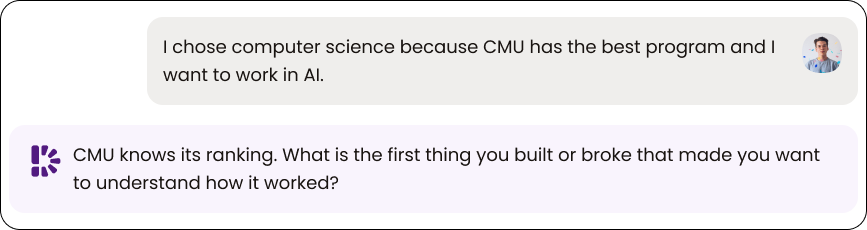
1. The passion or inspiration behind your area of study (300 words)
The prompt. Most students choose their intended major or area of study based on a passion or inspiration that’s developed over time, what passion or inspiration led you to choose this area of study?
What CMU is testing. Whether your interest has a history and whether you have done anything with it. “Developed over time” is the hint. CMU wants the path, not a single moment of inspiration. The reader also checks whether the path leads to the specific program you named, because CMU asks you to apply directly to a college or school.
How to answer. Open with one specific experience where the interest became real: something you built, measured, read or argued about that left you with a better question. Spend about 180 words on the path, with two or three specific points along it. Spend the last 100 on where it leads at CMU: one program, one course sequence, one research group, connected to the question you have. CMU research should be a third of the essay or less.
Avoid. “I have loved computers since I was five.” A list of CMU rankings. The origin story that spends 250 words on how you got interested and 50 on what you are interested in. And a major chosen for how it sounds rather than for what you have done in it.
2. How you define a successful college experience (300 words)
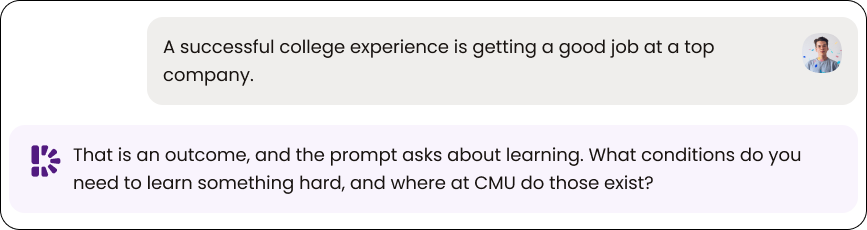
The prompt. Many students pursue college for a specific degree, career opportunity or personal goal. Whichever it may be, learning will be critical to achieve your ultimate goal. As you think ahead to the process of learning during your college years, how will you define a successful college experience?
What CMU is testing. Whether you have thought about how you learn, not just what you want to earn. The prompt steers you toward learning twice. A career plan does not answer it. The reader wants two or three things you need from a college in order to learn well, and evidence that CMU provides them.
How to answer. Name your definition of success in the first sentence, in terms of learning rather than outcomes. Then pick two or three factors: the kind of problems you want to work on, the kind of classmates you need, the environment you do your best work in. For each, give one piece of evidence from your life and one specific CMU resource that matches it. End with what you would want to be able to do by graduation that you cannot do now.
Avoid. A career or salary as the definition of success. A list of five things with no evidence. And a definition that would be true at any college. If CMU could be replaced by another school’s name, the essay is not finished.
3. What you want to emphasize that your application has not shown (300 words)
The prompt. Consider your application as a whole. What do you personally want to emphasize about your application for the admission committee’s consideration? Highlight something that’s important to you or something you haven’t had a chance to share. Tell us, don’t show us (no websites please).
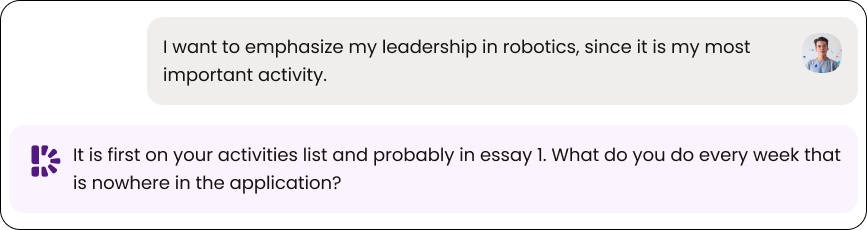
What CMU is testing. Whether there is more to you than the file shows. This is the most open prompt and the one most students waste by repeating something already in the application. The reader has just read your personal statement, your activities and your first two essays. This box is for what those cannot show. “Tell us, don’t show us” is an instruction about form: say it plainly, no websites or external links.
How to answer. List what the reader already knows from the rest of your application. Then find what’s missing: a responsibility at home, a skill with no award, a habit, or a part of your background that shaped how you work. Choose one. Explain it in plain words and give one example. Spend about 200 words on what it is and 100 on why it matters to the kind of student you’ll be at CMU.
Avoid. Repeating the personal statement. Repeating essay 1 or 2. A second activities list. And choosing the most common thing about you. If many applicants could write the same essay, choose something else.
Before you write: map the whole application
Your personal statement, activities list and the three CMU essays are read as one file. The third prompt asks you to consider the application as a whole, which is the instruction for all three. Each piece should add something the others do not. Repeating an interest is fine. Repeating the same evidence wastes space. Think of the reader as someone who has already read everything else in your file before they reach the CMU questions.
Write down what the reader already knows about you from the Common App. Then give each CMU essay one thing that list is missing.
If you use AI while working on your essays, follow CMU’s guidance: it may help with grammar, spelling or structure, but your voice and ideas should remain your own.
Want help connecting the pieces? Dakota, in College CoPilot’s Application Coach, uses what you have already shared to spot repetition and ask the question you have not answered. The writing stays yours.