Wake Forest asks for a “Why Wake” answer of up to 100 words, which it calls required, plus one response chosen from four prompts, which its pages call optional. The four range from a list of five books to a 300 word essay on a Maya Angelou quote. The change this cycle is that you pick one, not several. Wake reads for intellectual curiosity and says so on its own pages, so every answer should show how you think. For each prompt below, we offer expert guidance on what the question is really testing and how to answer it.
What is Wake Forest’s acceptance rate?
Wake Forest’s overall acceptance rate was 19% for the Class of 2030. Wake Forest has not reported Early Decision (ED) or Early Action (EA) acceptance rates for that class.
- Overall: 19%
- ED: Not Reported
- EA: Not Reported
- SAT 25th percentile: 1420
- SAT 50th percentile: 1450
- SAT 75th percentile: 1490
What SAT score do you need for Wake Forest?
Wake Forest has been test optional since 2008 and considers scores only if you ask it to. If you submit, the middle 50 percent of enrolled students scored 1420 to 1490. A score in that range helps put your application in the pile to be read. It does not get you in. Wake Forest says it looks at your life outside the classroom. The optional written response, video and interview let you share more about yourself, but Wake says none is required, expected or gives an admissions advantage.
When are Wake Forest’s application deadlines?
Early Decision I and Early Action: November 15th. Early Decision II and Regular Decision: January 1st. Early Action at Wake Forest is only for first generation college students. Both Early Decision rounds are binding. If you are admitted, you withdraw your other applications and enroll. Wake Forest does not admit by major, requires one recommendation letter, and offers an optional video and an optional virtual interview with their own deadlines shortly after each application date. Request a virtual interview or submit a video within five days of applying.
Does Wake Forest have a “Why Wake” essay in 2026/27?
Yes, at 100 words, and Wake Forest’s admissions blog calls it required. It now sits in the supplemental questions section of the application. Wake’s print application words it as why you decided to apply and what has made you interested in the institution. 100 words is room for two concrete reasons and one sentence connecting them to you. Guidance is below.
Wake Forest supplemental essay prompts 2026/27 and how to answer them
Prompts are quoted from Wake Forest’s July 22, 2026 admissions blog post announcing the 2026/27 application, linked at the bottom. The same questions apply on the Common App and the Coalition Application. Wake’s blog calls “Why Wake” required. Its checklist, its How to Apply page and its print application all call the pick one section optional and say none of the options gives an applicant an advantage. Treat “Why Wake” as required. Treat the pick one as optional and worth writing.
1. “Why Wake” (up to 100 words, required)
The prompt. Why have you decided to apply to Wake Forest? Share with us anything that has made you interested in our institution. Wake’s blog describes this as the “Why Wake” prompt, up to 100 words; read the exact wording inside your application.
What Wake Forest is testing. Whether you know something specific about Wake Forest and whether it connects to you. At 100 words, the reader wants two things you would do at Wake that you would not do the same way elsewhere, and one fact about you that explains why they matter.
How to answer. Name the thing, not the category: a first year seminar format, a particular major or minor, Wake Downtown, a study abroad program, a club you would join. Then attach one fact about you to each. Two reasons, one sentence of fit, done.
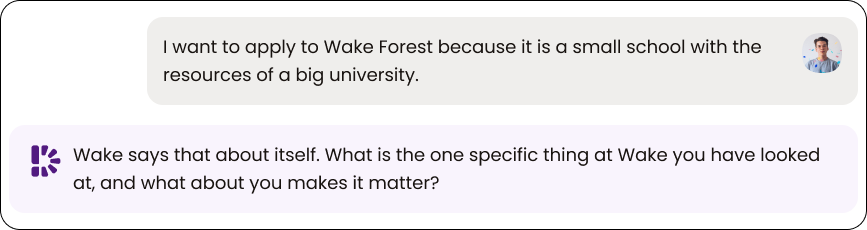
Avoid. “A small school with big school resources,” which every mid-sized research university says about itself. The ranking. And anything that would be as true of another school in the region.
2. Choose one of four (optional, worth writing)
Pick the prompt where you have the most specific material. Wake’s pages say none of the four gives an advantage, which means the choice is about which one lets you show how you think. The list options look easier and are not. They have to make sense with no explanation.
2A. Five books that intrigued you (150 characters per title)
The prompt. List five books you’ve read that have intrigued you.
What Wake Forest is testing. Whether you read, and what the list says about you as one piece. Five airport bestsellers say one thing. Five books assigned in English class say another. A spread that shows range with one surprising pick shows a reader. Wake’s print application also asks whether each was required reading, so be ready to say which ones you chose yourself.
How to answer. Five titles, with room for a short phrase after each but not a review. Only list books you could discuss in an interview. Let the five together form a portrait.
Avoid. Books chosen to impress. Five books from one genre. And any book you have not finished.
2B. What piques your intellectual curiosity (150 words)
The prompt. Tell us what piques your intellectual curiosity or has helped you understand the world’s complexity. This can include a work you’ve read, a project you’ve completed for a class, and even co-curricular activities in which you have been involved.
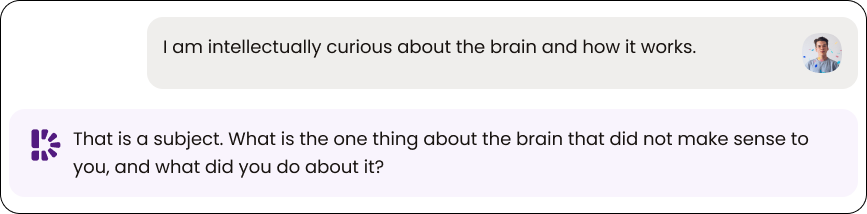
What Wake Forest is testing. What you think about when nobody is grading it. This is the prompt closest to what Wake says it screens for. The reader wants one moment where something did not make sense to you and what you did to figure it out.
How to answer. Name the thing in the first sentence. Then the question inside it, the one you could not answer. Then what you did: what you read, built, asked, tested. End with what you still do not know.
Avoid. A big topic with no question inside it. “I have always been curious.” And a list of interests.
2C. A Maya Angelou quote (300 words)
The prompt. Dr. Maya Angelou, renowned author, poet, civil-rights activist, and former Wake Forest University Reynolds Professor of American Studies, inspired others to celebrate their identities and to honor each person’s dignity. Choose one of Dr. Angelou’s powerful quotes. How does this quote relate to your lived experience or reflect how you plan to contribute to the Wake Forest community?
What Wake Forest is testing. Whether you can connect an idea to your own life and to what you would do at Wake. The prompt offers a choice, lived experience or planned contribution. Strong answers do both, briefly, in that order. This is the longest option and the hardest to do well.
How to answer. One or two sentences on the quote. Then your own story, in a scene, about 200 words. Then what you changed because of it and how that shows up in what you would do at Wake, about 60 words. Choose a quote that fits a story you already have, and one you can trace to Angelou’s actual books, poems or recorded interviews. Several lines circulate under her name that she did not say.
Avoid. Writing about Angelou instead of about you. A quote chosen because it sounds impressive. And a misattributed quote, which readers at Wake will recognize.
2D. Your Top Ten List (100 characters per line)
The prompt. Give us your Top Ten List. (The choice of theme is yours.)
What Wake Forest is testing. Whether you can be specific and revealing with no room to explain. The theme is the essay. Top ten foods is a list. Top ten things I learned working the register at my aunt’s bakery is a portrait.
How to answer. Pick a theme from your actual life. Make each line funny, specific or revealing, and let the order build toward something. The list has to make sense on its own.
Avoid. A generic theme. Lines that need explanation. And ten versions of the same joke.
The optional video
Separately, Wake Forest invites a two to three minute selfie-style video answering one of three prompts: a problem in the world you would solve and why, what the motto Pro Humanitate means to you and how you would act on it, or something important about you that is not already in your application. Wake says the video gives no advantage and explains why it offers it: it wants to know as much about you as possible. If you record one, take the third prompt at its word and show something new. Submit within five days of applying. The final deadline is November 20 for Early Decision I and Early Action, and January 9 for Early Decision II and Regular Decision.
Before you write: map the whole application
Your personal statement, activities list, the “Why Wake” answer and your pick one response are read as one file, along with the video and the interview if you use them. Each piece should add something the others do not. Think of the reader as someone who has already read everything else in your file before they reach the Wake questions. Choose a pick one prompt that shows a different side of you from the personal statement.
Write down what the reader already knows about you from the Common App. Then give each Wake answer one thing that list is missing.
As you brainstorm and revise, keep your writing in your own voice and make sure it reflects your own experiences and thinking.
Want help connecting the pieces? Dakota, in College CoPilot’s Application Coach, uses what you have already shared to spot repetition and ask the question you have not answered. The writing stays yours.