Vanderbilt asks for one supplemental essay of about 250 words, built on its motto, and no “Why Vanderbilt” essay. The prompt is the same for every applicant, but you choose one of five schools on the application, you stay in that school for your first year, and the essay’s contribution clause is read against it. Blair School of Music applicants also complete a separate Blair application with pre screening and an audition. This page gives the prompt, then a section for each school on how the same essay should be answered for it.
What is Vanderbilt’s acceptance rate?
Vanderbilt’s overall acceptance rate was 4.6% for the Class of 2030. Its combined Early Decision (ED) I and II admit rate was 11.9%, and its Regular Decision (RD) admit rate was 2.8%. Vanderbilt does not publish rates by school. Blair admits on audition and is a different pool.
- Overall: 4.6%
- ED: 11.90%
- RD: 2.8%
- SAT 25th percentile: 1510
- SAT 50th percentile: 1530
- SAT 75th percentile: 1560
What SAT score do you need for Vanderbilt?
Vanderbilt is test optional for 2026/27 and has announced it will require the SAT or ACT for students entering in fall 2029. If you submit, the middle 50 percent of enrolled students scored 1510 to 1560. A score in that range gets your essay read. It does not get you in. More applicants have perfect scores than Vanderbilt has places. That is “why” the essay matters here.
When are Vanderbilt’s application deadlines?
Early Decision I: November 1st. Early Decision II and Regular Decision: January 1st. Both Early Decision rounds are binding. If you are admitted, you withdraw your other applications and enroll. Blair applicants submit both Vanderbilt and Blair materials by their chosen plan’s deadline. The Blair deadline is November 1 for ED I. ED II and Regular Decision applicants have a December 1 priority deadline and a January 1 final deadline; applicants who pass prescreening are invited to audition. Vanderbilt fills a large share of its class through Early Decision.
Does Vanderbilt have a “Why Vanderbilt” essay in 2026/27?
Not as such. The single prompt ends by asking how your growth will contribute to the campus community as you dare to grow at Vanderbilt. That is a contribution clause, not a “Why Vanderbilt” essay. Naming Vanderbilt programs does not answer it. Naming what you would do in a room in your school does. The school sections below say what that room looks like for each.
The prompt, same for every school
The prompt is quoted from Vanderbilt’s personal essay and short answer prompts page, linked at the bottom. It is required of all first year applicants.
Crescere aude: dare to grow (about 250 words)
The prompt. Vanderbilt University’s motto, Crescere aude, is Latin for “dare to grow.” In your response, reflect on how one or more aspects of your identity, culture, or background has played a role in your personal growth, and how it will contribute to our campus community as you dare to grow at Vanderbilt.
What Vanderbilt is testing. Two things, both required. First, how a part of who you are drove your growth. The operative word is growth, not description. Second, what that growth lets you bring to the people around you. Most drafts do the first half well and wave at the second in a sentence. The reader works for the school you chose, so the second half should land in that school.
How to answer. Pick one aspect, not three. Spend about 100 words on a specific moment where that aspect pushed you to change: a thing you did that you could not have done before. Spend about 70 on the growth, stated as something you now do or believe. Spend the last 80 on the contribution, in plain words: what you would bring to a seminar, a lab group, a classroom placement or a rehearsal because of it. Make the contribution a behavior, not a promise.
Avoid. Quoting Crescere aude or dare to grow back to Vanderbilt. The identity label with no growth underneath. Hardship as a credential. And a contribution that is a list of Vanderbilt clubs.
Vanderbilt’s essay by school
College of Arts and Science
What it is. The largest school, home to the humanities, social sciences and natural sciences, and the usual choice for undecided and pre med applicants. Readers want evidence that you would use a broad curriculum well and bring something to discussion based classes.
The contribution clause for Arts and Science. Land it in a classroom or a research setting: what you would say in a seminar where people disagree, how you would approach a question in a lab, what you would notice that others might not. If the growth in your essay is about how you think, this is the school where that pays off.
Avoid. A pre med essay with Arts and Science as the wrapper. A contribution that could be made at any college. And naming Engineering or Peabody settings, which tells the reader you wanted a different school.
School of Engineering
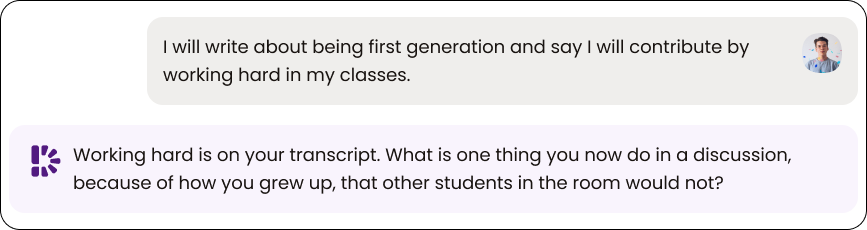
What it is. A smaller engineering school inside a liberal arts university, with a first year common curriculum before majors. Readers want evidence you have built something and that you would work well in teams.
The contribution clause for Engineering. Land it in a project team or a lab: what you would bring to a group that is stuck, how you handle a design that failed, what role you take when nobody assigns one. If the growth in your essay is about persistence, iteration or working with people unlike you, point it there.
Avoid. “I have loved math since I was five.” An essay that never shows a thing you made. And a contribution that is about leadership titles rather than what you do in a room.
Peabody College
What it is. A school with majors in education, human and organizational development, child studies, cognitive studies and special education. Readers want a specific problem in how people learn, develop or work together, and evidence you have engaged with it.
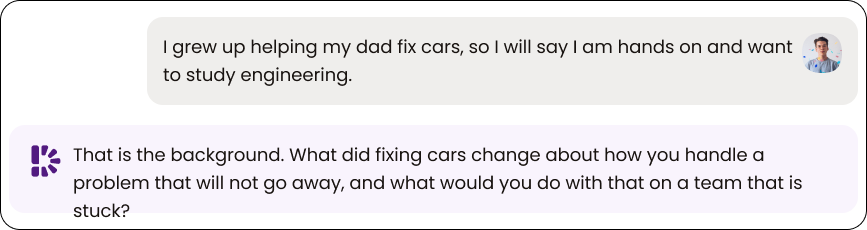
The contribution clause for Peabody. Land it in a field placement, a classroom, a community partnership or a research group: what you would bring to a room of children, families or coworkers because of how you grew. If the growth in your essay is about understanding people, teaching, or watching a system work or fail, this is where it belongs.
Avoid. “I want to help people” or “make a difference in education.” Choosing Peabody as a less competitive route into Vanderbilt, which readers see often. And a contribution with no setting in it.
Blair School of Music
What it is. Vanderbilt’s music school, admitting on pre screening and audition alongside the academic review. All Blair applicants submit the Vanderbilt application, then the Blair application through the MyAppVU portal with a music résumé and pre screening recordings, by the application deadline. Applicants who pass pre screening are invited to audition. Pre screening requirements depend on instrument, voice, composition or jazz, not on intended major.
The contribution clause for Blair. Land it in a studio, an ensemble or a rehearsal: what you bring to a group of musicians because of how you grew. If the growth in your essay is about practice, performance under pressure, or learning from a teacher, point it there. The essay supports the audition. It does not replace it.
Avoid. An essay about loving music with no practice in it. Treating the Vanderbilt essay as the Blair application, which is separate. And missing the pre screening deadline, which is the same date as the application.
College of Connected Computing
What it is. Vanderbilt’s newest undergraduate school will welcome its first class in fall 2027. Its undergraduate programs include computer science, data science, and AI Design and Practice, connecting computing with other fields.
The contribution clause for Connected Computing. Picture the room where your perspective would matter: a team deciding how to build a tool, a classroom weighing who benefits from it, or a research group bringing technical and human questions together. Connect that contribution to the experience that shaped you.
Avoid. Listing technology interests without showing what you would bring to the work, or promising to build “technology for good” without naming a problem you’ve explored.
Choosing the school
You stay in your school for your first year, and switching later requires meeting that school’s requirements and is not guaranteed. Choose by where your evidence lives, not by where the odds seem better. An essay whose contribution clause lands in the wrong school tells the reader you chose for the wrong reason.
Before you write: map the whole application
Your personal statement, activities list and this one Vanderbilt essay are read as one file by readers for the school you chose. With only one supplement, it has to add something the personal statement does not. If your Common App essay is already about your background, this essay needs a different aspect or a different moment. Think of the reader as someone who works for your school and is deciding whether you belong in it.
Write down what the reader already knows about you from the Common App. Then give the Vanderbilt essay the one thing that list is missing, and make the contribution land in your school.
Want help connecting the pieces? Dakota, in College CoPilot’s Application Coach, uses what you have already shared to spot repetition and ask the question you have not answered. The writing stays yours. Follow Vanderbilt’s current rules on AI assistance.
Official Vanderbilt Sources
- Personal essay and short answer prompts
- First year application process, including Blair requirements
- Apply, plans and deadlines
- Blair School of Music 2026/27 application and audition information
- Class of 2030 Admit Rates – Early Decision, Regular Decision, & Overall Acceptance
- Vanderbilt Common Data Set (2025-2026)