UT Austin asks for one essay, which your Common App personal essay satisfies, plus two required short answers of 250 to 300 words and one optional short answer. The two required answers are about your first choice major and the activity you are proudest of. That is down from one essay plus four short answers in past cycles, and the “Why UT” and “Change the World” prompts you may have seen are gone. For each prompt below, we offer expert guidance on what the question is really testing and how to answer it.
What is UT Austin’s acceptance rate?
UT Austin’s overall acceptance rate was 22.2% for the Class of 2029, according to its 2025–26 Common Data Set. The overall rate hides a wide gap by residency. UT’s admit rate was 35.9% for Texas residents and 7.5% for out-of-state applicants. UT does not report separate Early Action (EA) or Regular Decision (RD) rates. For Summer/Fall 2027 applicants, eligible Texas high school students in the top 5% of their class qualify for automatic admission. That guarantees admission to the university, not to a specific major.
- Overall: 22.2%
- EA: Not Reported
- SAT 25th percentile: 1200
- SAT 50th percentile: Not Reported
- SAT 75th percentile: 1470
What SAT score do you need for UT Austin?
UT Austin requires the SAT or ACT, sent as an official score report rather than self reported. The middle 50 percent of enrolled students scored 1200 to 1470. A score in that range gets your file read. It does not get you into your major. Admission to UT and admission to a competitive major are two different decisions, and the first short answer is where the second one gets made.
When are UT Austin’s application deadlines?
Early Action: October 15th, with supplemental materials by October 22nd. Regular deadline: December 1st, with supplemental materials by December 10th. Honors applications: December 1st. UT Austin’s deadlines run earlier than most selective schools, and the Early Action date is in mid October. UT accepts the Common App and ApplyTexas with identical requirements and tells applicants not to file both.
Does UT Austin have a “Why UT” essay in 2026/27?
No. UT removed it. The first short answer asks why your first-choice major interests you. Use it to explain the experiences and questions that led you to that major. Austin, football and UT’s ranking do not answer that question. Think of the reader as someone in the department you named, deciding whether you belong in it. The Common App personal essay satisfies UT’s essay requirement, so you do not need to submit an additional Common App essay.
UT Austin supplemental essay prompts 2026/27 and how to answer them
Prompts are quoted from UT Austin’s essays and short answers page, linked at the bottom. UT describes the short answer length as no more than 40 lines, or about 250 to 300 words, typically one paragraph, and says the short answers must be completed to submit the application. Applicants to majors with honors programs answer that program’s own prompts as well.
The essay (500 to 650 words, satisfied by your Common App essay)
The prompt. Share an essay on any topic of your choice. It can be one you’ve already written, one that responds to a different prompt or one of your own design.
What UT is testing. Nothing new. UT says the Common App personal essay completes this requirement. Do not write a second essay for Texas. Get the Common App essay right once and spend your UT time on the short answers.
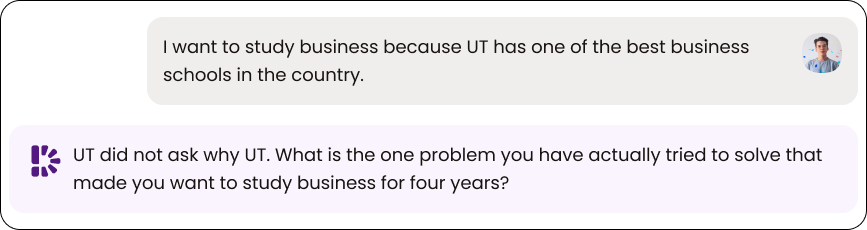
1. Why your first choice major (250 to 300 words, required)
The prompt. Why are you interested in the major you indicated as your first-choice major?
What UT is testing. Whether you have a reason for this major that goes further than liking it. This answer matters more at UT than a major essay does at most universities, because UT admits to majors and competitive programs read it against their own demand. The question is about your first choice major only. Your second choice gets no prompt.
How to answer. Name where the interest started, in one sentence. Then show what you did with it: a course you took on purpose, a project, a job, a problem you kept coming back to. About 180 words on that. End with what you want to do inside the major, concretely enough that a reader can picture it. One real story and one forward looking claim is the right shape for 250 to 300 words.
Avoid. Turning it into a “Why UT” or writing about both majors. “I have always loved” with no evidence. And a career title in place of a direction.
2. The activity you are most proud of (250 to 300 words, required)
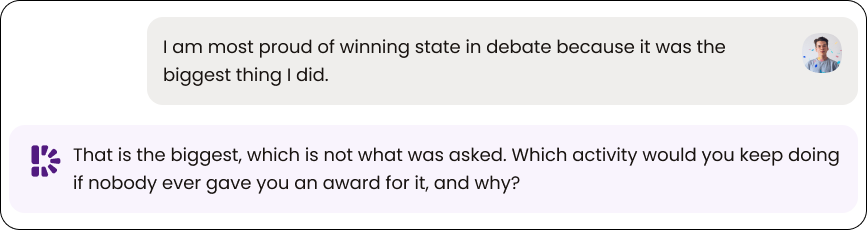
The prompt. Think of all the activities — both in and outside of school — that you have been involved with during high school. Which one are you most proud of and why? UT adds that this can include an extracurricular activity, a club or organization, volunteer activity, work or a family responsibility.
What UT is testing. What you value and what you actually did. “Most proud of” asks for a choice that shows judgment, and “and why” is where the answer lives. UT’s note widens the field on purpose. Work and family responsibilities count equally with clubs, and UT says so in the prompt.
How to answer. Pick the activity with the best why, not the most impressive title. Name one moment inside it and what you did there. Then say why it matters to you more than the others. If you spent three years picking up siblings and cooking dinner so a parent could keep a night shift, that can be the right answer, and UT’s wording tells you so.
Avoid. The résumé in paragraph form. UT accepts an optional résumé and asks for detail there. This answer covers depth and the reason you are proud. And choosing the biggest trophy over the thing that changed you.
3. Optional: circumstances that affected your academic performance (250 to 300 words)
The prompt. Please share background on events or special circumstances that you feel may have impacted your high school academic performance.
What UT is testing. Whether there is context the transcript cannot explain. This is the additional information section under another name.
How to answer. Only if something actually affected your grades: an illness, a move, a family crisis, caregiving or work hours. State what happened and when, point to where it shows in your record, and say what changed afterward if that is true. Factual and brief.
Avoid. Using it for a third activity essay. A blank answer costs you nothing.
Honors program applicants
Some honors programs require separate essays or materials; requirements differ by program. Check your program’s instructions and deadline. Check UT’s honors application page, linked below. For example, Canfield Business Honors asks applicants to describe how an experience on their résumé reflects teamwork and community, and how they would bring those values to the program. The response limit is 300 words. Treat each honors response as a separate essay, with evidence chosen for that prompt.
Before you write: map the whole application
Your Common App essay, your activities list or résumé, and the two UT short answers are read as one file, and UT says it reviews only what is required. Each piece should add something the others do not. The Common App essay is the person. Short answer one is the major. Short answer two is the activity with the best why. Think of the reader as someone in the department you named, deciding whether you belong in it. Write down what the reader already knows about you from the Common App. Then give each UT answer one thing that list is missing.
Remember to write in your own voice and make sure the essays reflect your own experiences and thinking.
Want help connecting the pieces? Dakota, in College CoPilot’s Application Coach, uses what you have already shared to spot repetition and ask the question you have not answered. The writing stays yours.