Tufts rebuilt its supplement this cycle. Every applicant answers two short responses: 75 to 150 words on how you learned about and engaged with Tufts, and 100 to 200 words on a prompt set by the school you apply to. The whole supplement is about 350 words, which is less work than most peer schools ask for and means a weak answer has nowhere to hide. Both limits include a minimum, which is unusual. For each prompt below, we offer expert guidance on what the question is really testing and how to answer it.
What is Tufts’ acceptance rate?
Tufts’ overall acceptance rate was 10% for the Class of 2030. Tufts has not reported Early Decision (ED) or Regular Decision (RD) acceptance rates for that class.
- Overall: 10%
- ED: Not Reported
- SAT 25th percentile: 1460
- SAT 50th percentile: 1500
- SAT 75th percentile: 1520
What SAT score do you need for Tufts?
Tufts is test optional for 2026/27 and brings back the SAT or ACT requirement for 2027/28. The middle 50 percent of enrolled students scored 1460 to 1520. A score in that range gets your answers read. It does not get you in. More applicants have perfect scores than Tufts has places. That is why the short answers matter here.
When are Tufts’ application deadlines?
Early Decision I: November 2nd. Early Decision II and Regular Decision: January 4th. Both Early Decision rounds are binding. If you are admitted, you withdraw your other applications and enroll. You apply to one school, Arts and Sciences, Engineering, the BFA at SMFA, or the Combined Degree, and Tufts considers you only for that school. Tufts weighs demonstrated interest more than most of its peers, and the first short answer is where it measures it.
Does Tufts have a “Why Tufts” essay in 2026/27?
Not by name. The first short answer asks how you learned about and engaged with Tufts. Describe what you did and what you learned. It’s a demonstrated-interest question, not a request to explain why you admire Tufts. Tufts suggests ways to learn about the school, including its website, admissions events, Jumbo Magazine, student blogs and Instagram. None requires an in-person visit. Guidance is below.
Tufts supplemental essay prompts 2026/27 and how to answer them
Prompts are quoted from Tufts’ short answer questions page, headed Short Answer Prompts for the Class of 2031, linked at the bottom. Both answers are required. There are no optional essays. Tufts states on the same page that it strongly discourages the use of generative AI for essays and short answers, because it produces formulaic writing, and that the committee expects your original ideas in your own words.
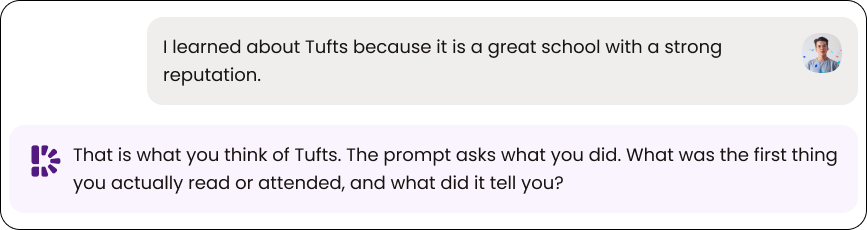
1. How you learned about and engaged with Tufts (75 to 150 words, all applicants)
The prompt. Please describe how you have learned about and engaged with Tufts during your college search process.
What Tufts is testing. Whether you actually looked. “Learned about” and “engaged with” are verbs that describe actions: a tour, an information session, a conversation, a class you sat in on, a student blog you kept reading. The reader wants a short story about your search, not a list of facts about Tufts. If you could not visit, say what you did instead, and be specific.
How to answer. One or two moments of engagement, in order, and what each one taught you. What first caught your attention, what you looked into next, what you found out that moved Tufts onto your list. Every sentence should contain something you did. 75 to 150 words is four to seven sentences.
Avoid. Facts about Tufts, which do not answer the question. Admiration with no action behind it. And a generic sentence of any kind. At this length it is impossible to hide.
2. The school specific short answer (100 to 200 words)
The second prompt varies by school. Arts and Sciences applicants write about a favorite school assignment from the past two years. Engineering applicants describe a recent engineering or science project and their role in it. BFA applicants discuss a portfolio piece and the ideas behind it. Combined Degree applicants explain how a portfolio piece connects to an academic course, project or interest.
School of Arts and Sciences: a favorite assignment
The prompt. Tell us about one of your favorite school assignments in the past two years. What was the assignment and why did you enjoy it?
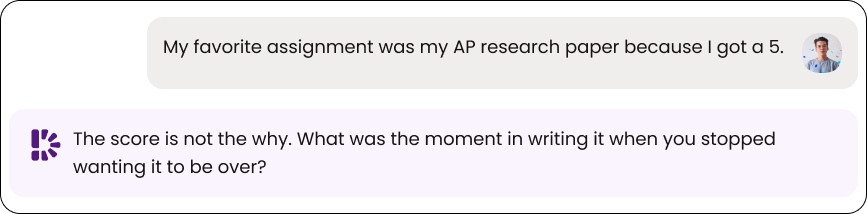
What Tufts is testing. How you think and what kind of work you like. The limit to the past two years is deliberate. Most of your words should go to the why. What does enjoying this assignment say about how you like to work?
How to answer. Name the assignment in one sentence. Spend the rest on why: the moment it got interesting, what you did that the rubric did not require, what you still think about. Choose one you enjoyed, not one that won an award. A quiet assignment you can explain vividly beats a prize winning project you can only summarize.
Avoid. The assignment with the best grade. A summary of the topic instead of your experience of it. And turning it into a why major essay.
School of Engineering: a project and your role
The prompt. Tell us about an engineering or science-related project that you have helped build, design, create, or iterate in the past two years. What was the project and what was your role?
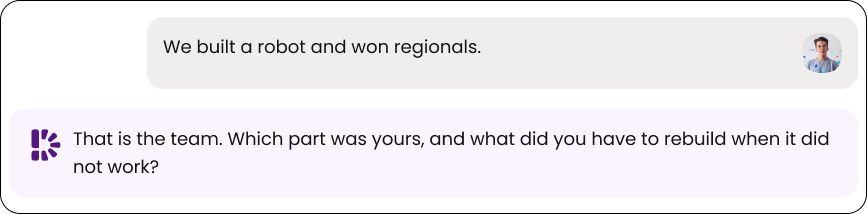
What Tufts is testing. Whether you have done any engineering and what you personally did. “Helped” and “your role” tell you Tufts expects team projects and wants to know your part. “Iterate” tells you a failed first version you fixed is good material. The project can come from a class, a club or your garage.
How to answer. Name the project in one sentence. Spend most of the words on your role, in the first person singular: what you built, what broke, what you changed. End with what you would do differently.
Avoid. “We” throughout with no “I.” A polished result with no process. And the team’s achievements standing in for yours.
BFA at SMFA: a piece in your portfolio
The prompt. Tell us more about a specific piece in your portfolio. What were the ideas you intended to explore, and how did those ideas inform the process of making the piece?
What Tufts is testing. Whether you can talk about your work as ideas and process, not only as an object. The reader can see the piece. Your answer explains what it does not show.
How to answer. One piece. The idea you set out to explore, then how that idea changed what you did while making it: the material you chose, the thing you cut, the point where the piece stopped doing what you planned.
Avoid. Describing the finished object. Listing media. And an artist statement about your whole practice instead of one piece.
Combined Degree: a piece and an academic connection
The prompt. Tell us more about a specific piece in your portfolio. How did an academic course, project, or interest inspire the ideas that you explored in this piece? Or, how did making this piece influence your academic interests?
What Tufts is testing. Whether the two halves of a combined degree are real for you. The prompt runs in either direction: academics into art, or art into academics. Pick the direction that is true.
How to answer. One piece, one course or interest, and the specific way one shaped the other. Process, not the finished object.
Avoid. Claiming both directions in 200 words. A connection asserted but not shown. And the piece described without the academic half.
Before you write: map the whole application
Your personal statement, activities list and the two Tufts answers are read as one file. The second answer should show a different part of your life from the personal statement. If your Common App essay is about the robotics team, use a different project here, or a later version of the same one. Think of the reader as someone who has already read everything else in your file before they reach the Tufts questions.
Write down what the reader already knows about you from the Common App. Then give the second Tufts answer the one thing that list is missing. The first answer is about your search and belongs to Tufts alone.
As a reminder, Tufts strongly discourages generative AI use in for essays and short answers.
Want help connecting the pieces? Dakota, in College CoPilot’s Application Coach, uses what you have already shared to spot repetition and ask the question you have not answered. The writing stays yours.