Emory requires two short answers: one about your academic interests (200 words recommended) and one 150-word answer to one of four Getting to Know You prompts. Applicants to Emory College, Oxford College or both answer the same prompts. That’s about 350 words total. Emory kept last cycle’s questions unchanged and says on its admission blog that there is no right answer. For each prompt below, we offer expert guidance on what the question is really testing and how to answer it.
What is Emory’s acceptance rate?
Emory’s overall acceptance rate was 12.3% for the Class of 2030. Its Early Decision (ED) I acceptance rate was 29.0% for the same class.
- Overall: 12.3%
- ED I: 29.0%
- ED II: Not reported
- SAT 25th percentile: 1480
- SAT 50th percentile: 1510
- SAT 75th percentile: 1540
What SAT score do you need for Emory?
Emory is test optional for 2026/27 and has announced that the SAT or ACT will be required from 2027/28. The middle 50 percent of enrolled students scored 1480 to 1540. A score in that range helps put your application in the pile to be read. It does not get you in. It does not get you in. More applicants have perfect scores than Emory has places. That is why the short answers matter here.
When are Emory’s application deadlines?
Early Decision I: November 1st. Early Decision II and Regular Decision: January 1st. Emory University Scholar Programs: November 15th. Both Early Decision rounds are binding. If you are admitted, you withdraw your other applications and enroll. One application covers Emory College, Oxford College or both, and the short answers do not change by campus, so write the academic answer to work for either.
Does Emory have a “Why Emory” essay in 2026/27?
Yes, inside the academic interests answer. The prompt asks what academic areas you want to explore at Emory and why. The phrase “at Emory University” is the third part, and many drafts forget it. Emory’s executive director of admission has said a line about a specific course, professor or initiative shows thoughtfulness and depth, that it is about fit rather than name dropping, and that generalities are to be avoided. Guidance is below.
Try College CoPilot’s Application Coach →
Emory supplemental essay prompts 2026/27 and how to answer them
Prompts are quoted from Emory’s admission blog post on the 2026/27 short answer questions, linked at the bottom. The academic answer is required. One of the four “Getting to Know You” prompts is required.
1. Academic interests (about 200 words, required)
The prompt. What academic areas are you interested in exploring at Emory University and why?
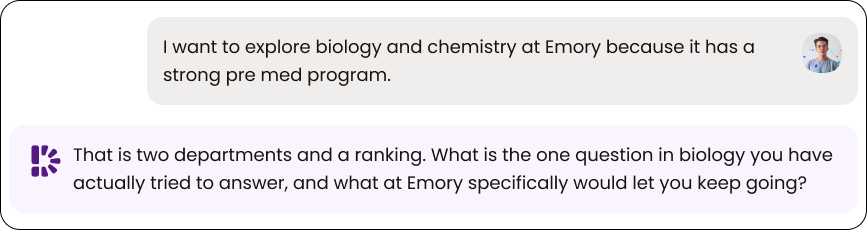
What Emory is testing. Whether your academic interest is real and whether you have looked at how Emory teaches it. “Academic areas,” plural, and “exploring” mean undecided is fine and two connected areas are fine. The prompt asks three things: which areas, why, and at Emory. The reader wants evidence that the interest exists and one or two Emory details that follow from it.
How to answer. Spend about two thirds of the words on why the interest is real, with at least one piece of evidence: a question you keep returning to, something you built or measured or argued about. Spend the rest on one or two specific Emory details that fit it: a course, a program, a research setting. If you apply to both campuses, choose details that fit both; if you apply only to Oxford, you can focus on opportunities there.
Avoid. A list of majors. A string of Emory names with no reason attached. Generalities, which Emory names as the thing to avoid. And an answer that argues for one campus in a way that undercuts the other.
2. Getting to Know You: choose one of four (150 words)
Each prompt has a key clause. Pick the one where you have the most specific material, and make sure it covers different ground from the academic answer and your personal statement. If your personal statement is about community or culture, choose option 3 or 4.
2A. A community you helped change for the better
The prompt. Emory University has a strong commitment to building community. Tell us about a community that you have been part of where your personal participation helped to change or shape the community for the better.
What Emory is testing. Whether something was different because you were there. The key words are “your personal participation helped to change.” Belonging is not enough.
How to answer. One community, one change, shown before and after. Say what you did in the first person. About 60 words on the community, 90 words on the change.
Avoid. “We” for the whole answer. The service record. And a community so large that no individual could have changed it.
2B. Intentionally expanding your cultural awareness
The prompt. Reflect on a personal experience where you intentionally expanded your cultural awareness.
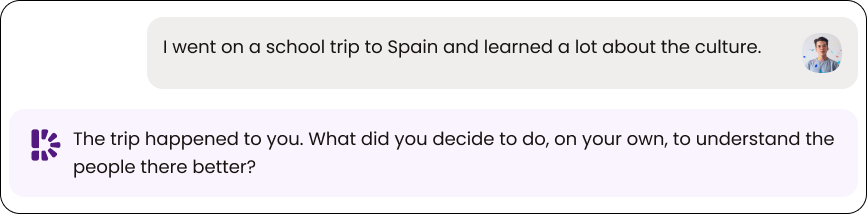
What Emory is testing. What you chose to do in order to learn about people unlike you. “Intentionally” is the key word. Being exposed to a culture does not answer it. Deciding to learn a language, join a community or change a habit does.
How to answer. One decision, one experience, one thing you understand now that you did not before. The decision is the point.
Avoid. A trip described as sightseeing. Exposure that happened to you. And a conclusion that the world is diverse, which is not a reflection.
2C. How you would contribute to service to humanity
The prompt. Emory University’s unique mission calls for service to humanity. Share how you might personally contribute to this mission of service to humanity.
What Emory is testing. Whether you can name a specific way you hope to contribute to service and explain why it matters to you. Past experience can make your plan more concrete, but the prompt does not require a service record.
How to answer.Name one specific way you hope to contribute to service at Emory. If you have relevant past experience, use it to explain where that plan comes from. Make the plan as concrete and narrow as you can.
Avoid. Changing the world. Quoting Emory’s mission back to Emory. And a plan with no past behind it.
2D. How you navigate disagreement
The prompt. In a scholarly community, differing ideas often collide before they converge. How do you personally navigate disagreement in a way that promotes progress and deepens meaningful dialogue?
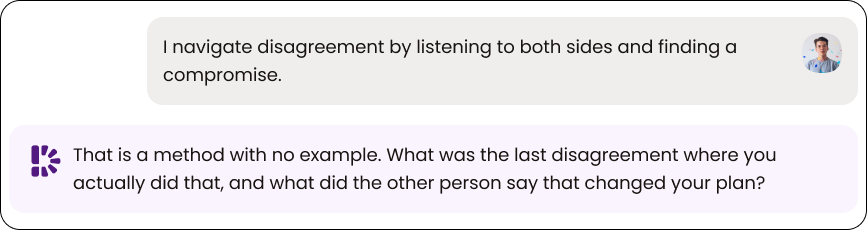
What Emory is testing. Whether you have a method. The prompt asks how you navigate disagreement and wants a result that promotes progress and deepens dialogue. “Converge” is the word to notice. Agreeing to disagree is the opposite of what was asked.
How to answer. One real disagreement, one specific move you made, and what changed as a result. End by turning the story into a habit: the thing you now do when you disagree.
Avoid. Ending with agreeing to disagree. A position paper on the issue. And a disagreement you won cleanly.
Before you write: map the whole application
Your personal statement, activities list and the two Emory answers are read as one file. Each piece should add something the others do not. Repeating an interest is fine. Repeating the same evidence wastes space. Think of the reader as someone who has already read everything else in your file before they reach the Emory questions.
Write down what the reader already knows about you from the Common App. Then give each Emory answer one thing that list is missing.
Emory says AI may help polish or refine your writing, but it should not replace or generate your ideas, voice, or personal experiences. Read Emory’s AI guidance before using AI on your application.
Want help connecting the pieces? Dakota, in College CoPilot’s Application Coach, uses what you have already shared to spot repetition and ask the question you have not answered. The writing stays yours.