Category: Applications and Essays

  • Emory Supplemental Essays 2026/27: Prompts and How to Answer Them


    Emory requires two short answers: one about your academic interests (200 words recommended) and one 150-word answer to one of four Getting to Know You prompts. Applicants to Emory College, Oxford College or both answer the same prompts. That’s about 350 words total. Emory kept last cycle’s questions unchanged and says on its admission blog that there is no right answer. For each prompt below, we offer expert guidance on what the question is really testing and how to answer it.


    What is Emory’s acceptance rate?

    Emory’s overall acceptance rate was 12.3% for the Class of 2030. Its Early Decision (ED) I acceptance rate was 29.0% for the same class. 

    • Overall: 12.3%
    • ED I: 29.0%
    • ED II: Not reported
    • SAT 25th percentile: 1480
    • SAT 50th percentile: 1510
    • SAT 75th percentile: 1540

    What SAT score do you need for Emory?

    Emory is test optional for 2026/27 and has announced that the SAT or ACT will be required from 2027/28. The middle 50 percent of enrolled students scored 1480 to 1540. A score in that range helps put your application in the pile to be read. It does not get you in. It does not get you in. More applicants have perfect scores than Emory has places. That is why the short answers matter here.


    When are Emory’s application deadlines?

    Early Decision I: November 1st. Early Decision II and Regular Decision: January 1st. Emory University Scholar Programs: November 15th. Both Early Decision rounds are binding. If you are admitted, you withdraw your other applications and enroll. One application covers Emory College, Oxford College or both, and the short answers do not change by campus, so write the academic answer to work for either.


    Does Emory have a “Why Emory” essay in 2026/27?

    Yes, inside the academic interests answer. The prompt asks what academic areas you want to explore at Emory and why. The phrase “at Emory University” is the third part, and many drafts forget it. Emory’s executive director of admission has said a line about a specific course, professor or initiative shows thoughtfulness and depth, that it is about fit rather than name dropping, and that generalities are to be avoided. Guidance is below.

    Try College CoPilot’s Application Coach →


    Emory supplemental essay prompts 2026/27 and how to answer them

    Prompts are quoted from Emory’s admission blog post on the 2026/27 short answer questions, linked at the bottom. The academic answer is required. One of the four “Getting to Know You” prompts is required.

    1. Academic interests (about 200 words, required)

    The prompt. What academic areas are you interested in exploring at Emory University and why?

    What Emory is testing. Whether your academic interest is real and whether you have looked at how Emory teaches it. “Academic areas,” plural, and “exploring” mean undecided is fine and two connected areas are fine. The prompt asks three things: which areas, why, and at Emory. The reader wants evidence that the interest exists and one or two Emory details that follow from it.

    How to answer. Spend about two thirds of the words on why the interest is real, with at least one piece of evidence: a question you keep returning to, something you built or measured or argued about. Spend the rest on one or two specific Emory details that fit it: a course, a program, a research setting. If you apply to both campuses, choose details that fit both; if you apply only to Oxford, you can focus on opportunities there.

    Avoid. A list of majors. A string of Emory names with no reason attached. Generalities, which Emory names as the thing to avoid. And an answer that argues for one campus in a way that undercuts the other.

    2. Getting to Know You: choose one of four (150 words)

    Each prompt has a key clause. Pick the one where you have the most specific material, and make sure it covers different ground from the academic answer and your personal statement. If your personal statement is about community or culture, choose option 3 or 4.

    2A. A community you helped change for the better

    The prompt. Emory University has a strong commitment to building community. Tell us about a community that you have been part of where your personal participation helped to change or shape the community for the better.

    What Emory is testing. Whether something was different because you were there. The key words are “your personal participation helped to change.” Belonging is not enough.

    How to answer. One community, one change, shown before and after. Say what you did in the first person. About 60 words on the community, 90 words on the change.

    Avoid. “We” for the whole answer. The service record. And a community so large that no individual could have changed it.


    2B. Intentionally expanding your cultural awareness

    The prompt. Reflect on a personal experience where you intentionally expanded your cultural awareness.

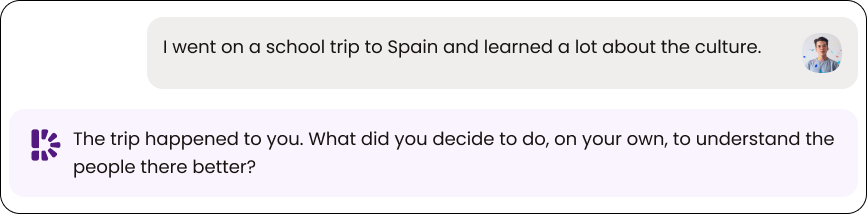
    What Emory is testing. What you chose to do in order to learn about people unlike you. “Intentionally” is the key word. Being exposed to a culture does not answer it. Deciding to learn a language, join a community or change a habit does.

    How to answer. One decision, one experience, one thing you understand now that you did not before. The decision is the point.

    Avoid. A trip described as sightseeing. Exposure that happened to you. And a conclusion that the world is diverse, which is not a reflection.

    2C. How you would contribute to service to humanity

    The prompt. Emory University’s unique mission calls for service to humanity. Share how you might personally contribute to this mission of service to humanity.

    What Emory is testing. Whether you can name a specific way you hope to contribute to service and explain why it matters to you. Past experience can make your plan more concrete, but the prompt does not require a service record. 

    How to answer.Name one specific way you hope to contribute to service at Emory. If you have relevant past experience, use it to explain where that plan comes from. Make the plan as concrete and narrow as you can. 

    Avoid. Changing the world. Quoting Emory’s mission back to Emory. And a plan with no past behind it.


    2D. How you navigate disagreement

    The prompt. In a scholarly community, differing ideas often collide before they converge. How do you personally navigate disagreement in a way that promotes progress and deepens meaningful dialogue?

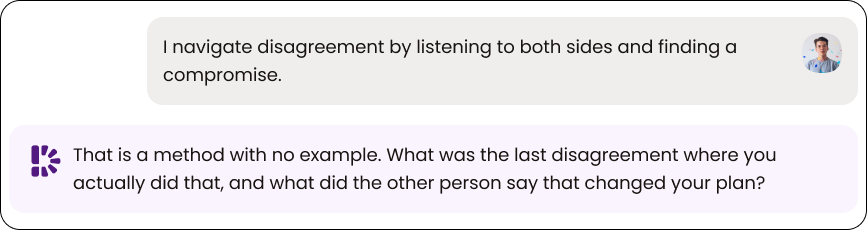
    What Emory is testing. Whether you have a method. The prompt asks how you navigate disagreement and wants a result that promotes progress and deepens dialogue. “Converge” is the word to notice. Agreeing to disagree is the opposite of what was asked.

    How to answer. One real disagreement, one specific move you made, and what changed as a result. End by turning the story into a habit: the thing you now do when you disagree.

    Avoid. Ending with agreeing to disagree. A position paper on the issue. And a disagreement you won cleanly.

    Before you write: map the whole application

    Your personal statement, activities list and the two Emory answers are read as one file. Each piece should add something the others do not. Repeating an interest is fine. Repeating the same evidence wastes space. Think of the reader as someone who has already read everything else in your file before they reach the Emory questions.

    Write down what the reader already knows about you from the Common App. Then give each Emory answer one thing that list is missing.

    Emory says AI may help polish or refine your writing, but it should not replace or generate your ideas, voice, or personal experiences. Read Emory’s AI guidance before using AI on your application.

    Want help connecting the pieces? Dakota, in College CoPilot’s Application Coach, uses what you have already shared to spot repetition and ask the question you have not answered. The writing stays yours.
    Official Emory Sources

  • Georgia Tech 2026/27: What Changed and What Georgia Tech Reads Instead


    Georgia Tech asks for no supplemental essay in 2026/27. It removed its “Why Georgia Tech” question in July 2026 and now requires no school-specific essay. Applicants still submit the Common App personal essay and the rest of their application. That is a change from recent cycles, and a student who finds last year’s guide will be writing an essay Georgia Tech no longer collects. This page explains what Georgia Tech reads now and how the personal essay and activities list carry the weight the supplement used to.


    What is Georgia Tech’s acceptance rate?

    Georgia Tech’s overall acceptance rate was 12.8% for the Class of 2030. Its published Early Action (EA) admit rates were 30% for EA1 and 8% for EA2.  Rates differ sharply for Georgia residents and out of state applicants, and Georgia Tech runs separate Early Action (EA) rounds for each.

    • Overall: 12.8%
    • EA1: 30%
    • EA2: 8%
    • SAT 25th percentile: 1370
    • SAT 50th percentile: 1460
    • SAT 75th percentile: 1530

    What SAT score do you need for Georgia Tech?

    Georgia Tech requires the SAT or ACT. The middle 50 percent of enrolled students scored 1370 to 1530. A score in that range helps put your application in the pile to be read. It does not get you in. With no supplement, your personal essay and your activities list are the only places Georgia Tech hears from you in your own words.


    When are Georgia Tech’s application deadlines?

    Early Action 1, for Georgia residents: October 15th. Early Action 2, for non residents: November 2nd. Regular Decision: January 6th. Early Action at Georgia Tech is not binding. You select an intended major, and Georgia Tech considers your interest and preparation for it as part of application review. 


    Does Georgia Tech have a “Why Georgia Tech” essay in 2026/27?

    No. Georgia Tech asked a version of that question for years and removed it for the 2026/27 cycle to simplify the first year application. Its admission site now says only that applicants complete one of the Common App first year essay prompts. There is no required Georgia Tech-specific essay asking why you want to attend or why you chose your major. Georgia Tech considers your intended major and your interest and preparation for it as part of its review. 


    What Georgia Tech reads in 2026/27 and how to use it

    The Common App personal essay, 250 to 650 words on one of the Common App prompts, is the only essay. Georgia Tech says this portion of the application helps it get to know you and what is important to you. Beyond it, Georgia Tech reads your activities list, your coursework, your recommendations and your test scores.

    The Common App personal essay (250 to 650 words)

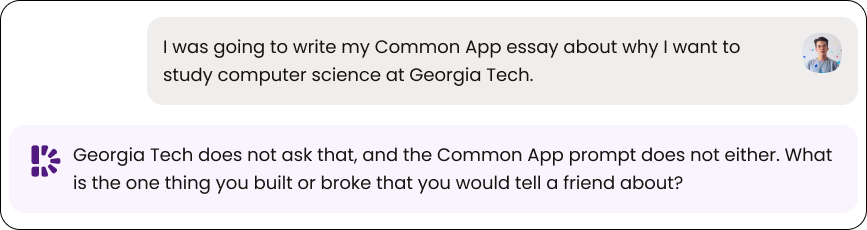
    What Georgia Tech is testing. Who you are apart from grades and scores. Georgia Tech receives more applications than it can read closely, and its applicant pool is dense with strong STEM transcripts. The essay is where it separates people with the same numbers. It is not a place to explain your major. Georgia Tech already knows your major from the application.

    How to use it. Answer the Common App prompt you chose. Do not rewrite the essay to mention Georgia Tech or your intended field. The strongest essays for a school like this show something the transcript cannot: how you handle a problem that did not have a textbook answer, a responsibility you carried, a thing you built or fixed outside any class. If your interest in engineering or computing appears, it should appear as something you did, not as a declaration.

    Avoid. A “Why Georgia Tech” essay in disguise. A why major essay in disguise. And a résumé in paragraph form. The activities list already holds that.

    The activities list

    With no supplement, the ten activity entries do the work a school specific essay would do elsewhere. Georgia Tech reads them against the major you selected. Each entry gets 150 characters for the description. Use them for what you did and what came of it, not for the organization’s mission. Put the entries that show your field first. A job, a family responsibility or a self taught project counts as much as a club, and often says more.


    Before you write: map the whole application

    Georgia Tech reads your personal essay, your activities list and your recommendations as one file, and there is nothing else in your own words. The personal essay has to show who you are without help from a supplement. The activities list has to show your fit with your major without an essay to explain it. Think of the reader as someone who will know you only through those two things, and who is deciding whether you belong in the major you chose.

    Write down what the reader will see in your activities list. Then make sure the personal essay shows something that list cannot.

    Want help connecting the pieces? Dakota, in College CoPilot’s Application Coach, uses what you have already shared to spot repetition between your personal essay and your activities and to ask the question you have not answered. The writing stays yours. 


    Official Georgia Tech Sources

  • Johns Hopkins Supplemental Essays 2026/27: Prompts and How to Answer Them


    Johns Hopkins asks for one supplemental essay of up to 350 words, on what you have learned about engaging across differences, and no “Why Hopkins” essay. The whole supplement is one answer. With a single prompt and a pool where most applicants arrive with comparable grades and scores, it carries more weight than one short essay usually does. For the prompt below, we offer expert guidance on what the question is really testing and how to answer it.


    What is Johns Hopkins’ acceptance rate?

    Johns Hopkins’ overall acceptance rate was 6.1% for the Class of 2029. Its Early Decision (EA) acceptance rate was 10.9% for the Class of 2029, according to the 2025–26 Common Data Set.

    • Overall: 6.1%
    • ED: 10.9%
    • SAT 25th percentile: 1530
    • SAT 50th percentile: 1550
    • SAT 75th percentile: 1565

    What SAT score do you need for Johns Hopkins?

    Johns Hopkins requires the SAT or ACT. The middle 50 percent of enrolled students scored 1530 to 1565. A score in that range helps put your application in the pile to be read. It does not get you in. More applicants have perfect scores than Hopkins has places. That is why the essay matters here.


    When are Johns Hopkins’ application deadlines?

    Early Decision I: November 1st. Early Decision II: January 2nd. Regular Decision: January 2nd. Both Early Decision rounds are binding. If you are admitted, you withdraw your other applications and enroll. One mechanical point: Hopkins collects the supplemental essay through your applicant portal after you submit the application, not inside the Common App, so submitting the application is not the end of the job.


    Does Johns Hopkins have a “Why Hopkins” essay in 2026/27?

    No. The single prompt is about you and how you work with people unlike you. Hopkins says on its own blog that you do not need to mention Hopkins at all. A sentence connecting what you learned to how you would show up on campus can strengthen the ending if it comes naturally. A paragraph about Hopkins programs answers a question nobody asked.


    Johns Hopkins supplemental essay prompt 2026/27 and how to answer it

    The prompt is quoted from Hopkins’ application requirements page, linked below. This is the required Hopkins supplement for applicants to the Krieger School of Arts & Sciences and the Whiting School of Engineering, including biomedical engineering applicants. Peabody applicants complete a separate application with its own essay requirements; applicants to the Peabody/JHU double-degree program must follow both sets of instructions. Direct Matriculation Program applicants also submit an additional program essay. Hopkins published a line-by-line explanation of this prompt on its Hopkins Insider blog in August 2026; it is linked below and worth reading before you draft.

    1. Engaging across differences (350 words)

    The prompt. At Johns Hopkins, community is built through dialogue, collaboration, and a willingness to engage across differences. Whether on campus or in the broader world, community depends on bridge builders who can listen to differing perspectives, challenge their own assumptions, or work together toward shared goals. Drawing on your own experiences, what have you learned about engaging across differences and how has it shaped the way you think about building bridges, enhancing community, and working with others?

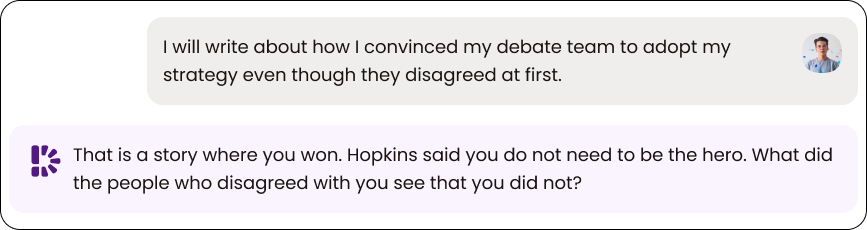
    What Hopkins is testing. What kind of community member you will be. The prompt defines a bridge builder in its own words: someone who can listen to a perspective unlike their own, challenge their own assumptions, or work with others toward a shared goal. It asks two things: what you learned, and how that learning shapes the way you think now. Hopkins says on its blog that it wants to see how you engaged across differences, not that you resolved them or changed someone’s mind, and that you do not need to be the hero of the story. “Differences” is wider than most students assume. Hopkins lists identity based differences as material, but differences of opinion, experience, age, role and working style count too.

    How to answer. One experience, shown in a scene. Spend about 150 words on it: who the people were, where the difference lay, what you did and what you got wrong. Spend about 100 on what you learned, stated as something specific you now believe or do, not a trait. Spend the last 100 on how it shapes the way you work with people now, with a later moment where you put it into practice. Taking “how” and “what” literally keeps the essay on the prompt. You can end with the difference still unresolved.

    Avoid. The straw man, where the other person is simply wrong. The hero story, where you fixed everyone. A political position paper, which is not what was asked. Bridge building described in the abstract with no scene underneath it. And spelling it John Hopkins. It is Johns, and the reader notices.


    Before you write: map the whole application

    Your personal statement, activities list and this one Hopkins essay are read as one file. Hopkins says the essays are where it learns how you actually think, and it gives you two: the personal statement and this. With a single supplement, it has to add something the personal statement does not. If your Common App essay is already about a disagreement or a community, choose a different experience here. Think of the reader as someone who has already read everything else in your file before they reach the Hopkins question.

    Write down what the reader already knows about you from the Common App. Then give the Hopkins essay the one thing that list is missing.

    Hopkins allows AI for brainstorming or refining ideas before writing and for basic proofreading of your own work. The submitted essay must be your original work; submitting substantive AI-generated content is not allowed.

    Want help connecting the pieces? Dakota, in College CoPilot’s Application Coach, uses what you have already shared to spot repetition and ask the question you have not answered. The writing stays yours.

    Official Johns Hopkins Sources

  • WashU Supplemental Essays 2026/27: Prompts and How to Answer Them


    Washington University in St. Louis asks for one required supplemental essay of 250 words: what you are interested in studying at college and why. The prompt never says WashU, and WashU reads it as its “Why WashU” essay anyway. It says so on its own “What We’re Looking For” page. Beyond Boundaries applicants and Signature Scholar applicants answer one more 250 word question each, and there is an optional 90 second video. For each prompt below, we offer expert guidance on what the question is really testing and how to answer it.


    What is WashU’s acceptance rate?

    WashU’s overall acceptance rate was 12.2% for the Class of 2030. It has not released acceptance rates by application round for that class.

    • Overall: 12.2%
    • ED: Not Reported
    • EA: Not Reported
    • RD: Not Reported
    • SAT 25th percentile: 1500
    • SAT 50th percentile: 1530
    • SAT 75th percentile: 1550

    What SAT score do you need for WashU?

    WashU is test optional and lists scores among the things it calls truly optional, with no penalty for leaving them out. If you submit, the middle 50 percent of enrolled students scored 1500 to 1550. A score in that range gets your essay read. It does not get you in. More applicants have perfect scores than WashU has places, and WashU says it considers demonstrated interest as a small part of its review. The one essay is where that interest shows up in writing.


    When are WashU’s application deadlines?

    Early Action and Early Decision I: November 2nd. Early Decision II and Regular Decision: January 4th. Signature Scholar priority deadline: [SCHOLAR DEADLINE]. Early Action is not binding. Both Early Decision rounds are binding. You must select one of WashU’s five undergraduate schools when you apply: Architecture, Art, Arts and Sciences, Business or Engineering. You do not declare a major until your second year, but your essay should make sense next to the school you pick.


    Does WashU have a “Why WashU” essay in 2026/27?

    Yes, in disguise. The prompt asks what you want to study at college and why. WashU’s “What We’re Looking For” page says, under fit and engagement, that this is its one required essay specific to WashU, and that it hopes you will learn what makes a WashU experience great and reflect that in the why you share. So one 250 word answer does two jobs most schools split: the academic pull and WashU’s place in it. Guidance is below.


    WashU supplemental essay prompts 2026/27 and how to answer them

    Prompts are quoted from WashU’s first year applicants page and its program pages, linked at the bottom. The 250 word essay is required of every applicant. The Beyond Boundaries question is required only if you indicate interest in that program. The Signature Scholar questions appear in the WashU Pathway after you apply and are not published.

    1. What you want to study at college and why (250 words, required)

    The prompt. Please tell us what you are interested in studying at college and why.

    What WashU is testing. Two things in one answer: whether your academic interest is real, and whether you have looked at how WashU would let you pursue it. Read alone, the prompt is a why major question. Read with WashU’s own explanation, it is also the “Why WashU.” The reader checks the answer against the undergraduate school you selected.

    How to answer. Spend about half the words on the question you want to work on and where it came from: something you did, measured, built or argued about that left you with a better question. Spend the other half on how you would pursue it at WashU: name the school you chose and one or two concrete things inside it, a course sequence, a research setting, a cross school combination WashU makes possible, or St. Louis as a place to do the work. If you are undecided, name the two or three questions pulling at you and say why WashU’s structure lets you test them. That is an answer. “I do not know yet” is not.

    Avoid. A generic why major that could go to any university, which meets the prompt and misses WashU’s reason for asking it. The opposite: 200 words of WashU programs with no reason you want them. An interest that does not fit the school you selected, with no explanation of the cross school plan. And reusing your Common App essay’s central story as the why. WashU already has that essay.


    2. Beyond Boundaries, only if you indicate interest (250 words)

    The prompt. The Beyond Boundaries Program equips students with a set of tools to critically understand and make a difference in a complicated world where challenges require varied perspectives and skill sets. What is the big societal issue you would like to tackle? Who would you need on your team? How would the Beyond Boundaries Program support you to work with collaborative teams to address this issue?

    What WashU is testing. Whether you can think about a problem as a team effort. Three questions in 250 words: the issue, who you would need, and how the program would support the team. Most drafts answer the first well and skip the other two. “Who would you need” is another way of asking what you cannot do alone.

    How to answer. Pick an issue narrow enough to picture. Then name the disciplines you would need by role, the public health student, the economist, the person who knows the tenants, and say what you bring and what you do not. End with how the program’s collaborative structure fits that team.

    Avoid. Climate change as the issue. Casting yourself as the lone solver with a team of assistants. And skipping the program question.


    Signature Scholar Programs

    Applicants to the Rodriguez, Ervin and Danforth Scholars programs answer one 250 word question per program inside the WashU Pathway after applying. WashU posts the questions on each program’s page. Applicants submit a response of up to 250 words for each program they apply to through the WashU Pathway. Rodriguez recognizes community service and celebrating cultural differences, Ervin rests on academic excellence, leadership, community service and diversity, and Danforth honors a passion for helping others. Read your question with that description in mind. Submit your admission application by December 16, 2026, for priority consideration. Complete the Scholar application in Pathway by January 4, 2027.

    The optional video

    WashU invites a 90 second video telling it about something important to you and says, in its own emphasis, that it is optional and that applicants will not be penalized for skipping it. If you record one, show something not already in the application. Deadlines fall about a week after each application date.


    Before you write: map the whole application

    Your personal statement, activities list and the one WashU essay are read as one file. With a single supplement doing two jobs, it has to add something the personal statement does not. If your Common App essay already tells the origin story of your interest, give the WashU essay a different reason or a different angle. Think of the reader as someone who has already read everything else in your file before they reach the WashU question, and who is checking it against the school you selected.

    Write down what the reader already knows about you from the Common App. Then give the WashU essay the one thing that list is missing, and make at least a third of it about WashU.

    WashU publishes an AI policy that lists using AI to brainstorm, draft or write essays as unethical and treats grammar review of a completed essay as a sometimes use. Read it on the What We’re Looking For page before you use any tool.

    Want help connecting the pieces? Dakota, in College CoPilot’s Application Coach, uses what you have already shared to spot repetition and ask the question you have not answered. The writing stays yours.

    Official WashU Sources

  • Stanford Supplemental Essays 2026/27: Prompts and How to Answer Them


    Stanford asks for eight answers: five short questions of 3 to 50 words and three essays of 100 to 250 words, and no “Why Stanford” essay. The whole supplement is under 1,000 words. Short means every sentence has to work. For each prompt below, we offer expert guidance on what each question is really testing and how to answer them.


    What is Stanford’s acceptance rate?

    Stanford’s overall acceptance rate was 3.8% for the Class of 2029, according to the 2025–26 Stanford Common Data Set. Its Restrictive Early Action (REA) acceptance rate was not reported.

    • Overall: 3.8%
    • REA: Not Reported
    • SAT 25th percentile: 1520
    • SAT 50th percentile: 1550
    • SAT 75th percentile: 1570

    What SAT score do you need for Stanford?

    Stanford requires the SAT or ACT. The middle 50 percent of admitted students scored 1520 to 1570. A score in that range helps put your application in the pile to be read. It does not get you in. More applicants have perfect scores than Stanford has places. That is why the essays matter here.


    When are Stanford’s application deadlines?

    Restrictive Early Action: November 1st. Regular Decision: January 5th. Restrictive means no other private college early. Stanford admits to the university as a whole, not to a major or school, so your stated major does not bind you.


    Does Stanford have a “Why Stanford” essay in 2026/27?

    No. None of the eight questions asks why you want to attend. The closest is the third essay, which asks what would help you make a distinctive contribution to Stanford, and that is a question about you, not about Stanford. There is no prompt where listing Stanford’s programs, professors or the weather earns anything. Stanford says the questions are there to help it know you as a friend, a future roommate and a classmate. Write to that.


    Stanford supplemental essay prompts 2026/27 and how to answer them

    Prompts are quoted from Stanford’s application and essays page, linked at the bottom. All eight are required. Stanford reads them as a set, so plan them together: use the eight answers to add distinct details and perspectives. Avoid repeating the same story or evidence from your Common App essay.

    Short questions: how the five work together

    50 words is two sentences. Stanford prints a 3 word minimum, which tells you that a one line answer is allowed and sometimes right. The five together form a quick portrait. Plan them so each one comes from a different part of your life and each one holds a concrete noun. Do not write five tiny essays with a thesis. Answer the question and stop.

    One warning. Readers can tell when a detail was chosen to seem interesting rather than because it is true of you. A plain true answer beats a clever invented one every time.

    1. The most significant challenge society faces (50 words)

    The prompt. What is the most significant challenge that society faces today?

    What Stanford is testing. Not your politics. Whether you can name a problem specifically and say why in a sentence. The reader has seen “climate change” and “inequality” thousands of times, and both are fine if the second sentence is yours.

    How to answer. Name the challenge in the first sentence, as narrowly as you can. Use the second to say why it matters more than the others, from something you have seen. A narrow true answer beats a broad safe one.


    2. Your last two summers (50 words)

    The prompt. How did you spend your last two summers?

    What Stanford is testing. What you do when nobody sets your schedule. Stanford is not checking for prestige programs. A job, caring for siblings, and a summer spent on one project all answer the question.

    How to answer. Both summers, plainly, with one specific detail each. If one summer was unremarkable, say what it was and move on. Honesty reads better than inflation here.


    3. A historical moment you wish you had witnessed (50 words)

    The prompt. What historical moment or event do you wish you could have witnessed?

    What Stanford is testing. What you find interesting and why. The moment itself matters less than the reason. The reader wants a specific event and a reason that only you would give.

    How to answer. Name the moment in the first sentence. Spend the second on why: what you would want to see, or what question it would answer. Small moments work as well as famous ones, and often better.


    4. An activity, job or family responsibility (50 words)

    The prompt. Briefly elaborate on one of your extracurricular activities, a job you hold, or responsibilities you have for your family.

    What Stanford is testing. Whether one of the things you do means something beyond the line on your activities list. Stanford names jobs and family responsibilities on purpose. A job or caring for a family member counts as much as a club, and often says more.

    How to answer. One thing. One sentence on what you do and one on why it matters to you. Pick the one that would not be obvious from your activities list.


    5. Five things that are important to you (50 words)

    The prompt. List five things that are important to you.

    What Stanford is testing. Whether you can be concrete about what you value. Five abstractions, family, friends, learning, kindness, growth, tell the reader nothing. Five specific things tell them who you are.

    How to answer. A list is fine. Mix the scale: a person, an object, a habit, a place, an idea. Each one should be something a friend would recognize as yours. Ten words each is plenty.


    Essay 1. An idea or experience that makes you excited about learning (100 to 250 words)

    The prompt. The Stanford community is deeply curious and driven to learn in and out of the classroom. Reflect on an idea or experience that makes you genuinely excited about learning.

    What Stanford is testing. Whether you can think about one specific thing in public. This is the intellectual essay, and the phrase “in and out of the classroom” means the idea does not have to be academic. The reader wants to watch your mind work, not hear that you love learning.

    How to answer. Name the idea or experience in the first sentence. Spend the middle on what you did with it: what you read, built, tested or argued about, and what you still do not understand. Spend about 150 words on the idea and 50 on how you found it. Most drafts do the reverse and turn into origin stories.

    Avoid. “I have always loved learning.” An introduction to a subject. And a why major essay with the word “excited” added.


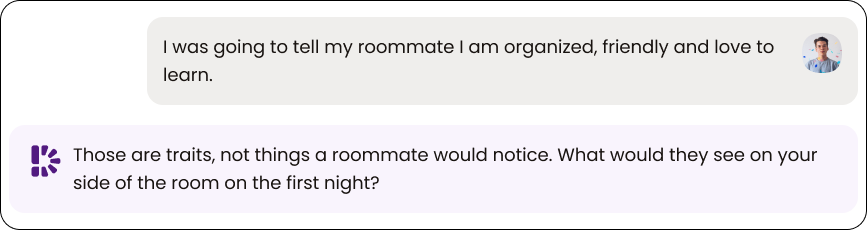
    Essay 2. A note to your future roommate (100 to 250 words)

    The prompt. Virtually all of Stanford’s undergraduates live on campus. Write a note to your future roommate that reveals something about you or that will help your roommate—and us—get to know you better.

    What Stanford is testing. Whether you can be a person rather than an applicant. This is the most famous prompt in college admissions and the one Stanford uses to see who shows up in the dorm. The reader has read seven serious answers. This one should sound like you talking.

    How to answer. Write it as a note, to a person, in your own voice. Pick two or three concrete things a roommate would actually notice: the habit, the object, the rule, the thing you cook at midnight. Let the details reveal the traits without naming them. Humor is welcome if it is yours. End the way you would end a real note.

    Avoid. A third essay with a thesis. Accomplishments in disguise. A list of Stanford things you cannot wait to do together, which turns the note into a “Why Stanford” essay. And invented quirks. Readers can tell.


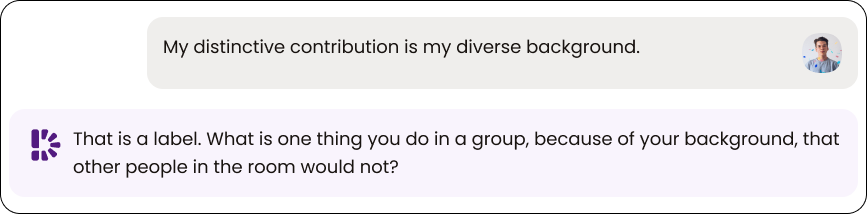
    Essay 3. Your distinctive contribution to Stanford (100 to 250 words)

    The prompt. Please describe what aspects of your life experiences, interests, and character would help you make a distinctive contribution as an undergraduate to Stanford University.

    What Stanford is testing. Whether you can connect one thing about you to one thing you would do with it. The prompt names three sources, experiences, interests and character, and asks for a contribution. The word “distinctive” is the test. The reader wants something that is specific to you, shown, and then turned into what it lets you bring to a seminar, a lab group or a dorm.

    How to answer. Pick one aspect, not three. Spend about 120 words on a scene that shows it. Spend the rest on the contribution, in plain words: what you would do or bring because of it. Do not leave the contribution for the reader to infer, and do not make it about Stanford’s programs.

    Avoid. The list of identities with no scene underneath. The diversity statement. And turning this into the “Why Stanford” essay that Stanford chose not to ask for.


    Before you write: map the whole application

    Your personal statement, activities list and the eight Stanford answers are read as one file. Each piece should add something the others do not. Repeating an interest is fine. Repeating the same evidence wastes space. Think of the reader as someone who has already read everything else in your file before they reach the Stanford questions.

    Write down what the reader already knows about you from the Common App. Then give each Stanford answer one thing that list is missing.

    As you brainstorm and revise, keep your essays in your own voice and make sure they reflect your own experiences and thinking.

    Want help connecting the pieces? Dakota, in College CoPilot’s Application Coach, uses what you have already shared to spot repetition and ask the question you have not answered. The writing stays yours.

    Official Stanford Sources

  • Penn Supplemental Essays 2026/27: Prompts and How to Answer Them


    Penn asks for three short answers of 50 to 200 words each: a thank you note, a community answer, and one prompt for the undergraduate school you choose. Dual degree programs add more. The core supplement has a combined maximum of 600 words. Short means every sentence has to work. For each prompt below, we offer expert guidance on what each question is really testing and how to answer them.


    What is Penn’s acceptance rate?

    For the Class of 2029, Penn’s overall acceptance rate was 4.9%, and its Early Decision (ED) acceptance rate was 13.3% based on Penn’s 2025–2026 Common Data Set.

    • Overall: 4.9%
    • ED: 13.3%
    • SAT 25th percentile: 1510
    • SAT 50th percentile: 1550
    • SAT 75th percentile: 1570

    What SAT score do you need for Penn?

    Penn requires the SAT or ACT. The middle 50 percent of admitted students scored 1510 to 1570. A score in that range helps put your application in the pile to be read. It does not get you in. More applicants have perfect scores than Penn has places. That is why the essays matter here.


    When are Penn’s application deadlines?

    Early Decision: November 1st. Regular Decision: January 5th. Early Decision at Penn is binding. If you are admitted, you withdraw your other applications and enroll.


    Does Penn have a “Why Penn” essay in 2026/27?

    Yes, split across two prompts. The community prompt asks how you will explore community at Penn, which is “Why Penn” through the people and places. The school specific prompt asks about your subject at the College, Wharton, Engineering or Nursing, which is “Why Penn” through the academics. Penn’s own instructions say to be precise about both why Penn and why that school. Keep the clubs and the campus in the community answer and the courses and research in the school answer. Guidance for both is below.


    Penn supplemental essay prompts 2026/27 and how to answer them

    Prompts are quoted from Penn’s Writing page, linked at the bottom. Penn says the short answers are meant to show how you consider others, how you think about community, what motivates your academic aspirations, and what draws you to Penn. Those map onto the three prompts in order.

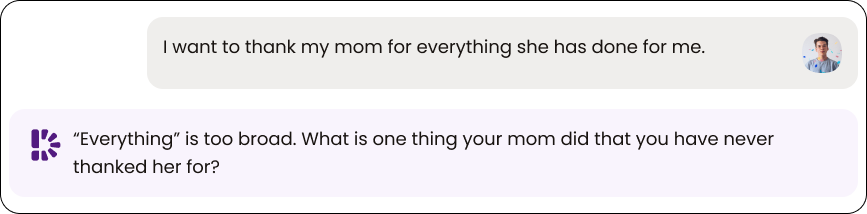
    1. A thank you note to someone you have not yet thanked (50 to 200 words)

    The prompt. Write a short thank-you note to someone you have not yet thanked and would like to acknowledge. (We encourage you to share this note with that person, if possible, and reflect on the experience!)

    What Penn is testing. How you consider others. That is Penn’s own phrase for this prompt. The reader is looking at who you chose, what you noticed about what they did, and whether you can be specific about why it mattered. The choice of person says as much as the note. Penn adds that it hopes you actually send it, which tells you the tone it wants: a real note to a real person, not an essay addressed to admissions.

    How to answer. Write it as a letter. Name the person in the first line. Spend the middle on one specific thing they did, with the detail that shows you were paying attention. End with what it changed for you. Keep it under 200 words. A note that could be sent is the goal.

    Avoid. Thanking a parent or teacher in general terms, which is the most common answer and the hardest to make specific. Using the note to list your own achievements. And writing to the admissions reader rather than to the person.


    2. How you will explore community at Penn (50 to 200 words)

    The prompt. How will you explore community at Penn? Consider how Penn will help shape your perspective, and how your experiences and perspective will help shape Penn.

    What Penn is testing. Whether you have looked at Penn beyond the name, and whether you know what you would do there. The prompt runs in both directions: what Penn will do to you and what you will do to Penn. Most answers only do the second. The reader wants to see one or two specific Penn communities, named, connected to something you already do, and a sentence about what you expect them to change in you.

    How to answer. Pick one or two communities at Penn you have actually examined: a club, a program, a residential option, a research group. For each one, say what you already do that connects to it and what you would bring. Then answer the first half of the prompt in one sentence: what you expect that community to change in how you see things. About 90 words per community.

    Avoid. A list of five clubs with no reason attached. Philadelphia as the whole answer. And repeating anything from the school specific prompt below. The academic reasons belong there.


    3. The school specific prompt

    Every applicant answers one of the four prompts below, for the undergraduate school they chose as their single degree option. Penn says to be precise about why that school. The four schools have different curricula and the prompts are written to test whether you know it.

    College of Arts and Sciences (50 to 200 words)

    The prompt. The College of Arts and Sciences is designed to foster discovery and connection. Describe something you are curious about—something you’d like to learn more about or find a new approach to—and how you might pursue that curiosity in the College.

    What Penn is testing. Whether your curiosity is specific and whether you have looked at how the College is organized. The College is the broadest of Penn’s four schools, so the prompt asks you to narrow: one thing you are curious about and one way to pursue it. Penn points you to the College’s departments and areas of study for a reason.

    How to answer. Spend about 120 words on the curiosity, with evidence that it is real: a question you keep returning to, something you read or measured or argued about that left you with a better question. Spend about 60 on the fit: one department, one program, one way the College lets you cross subjects. One thing, explained, beats five, listed.

    Avoid. Naming a professor you have never read. A cause instead of a question. And the origin story, where most of the words explain how you first got interested.


    The Wharton School (50 to 200 words)

    The prompt. Wharton prepares its students to make an impact by applying business methods and economic theory to real-world problems, including economic, political, and social issues. Discuss a current issue of importance to you and how you hope a Wharton education would help you explore it.

    What Penn is testing. Whether you see business as a way to work on a problem rather than a career path. The prompt asks for a current issue first and Wharton second. The reader wants to see that you understand the issue well enough to say what is hard about it, and that you can name what business methods or economic thinking would add.

    How to answer. Name the issue in the first sentence, as narrowly as you can. Spend the middle on what you know about it from your own experience or reading, including the part that is unresolved. Spend the last 60 words on how a Wharton education helps: a concentration, a way of analyzing the problem, a specific tool. Connect it to the issue, not to your résumé.

    Avoid. “I want to be an entrepreneur” with no problem attached. Issues so large that nothing can be said about them. And treating Wharton as a brand rather than a set of methods.


    Penn Engineering (50 to 200 words)

    The prompt. Penn Engineering prepares its students to become leaders in technology by combining a strong foundation in the natural sciences and mathematics with depth of study in focused disciplinary majors. Describe how you plan to pursue your engineering interests at Penn, particularly within the intended major you selected.

    What Penn is testing. Whether you know what your intended major actually involves and whether you have done any engineering. The prompt names the major you selected, so the reader will check your answer against it. Penn points you to the curriculum for that major.

    How to answer. Start with one thing you have built, fixed, measured or programmed, and what happened when it did not work. That is your engineering interest, shown. Then name one or two things in your intended major’s curriculum, a course, a lab, a research group, and say what you would do there. About 100 words on you, 80 on Penn.

    Avoid. The robotics club résumé. “I have loved math since I was five.” And a major chosen because it sounds impressive rather than because you have done anything in it.


    School of Nursing (50 to 200 words)

    The prompt. Penn Nursing intends to meet the health needs of society in a global and multicultural world by preparing its students to impact healthcare by advancing science. Why are you applying to Nursing, where do you see yourself professionally in the future, and how will you contribute to our mission of promoting equity in healthcare?

    What Penn is testing. Three things, named in the prompt: why nursing, where you are headed, and how you will contribute to equity in healthcare. The reader wants a real reason for choosing nursing, a direction that is specific without being a job title, and a concrete understanding of what equity in healthcare means from something you have seen.

    How to answer. Answer all three parts in order and give each about 60 words. For why nursing, use one experience with care, given or received. For the future, name a kind of work rather than a title. For equity, name one specific gap you have seen and what you would do about it.

    Avoid. Writing about medicine and swapping in the word nursing. Skipping the equity question, which Penn placed in the prompt on purpose. And “I want to help people,” which every applicant says.


    Coordinated dual degree and specialized programs

    If you apply to Huntsman, LSM, M&T, NHCM, VIPER or VIC, Penn adds one to three program essays of 50 to 400 words on top of the three above. Penn’s instruction is firm: the three core answers address your single degree school choice, and the program essay addresses the program. Do not mix them. Each program prompt asks the same underlying question, why this combination and what you would do with it, and several ask for a specific problem at the intersection. Answer with a problem, not a career. The full prompts are on Penn’s Writing page, linked below.


    Before you write: map the whole application

    Your personal statement, activities list and the Penn answers are read as one file. Each piece should add something the others do not. Repeating an interest is fine. Repeating the same evidence wastes space. Think of the reader as someone who has already read everything else in your file before they reach the Penn questions. Penn says this in its own words: it does not need you to summarize the rest of your application.

    Write down what the reader already knows about you from the Common App. Then give each Penn answer one thing that list is missing.

    As you plan and draft, remember to check Penn’s current rules on AI and essays.

    Want help connecting the pieces? Dakota, in College CoPilot’s Application Coach, uses what you have already shared to spot repetition and ask the question you have not answered. The writing stays yours.

    Official Penn Sources

  • MIT Supplemental Essays 2026/27: Prompts and How to Answer Them


    MIT asks for eight answers on its own application: four essays of about 100 to 200 words and four short responses of 40 to 50 words, plus an optional additional information box. MIT does not require the Common App personal essay and does not receive it. The eight required answers have a combined maximum of 1,000 words. Short means every sentence has to work. For each prompt below, we offer expert guidance on what each question is really testing and how to answer them.


    What is MIT’s acceptance rate?

    MIT’s overall acceptance rate was 4.6% for the Class of 2030. Its Early Action (EA) acceptance rate was 5.5%; Regular Decision (RD) was not reported.

    • Overall: 4.6%
    • EA: 5.5%
    • RD: Not Reported
    • SAT 25th percentile: 1520
    • SAT 50th percentile: 1550
    • SAT 75th percentile: 1570

    What SAT score do you need for MIT?

    MIT requires the SAT or ACT. The middle 50 percent of admitted students scored 1520 to 1570. A score in that range helps put your application in the pile to be read. It does not get you in. More applicants have perfect math scores than MIT has places. That is why the essays matter here.


    When are MIT’s application deadlines?

    Early Action: November 5th. Regular Action: January 15th. MIT’s Early Action is not restrictive and not binding. You can apply early elsewhere unless that school forbids it. MIT uses its own application, not the Common App, so the pieces are different: the MIT form, a secondary school report, two teacher letters, test scores, and an activities form with room for only four activities.


    Does MIT have a “Why MIT” essay in 2026/27?

    No. None of the eight prompts asks why you want MIT. The third essay comes closest, asking what problems you would want to tackle with an MIT education, and that is a question about the problems and about you. There is no prompt where listing MIT labs, professors or the Infinite Corridor earns anything. MIT’s own advice on its essays page is blunt: if you are spending your time strategizing about what makes you look best instead of answering honestly, you are doing it wrong.


    MIT supplemental essay prompts 2026/27 and how to answer them

    Prompts are quoted from MIT’s essays, activities and academics page, linked at the bottom. All eight are required. MIT does not receive your Common App personal essay so these eight answers plus four activities are everything MIT learns about you in your own words. Plan them as a set.

    1. The field of study that appeals to you most right now (100 to 200 words)

    The prompt. What field of study appeals to you the most right now? (Note: Applicants select from a drop-down list.) Reflect on what has led you to this interest.

    What MIT is testing. Whether your interest has a history. The words “right now” and “reflect on what has led you” are the instruction. MIT does not admit by major, and it says so. The reader wants the path: what you did that pulled you toward this field, with evidence. A field chosen from a list, with a reason, is more honest than a lifelong calling.

    How to answer. Name the field in the first sentence, since you picked it from a menu anyway. Spend the rest on two or three specific things you did, built, read or tested that moved you toward it, and what each one taught you. End with the question you still have. 200 words is three short paragraphs.

    Avoid. “I have loved math since I was five.” A why MIT for this major essay, which is not what was asked. And naming a field because it sounds strong at MIT rather than because you have done anything in it.


    2. Something you did differently from what was expected (100 to 200 words)

    The prompt. While some reach their goals following well-trodden paths, others blaze their own trails achieving the unexpected. In what ways have you done something different than what was expected in your educational journey?

    What MIT is testing. Initiative. Whether you have ever made a choice about your own education that nobody required. The scale does not matter. Teaching yourself something your school did not offer, taking a course at a community college, dropping a track everyone expected you to follow, or building something outside any class all answer it.

    How to answer. One choice, stated in the first sentence, with what the expected path was. Then what you did instead and what it cost or risked. Then what came of it, including the parts that did not work. The reader is looking for agency, not success.

    Avoid. Reframing a normal achievement as a trail you blazed. A choice your parents or school made for you. And the hardship story, which belongs in essay 4 if anywhere.


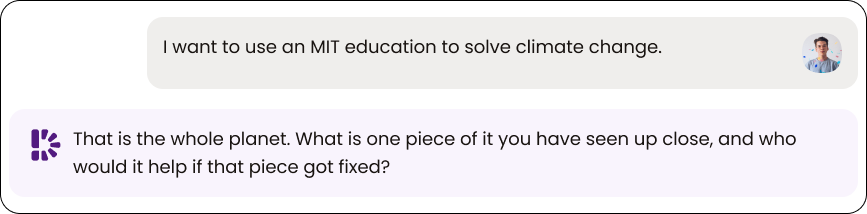
    3. The problems you want to tackle and the impact you aim to make (100 to 200 words)

    The prompt. How have your personal and academic experiences influenced the types of problems you would want to tackle with an MIT education and the impact you aim to make on your community?

    What MIT is testing. Whether your ambitions are attached to something you have seen. The prompt runs from experiences to problems to impact, in that order. MIT’s stated mission is to use science and technology in service of the nation and the world, and this is the prompt that checks whether you mean it. The reader wants a type of problem, not a career, and a community you can name.

    How to answer. Start with the experience, personal or academic, where you met the problem up close. Spend about 80 words on it. Then name the type of problem it points to, as narrowly as you can. Then the impact and the community, in plain words. Keep MIT to one clause. The prompt asks what you would do with an MIT education, not why MIT.

    Avoid. Changing the world. Problems so large that nothing specific can be said about them. And turning this into the “Why MIT” essay that MIT chose not to ask for.


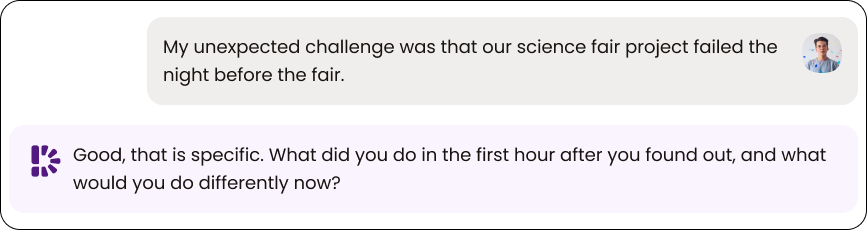
    4. A situation or challenge you did not expect (100 to 200 words)

    The prompt. How did you manage a situation or challenge that you didn’t expect? What did you learn from it?

    What MIT is testing. How you behave when a plan fails. MIT’s own description says it wants to know how you handle things, not how big the thing was. The prompt has two parts, how you managed it and what you learned, and the second is where the answer lives. A small surprise handled honestly beats a large one described vaguely.

    How to answer. State the situation in two sentences. Spend the middle on what you actually did, including the first thing you tried that did not work. Spend the last 60 words on what you learned, stated as something you now do differently. “Managed” asks for your actions, not your feelings.

    Avoid. Choosing the biggest hardship you can think of because it seems expected. A story where the challenge simply ended. And a lesson stated as a trait, “I became more resilient,” instead of a behavior.


    Short responses: how the four work together

    40 to 50 words is two sentences. MIT says these are designed to get to know you better, and it means it. The four together form a quick portrait. Plan them so each comes from a different part of your life and each holds a concrete noun. Do not write four tiny essays with a thesis. Answer the question and stop.

    One warning. Readers can tell when a detail was chosen to seem interesting rather than because it is true of you. A plain true answer beats a clever invented one every time. MIT says the same thing on its own page.


    5. What you do just for fun (40 to 50 words)

    The prompt. What do you do just for fun?

    What MIT is testing. Whether there is a person behind the application. Choose something you do for fun, even if it’s also on your activities list. Focus on the part you enjoy, not the awards or results. The reader wants the thing with no award attached.

    How to answer. Name it in the first sentence. Use the second for one detail that shows you actually do it. If it is small and ordinary, that is the point.


    6. Someone you admire (40 to 50 words)

    The prompt. Who is someone you admire, whether you know them personally or look up to them from afar? Tell us why.

    What MIT is testing. What you value, through who you chose. The person matters less than the reason. A parent, a teacher, a coworker or a public figure all work if the why is specific.

    How to answer. Name the person, then one specific thing they do or did that you admire, not a trait. “She rebuilt the engine herself” says more than “she is hardworking.”


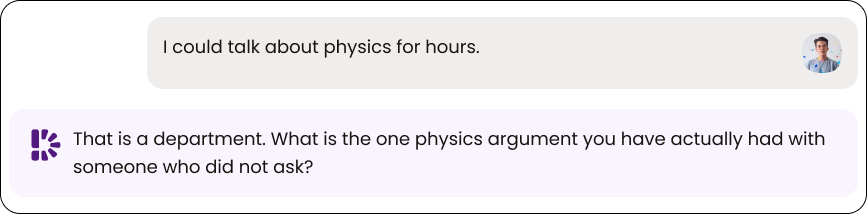
    7. A topic you could talk about for hours (40 to 50 words)

    The prompt. What’s a topic, academic or non-academic, that you could talk about for hours?

    What MIT is testing. Enthusiasm with detail. The thing you explain too long at dinner. “Academic or non-academic” is a real invitation. The reader wants to feel the hours.

    How to answer. Name the topic, then one specific sub question inside it that you would get to by the second hour. The sub question is what proves you could actually talk for hours.


    8. Generalist or specialist (40 to 50 words)

    The prompt. MIT values both “generalists” with varied interests and “specialists” who focus deeply on one or a few passions. Which do you think best describes you, and why?

    What MIT is testing. Self knowledge. MIT says it values both, so there is no right answer. The reader wants you to pick one honestly and give a reason that matches the rest of your application. If your activities form shows one thing done deeply, “generalist” will not land.

    How to answer. Pick one in the first sentence. Use the second for the evidence: the pattern in how you spend your time that proves it. If you are in between, say which way you lean and why.


    The additional information box

    MIT adds one open text box for anything else it ought to know. Use it only for something that explains your application and fits nowhere else: a gap in your transcript, a circumstance that shaped your choices, a project that needs two sentences of context. Do not use it for a ninth essay. If nothing needs explaining, leave it empty.


    Before you write: map the whole application

    MIT reads your eight answers, your four activities and your coursework form as one file, and it never sees your Common App essay. That changes the job. Whatever story carries your 650 words elsewhere reaches MIT only if you rebuild it inside one of these prompts at 100 to 200 words. Each answer should add something the others do not. Repeating an interest is fine. Repeating the same evidence wastes space.

    Write down the four activities you will list. Then give each MIT answer one thing that list is missing.

    As you draft and revise, keep your responses in your own voice and make sure they reflect your own experiences and thinking.

    Want help connecting the pieces? Dakota, in College CoPilot’s Application Coach, uses what you have already shared to spot repetition and ask the question you have not answered. The writing stays yours.

    Official MIT Sources

  • Georgetown Supplemental Essays 2026/27: Prompts and How to Answer Them


    Georgetown asks for four essays: two short essays of 250 words each, a personal or creative essay of up to 650 words, and a 500-word essay for the undergraduate school or joint program you apply to. The combined maximum is 1,650 words. This is the longest supplement of any of the selective schools, and the school-specific essay is your clearest chance to explain why Georgetown fits your academic goals. For each prompt below, we offer expert guidance on what each question is really testing and how to answer them.


    What is Georgetown’s acceptance rate?

    Georgetown admitted 13% of applicants to the Class of 2030. It has not reported separate Early Action (EA) or Regular Decision (RD) admit rates for that class.

    • Overall: 13%
    • EA: Not Reported
    • SAT 25th percentile: 1405
    • SAT 50th percentile: 1480
    • SAT 75th percentile: 1530

    What SAT score do you need for Georgetown?

    Georgetown requires the SAT or ACT. The middle 50 percent of admitted students scored 1405 to 1530. A score in that range helps put your application in the pile to be read. It does not get you in. More applicants have perfect scores than Georgetown has places. That is why the essays matter here.


    When are Georgetown’s application deadlines?

    Early Action: November 1st. Regular Decision: January 10th. Georgetown has no Early Decision. Its Early Action is not binding, but Early Action applicants may not apply to any binding Early Decision program elsewhere. Georgetown accepts either its own Georgetown Application or the Common Application, says there is no advantage to either, and warns against submitting both. It also assigns alumni interviews after the first part of the application is submitted and requires students to complete the interview when assigned, so submit the first part early.


    Does Georgetown have a “Why Georgetown” essay in 2026/27?

    Yes, in the form of a Why This School essay. You apply directly to one of Georgetown’s undergraduate schools, and the 500 word essay asks why that field and why at Georgetown’s version of it. Each school’s prompt opens with a sentence about the school’s mission, which is a hint about what it cares about. Guidance for every school is below.


    Georgetown supplemental essay prompts 2026/27 and how to answer them

    Prompts are quoted from Georgetown’s application requirements and forms page, linked at the bottom. All four essays are required on either application. Georgetown does not require the Common App personal statement; its own 650 word essay stands in for it.

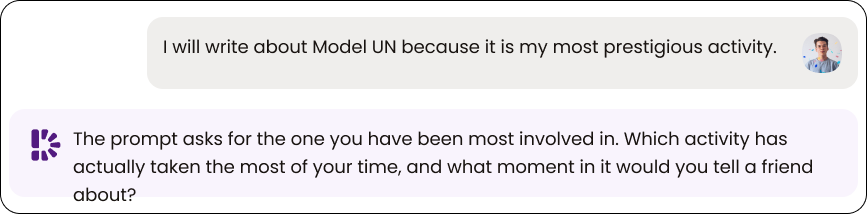
    1. Short Essay: the activity you have been most involved in (250 words)

    The prompt. Briefly discuss the significance to you of the school or summer activity in which you have been most involved.

    What Georgetown is testing. Depth and meaning. The key word is “significance,” not “description,” and the prompt asks for the activity in which you have been most involved, not the most impressive one. Georgetown scopes it to school or summer, which means a summer job or a responsibility you carried every summer qualifies. The alumni interviewer may ask about it.

    How to answer. Name the activity in the first sentence. Spend most of the 250 words on one specific moment inside it and what it changed in you. The reader already has your activities list. This is about why it matters to you.

    Avoid. Choosing the activity with the best title over the one with the most hours. The résumé walk. And describing what you did without saying what it did to you.


    2. Short Essay: interacting with a different viewpoint (250 words)

    The prompt. In all our lives, we interact with people who hold different viewpoints than our own. Describe such an event you experienced. What did you learn from the experience?

    What Georgetown is testing. Whether you can describe a real disagreement fairly and show what changed in you. The prompt asks for an event and a lesson. That is a story, not an opinion piece. The reader wants to see the other view presented well enough that its holder would recognize it.

    How to answer. State the disagreement in one sentence. Describe the exchange: what the other person said, what you said back, the moment it got uncomfortable. End with what you learned, stated as something specific you now do differently. You can end still disagreeing.

    Avoid. The straw man. If the other person comes across as simply wrong, you have not shown that you learned anything. A position paper on the issue. And a disagreement you won cleanly.


    3. Personal or creative essay (650 words)

    The prompt. As Georgetown is a diverse community, the Admissions Committee would like to know more about you in your own words. Please submit a brief personal or creative essay which you feel best describes you and reflects on your personal background and individual experiences, skills, and talents.

    What Georgetown is testing. Who you are, in a broader frame than most personal statements. The prompt names background, experiences, skills and talents, which is wider than a single moment story. Georgetown says you may reuse your Common App essay if it fits this prompt. If your Common App essay is a narrow story about one event, it may not.

    How to answer. Decide first whether your existing personal statement answers this prompt. If it reflects on where you come from and what you can do, use it. If not, write something broader: two or three threads of your life, connected by one idea about who you are. “Creative” is allowed, but the reader still needs to come away knowing you.

    Avoid. Reusing a Common App essay that answers a different question. A list of accomplishments in paragraph form. And a creative piece so stylized that the person disappears behind it.


    4. The school specific essay (500 words)

    Every applicant answers one of the seven prompts below, for the school they apply to. Most ask for your primary motivations and several add a destination: public service, global service, positive change in the world. Answer that clause too, or you have answered only half the prompt. Each prompt opens by describing the school. Connect your motivation to what that opening says the school cares about.

    Applying to a joint degree program? See Georgetown’s application requirements, linked in the sources below, for the essay instructions that apply to your program.

    College of Arts and Sciences

    The prompt. Founded in 1789, the Georgetown College of Arts & Sciences is committed to the Jesuit traditions of an integrated education and of productive research in the natural sciences, humanities, social sciences, and fine arts. Describe your interest in studying in the College of Arts & Sciences. Applicants interested in the sciences, mathematics, or languages are encouraged to make specific reference to their choice of major.

    What Georgetown is testing. Whether your curiosity is specific and whether you understand what an integrated Jesuit education means in practice: breadth across fields, a core curriculum, and reflection built into study. If you are in the sciences, mathematics or languages, the prompt tells you to name the major.

    How to answer. Spend about 250 words on the interest, with evidence: a question you keep returning to, something you read or measured or argued about. Spend the rest on the College: one or two things about how it teaches that fit how you want to learn, and how its breadth would let you connect your interest to others. Name the major if the prompt tells you to.

    Avoid. A “why major” essay with Georgetown added at the end. Quoting the Jesuit tradition back to Georgetown. And a list of departments.


    Walsh School of Foreign Service

    The prompt. Georgetown University’s Walsh School of Foreign Service was founded more than a century ago to prepare generations of leaders with the foundational skills to address global issues. Describe your primary motivations for studying international affairs at Georgetown University and dedicating your undergraduate studies toward a future in global service.

    What Georgetown is testing. Two things: why international affairs, and whether you mean “global service.” The second clause is where most essays go thin. The reader wants a global issue you have seen up close and an honest account of what service means to you.

    How to answer. Start with the issue and where you met it. Spend about 250 words there. Then name the kind of work you want to do, as a problem rather than a title. Then why the School of Foreign Service specifically, which means its curriculum and its structure, not its reputation.

    Avoid. “I have always been fascinated by other cultures.” A career essay with no problem in it. And skipping the service clause.


    McDonough School of Business

    The prompt. Georgetown University’s McDonough School of Business provides graduates with essential global, ethical, analytical, financial, and diverse perspectives on the economies of our nation and the world. Describe your primary motivations for studying business at Georgetown University.

    What Georgetown is testing. Whether you see business as a way to work on something rather than a path to a salary. The prompt’s opening names ethics alongside finance, which is a hint. The reader wants a problem or a question you care about and a reason business is the right tool.

    How to answer. Open with the issue or the experience, as specifically as you can. Spend about 250 words on it. Then why business, as a method. Then why McDonough, one or two things about its curriculum and its ethical framing that fit your issue.

    Avoid. “I want to be an entrepreneur” with no problem attached. Treating McDonough as a brand. And an essay that could be sent to any business school unchanged.


    McCourt School of Public Policy

    The prompt. Describe your primary motivations for studying public policy at Georgetown University and dedicating your undergraduate studies toward a future related to public service. The full prompt opens with a sentence about the school and notes that students spend two years on the Hilltop and two on the Capitol Campus.

    What Georgetown is testing. Whether your interest in policy is attached to a specific problem and whether you understand what public service means for you. The two campus structure is named on purpose.

    How to answer. Name the policy problem in the first paragraph, as narrowly as you can. Spend about 250 words on how you came to it. Then why McCourt, including what the Capitol Campus years would let you do. Then the service clause, in one honest paragraph.

    Avoid. A political opinion dressed as a policy interest. “I want to make a difference.” And problems too large to say anything about.


    School of Health

    The prompt. Describe the factors that influenced your interest in studying health care at Georgetown University, specifically addressing your intended related major: Global Health, Health Care Management & Policy, or Human Science. The full prompt opens with a sentence about the school.

    What Georgetown is testing. Whether you know which of the three majors you want and why. The prompt requires you to address one. The reader wants a health problem you have seen and a reason that major is the way into it.

    How to answer. Name the major early. Spend about 250 words on the factors, which means experiences and questions, not traits. Then why that major at Georgetown, with one or two specifics.

    Avoid. Writing about medicine and swapping in health care. Skipping the major. And “I want to help people.”


    Berkley School of Nursing

    The prompt. Georgetown University’s Berkley School of Nursing is committed to the formation of ethical, empathetic, and transformational nursing leaders. Describe the factors that have influenced your interest in studying Nursing at Georgetown University.

    What Georgetown is testing. Whether you want nursing rather than medicine, and why. The opening names ethics, empathy and leadership. The reader wants one experience with care, given or received, and a reason nursing is the role.

    How to answer. One experience, in detail, about 250 words. Then what it taught you about what nurses actually do. Then why Georgetown’s program, with one or two specifics.

    Avoid. “I like science and helping people.” A medicine essay with the word nursing substituted. And skipping the question of why nursing specifically.


    Earth Commons Institute

    The prompt. Describe your primary motivations for studying environment and sustainability at Georgetown University to effect positive change in the world. The full prompt opens with a sentence about the institute.

    What Georgetown is testing. Whether your environmental interest is attached to a specific problem and whether “positive change” means something concrete to you. The reader wants a piece of the environment you have seen up close.

    How to answer. Start with the specific problem and where you met it. Spend about 250 words there. Then why Georgetown’s program, and then the change clause, stated as the one thing you want to be able to do.

    Avoid. Climate change as the whole answer. Changing the world. And an essay with no particular place, species, policy or system in it.


    Before you write: map the whole application

    Your activities list and the four Georgetown essays are read as one file, and if you apply on the Common App, Georgetown does not require the personal statement, so your 650 word essay here does that job. Each piece should add something the others do not. Repeating an interest is fine. Repeating the same evidence wastes space. Think of the reader as someone who has already read everything else in your file before they reach the Georgetown essays.

    Write down what the reader already knows about you from your activities and transcript. Then give each Georgetown essay one thing that list is missing.

    Georgetown prohibits applicants from using AI tools to complete any part of the application, including essays.

    Want help connecting the pieces? Dakota, in College CoPilot’s Application Coach, uses what you have already shared to spot repetition and ask the question you have not answered. The writing stays yours. 

    Official Georgetown Sources

  • Duke Supplemental Essays 2026/27: Prompts and How to Answer Them


    Duke requires two essays, each with a 250-word limit—”Why Duke” and Communities—and offers three optional prompts, of which you may answer one or none. Across these, you can write up to 750 words. Short means every sentence has to work. With only two required Duke-specific essays, each one needs to add something distinct. For each prompt below, we offer expert guidance on what each question is really testing and how to answer them.


    What is Duke’s acceptance rate?

    For the Class of 2030, Duke’s overall acceptance rate was 4.7%, and its Early Decision (ED) acceptance rate was 11.9%. Duke has not published a separate Regular Decision (RD) rate for this class.

    • Overall: 4.7%
    • ED: 11.9%
    • RD: Not Reported
    • SAT 25th percentile: 1510
    • SAT 50th percentile: 1550
    • SAT 75th percentile: 1570

    What SAT score do you need for Duke?

    Duke is test optional for 2026/27 and says applicants without scores are not at a disadvantage. If you submit, the middle 50 percent of enrolled students scored 1510 to 1570. A score in that range helps put your application in the pile to be read. It does not get you in. More applicants have perfect scores than Duke has places. That is why the essays matter here.


    When are Duke’s application deadlines?

    Early Decision: November 2nd. Regular Decision: January 4th. Early Decision at Duke is binding. If you are admitted, you withdraw your other applications and enroll. You apply to either Trinity College of Arts and Sciences or the Pratt School of Engineering. Duke also accepts an optional Glimpse video of 60 to 90 seconds with its own deadline about a week after each application date, and it does not accept separate résumés.


    Does Duke have a “Why Duke” essay in 2026/27?

    Yes, and it is required. Duke’s own name for what it wants is “demonstrated knowledge.” Its FAQ says demonstrated interest, meaning visits, emails and meetings with your regional officer, is not a plus factor. What counts is showing in the essay that you understand Duke and why it matches you. Guidance is below.


    Duke supplemental essay prompts 2026/27 and how to answer them

    Prompts are quoted from the Essays tab of Duke’s Apply page, linked at the bottom. Duke’s What We Look For page lists the quality of thought and expression in the essays as one of five primary factors, and tells applicants to craft the short writing as carefully as the personal essay.

    1. “Why Duke” (250 words, required)

    The prompt. What is your impression of Duke as a university and community, and why do you believe it is a good match for your goals, values, and interests? If there is something specific that attracts you to our academic offerings in Trinity College of Arts and Sciences or the Pratt School of Engineering, or to our co-curricular opportunities, feel free to include that, too.

    What Duke is testing. What you know about Duke and how it connects to you. The prompt has two parts. First, your impression of Duke as a university and a community. Second, why it matches your goals, values and interests. The academic detail is marked “feel free,” which makes it optional. Most weak essays skip the impression and go straight to a list of programs.

    How to answer. Open with an impression in your own words: what you noticed about Duke and how you noticed it, not a line from the website. Then connect two or three specifics to things you already do or want. If one is academic, from Trinity or Pratt, make sure it is real and tied to your own work. End with the match stated plainly. About 80 words on the impression, 170 on the match.

    Avoid. Listing facts to prove you researched. Duke’s word is knowledge, and knowledge shows in how you connect the facts to yourself, not in how many you name. Basketball as the whole answer. And writing only about one program and skipping the “university and community” half the prompt asks for first.


    2. Communities (250 words, required)

    The prompt. We all belong to communities defined by place, faith, family, culture, interests or shared experience. Tell us about a community that has shaped who you are, any way it has set you apart, and what you’ve learned from being part of it that you hope to bring to Duke.

    What Duke is testing. Three things named in the prompt: how the community shaped you, how it set you apart, and what you hope to bring to Duke. The “set you apart” part is what makes Duke’s prompt different from many other community prompts, and it is the part many students skip. It can mean how being part of the community shaped your perspective or made you different from your peers. Either can be an honest answer, including if that difference came with a cost.

    How to answer. Pick one community small enough to describe concretely, and show what you actually do in it. Spend about 100 words on that. Spend 75 on how it set you apart, honestly. Spend the last 75 on what you bring to Duke, as a specific habit or skill rather than a promise. All three clauses, in order, each answered in plain words.

    Avoid. Leaving out how the community set you apart. Choosing a community so large that your role in it stays vague. Listing service hours instead of explaining what the community means to you. Repeating the same story as your personal essay, which Duke reads alongside this. 


    3. Optional: answer one of three, or none (250 words)

    Duke’s condition is exact. Answer one of these only if it adds something meaningful that is not already addressed elsewhere in your application. Check your personal essay, your Communities essay and your activities list first. If a part of your background, a way you disagree with people, or a current excitement is missing from all three, write the matching essay. If you would be retelling your personal essay, skip it. Skipping is a choice Duke explicitly allows, and a weak optional essay is worse than none.

    3A. Viewpoints and experiences

    The prompt. We believe a wide range of viewpoints and experiences is essential to maintaining Duke’s vibrant living and learning community. Please share anything in this context that might help us better understand you and your potential contributions to Duke.

    What Duke is testing. Whether there is a perspective in your file that the reader has not seen yet. “Anything in this context” is wide on purpose. The reader wants one viewpoint or experience, shown, and what it lets you contribute.

    How to answer. One aspect, one scene, one contribution. Spend about 120 words on the scene, the rest on what it changed in how you see things and what you would bring to a room because of it. Do not leave the contribution for the reader to infer.

    Avoid. Repeating the Communities essay. The list of identities with no scene underneath. And the phrase “diverse perspective,” which is the prompt handed back.


    3B. Difference of opinion

    The prompt. Meaningful dialogue often involves respectful disagreement. Provide an example of a difference of opinion you’ve had with someone you care about. What did you learn from it?

    What Duke is testing. How you handle disagreement with someone whose relationship you want to keep. “Someone you care about” rules out a debate opponent or a stranger online. The reader is watching how you engaged and what moved, not whether you won.

    How to answer. State the disagreement in one sentence. Describe the exchange, including the moment it got uncomfortable and what the other person said that you had not weighed. End with what you learned, which can be small. You still disagree, but you understand why someone you respect holds the other view.

    Avoid. A position paper on the issue. A disagreement you won cleanly. And one where the other person is a straw man.


    3C. Something you are excited about

    The prompt. What’s the last thing that you’ve been really excited about?

    What Duke is testing. What you are like when you are not trying to achieve anything. “The last thing” means something recent, not your life’s passion. The reader wants to see what the excitement consists of.

    How to answer. Name it in the first sentence. Spend the rest showing the excitement in action: what you did about it, who you told, what you still want to know. Small and recent beats large and old.

    Avoid. Substituting an achievement for the excitement. Your intended major, which reads as strategy. And invented enthusiasm. Readers can tell when a detail was chosen to seem interesting rather than because it is true of you.


    Before you write: map the whole application

    Your personal statement, activities list and the Duke essays are read as one file. Each piece should add something the others do not. Repeating an interest is fine. Repeating the same evidence wastes space. Think of the reader as someone who has already read everything else in your file before they reach the Duke questions. Duke’s own test for the optional essay, whether it adds something not addressed elsewhere, is a good test for all of them.

    Write down what the reader already knows about you from the Common App. Then give each Duke essay one thing that list is missing.

    As you plan and draft, keep your writing in your own voice and make sure they reflect your own experiences and thinking.

    Want help connecting the pieces? Dakota, in College CoPilot’s Application Coach, uses what you have already shared to spot repetition and ask the question you have not answered. The writing stays yours.
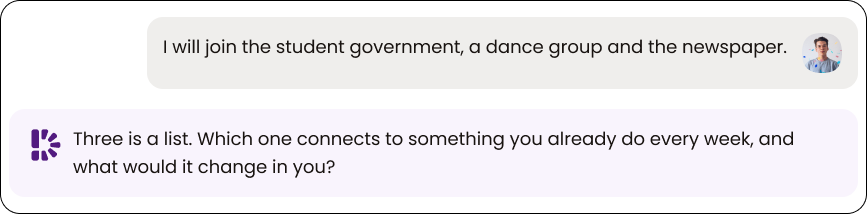

    Official Duke Sources

  • Harvard Supplemental Essays 2026/27: Prompts and How to Answer Them


    Harvard asks for five short answers, each with a 150-word limit (up to 750 words total). Short means every sentence has to work. For each prompt below, we offer expert guidance on what each question is really testing and how to answer them.


    What is Harvard’s acceptance rate?

    For the Class of 2029, Harvard’s overall acceptance rate was 4.2%; it did not release separate Restrictive Early Action (REA) or Regular Decision (RD) rates.

    • Overall: 4.2%
    • REA: Not Reported
    • SAT 25th percentile: 1510
    • SAT 50th percentile: 1550
    • SAT 75th percentile: 1580

    What SAT score do you need for Harvard?

    Harvard requires the SAT or ACT. The middle 50 percent of admitted students scored [SAT 25] to [SAT 75]. A score in that range helps put your application in the pile to be read. It does not get you in. More applicants have perfect scores than Harvard has places. That is why the essays matter here.


    When are Harvard’s application deadlines?

    Restrictive Early Action: November 1st. Regular Decision: January 1st. Restrictive means no other private college early. Harvard says on its own site that it gives no advantage to early applicants.


    Does Harvard have a “Why Harvard” essay in 2026/27?

    No. None of the five questions asks why you want to attend. The closest is question 4, which asks how you hope to use a Harvard education, and that is a question about you and your future, not about Harvard. There is no prompt where listing Harvard’s houses, programs or professors earns anything. If you write the words “at Harvard,” check that the sentence still answers the question asked.


    Harvard supplemental essay prompts 2026/27 and how to answer them

    Prompts are quoted from Harvard’s application requirements page, linked at the bottom. All five are required. Harvard reads them as a set, so plan them together: each one should show a different side of you, and none should repeat your Common App essay.

    1. Life experiences and how you will contribute (150 words)

    The prompt. Harvard has long recognized the importance of enrolling a student body with a diversity of perspectives and experiences. How will the life experiences that shaped who you are today enable you to contribute to Harvard?

    What Harvard is testing. Whether you can connect one experience to one contribution. The word that matters is “contribute.” Harvard is not asking you to describe your background. It is asking what you will do with it in a room full of people who do not share it. The reader wants to see a specific stance, habit or skill that came from your life and that other students will benefit from.

    How to answer. One experience, not a summary of your identity. Spend about 60 words on a scene from it and 60 on what it taught you, stated as something you now do or believe. Spend the last 30 on the contribution, in plain words: what you will bring to a seminar, a lab group or a dorm conversation because of it. Do not leave the contribution for the reader to infer.

    Avoid. The list of identities with no scene underneath. Hardship told as a credential. And the phrase “diverse perspective,” which is the prompt handed back to the reader.


    2. A time you strongly disagreed (150 words)

    The prompt. Describe a time when you strongly disagreed with someone about an idea or issue. How did you communicate or engage with this person? What did you learn from this experience?

    What Harvard is testing. How you handle disagreement, not whether you won. Harvard’s own description of what it looks for includes the willingness to engage respectfully with differing ideas. The prompt asks three things: what the disagreement was, how you engaged, and what you learned. In 150 words the first one gets a sentence and the other two get everything else.

    How to answer. State the disagreement in one sentence. Then describe the exchange: what the other person said, what you said back, the moment it got uncomfortable. End with what changed, which can be small. You still disagree, but you understand why a reasonable person holds the other view. That counts.

    Avoid. Turning it into a position paper on the issue. At 150 words the argument crowds out the engagement, and the engagement is what Harvard asked about. Hot political topics written as advocacy. And a disagreement you won cleanly, which teaches the reader nothing.


    3. Activities, work, travel or family responsibilities that shaped you (150 words)

    The prompt. Briefly describe any of your extracurricular activities, employment experience, travel, or family responsibilities that have shaped who you are.

    What Harvard is testing. Whether one of the things you do has changed you. The key words are “shaped who you are.” Harvard already has your activities list. This is not a second copy of it. Notice that the prompt names employment and family responsibilities alongside activities. Harvard is telling you that a job or caring for a sibling counts as much as a club, and often says more.

    How to answer. Pick one. Spend most of the 150 words on a specific moment inside it and the rest on what it changed in you. The strongest answers often come from the thing with no title and no award: the shift at the restaurant, the Saturday mornings driving a grandparent to dialysis.

    Avoid. The résumé walkthrough three activities. Choosing the most impressive activity rather than the one that shaped you. And describing what you did without saying what it did to you.


    4. How you hope to use your Harvard education (150 words)

    The prompt. How do you hope to use your Harvard education in the future?

    What Harvard is testing. Whether you have a direction and a reason for it. Harvard’s stated mission is students who contribute to society throughout their lives, and the word “use” in the prompt points the same way. This is an aspiration question. It is not a career plan and it is not a “Why Harvard” essay. The reader wants to see a problem you care about or a kind of work you want to do, and why.

    How to answer. Name the direction in the first sentence. Spend the middle on why it matters to you, with one piece of evidence from your life. End with what you want to be able to do that you cannot do now. You are allowed to be uncertain about the job title. You are not allowed to be vague about the reason.

    Avoid. A list of Harvard programs. A ten year plan with a title at the end of it. And “make a difference” or “change the world,” which say nothing.


    5. Top three things your roommates might like to know about you (150 words)

    The prompt. Top 3 things your roommates might like to know about you.

    What Harvard is testing. Whether you can be a person rather than an applicant. This is the one light question, and it is placed last for a reason. The reader has just read four serious answers. They want to see who shows up in the dorm.

    How to answer. Three concrete things, each with a detail a roommate would actually notice: the habit, the object, the rule. Vary them. One about how you live, one about what you love, one that is simply funny or true. A numbered list is fine. About 50 words each is plenty.

    Avoid. A fifth essay with a thesis. Three accomplishments in disguise. And invented quirks. Readers can tell when a detail was chosen to seem interesting rather than because it is true of you. A plain true detail beats a clever invented one every time.


    Before you write: map the whole application

    Your personal statement, activities list and the five Harvard answers are read as one file. Each piece should add something the others do not. Repeating an interest is fine. Repeating the same evidence wastes space. Think of the reader as someone who has already read everything else in your file before they reach the Harvard questions.

    Write down what the reader already knows about you from the Common App. Then give each Harvard answer one thing that list is missing.

    As you plan and draft, remember to check Harvard’s guidance on AI and essays.

    Want help connecting the pieces? Dakota, in College CoPilot’s Application Coach, uses what you have already shared to spot repetition and ask the question you have not answered. The writing stays yours.

    Official Harvard Sources