Stanford asks for eight answers: five short questions of 3 to 50 words and three essays of 100 to 250 words, and no “Why Stanford” essay. The whole supplement is under 1,000 words. Short means every sentence has to work. For each prompt below, we offer expert guidance on what each question is really testing and how to answer them.
What is Stanford’s acceptance rate?
Stanford’s overall acceptance rate was 3.8% for the Class of 2029, according to the 2025–26 Stanford Common Data Set. Its Restrictive Early Action (REA) acceptance rate was not reported.
- Overall: 3.8%
- REA: Not Reported
- SAT 25th percentile: 1520
- SAT 50th percentile: 1550
- SAT 75th percentile: 1570
What SAT score do you need for Stanford?
Stanford requires the SAT or ACT. The middle 50 percent of admitted students scored 1520 to 1570. A score in that range helps put your application in the pile to be read. It does not get you in. More applicants have perfect scores than Stanford has places. That is why the essays matter here.
When are Stanford’s application deadlines?
Restrictive Early Action: November 1st. Regular Decision: January 5th. Restrictive means no other private college early. Stanford admits to the university as a whole, not to a major or school, so your stated major does not bind you.
Does Stanford have a “Why Stanford” essay in 2026/27?
No. None of the eight questions asks why you want to attend. The closest is the third essay, which asks what would help you make a distinctive contribution to Stanford, and that is a question about you, not about Stanford. There is no prompt where listing Stanford’s programs, professors or the weather earns anything. Stanford says the questions are there to help it know you as a friend, a future roommate and a classmate. Write to that.
Stanford supplemental essay prompts 2026/27 and how to answer them
Prompts are quoted from Stanford’s application and essays page, linked at the bottom. All eight are required. Stanford reads them as a set, so plan them together: use the eight answers to add distinct details and perspectives. Avoid repeating the same story or evidence from your Common App essay.
Short questions: how the five work together
50 words is two sentences. Stanford prints a 3 word minimum, which tells you that a one line answer is allowed and sometimes right. The five together form a quick portrait. Plan them so each one comes from a different part of your life and each one holds a concrete noun. Do not write five tiny essays with a thesis. Answer the question and stop.
One warning. Readers can tell when a detail was chosen to seem interesting rather than because it is true of you. A plain true answer beats a clever invented one every time.
1. The most significant challenge society faces (50 words)
The prompt. What is the most significant challenge that society faces today?
What Stanford is testing. Not your politics. Whether you can name a problem specifically and say why in a sentence. The reader has seen “climate change” and “inequality” thousands of times, and both are fine if the second sentence is yours.
How to answer. Name the challenge in the first sentence, as narrowly as you can. Use the second to say why it matters more than the others, from something you have seen. A narrow true answer beats a broad safe one.
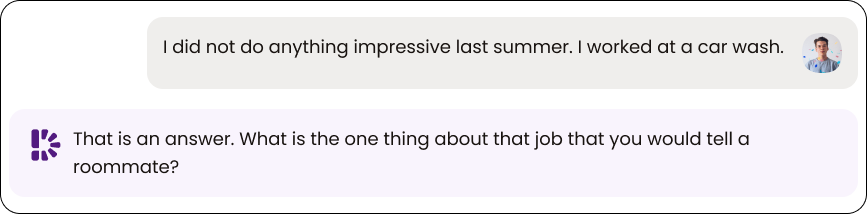
2. Your last two summers (50 words)
The prompt. How did you spend your last two summers?
What Stanford is testing. What you do when nobody sets your schedule. Stanford is not checking for prestige programs. A job, caring for siblings, and a summer spent on one project all answer the question.
How to answer. Both summers, plainly, with one specific detail each. If one summer was unremarkable, say what it was and move on. Honesty reads better than inflation here.
3. A historical moment you wish you had witnessed (50 words)
The prompt. What historical moment or event do you wish you could have witnessed?
What Stanford is testing. What you find interesting and why. The moment itself matters less than the reason. The reader wants a specific event and a reason that only you would give.
How to answer. Name the moment in the first sentence. Spend the second on why: what you would want to see, or what question it would answer. Small moments work as well as famous ones, and often better.
4. An activity, job or family responsibility (50 words)
The prompt. Briefly elaborate on one of your extracurricular activities, a job you hold, or responsibilities you have for your family.
What Stanford is testing. Whether one of the things you do means something beyond the line on your activities list. Stanford names jobs and family responsibilities on purpose. A job or caring for a family member counts as much as a club, and often says more.
How to answer. One thing. One sentence on what you do and one on why it matters to you. Pick the one that would not be obvious from your activities list.
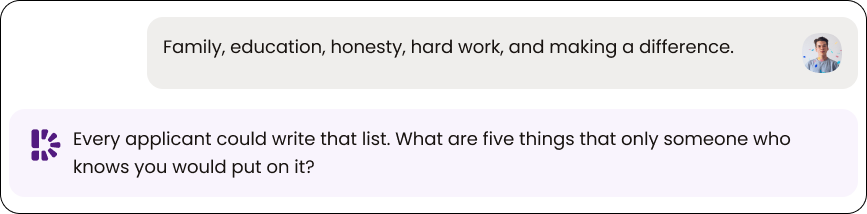
5. Five things that are important to you (50 words)
The prompt. List five things that are important to you.
What Stanford is testing. Whether you can be concrete about what you value. Five abstractions, family, friends, learning, kindness, growth, tell the reader nothing. Five specific things tell them who you are.
How to answer. A list is fine. Mix the scale: a person, an object, a habit, a place, an idea. Each one should be something a friend would recognize as yours. Ten words each is plenty.
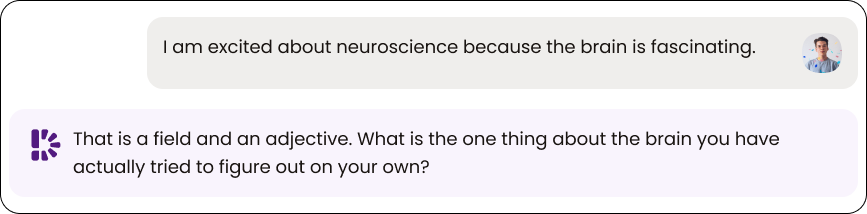
Essay 1. An idea or experience that makes you excited about learning (100 to 250 words)
The prompt. The Stanford community is deeply curious and driven to learn in and out of the classroom. Reflect on an idea or experience that makes you genuinely excited about learning.
What Stanford is testing. Whether you can think about one specific thing in public. This is the intellectual essay, and the phrase “in and out of the classroom” means the idea does not have to be academic. The reader wants to watch your mind work, not hear that you love learning.
How to answer. Name the idea or experience in the first sentence. Spend the middle on what you did with it: what you read, built, tested or argued about, and what you still do not understand. Spend about 150 words on the idea and 50 on how you found it. Most drafts do the reverse and turn into origin stories.
Avoid. “I have always loved learning.” An introduction to a subject. And a why major essay with the word “excited” added.
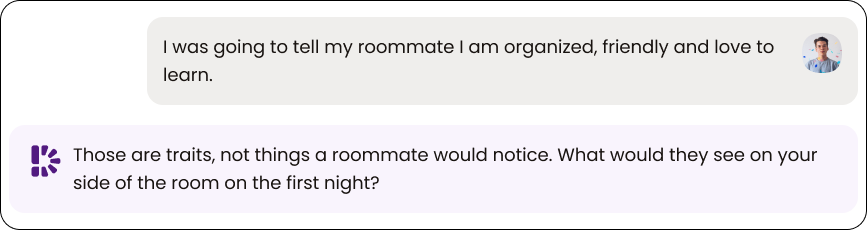
Essay 2. A note to your future roommate (100 to 250 words)
The prompt. Virtually all of Stanford’s undergraduates live on campus. Write a note to your future roommate that reveals something about you or that will help your roommate—and us—get to know you better.
What Stanford is testing. Whether you can be a person rather than an applicant. This is the most famous prompt in college admissions and the one Stanford uses to see who shows up in the dorm. The reader has read seven serious answers. This one should sound like you talking.
How to answer. Write it as a note, to a person, in your own voice. Pick two or three concrete things a roommate would actually notice: the habit, the object, the rule, the thing you cook at midnight. Let the details reveal the traits without naming them. Humor is welcome if it is yours. End the way you would end a real note.
Avoid. A third essay with a thesis. Accomplishments in disguise. A list of Stanford things you cannot wait to do together, which turns the note into a “Why Stanford” essay. And invented quirks. Readers can tell.
Essay 3. Your distinctive contribution to Stanford (100 to 250 words)
The prompt. Please describe what aspects of your life experiences, interests, and character would help you make a distinctive contribution as an undergraduate to Stanford University.
What Stanford is testing. Whether you can connect one thing about you to one thing you would do with it. The prompt names three sources, experiences, interests and character, and asks for a contribution. The word “distinctive” is the test. The reader wants something that is specific to you, shown, and then turned into what it lets you bring to a seminar, a lab group or a dorm.
How to answer. Pick one aspect, not three. Spend about 120 words on a scene that shows it. Spend the rest on the contribution, in plain words: what you would do or bring because of it. Do not leave the contribution for the reader to infer, and do not make it about Stanford’s programs.
Avoid. The list of identities with no scene underneath. The diversity statement. And turning this into the “Why Stanford” essay that Stanford chose not to ask for.

Before you write: map the whole application
Your personal statement, activities list and the eight Stanford answers are read as one file. Each piece should add something the others do not. Repeating an interest is fine. Repeating the same evidence wastes space. Think of the reader as someone who has already read everything else in your file before they reach the Stanford questions.
Write down what the reader already knows about you from the Common App. Then give each Stanford answer one thing that list is missing.
As you brainstorm and revise, keep your essays in your own voice and make sure they reflect your own experiences and thinking.
Want help connecting the pieces? Dakota, in College CoPilot’s Application Coach, uses what you have already shared to spot repetition and ask the question you have not answered. The writing stays yours.