Johns Hopkins asks for one supplemental essay of up to 350 words, on what you have learned about engaging across differences, and no “Why Hopkins” essay. The whole supplement is one answer. With a single prompt and a pool where most applicants arrive with comparable grades and scores, it carries more weight than one short essay usually does. For the prompt below, we offer expert guidance on what the question is really testing and how to answer it.
What is Johns Hopkins’ acceptance rate?
Johns Hopkins’ overall acceptance rate was 6.1% for the Class of 2029. Its Early Decision (EA) acceptance rate was 10.9% for the Class of 2029, according to the 2025–26 Common Data Set.
- Overall: 6.1%
- ED: 10.9%
- SAT 25th percentile: 1530
- SAT 50th percentile: 1550
- SAT 75th percentile: 1565
What SAT score do you need for Johns Hopkins?
Johns Hopkins requires the SAT or ACT. The middle 50 percent of enrolled students scored 1530 to 1565. A score in that range helps put your application in the pile to be read. It does not get you in. More applicants have perfect scores than Hopkins has places. That is why the essay matters here.
When are Johns Hopkins’ application deadlines?
Early Decision I: November 1st. Early Decision II: January 2nd. Regular Decision: January 2nd. Both Early Decision rounds are binding. If you are admitted, you withdraw your other applications and enroll. One mechanical point: Hopkins collects the supplemental essay through your applicant portal after you submit the application, not inside the Common App, so submitting the application is not the end of the job.
Does Johns Hopkins have a “Why Hopkins” essay in 2026/27?
No. The single prompt is about you and how you work with people unlike you. Hopkins says on its own blog that you do not need to mention Hopkins at all. A sentence connecting what you learned to how you would show up on campus can strengthen the ending if it comes naturally. A paragraph about Hopkins programs answers a question nobody asked.
Johns Hopkins supplemental essay prompt 2026/27 and how to answer it
The prompt is quoted from Hopkins’ application requirements page, linked below. This is the required Hopkins supplement for applicants to the Krieger School of Arts & Sciences and the Whiting School of Engineering, including biomedical engineering applicants. Peabody applicants complete a separate application with its own essay requirements; applicants to the Peabody/JHU double-degree program must follow both sets of instructions. Direct Matriculation Program applicants also submit an additional program essay. Hopkins published a line-by-line explanation of this prompt on its Hopkins Insider blog in August 2026; it is linked below and worth reading before you draft.
1. Engaging across differences (350 words)
The prompt. At Johns Hopkins, community is built through dialogue, collaboration, and a willingness to engage across differences. Whether on campus or in the broader world, community depends on bridge builders who can listen to differing perspectives, challenge their own assumptions, or work together toward shared goals. Drawing on your own experiences, what have you learned about engaging across differences and how has it shaped the way you think about building bridges, enhancing community, and working with others?
What Hopkins is testing. What kind of community member you will be. The prompt defines a bridge builder in its own words: someone who can listen to a perspective unlike their own, challenge their own assumptions, or work with others toward a shared goal. It asks two things: what you learned, and how that learning shapes the way you think now. Hopkins says on its blog that it wants to see how you engaged across differences, not that you resolved them or changed someone’s mind, and that you do not need to be the hero of the story. “Differences” is wider than most students assume. Hopkins lists identity based differences as material, but differences of opinion, experience, age, role and working style count too.
How to answer. One experience, shown in a scene. Spend about 150 words on it: who the people were, where the difference lay, what you did and what you got wrong. Spend about 100 on what you learned, stated as something specific you now believe or do, not a trait. Spend the last 100 on how it shapes the way you work with people now, with a later moment where you put it into practice. Taking “how” and “what” literally keeps the essay on the prompt. You can end with the difference still unresolved.
Avoid. The straw man, where the other person is simply wrong. The hero story, where you fixed everyone. A political position paper, which is not what was asked. Bridge building described in the abstract with no scene underneath it. And spelling it John Hopkins. It is Johns, and the reader notices.
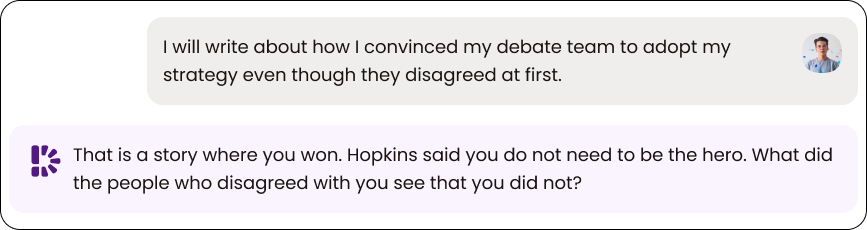
Before you write: map the whole application
Your personal statement, activities list and this one Hopkins essay are read as one file. Hopkins says the essays are where it learns how you actually think, and it gives you two: the personal statement and this. With a single supplement, it has to add something the personal statement does not. If your Common App essay is already about a disagreement or a community, choose a different experience here. Think of the reader as someone who has already read everything else in your file before they reach the Hopkins question.
Write down what the reader already knows about you from the Common App. Then give the Hopkins essay the one thing that list is missing.
Hopkins allows AI for brainstorming or refining ideas before writing and for basic proofreading of your own work. The submitted essay must be your original work; submitting substantive AI-generated content is not allowed.
Want help connecting the pieces? Dakota, in College CoPilot’s Application Coach, uses what you have already shared to spot repetition and ask the question you have not answered. The writing stays yours.