Dartmouth asks for three answers: a 100 word “Why Dartmouth,” one 250 word essay chosen from two prompts, and one 250 word essay chosen from six. The whole supplement is 600 words. Short means every sentence has to work, and choosing well matters as much as writing well. For each prompt below, we offer expert guidance on what each question is really testing and how to answer them.
What is Dartmouth’s acceptance rate?
Dartmouth’s overall acceptance rate was 5.84% for the Class of 2030. Its latest published Early Decision (ED) acceptance rate was 21.62%.
- Overall: 5.84%
- ED: 21.62%
- SAT 25th percentile: 1440
- SAT 50th percentile: 1520
- SAT 75th percentile: 1550
What SAT score do you need for Dartmouth?
Dartmouth requires the SAT or ACT. The middle 50 percent of admitted students scored 1440 to 1550. A score in that range gives your application a solid chance of getting read. It does not get you in. More applicants have perfect scores than Dartmouth has places. That is why the essays matter here.
When are Dartmouth’s application deadlines?
Early Decision: November 1st. Regular Decision: January 1st. Early Decision at Dartmouth is binding. If you are admitted, you withdraw your other applications and enroll. Dartmouth also strongly encourages a peer recommendation from a friend, teammate, sibling or classmate, which is accepted after the deadline; Dartmouth says it is most helpful if received within ten days.
Does Dartmouth have a “Why Dartmouth” essay in 2026/27?
Yes, and it is the shortest in the Ivy League at 100 words. The prompt asks two things: what attracts you, and how Dartmouth is a good fit for you. At that length you cannot answer either with a list. Everything else in the supplement is about you. Guidance is below.
Dartmouth supplemental essay prompts 2026/27 and how to answer them
Prompts are quoted from Dartmouth’s writing supplement page, linked at the bottom. All three answers are required. Dartmouth’s own FAQ says the essays should show the intangibles a résumé cannot, and that it reads every word.
1. “Why Dartmouth” (100 words)
The prompt. As you seek admission to Dartmouth’s Class of 2031, what aspects of the college’s academic program, community, and/or campus environment attract your interest? How is Dartmouth a good fit for you?
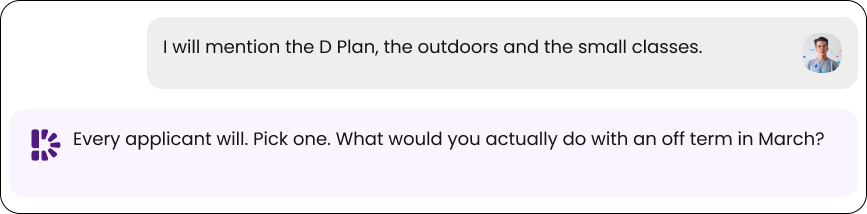
What Dartmouth is testing. Whether you know something true about Dartmouth and whether it matches something true about you. The second question, how is Dartmouth a good fit for you, is the one most students skip. The reader has seen the D Plan, the outdoors and the small size named a thousand times. Named without a connection to you, they are half an answer.
How to answer. One or two features, each tied to something you already do. If it is the D Plan, say what you would do with an off term that you could not do elsewhere. If it is the size, say what you do in small rooms that you cannot do in big ones. End with one sentence of fit in your own voice. 100 words is four or five sentences. Test every one: if it would be just as true of any rural college, cut it.
Avoid. A list of three things with no reason attached. Prestige and the ranking. And anything Dartmouth already knows about itself. Most applicants spend a third of this space on that.
2. Choose one: Let your life speak, or Introduce yourself (250 words)
Treat prompts 2 and 3 as one decision. Start with your Common App essay and ask what it already covers. If it is about your background, choose 2B here. If it is about an activity or achievement, 2A is open. Whatever you pick, the two 250 word answers should show two different sides of you.
2A. Let your life speak
The prompt. There is a Quaker saying: Let your life speak. Describe the environment in which you were raised and the impact it has had on the person you are today.
What Dartmouth is testing. Where you come from and what it did to you. “Environment” can mean a place, a household, a language, a set of responsibilities or a community. The second half, the impact on who you are today, is the question. A description of your town with no effect on you answers only half of it.
How to answer. Pick one aspect of the environment, not the whole childhood. Spend about 120 words on a scene from it. Spend the rest on the impact, stated as something specific you now do or believe. The reader learns about your background through you, not through a history of it.
Avoid. Repeating your personal essay. Hardship as a credential. And a tour of your hometown that could have been written by anyone who lives there.
2B. Introduce yourself
The prompt. “Be yourself,” Oscar Wilde advised. “Everyone else is taken.” Introduce yourself.
What Dartmouth is testing. Whether you can show who you are without listing what you have done. This is the most open prompt in the set, which means it gives you the least help. Dartmouth’s FAQ says it wants your sense of humor, your passion, your curiosity, your self awareness or your social awareness. Pick one or two and show them.
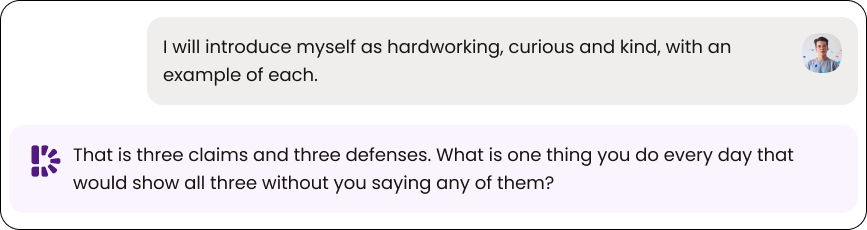
How to answer. One strong format: a single habit, object or routine that reveals several traits without naming them. The way you organize your desk, the thing you always cook, the argument you always start at dinner. Let the reader draw the conclusions. 250 words is one scene and a short reflection.
Avoid. The résumé in paragraph form. Three adjectives followed by proof of each. And an introduction that sounds like it was written for a job interview.
3. Choose one of six (250 words)
Six options, one answer. The choice is itself an answer: Dartmouth sees which one you picked. Choose the prompt where you have the most specific material, not the one that sounds most impressive. If you chose 2A above, avoid 3F unless the two cover clearly different ground.
3A. What excites you?
The prompt. What excites you?
What Dartmouth is testing. Intellectual curiosity, in the broadest frame Dartmouth offers. Three words give you no stakes, so you have to supply them. The reader wants to see what you chase when nobody assigns it and how far you have chased it.
How to answer. One thing, named in the first sentence. Then show the chasing: what you read, built, tried or argued about, and what you still do not understand. Academic interests fit well. So does anything else, as long as the excitement is visible in what you have done about it.
Avoid. A respectable topic you chose because it sounds right. The reader can tell the difference between interest and enthusiasm. And a “why major” essay with the word “excites” added.
3B. Making an impact
The prompt. Labor leader and civil rights activist Dolores Huerta recommended a life of purpose. “We must use our lives to make the world a better place to live, not just to acquire things,” she said. “That is what we are put on the earth for.” In what ways do you hope to make—or are you already making—an impact? Why? How?
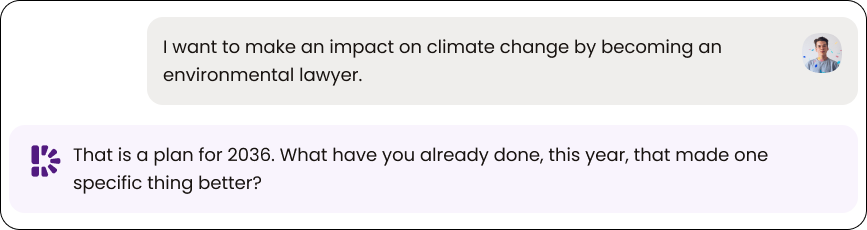
What Dartmouth is testing. Whether you have done anything yet, and whether you can explain why. The prompt asks three questions, why and how and whether you are already doing it, and present tense evidence is what separates the strong answers. Scale does not matter. A small impact you can explain beats a large one you only assert.
How to answer. One impact, real and specific. Say what you did, who it reached, and what it cost you. Then answer why in a sentence that could not be said by everyone. Then how, which means the mechanism, not the mission.
Avoid. The service hours list. Changing the world. And writing about an impact you hope to make with no evidence that you have started.
3C. Insight from reading
The prompt. In an Instagram post, best-selling British author Matt Haig cheered the impact of reading. “A good novel is the best invention humans have ever created for imagining other lives,” he wrote. How have you experienced such insight from reading? What did you read and how did it alter the way you understand yourself and others?
What Dartmouth is testing. Whether a book has actually changed you. The prompt asks what you read and how it altered your understanding of yourself and others. Both halves count. A plot summary answers neither.
How to answer. Name the book in the first sentence. Go straight to one moment in it, a scene or a line, and the thing it made you see differently. Spend most of the words on the change in you, with a specific example of how you now see someone or something differently. The book is the door, not the room.
Avoid. Picking a book for its reputation. Summarizing the plot. And writing a book report with “I” attached to the end.
3D. A difficult conversation
The prompt. The social and family interactions of wild chimpanzees have been the focus of Dame Jane Goodall’s research for decades. Her understanding of animal behavior prompted the English primatologist to see a lesson for human communities as well: “Change happens by listening and then starting a dialogue with the people who are doing something you don’t believe is right.” Channel Dame Goodall: Tell us about a moment when you engaged in a difficult conversation or encountered someone with an opinion or perspective that was different from your own. How did you find common ground?
What Dartmouth is testing. How you handle disagreement, not whether you won. The last sentence, how did you find common ground, assumes you did. Partial common ground is fine, but the essay has to show the listening, which is the word the quote leads with.
How to answer. State the tension or difference in perspective in one sentence. Then describe the exchange: what the other person said, what you said back, the moment it got uncomfortable. End with the common ground you found, even if it was only a shared concern or value. You can still disagree, but show what you came to understand about the other person. That counts.
Avoid. A story where you were right and the other person came around. Readers can tell when the other side is a straw man. And a position paper on the issue, which is not what was asked.
3E. Celebrate your nerdy side
The prompt. Celebrate your nerdy side.
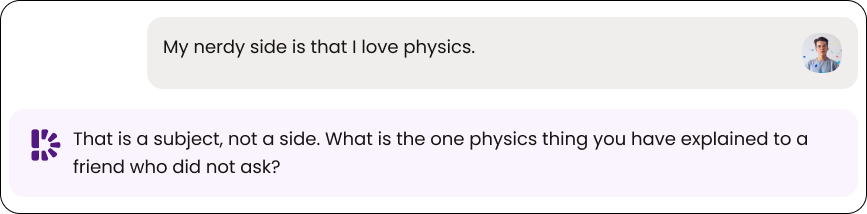
What Dartmouth is testing. Enthusiasm and detail. The thing you explain too long at dinner, the rabbit hole you went down at 2am, the obscure fact you cannot stop sharing. This is the sister prompt to 3A with the stakes set to joy. The trap is thinking that naming a nerdy subject is enough. The reader wants to see the nerdiness in action.
How to answer. One obsession. Show it in a specific episode: the thing you built, the argument you had, the spreadsheet you keep. Let the reader feel how far down the hole you went. Write it so a reader who knows nothing about the subject can follow, because the admissions officer is not an expert in it.
Avoid. “I am a nerd about science.” Jargon that shuts the reader out. And choosing a subject to impress rather than the one you actually love.
3F. How difference has been part of your life
The prompt. “It’s not easy being green…” was the frequent refrain of Kermit the Frog. How has difference been a part of your life, and how have you embraced it as part of your identity, outlook, or sense of purpose?
What Dartmouth is testing. Whether you can turn difference into something you use. The prompt asks two things: how difference has been part of your life, and how you embraced it. The second half is where the essay lives. A description of being different, with no account of what you did with it, answers only half the prompt.
How to answer. One way you are different, shown in a specific moment where it mattered. Then the embracing: what you now do, see or want because of it, stated as behavior rather than feeling. If you chose 2A, make sure this tells a clearly different story.
Avoid. The identity label with no scene underneath. Difference as hardship only. And writing the same story twice across 2A and 3F.
Before you write: map the whole application
Your personal statement, activities list and the three Dartmouth answers are read as one file. Each piece should add something the others do not. Repeating an interest is fine. Repeating the same evidence wastes space. Think of the reader as someone who has already read everything else in your file before they reach the Dartmouth questions. Dartmouth’s own dean puts it as one question: who do I want the admission officer to meet?
Write down what the reader already knows about you from the Common App. Then choose the two 250 word prompts that cover what that list is missing.
As you plan and draft, remember to keep your essays in your own voice.
Want help connecting the pieces? Dakota, in College CoPilot’s Application Coach, uses what you have already shared to spot repetition and ask the question you have not answered. The writing stays yours.