Cornell has no university-wide supplement; applicants answer only the prompt or prompts for their chosen undergraduate college. Most colleges set one essay of 550 to 650 words. CALS sets two of 350. Engineering sets two of 200 and four of 100. You apply to one college and you answer only its prompt. For each college below, we offer expert guidance on what the question is really testing and how to answer it.
What is Cornell’s acceptance rate?
Cornell’s overall acceptance rate was 9.2% for the Class of 2030, and its Early Decision (ED) acceptance rate was 20.9%, according to Cornell’s First-Year Admissions Factbook.
- Overall: 9.2%
- ED: 20.9%
- SAT 25th percentile: 1490
- SAT 50th percentile: 1530
- SAT 75th percentile: 1550
What SAT score do you need for Cornell?
Cornell requires the SAT or ACT. The middle 50 percent of admitted students scored 1490 to 1550. A score in that range gives your application a solid chance of getting read. It does not get you in. More applicants have perfect scores than Cornell has places. That is why the essay matters here, and at Cornell it matters more than at most Ivies because it is the only one you write.
When are Cornell’s application deadlines?
Early Decision: November 1st. Regular Decision: January 2nd. Early Decision at Cornell is binding. If you are admitted, you withdraw your other applications and enroll. Some majors in AAP, CALS and Human Ecology require a portfolio or design supplement with its own deadline.
Does Cornell have a “Why Cornell” essay in 2026/27?
Yes, but it is a “Why This College” essay, not a “Why Cornell” essay. Cornell dropped its university wide community essay this cycle. Every remaining prompt asks about your fit with one of Cornell’s undergraduate colleges and its curriculum. Cornell admits you to a college, not to the university, and each college’s readers list “your reasons for choosing” that college among the things they look for. A general “Why Cornell” essay that mentions Ithaca and the gorges answers a question nobody asked. Name your college, not the university, wherever you can.
Cornell supplemental essay prompts 2026/27 by college and how to answer them
Prompts are quoted from each college’s first year applicant page on Cornell’s admissions site, linked at the bottom. Find the college your major sits in, then read that section. The prompts differ by college. Some ask about an academic interest and college fit; others ask about a project, a personal experience, or what matters to you. Read the section for your college and answer each prompt on its own terms.
College of Arts and Sciences (650 words)
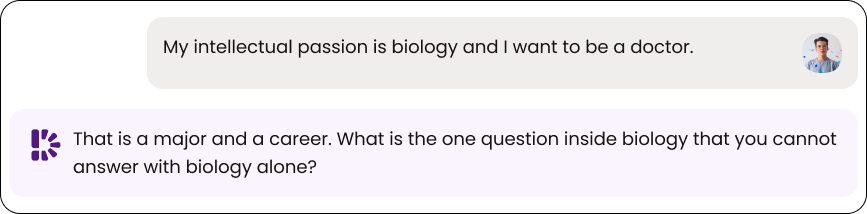
The prompt. At the College of Arts and Sciences, your education is yours to shape. Describe an intellectual passion, question, or idea that has captured your attention—whether it emerges from your studies or extends beyond your coursework. What specific aspects of our liberal arts curriculum would you draw on to explore and connect your varied interests?
What A&S is testing. Whether your curiosity is specific and whether you would use a liberal arts curriculum to connect subjects rather than to study one. The prompt says “question or idea,” then “varied interests,” then “connect.” A single subject essay misses on purpose. The reader wants one question you keep returning to and two or three departments you would use to chase it.
How to answer. Name the question in the first paragraph, with evidence that it is real: something you read, built, measured or argued about that left you with a better question. Spend about 300 words on that. Then spend about 300 on the curriculum: which named A&S courses or departments you would draw on, and how they connect to each other through your question. End with what you do not know yet, because the prompt is about an education you would shape, not one you have finished.
Avoid. A why major essay. A list of ten courses. Paragraphs about Ithaca, which tell an A&S reader nothing about fit with its curriculum. And the origin story, where half the words explain how you first got interested.
College of Agriculture and Life Sciences (two essays, 350 words each)
Prompt 1. What interests you about the major you selected? Tell us about experiences (both in and outside of the classroom), questions, and goals that influenced your choice.
Prompt 2. What draws you to Cornell’s College of Agriculture and Life Sciences (CALS)? Reflect on the learning, community, or impact opportunities that matter most to you, and share how they align with Cornell CALS (as you understand it currently).
What CALS is testing. Two things, kept separate on purpose: why this major, and why CALS. You apply directly to one of CALS’s 20 majors, so the first essay is about the major and the second is about the college. CALS says it is normal to have trouble choosing a major, and the second prompt adds “as you understand it currently,” which openly allows an incomplete picture.
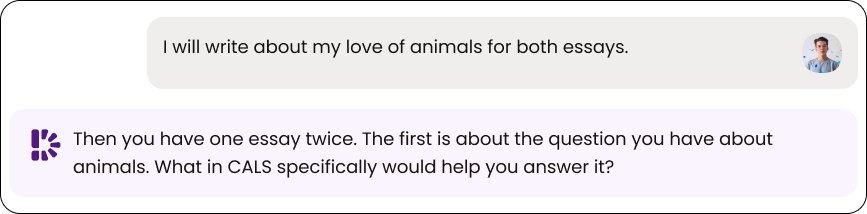
How to answer. Essay 1 follows a path: a first experience, the question it raised, the goal it points to. Use an experience from outside the classroom if you have one, because the prompt asks for both. Essay 2 names two or three things at CALS, a program, a lab, a community, and ties each one back to the question in essay 1. Essay 2 should build on the major interest from essay 1 without retelling it.
Avoid. Repeating material across the two essays. If essay 2 describes your major again, you have written one essay twice. And “purpose driven science” quoted back to CALS, which is its phrase, not yours.
College of Engineering (two long answers of 200 words, four short answers of 100 words)
Long 1. Fundamentally, engineering is the application of math, science, and technology to solve complex problems. Why do you want to study engineering?
Long 2. Why do you think you would love to study at Duffield Engineering?
Short 1. What brings you joy?
Short 2. What do you believe you will contribute to the Duffield Engineering community beyond what you’ve already detailed in your application? What unique voice will you bring?
Short 3. What is one activity, club, team, organization, work/volunteer experience or family responsibility that is especially meaningful to you? Please briefly tell us about its significance for you.
Short 4. What is one award you have received or achievement you have attained that has meant the most to you? Please briefly describe its importance to you.
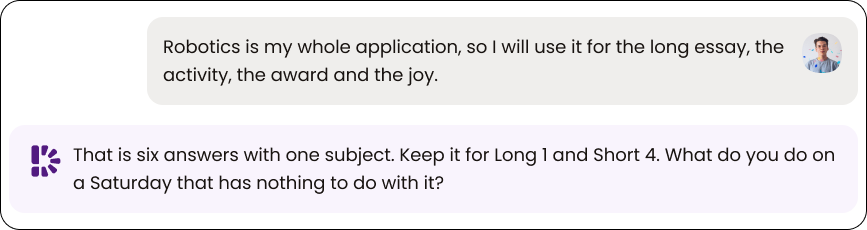
What Engineering is testing. Whether you can cover six different sides of yourself in 800 words. Engineering is the only Cornell college that splits its supplement this way, and the structure is the test. Long 1 is why engineering, shown in something you have built or fixed. Long 2 is why this school, which means its curriculum and its project teams, not Cornell in general. The four shorts each want new material. Short 2 says “beyond what you’ve already detailed,” so it has to be something not in your activities list.
How to answer. Give each answer its own piece of your life. Long 1: one problem you tried to solve and what happened when it did not work. Long 2: one or two named things at Duffield that match how you work. Short 1: a small real moment, not an engineering win. Short 2: a habit or perspective not already detailed elsewhere in your application. Short 3: one commitment, your role, why it matters. Short 4: one achievement and what it cost you, not what it earned you.
Avoid. Using the same robotics team in four answers. A joy answer that is also an achievement. And Long 2 written about Cornell when the prompt names Duffield Engineering.
Cornell SC Johnson College of Business: Dyson and Nolan (650 words)
The prompt. What kind of business student are you? Using your personal, academic, or volunteer/work experiences, describe the topics or issues that you care about and why they are important to you. Your response should convey how your interests align with the school to which you are applying within the Cornell SC Johnson College of Business (Dyson or Nolan).
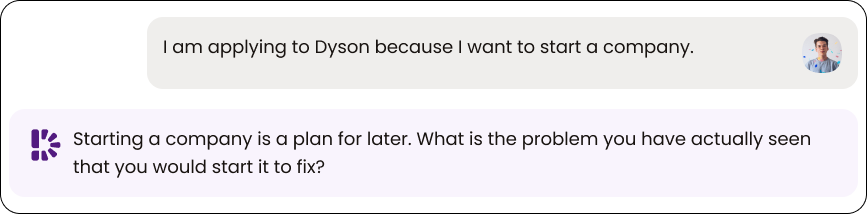
What SC Johnson is testing. Whether you have a problem you care about and whether you know which school fits it. Dyson is applied economics and management with a strong public purpose. Nolan is hotel administration and the broader hospitality and service economy. The prompt names them and expects you to name one. “What kind of business student” is asking for a stance, not a résumé. A résumé is also required separately.
How to answer. Open with the issue, as narrowly as you can state it. Spend about 300 words on where it came from in your experience, including the part that is unresolved. Spend the rest on the school: why Dyson or Nolan specifically, which part of its curriculum, and what you would do with it. The word “business” should appear as a method, not as a goal.
Avoid. “I want to be an entrepreneur” with no problem attached. Failing to name Dyson or Nolan. And forgetting the résumé, which SC Johnson requires.
College of Human Ecology (550 words)
The prompt. Think about an extracurricular/community engagement/work experience that most closely connects you to the CHE mission and your intended choice of major. Tell us what that experience taught you about your broader community and its needs, and the impact you can make. How will your intended CHE major help you make that impact?
What CHE is testing. Three things, in order: one experience, what it taught you about a community’s needs, and how your CHE major lets you act on that. The third question deserves at least a third of the essay. CHE’s own tips say to take a college specific approach and not to reuse a general essay.
How to answer. Choose a job, service role or responsibility where you saw a need up close. Spend about 200 words on it, including a specific moment. Spend 150 on what it taught you about the community, stated as something you now understand that you did not before. Spend the last 200 on the major: which CHE major, which parts of it, and what impact it would let you make that you cannot make now.
Avoid. A community service story with the major added at the end. The hours count. And the mission statement quoted back to CHE.
Brooks School of Public Policy (650 words, plus 350 for DC Start)
The prompt. Discuss your interest in pursuing a major in policy at the Cornell Jeb E. Brooks School of Public Policy and what draws you to this field of study. You are encouraged to consider including details related to your personal experiences, values, academic influences, or extracurricular activities that have shaped your perspective and future goals.
DC Start only. Please describe why you are interested in being considered for the Brooks School DC Start program.
What Brooks is testing. Whether your interest in policy is attached to a specific problem and whether you know what studying policy, as opposed to politics or law, actually involves. The prompt lists four sources of evidence: experiences, values, academic influences, activities. The reader wants to see at least two of them pointing at the same problem.
How to answer. Name the policy problem in the first paragraph, as narrowly as you can. Spend about 300 words on how you came to it, with specifics from the list in the prompt. Spend the rest on Brooks: what about the major and its approach fits the problem, and what you would want to be able to do by graduation. If you are applying for DC Start, the 350 word essay should be about the program, not a repeat of the main essay.
Avoid. A political opinion dressed as a policy interest. “I want to make a difference.” And problems so large that nothing specific can be said about them.
School of Industrial and Labor Relations (650 words)
The prompt. Using your personal, academic, or volunteer/work experiences, describe the topics or issues that you care about and why they are important to you. Your response should show us that your interests align with the ILR School.
What ILR is testing. Whether you understand what ILR is and whether your interests fit it. ILR studies work, workers and workplaces, through economics, law, history, psychology and sociology. Its page says no activity matters more than another because every experience requires you to work with people. The reader wants an issue about work, broadly defined, that you have seen up close.
How to answer. Start with the issue and the experience it came from: a job, a family business, a team, a dispute you watched. Spend about 350 words on that. Spend the rest on ILR: which parts of its curriculum fit the issue and what you would do with them. The essay should make clear you know ILR is not a business school and not a law school.
Avoid. Writing about business and swapping in the word labor. Ignoring the second sentence of the prompt. And an essay that could be sent to any social science program unchanged.
College of Architecture, Art, and Planning (650 words, by major)
B.Arch. Describe how your interests connect to architecture. Include an example of a creative project, design experience, or personal passion that sparked your interest in pursuing a 5-year professional degree in architecture. Reflect on how this experience shaped your understanding of the field and your motivation to study architecture.
BFA. Submit an artist statement describing your creative interests and practice. Address how your work reflects your artistic voice, influences, and process, and how studying art at Cornell AAP would support and expand your practice.
URS. Describe your interest in urban and regional studies. Discuss experiences, ideas, or issues that have shaped your interest in cities, communities, and regional systems, and explain how URS at Cornell aligns with your academic and career goals.
What AAP is testing. Three different things for three majors. B.Arch wants one creative project and what it taught you about the field, because a five year professional degree is a commitment. BFA wants an artist statement, which is a specific form: your practice, your influences, your process, and what AAP would add. URS wants a question about cities and the experiences behind it. All three are read alongside a portfolio where one is required.
How to answer. B.Arch: one project, described in enough detail that the reader can see it, then what you understand about architecture now that you did not before. BFA: write it as an artist statement, in the first person, about the work itself, then AAP. URS: one urban issue you have seen, the question it raised, and how URS fits it. In every case, spend the last third on AAP specifically.
Avoid. Writing about Cornell when the prompt asks about AAP. A B.Arch essay about loving buildings with no project in it. A BFA statement that is a list of media. And a URS essay about wanting to help cities with no city in it.
Before you write: map the whole application
Your personal statement, activities list and the Cornell supplement are read as one file. Each piece should add something the others do not. Repeating an interest is fine. Repeating the same evidence wastes space. Think of the reader as someone who has already read everything else in your file before they reach the Cornell essay. At Cornell the reader works for one college, so the file is read against that college’s mission.
Write down what the reader already knows about you from the Common App. Then give the Cornell essay the one thing that list is missing.
As you plan and draft, read Cornell’s guidance on what application help is acceptable, including its rules on AI.
Want help connecting the pieces? Dakota, in College CoPilot’s Application Coach, uses what you have already shared to spot repetition and ask the question you have not answered. The writing stays yours.