USC requires a 250-word essay on your academic interests and why you want to explore them at USC, plus ten short answers: three words for the first, and up to 100 characters for each of the other nine. There is also an optional 250-word disagreement response and an optional response for applicants who had a gap in enrollment during a fall or spring term after starting high school. Some programs add writing questions or require portfolios or auditions. The universitywide required responses total under 600 words; program-specific requirements can add more.
What is USC’s acceptance rate?
USC’s overall acceptance rate was 12.6% for the Class of 2030, according to its 2026–27 First-Year Student Profile. USC reports Early Decision (ED) and Early Action (EA) together: 3,840 admits from 41,202 applicants, a combined admit rate of 9.3%. It does not report separate ED and EA rates. USC’s published profile does not give acceptance rates by school. Some programs have additional application requirements, such as portfolios or auditions.
- Overall: 12.6%
- ED & EA combined: 9.3%
- SAT 25th percentile: 1470
- SAT 50th percentile: 1510
- SAT 75th percentile: 1540
What SAT score do you need for USC?
USC is test optional for 2026/27 application cycle. The middle 50 percent of enrolled students scored 1470 to 1540. A score in that range helps put your application in the pile to be read. It does not get you in. USC describes its review as holistic; the essays and short answers help it understand your interests and perspective.
When are USC’s application deadlines?
Early Decision and Early Action: November 1. Early Decision is binding; Early Action is nonbinding and nonrestrictive. Regular Decision is December 1 for majors in the Kaufman School of Dance, School of Dramatic Arts and Thornton School of Music, and January 10 for most other majors. For merit scholarship consideration, apply by November 1 for most majors or December 1 for those performing arts majors. Some programs have separate application materials and deadlines.
Does USC have a “Why USC” essay in 2026/27?
Yes, combined with the “why major”. The required essay asks how you plan to pursue your academic interests and why you want to explore them at USC specifically, and invites you to address your first and second choice majors. Two questions, one essay, 250 words. Guidance is below.
USC supplemental essay prompts 2026/27 and how to answer them
Prompts are quoted from USC’s Common App supplement for 2026/27 as reproduced by sources quoting it, linked at the bottom. The academic essay and the ten short answers are required. The disagreement essay is marked optional. Write it. At a school this selective, a blank optional essay tells the reader you had nothing to say about engaging with people who disagree with you, which is the quality the prompt was written to find.
1. Your academic interests and “why USC” (250 words, required)
The prompt. Describe how you plan to pursue your academic interests and why you want to explore them at USC specifically. Please feel free to address your first- and second-choice major selections.
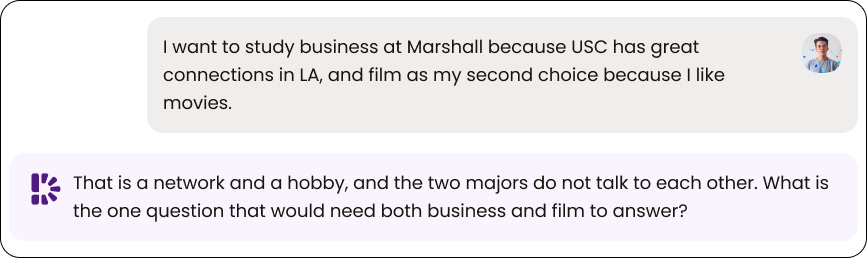
What USC is testing. Whether your academic interest is real and whether you have looked at how USC teaches it. Two halves, in order. The reader also checks whether your first and second choice majors make sense together. If they are far apart, the essay has to show the question that connects them.
How to answer. Open with where the interest became real, from your high school years, not your childhood, with something you did: a question you chased, a thing you built or measured. About 120 words. Then USC: one or two specific features of the school or program you are applying to, a course, a lab, a center, an interdisciplinary option, and what you would do with each. If you named two majors, one sentence on what connects them. Keep the second half specific to USC. An answer that could go to UCLA fails the word “specifically.”
Avoid. The childhood origin story. Los Angeles as the reason. The ranking. And two unrelated majors with no connection, which reads as a hedge.
2. A disagreement with someone you know (250 words, optional but expected)
The prompt. The USC Student Commitment charges Trojans to “value honest, open communication and robust debate,” and to “champion ideological diversity and embrace freedom of expression.” Describe a time when you disagreed with someone you know about something important to you. Did you change your mind or reach common ground?
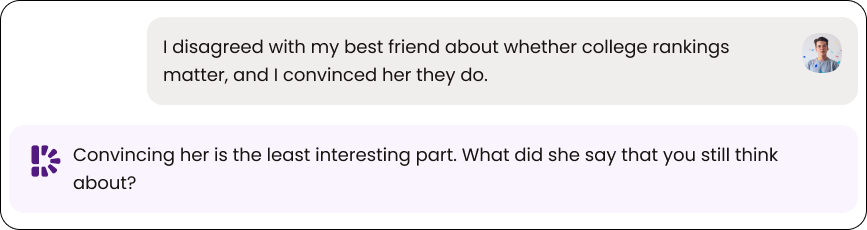
What USC is testing. How you handle disagreement with someone whose relationship you keep. “Someone you know” rules out strangers online. The closing question, did you change your mind or reach common ground, assumes something moved. The reader is watching the listening, not the winning.
How to answer. State the disagreement in one sentence and why it mattered to you. Then the exchange: what the other person said, what you said back, the moment it got uncomfortable. End with what moved, which can be small. You still disagree, but you understand why a reasonable person holds the other view. Then one sentence on how you have carried it since.
Avoid. A position paper on the issue. A disagreement where the other side was simply wrong, or bigoted, which gives you nothing to learn. A disagreement you won cleanly. And leaving it blank.
Short answers: how the ten work together
USC’s short answers look like throwaways. They are not. Readers scan all ten in a minute and check them against your essays and activities for one consistent person. Each should hold a concrete noun, and wherever the 100 characters leave room for a reason, use it. The reason is where you show how you think. Spread them across different parts of your life. One warning: readers can tell when an answer was chosen to seem impressive or clever rather than because it is true of you. A plain true answer beats a curated one.
3. Describe yourself in three words (3 words)
Three words that a friend would recognize as yours, not three adjectives every applicant reaches for. Specific beats flattering. If one of the three surprises the reader, good.
4. What is your favorite snack? (100 characters)
A snack with a story: a dish from home, a regional thing outsiders do not know, a ritual food tied to a person or place. The reader should learn something about where you come from.
5. Best movie of all time (100 characters)
The film matters less than the reason. Pick one that changed how you see something and say what the film changed in the way you see something. Skip the canonical pick with no reason, and skip anything provocative enough to become the story.
6. Dream job (100 characters)
The natural destination of everything else in your file. If it arrives out of nowhere, the reader doubts the rest. If it feels inevitable given your essays and activities, it proves the story is real.
7. If your life had a theme song, what would it be? (100 characters)
A song that maps onto your life, with the reason if there is room. An older or unexpected track signals range. Avoid lyrics that could pull focus.
8. Dream trip (100 characters)
A destination with a purpose: a question you want to answer, a history you want to stand inside, roots you want to trace. An expensive itinerary with no reason reads as privilege.
9. What TV show will you binge watch next? (100 characters)
Same rule as the movie. A show that extends a real thread of yours, with the reason explicit. The why is the only part that reveals anything.
10. Which well known person or fictional character would be your ideal roommate? (100 characters)
Your pick answers who you want to learn from. The household names fall flat. Someone less obvious, with a word on what living beside them would teach you.
11. Favorite book (100 characters)
Not a book assigned in tenth grade, not one written for younger readers, not one you first met as a film. A book you found on your own that changed how you think, with what it changed.
12. If you could teach a class on any topic, what would it be? (100 characters)
A subject you know deeply enough that only you could teach it. Give it a title with a point of view and, if characters remain, a hint of what the class explores.
School specific prompts
Applicants to the Viterbi School of Engineering answer two additional prompts, and applicants to Dornsife answer one, inside the USC supplement. Several arts schools, including Cinematic Arts, Roski, Thornton and Dramatic Arts, require portfolios, auditions or separate supplements with earlier dates. Treat each as its own essay with its own evidence, not a rerun of the academic essay. Additional writing questions may appear in the Common App after you select your major. USC identifies Dornsife, Viterbi and the World Bachelor in Business program as having additional questions. This guide covers USC’s university-wide prompts; check your application for the exact program-specific questions.
Optional: gap year or interrupted education (250 words)
If you took a gap year or your education was interrupted, USC asks what you did during that time. Factual and brief. Summer breaks do not count and the prompt says so.
Before you write: map the whole application
Your personal statement, activities list, the two essays and the ten short answers are read as one file, and USC reads the short answers for consistency with the rest. Each piece should add something the others do not. Repeating an interest is fine. Repeating the same evidence wastes space. Think of the reader as someone who has already read everything else in your file before they reach the USC questions, and who will notice if the dream job does not match the essays.
Write down what the reader already knows about you from the Common App. Then give each USC answer one thing that list is missing.
Want help connecting the pieces? Dakota, in College CoPilot’s Application Coach, uses what you have already shared to spot repetition and ask the question you have not answered. The writing stays yours. USC allows thoughtful AI use for brainstorming or improving a sentence, but says the ideas and words you submit should be yours. It says AI should not draft or rewrite your essays. Read USC’s AI guidance before using a tool.