The University of California does not ask for a personal statement and does not have supplemental essays. It runs its own application, not the Common App, and one application covers all nine undergraduate campuses: UC Berkeley, UC Davis, UC Irvine, UCLA, UC Merced, UC Riverside, UC San Diego, UC Santa Barbara and UC Santa Cruz.
Every first year applicant answers four of eight Personal Insight Questions, called PIQs, at 350 words each, and the same four answers go to every campus you select. There is no “Why UCLA” essay and no “Why Berkeley” essay anywhere in the application. UC is also test blind, so the PIQs, your activities and your transcript are the whole case. This page gives all eight questions, how to choose four, and how to answer each one.
What is the UC acceptance rate?
UC admission rates are set by campus, not by the system, and UC publishes them on its first year admit data page. UCLA’s overall rate is 9.4% and Berkeley’s is 11.4%. Merced, Riverside and Santa Cruz admit the majority of applicants. Admission rates vary by campus and residency, and selectivity can also vary by major. Across the UC system, 78% of California-resident first-year applicants were admitted to at least one campus for Fall 2026.
- UC Berkeley overall: 10.5%
- UCLA overall: 10.8%
- UC San Diego overall: 27.2%
- UC Irvine overall: 30.3%
- UC Santa Barbara overall: 44.0%
- UC Davis overall: 45.8%
- UC Santa Cruz overall: 82.1%
- UC Riverside overall: 88.2%
- UC Merced overall: 94.7%
What SAT score do you need for the UCs?
Each campus reviews your four PIQs alongside your academic record, activities and awards, and the rest of your application. The PIQs are one part of comprehensive review, not the whole case. Think of the reader as someone at each campus considering how the pieces fit together. Some programs require additional materials.
When is the UC application due?
The application opens August 1st and must be submitted between October 1st and November 30th for fall 2027 admission. There is no early round at any UC campus. You select campuses inside one application, pay a fee per campus, and each campus reviews the same file independently.
Does UCLA or Berkeley have supplemental essays?
No UC campus has a supplemental essay or a “Why Us” prompt. UCLA, Berkeley and the other seven campuses all read the same four PIQ answers you submit once. Students who search for UCLA supplemental essays are looking for something that does not exist. What exists is the PIQ set below, and campus readers apply their own weight to it. UCLA’s admission page says it reads the PIQs for intellectual curiosity and interest in personal development. Berkeley reads them inside its holistic review alongside the activities section.
What are the UC Personal Insight Questions?
All eight are quoted from UC’s personal insight questions page, linked at the bottom. UC’s rules: choose any four, 350 words maximum each, all questions weighted equally, no advantage to any particular set. UC also provides an additional comments field for unusual circumstances, which is not an essay and should not be used as a fifth answer.
Which four should you choose?
Choose by evidence, not by which questions sound strongest. The right four are the ones where you can write a specific scene, with a thing you did and a result. Then check the set: four answers should show four different sides of you, drawn from different parts of your life. If two answers would use the same activity, swap one. UC readers see all four together and are looking for range as much as depth. A useful order: pick the one question where your best material lives, then pick three that cover what it leaves out.
Two structural notes. PIQ 8 is the open question, and it is the one most applicants waste by repeating something already in the application. Use it only if something real is missing. PIQ 5, the challenge question, is the one most likely to draw a hardship story told for its own sake. UCLA’s own guidance says an answer is not effective simply because it chronicles difficult circumstances. Both can be strong. Neither is required.
UC Personal Insight Questions and how to answer them
PIQ 1. Leadership (350 words)
The prompt. Describe an example of your leadership experience in which you have positively influenced others, helped resolve disputes or contributed to group efforts over time.
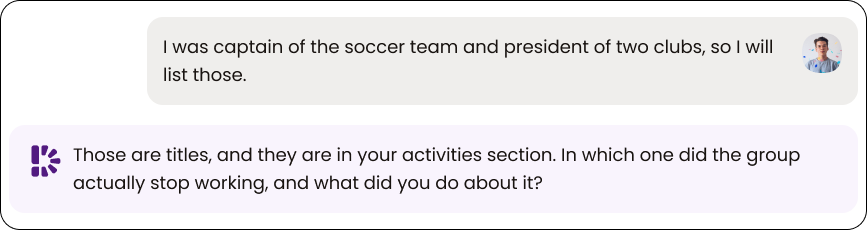
What UC is testing. What you did when a group needed something, not what title you held. UC’s own guidance says leadership can mean mentoring, running one task, organizing an event, or taking care of your family. The phrase “over time” asks for something sustained, and “resolve disputes” invites a story about a group that was not working.
How to answer. One group, one moment it needed something, what you did, what happened. Spend about 200 words on the scene and 150 on what you learned about leading, stated as something specific you now do differently. A family responsibility counts. UC says so.
Avoid. The list of titles. A story where you were in charge but nothing happened. And the word “leadership” doing the work the scene should do.
PIQ 2. Creativity (350 words)
The prompt. Every person has a creative side, and it can be expressed in many ways: problem solving, original and innovative thinking, and artistically, to name a few. Describe how you express your creative side.
What UC is testing. How you make or solve things, in any field. The prompt names problem solving first on purpose. Creativity here is not limited to art. A workaround you built, an argument you constructed, a system you designed all count.
How to answer. One creative act, shown in enough detail that the reader can see the problem and the solution. Then what it says about how you think. If your creativity connects to your major, say so in a sentence, not as the thesis.
Avoid. “I am a creative person.” A list of art forms. And describing a finished product with no process.
PIQ 3. Greatest talent or skill (350 words)
The prompt. What would you say is your greatest talent or skill? How have you developed and demonstrated that talent over time?
What UC is testing. Whether you have worked at something. The second sentence is the question: developed and demonstrated over time. UC says the talent does not need an award. A skill with no trophy and a clear history of practice answers this better than a prize with no story.
How to answer. Name the skill in the first sentence. Then the history: where it started, the point where you were bad at it, what you did about that, and one moment where it showed. End with why it matters to you.
Avoid. Choosing the most impressive skill over the one with the best history. Repeating PIQ 2 or PIQ 6 with a different label. And “I have always been good at.”
PIQ 4. An educational opportunity or barrier (350 words)
The prompt. Describe how you have taken advantage of a significant educational opportunity or worked to overcome an educational barrier you have faced.
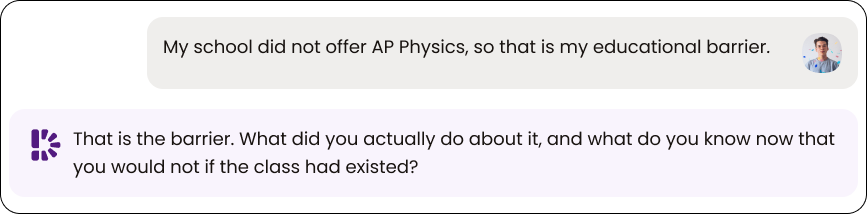
What UC is testing. What you did with what you were given, or what you did when you were given less. This is two questions and you answer one. The opportunity version is about an honors program, a summer course, an academy, advanced classes. The barrier version is about a school that did not offer what you needed and what you did about it.
How to answer. Name the opportunity or barrier in the first sentence. Spend the middle on what you did, not on what the program was. End with what changed in how you learn. For the barrier version, UC asks what characteristics or skills you called on. Name them through the actions, not as adjectives.
Avoid. A description of the program with no evidence you used it. A barrier told as hardship with no action. And a story that belongs in PIQ 5.
PIQ 5. The most significant challenge (350 words)
The prompt. Describe the most significant challenge you have faced and the steps you have taken to overcome this challenge. How has this challenge affected your academic achievement?
What UC is testing. How you act under difficulty and whether it explains anything in your record. The prompt asks three things: the challenge, the steps, and the effect on your academics. The steps are the answer. UC says the challenge can be personal or something in your community or school, and that you can still be working through it.
How to answer. State the challenge in two sentences. Spend most of the words on what you did, including what did not work. Answer the academic question directly, even if the answer is that your grades held and it cost you something else. End with where you are now.
Avoid. A hardship chronicle with no steps. Choosing the biggest challenge you can think of because it seems expected. And skipping the academic question, which UC placed in the prompt on purpose.
PIQ 6. An academic subject that inspires you (350 words)
The prompt. Think about an academic subject that inspires you. Describe how you have furthered this interest inside and/or outside of the classroom.
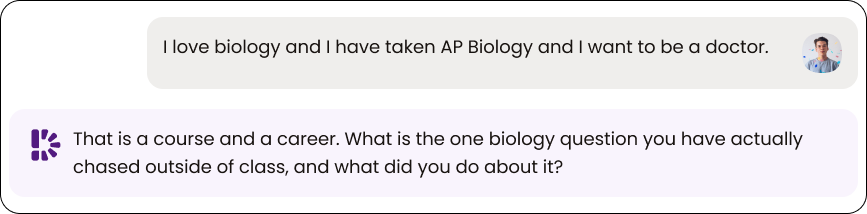
What UC is testing. Whether your interest has a history of action. “Furthered” is the word. UC lists what counts: coursework at a higher level, volunteer work, internships, employment, summer programs, clubs. UC’s guidance also asks whether you would pursue the subject at UC and how, which is the only place in the application that invites a sentence about your academic plan.
How to answer. Name the subject and one specific question inside it that caught you. Then two or three things you did to chase it, with what each taught you. End with how you would pursue it at UC, in one or two sentences that hold for any campus, since the same answer goes to all of them.
Avoid. “I have always loved science.” A list of courses. And naming one campus’s program, since your other campuses read the same answer.
PIQ 7. Making your school or community better (350 words)
The prompt. What have you done to make your school or your community a better place?
What UC is testing. Whether something is different because you were there. UC says community can be a group, a team, a school, a hometown or a home, and asks about your role. The reader wants a problem, an action and a result, at any scale.
How to answer. One community, one problem, what you did, what changed. Say why you acted. If you worked with others, say what part was yours. Small and specific beats large and vague.
Avoid. The service hours count. Changing the world. And a community so large that no individual could have changed it.
PIQ 8. What makes you a strong candidate (350 words)
The prompt. Beyond what has already been shared in your application, what do you believe makes you a strong candidate for admissions to the University of California?
What UC is testing. Whether there is something real that fits nowhere else. The phrase is “beyond what has already been shared.” UC’s guidance says to use it for a skill, talent, challenge or opportunity that did not fit another question, and adds that you should not be afraid to brag a little. The reader has already seen three answers and your activities list.
How to answer. Only pick this if something is missing from the other three answers and the activities section. One thing, shown, with one example. Then say plainly why it makes you a strong candidate.
Avoid. A summary of your other answers. A second activities list. And choosing this question because it seems open when the other seven ask for the same material more directly.
Before you write: map the whole application
UC reads your four PIQs, your activities and awards section and your transcript as one file, at every campus you select, and nothing else. There is no personal statement to carry your story and no scores to carry your numbers. The four answers together have to show a whole person. Think of the reader as someone at each campus who will know you only through those four answers and twenty activity entries.
UC says your PIQs should reflect your own ideas and words. It equates a fully AI-generated response with academic dishonesty and says an AI-generated PIQ with unattributed sources could lead to disqualification. Keep the ideas and writing yours.
Write down what the reader will see in your activities section. Then choose the four questions that show what that list cannot, and make sure each answer uses a different part of your life.
Want help choosing the four and connecting them? Dakota, in College CoPilot’s Application Coach, uses what you have already shared to spot repetition across your answers and ask the question you have not answered. The writing stays yours. UC says your answers must be your own ideas, written by you alone, and names plagiarism from any source as disqualifying. Read its writing tips before you use any tool.
Official UC sources
- Personal insight questions, first year, with all eight prompts and UC’s guidance
- UC’s Fall 2026 admissions announcement
- Dates and deadlines
- How applications are reviewed
- First year admit data by campus (Fall 2026)
- How the University of California evaluates student applications (including AI guidance)
- UC PIQ worksheet for first year applicants
- UCLA guidance on the personal insight questions