Columbia asks for one 100 word list and five short answers of 150 words each. Two of the short answers focus on Columbia: one asks why you want to attend, and the other asks about your academic interests at Columbia College or Columbia Engineering. The whole supplement has a maximum of 850 words. Short means every sentence has to work. For each prompt below, we offer expert guidance on what each question is really testing and how to answer them.
What is Columbia’s acceptance rate?
Columbia’s overall acceptance rate is 4.94%, per the Columbia Common Data Set, and its Early Decision (ED) rate is 13.96%. Both figures are for the Class of 2029, per the 2025-2026 Columbia Common Data Set.
- Overall: 4.94%
- ED: 13.96%
- SAT 25th percentile: 1510
- SAT 50th percentile: 1540
- SAT 75th percentile: 1560
What SAT score do you need for Columbia?
Columbia is test optional for 2026/27 and has announced that the SAT or ACT will be required from 2027/28. If you submit, the middle 50 percent of enrolled students scored 1510 to 1560. A score in that range gives your application a solid chance of getting read. It does not get you in. More applicants have perfect scores than Columbia has places. That is why the essays matter here.
When are Columbia’s application deadlines?
Early Decision: November 1st. Regular Decision: January 1st. Early Decision at Columbia is binding. If you are admitted, you withdraw your other applications and enroll.
Does Columbia have a “Why Columbia” essay in 2026/27?
Yes, two. Question 5 asks why you want to attend Columbia University. Question 6 asks what attracts you to your area of study at Columbia College or Columbia Engineering. Treat them as separate questions: keep Question 5 focused on Columbia as a place to live and learn, and Question 6 on your subject and the school you’re applying to. Readers notice when both answers make the same point. Keep the city out of question 6 and the department out of question 5. Guidance for both is below.
Columbia supplemental essay prompts 2026/27 and how to answer them
Prompts are quoted from Columbia’s Columbia specific questions page, linked at the bottom. All six are required. Columbia says these answers are an essential part of its review and reads them as a set, so plan them together.
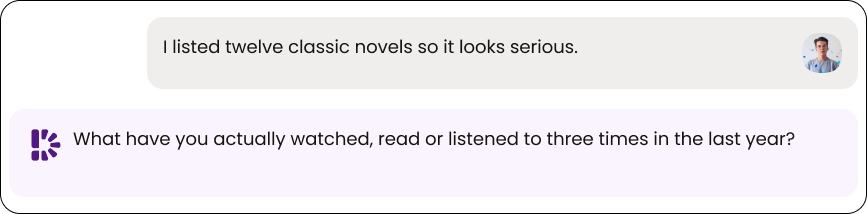
1. Texts, resources and outlets that shaped you outside class (100 words, list format)
The prompt. List the titles of texts, resources and outlets that have contributed to your intellectual development outside of academic courses, including but not limited to books, journals, websites, podcasts, essays, plays, presentations, videos, museums and other content that you enjoy. (100 words or fewer)
What Columbia is testing. What you read, watch and listen to when nobody assigns it. Columbia’s instructions say to list titles only, separated by commas, with no author names and no explanation. That means the list has to speak for itself. A reader scans it in ten seconds and forms a picture of your mind. Columbia has asked a version of this question for years and treats it seriously.
How to answer. Follow the format rules exactly: titles, commas, no commentary. Aim for 15 to 25 items. Mix the forms the prompt names, so a podcast and a museum sit next to a novel. Let the list show a few threads, a subject you keep returning to from different directions, rather than a random sample. Include things that are actually yours, including the ones that are not prestigious. A list that is all classics reads as a list someone else wrote.
Avoid. Explaining any item. Padding with books you have not finished. And a list that only confirms what your transcript already shows. The point of “outside of academic courses” is the part of your mind school did not build.
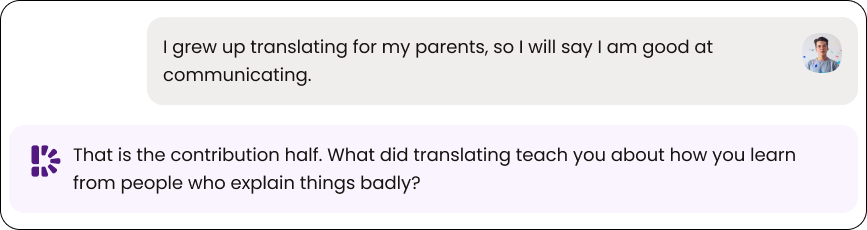
2. An aspect of your life and how it shapes how you will learn and contribute (150 words)
The prompt. Tell us about an aspect of your life so far or your lived experience that is important to you, and describe how it has shaped the way you would learn from and contribute to Columbia’s multidimensional and collaborative environment. (150 words or fewer)
What Columbia is testing. Whether you can connect one experience to one specific way of learning and one specific contribution. The prompt asks for both, learn from and contribute to, and most answers only do the second. “Multidimensional and collaborative” is Columbia’s description of itself. The reader wants to know what you will take from people unlike you as much as what you will give.
How to answer. One experience, not a summary of your identity. Spend about 60 words on a scene from it, 45 on what it changed in how you learn, and 45 on what it lets you contribute. Say both parts in plain words. Do not leave either for the reader to infer.
Avoid. The list of identities with no scene underneath. Hardship as a credential. And the phrase “diverse perspective,” which is the prompt handed back to the reader.
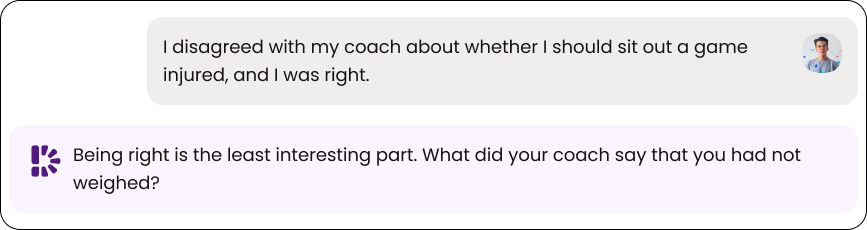
3. A time you did not agree with someone (150 words)
The prompt. At Columbia, students representing a wide range of perspectives are invited to live and learn together. In such a community, questions and debates naturally arise. Please describe a time when you did not agree with someone and discuss how you engaged with them and what you took away from the interaction. (150 words or fewer)
What Columbia is testing. How you handle disagreement, not whether you won. The prompt asks three things: what the disagreement was, how you engaged, and what you took away. In 150 words the first one gets a sentence and the other two get everything else. Columbia frames this through living and learning together, so a disagreement with a roommate, a teammate or a family member fits as well as a political one.
How to answer. State the disagreement in one sentence. Then describe the exchange: what the other person said, what you said back, the moment it got uncomfortable. End with what you took away, which can be small. You still disagree, but you understand why a reasonable person holds the other view. That counts.
Avoid. Turning it into a position paper on the issue. At 150 words the argument crowds out the engagement, and the engagement is what Columbia asked about. Hot political topics written as advocacy. And a disagreement you won cleanly, which teaches the reader nothing.
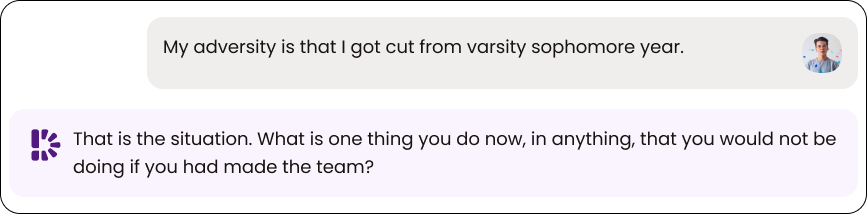
4. Navigating adversity and how you changed (150 words)
The prompt. In college/university, students are often challenged in ways that they could not anticipate. Please describe a situation in which you have navigated through adversity and discuss how you changed as a result. (150 words or fewer)
What Columbia is testing. Whether you can handle a setback and whether you learned anything from it. The second half of the prompt is the one that matters: how you changed. Columbia is not grading the size of the adversity. A small setback with a clear change beats a large one with no reflection. The prompt also tells you why it is asking: college will challenge you in ways you cannot plan for.
How to answer. One situation, stated in two sentences. Spend the middle on what you actually did while it was happening, including the part that did not work. Spend the last 50 words on the change, stated as something specific you now do differently. The word “navigated” asks for your actions, not your feelings.
Avoid. Choosing the biggest hardship you can think of because it seems expected. A story where the adversity simply ended. And a change described as a trait, “I became more resilient,” instead of a behavior.
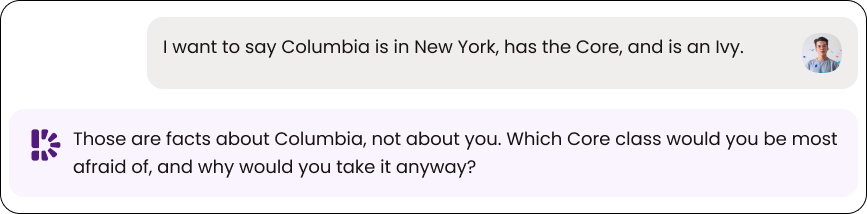
5. “Why Columbia” University (150 words)
The prompt. Why are you interested in attending Columbia University? We encourage you to consider the aspect(s) that you find unique and compelling about Columbia. (150 words or fewer)
What Columbia is testing. Whether you know what makes Columbia different from the schools it is usually compared to, and whether that difference matters to you specifically. Columbia says it in the prompt: unique and compelling. The reader has seen thousands of answers about New York City. The things that are actually unique are the Core Curriculum, which every Columbia College student takes and which is unlike the open curriculum at Brown or the distribution requirements at Yale, and the way the city is used in coursework rather than just nearby.
How to answer. Pick one or two things about Columbia that you have actually examined, and for each one say why it fits something you already do. If it is the Core, name which part and what you expect it to do to you, not that it is prestigious. If it is the city, name the specific way you would use it that you could not do elsewhere. About 75 words per item.
Avoid. A list of five things with no reason attached. New York City as the whole answer. Rankings, prestige and “world class.” And anything about your major, which belongs in question 6.
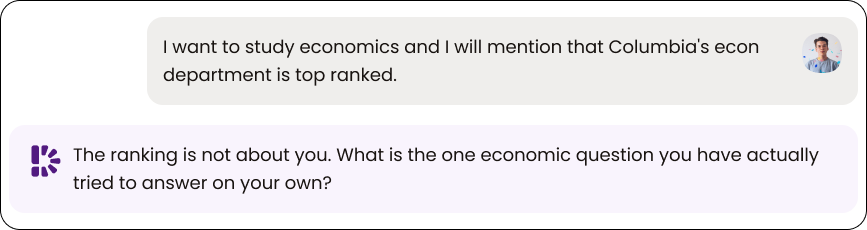
6. Why your area of study at Columbia College or Columbia Engineering (150 words)
The prompt. What attracts you to your preferred areas of study at Columbia College or Columbia Engineering? (150 words or fewer)
What Columbia is testing. Whether your academic interest is real and whether you understand which school you are applying to. Columbia College and Columbia Engineering are separate applications with separate curricula. Engineering has its own technical core alongside part of the Core Curriculum. The reader wants to see a question you want to pursue and one thing about how Columbia teaches that subject that fits it.
How to answer. Spend about 100 words on the curiosity, with evidence that it is real: a question you keep returning to, something you read or built or measured. Spend about 50 on the fit: one program, one research center, one way the department works. One thing, explained, beats five, listed. If you are undecided, say which two or three areas and what question connects them.
Avoid. Naming a professor you have never read. The origin story, where most of the words explain how you first got interested. And repeating anything from question 5. The reader has both in front of them.
Before you write: map the whole application
Your personal statement, activities list and the six Columbia answers are read as one file. Each piece should add something the others do not. Repeating an interest is fine. Repeating the same evidence wastes space. Think of the reader as someone who has already read everything else in your file before they reach the Columbia questions.
Write down what the reader already knows about you from the Common App. Then give each Columbia answer one thing that list is missing.
As you plan and draft, remember to check Columbia’s guidance on AI and essays.
Want help connecting the pieces? Dakota, in College CoPilot’s Application Coach, uses what you have already shared to spot repetition and ask the question you have not answered. The writing stays yours.