Dakota reached 90% mastery in about 6 hours for SAT® test prep. Achieving the same mastery levels using SAT® Bluebook questions took about 28 hours. Try Dakota free at collegecopilot.me
Students spend hundreds of hours studying. But more time studying does not necessarily mean more learning. We saw this clearly in SAT® preparation.
In one of the largest studies ever conducted on SAT® preparation, College Board and Khan Academy studied 545,640 students. Six or more hours of practice was associated with only about 18 additional SAT® points. When students combined six or more hours with at least one measured best-practice behavior, the gain was still only about 39 points.
This is a far cry from the 100- or 200-point gains widely advertised on social media — claims that are not backed by comparable published data or research.
So the question is not whether students can improve. It is about closing the gap between modest average gains and the much bigger results students need to get into their dream school.
We know what great learning looks like. An expert tutor gets to know the student: what they know, why they’re struggling, what they need next, when to push harder, when to review, and whether the learning has actually stuck.
But no tutor can do all of that continuously while tracking mastery across hundreds of subskills.
Dakota can.
Dakota combines a detailed understanding of the subject with a continuously evolving understanding of the learner — then uses both to decide what the learner needs next.
And when we tested Dakota in a simulator modeled on real SAT® student-response and benchmark data, the difference was dramatic:
In our simulator using real student data, the Dakota Mastery strategy achieved 90% mastery in about 6 hours of practice, compared with about 28 hours for SAT Bluebook practice with the same content.
Same underlying curriculum. Same mastery target. But a vastly different outcome for the student. And when you’ve got to manage homework, athletics, college passion projects and just trying to be a teenager — getting the right kind of academic support on a high-stakes exam such as the SAT® is critical. And these tests matter far beyond college admissions: more than 25 states require the SAT® or ACT® as part of public high-school testing.
Here is how it works.
The Dakota Learner Model
At the center of Dakota is a continuously evolving model of each learner.
Every question gives Dakota more information — not only whether the student got it right or wrong, but what they have mastered, how quickly they can use it, where they are struggling, which misconceptions or traps recur, and whether previous learning has stuck.
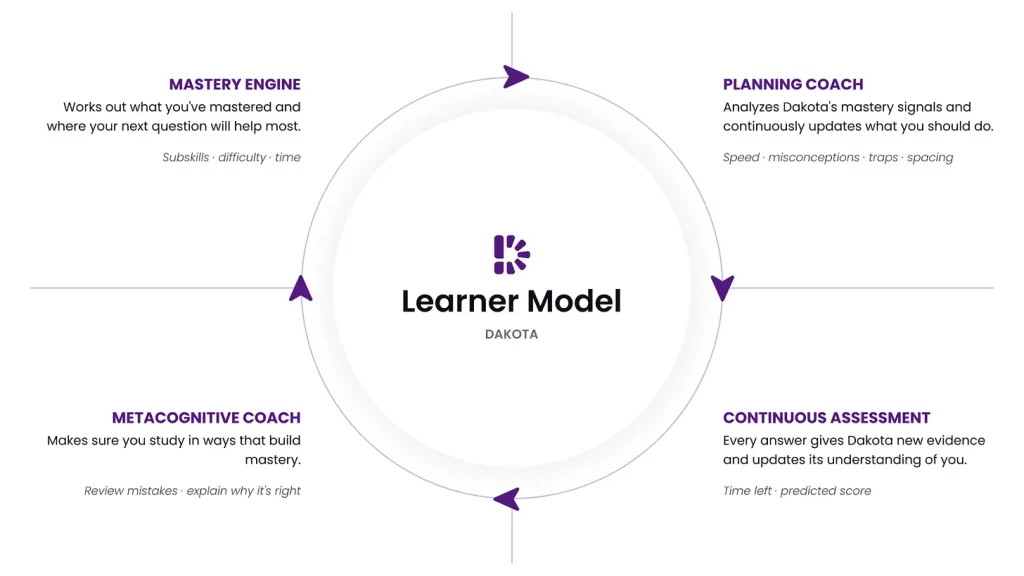
Together, these create a continuous loop: Dakota understands the learner, decides what they need next, coaches them through the work, measures what changed, and updates again.
From Chatbot to Learning Workspace
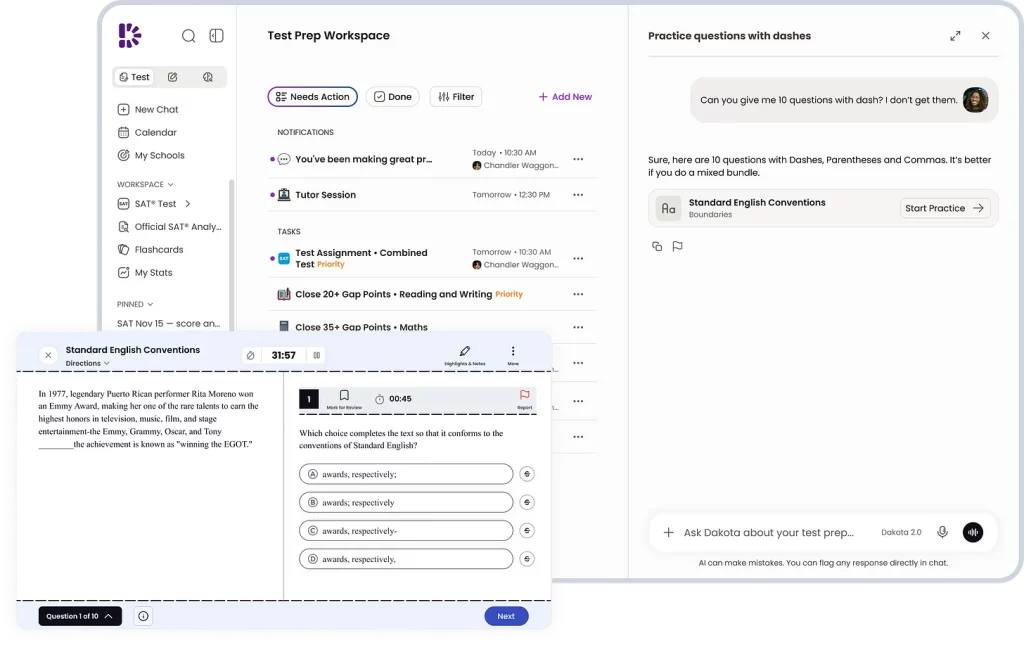
The interface for AI is changing rapidly — from chatbots that answer questions to persistent, agentic workspaces that understand context and help users complete complex work over time. Like Claude, Dakota’s new interface is built around connected workspaces with agentic capabilities.
Students can ask Dakota anything while they work — “Why do I keep getting these questions wrong?” “Am I on track for a 1500?” “Can you give me an assignment on the geometry I’m struggling with?” Their questions, goals, and preferences can inform Dakota’s recommendations and plan.
If a student asks for a specific assignment and completes it, those results become new evidence of what they know, updating their mastery and what Dakota recommends next. The student can shape the direction while every new piece of work deepens Dakota’s understanding of them.
A Richer Model Makes Better Decisions
Think about how Waymo made autonomous vehicles possible by going beyond Google Maps.
Waymo makes decisions from a richer picture of the journey. It combines the road network with signals such as speed, traffic, accidents, closures, and hazards to determine the best route.
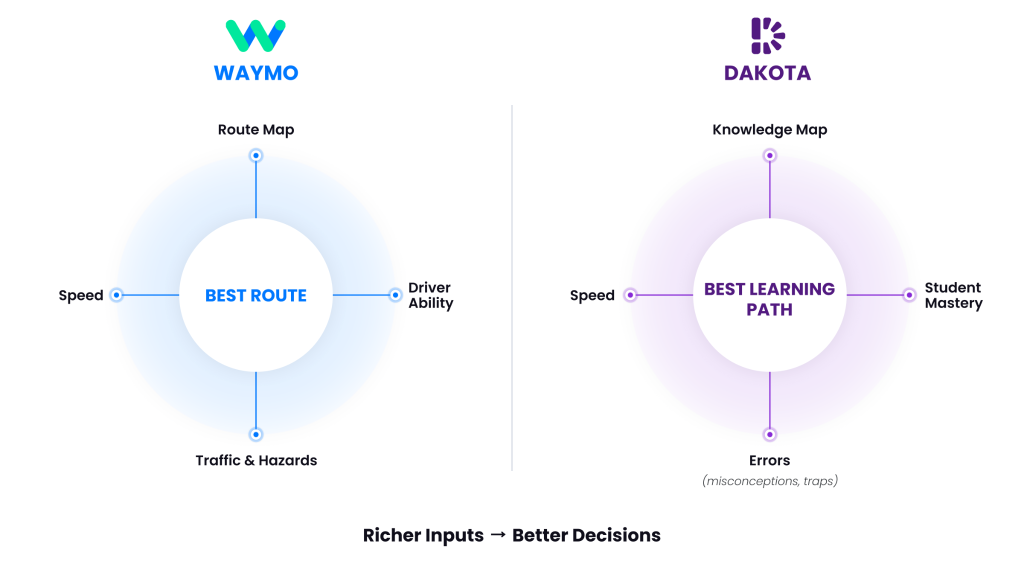
Dakota applies the same principle to learning with richer inputs that continuously enable Dakota to make better decisions. AI provides the unlock that finally makes personalized learning work.
Traditional adaptive learning uses limited signals — such as right-or-wrong answers and broad topic strengths — to decide what a student sees next.
Dakota builds a much richer picture, combining a detailed map of what needs to be learned with subskill mastery, speed, misconceptions, traps, metacognition, goals, and time remaining.
A wrong answer might reveal a missing subskill or expose a recurring misconception. A correct answer can take too long. And a skill mastered previously may need to be retrieved later to determine whether it has really stuck.
This matters because accurate prediction depends on accurate, current information about the learner. Continuous assessment gives Dakota the evidence to understand how a student is progressing and how much work remains. And it helps Dakota continually update their predicted score.
The College Board® Research – How You Study Matters
The challenge of effective practice is visible in real student outcomes. College Board and Khan Academy’s 2020 analysis followed 545,640 students who took the SAT® , and practiced with Khan Academy Official SAT® Practice. .
Students who practiced for six or more hours saw substantially different outcomes depending on how they practiced:
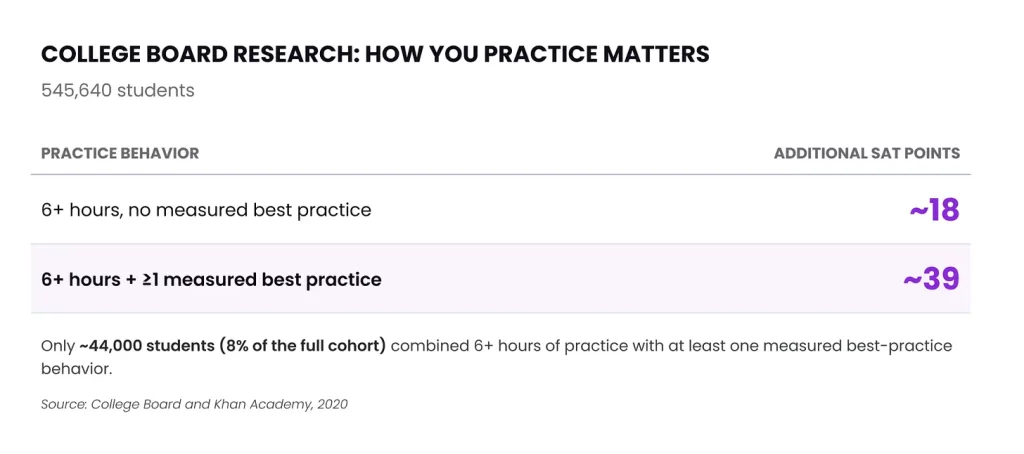
Best-practice behaviors included progressing toward mastery, following personalized recommendations, and completing full-length practice tests.
But only about 44,000 of the 545,640 students — roughly 8% of the full cohort — combined six or more hours of practice with best-practice behavior.
The lesson is bigger than SAT® preparation: Effective learning requires the right work, at the right time, in the right way.
But students have shown us that they won’t orchestrate it themselves. So, Dakota does it for them.
We Tested How Much the Learning Path Matters
We wanted to know how much the learning path itself matters. So we built a simulator modeled on real SAT® student responses and benchmark data.
We gave the same simulated learners the same underlying curriculum and tested different strategies for deciding what they should practice next.
The results were striking. Students achieved 90% mastery in about 6 hours with Dakota versus 28 hours practicing SAT® Bluebook questions.
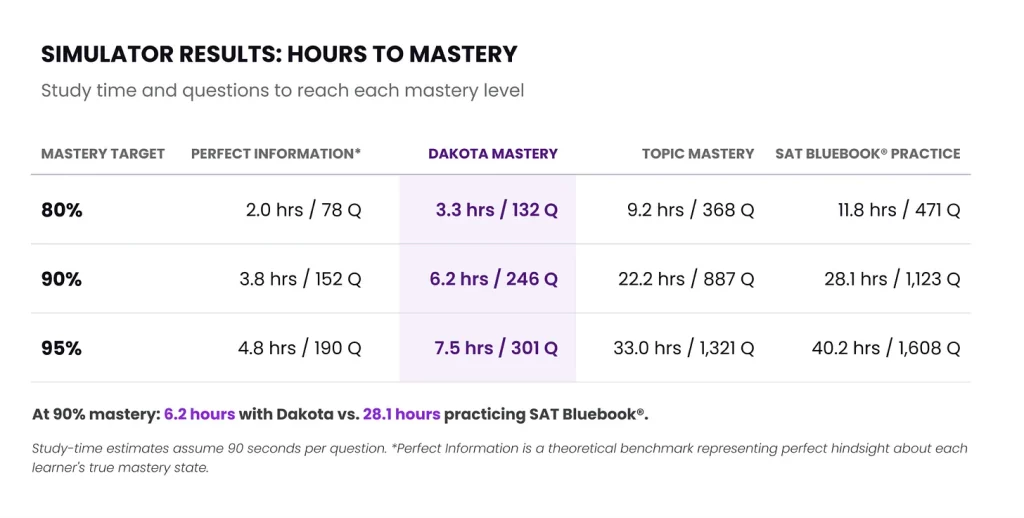
*Study-time estimates assume 90 seconds per question. **Perfect Information is a theoretical benchmark: what could happen if the learning strategy knew each learner’s true mastery state with perfect hindsight.
At 90% mastery, Dakota required 246 questions. SAT® Bluebook practice required 1,123.
Perfect Information is a benchmark that already knew exactly what every learner had mastered. It reached 90% mastery in about 3.8 hours. Dakota, on the other hand, didn’t have perfect information. It had to infer the learner’s state from their work, yet reached the same target in 6.2 hours.
As the mastery target increased, the difference became even greater. Dakota reached 95% mastery in about 7.5 hours, compared with 40 hours of SAT® Bluebook practice.
The experiment measures modeled mastery and learning efficiency, not SAT® score gains. But it demonstrates something fundamental:
What a student is asked to do next can dramatically change how long it takes them to master the same material.
Dakota Also Coaches You to “Learn How to Learn”
Choosing the right question is only part of effective learning. Students also need metacognition or to learn how to learn.
In practical terms, Dakota can prompt a student to review a wrong answer, understand the misconception or trap, explain why the correct answer is right, and later retrieve that learning again.
These aren’t extra lessons for the student to manage. They’re built into the learning path. The student does the thinking. Dakota coaches the learning.
Beyond SAT® Prep
The same architecture extends beyond SAT® prep. In Reading, Dakota learns from how students read to continuously understand fluency, comprehension, vocabulary, and knowledge.
The subject changes. The learner remains at the center.
You can try Dakota free with no credit card initially at collegecopilot.me
This blog was co-authored by Sofia Fenichell, founder of Dakota.Education and Matthew Simpson, Head of AI at Dakota.Education.
Dakota is built by a team that combines frontier AI research, production AI engineering, systems architecture, and deep education expertise. Dakota is a Google AI Accelerator company. You can read more about our team today at collegecopilot.me (or in the future at Dakota.Education).
Dakota.Education operates CollegeCopilot.me and will soon be releasing Dakota.Reading. Dakota is a native AI company and Google AI Accelerator company, and is one of the few companies to have express permission from Google to use generative AI with under-13s.