Only 2% score 1500+. Here’s why months of preparation often fail—and how Dakota is different.
About two million students take the SAT® each year. Only 2%—roughly 40,000 students—score 1500+, while 7% reach 1400+.
More practice does not guarantee a higher score. Students must overcome format shock, cover the full test map, close precise accuracy gaps, and perform accurately at speed. College Board’s own research shows why practice alone rarely delivers large gains.
More Practice Does Not Necessarily Mean More Points
In 2017, College Board promoted a 115-point PSAT-to-SAT® increase after 20 hours of practice. In 2025, it clarified that roughly 60 points reflected normal academic growth—not the practice itself.
Its larger 2020 study of 545,640 students associated six or more hours of practice with just 21 additional points—or 39 when students followed at least one best practice.
We found no published College Board or comparable third-party study substantiating the 100- or 200-point gains commonly promised by adaptive test-prep companies. The problem is not effort. It is where that effort goes—and what happens after each mistake.
Which Test Prep Strategies Are Most Likely to Plateau?
Bluebook provides the best official benchmark, while topic practice reveals broad weaknesses. But neither builds the complete path to a high score.
Common Test Prep Failures
| What students trusted | What students say | Most common failure |
| Bluebook grinding | “I’ve taken every Bluebook test. Why hasn’t my score moved?” | Bluebook samples performance; grinding it does not build coverage. |
| Bluebook grinding &
Adaptive test prep |
“The real SAT® had questions I had never seen before.” | Most question banks are too shallow to prevent test-day surprises. |
| Adaptive test prep | “The platform says I mastered Algebra. But I got tons wrong!” | Topic drilling is not mastery. |
| Adaptive test prep | “My practice scores were much higher than my real SAT® score.” | Most platforms lack SAT®-style IRT scoring; easier misses can cost more. |
| Adaptive test prep | “Can I trust my predicted SAT® score?” | Most predictions rely on too little learner data to be reliable. |
The Four Stages of SAT® Score Growth
Students’ needs change as they improve:
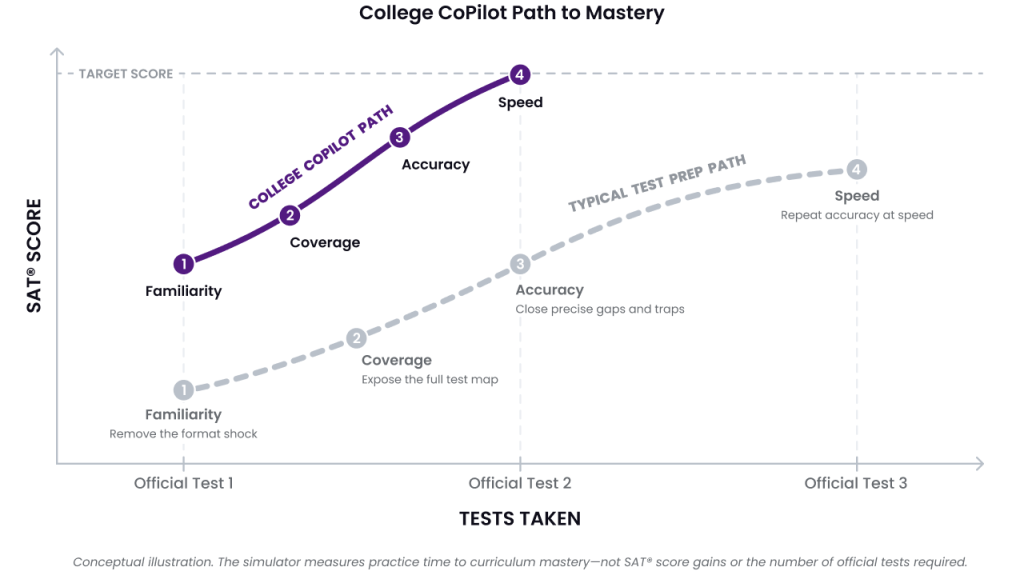
- Familiarity: The first test is always a shock. Remove format shock before the first official sitting.
- Coverage: Expose teens to the full range of question types before test day.
- Accuracy: Actively close precise gaps, misconceptions and recurring traps.
- Mastery: Create opportunities to repeat and demonstrate accuracy at speed under pressure.
As students approach 1400–1500, the barrier shifts from unfamiliarity to mastery at speed.
Reach Your Target With Fewer Official Tests
College CoPilot replicates official SAT® conditions before test day, making the first official test a meaningful benchmark—not a practice run. Preparation can then target accuracy gaps and mastery under pressure.
We built a simulator from real historical SAT® response and benchmark data to compare Dakota with the two strategies students use most: adaptive Topic Drilling and Bluebook Grinding—taking one full-length practice test after another. The same simulated students worked through the same 29-topic curriculum; only the way each strategy selected the next question changed.
Dakota reached 95% mastery in 7.5 hours, versus 33 hours with Topic Drilling and 40.2 hours with Bluebook Grinding. It preserved the repetition students needed while eliminating unnecessary practice.
The simulation measured curriculum mastery, not SAT® score gains, and assumed 90 seconds per question.
Dakota Is Different
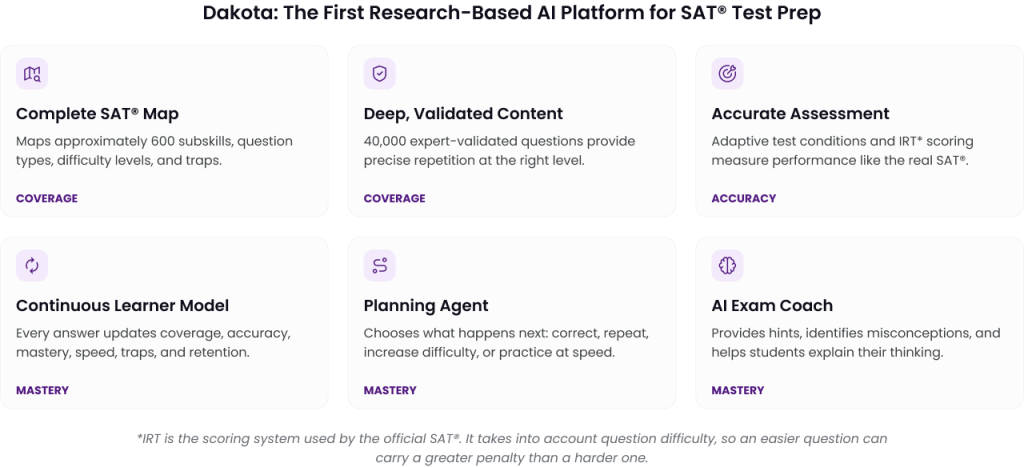
Dakota combines SAT®-style adaptive testing and IRT scoring, 40,000 expert-validated questions, and algorithms informed by real student responses. After every answer, it tracks coverage, accuracy, mastery, speed, traps, and retention—then chooses the next best step, with an AI tutor available whenever students get stuck.
More questions are not the answer. The right questions, in the right order, followed by the right learning behaviors, are.
Dakota vs. Test-Prep Platforms
Dakota connects all four stages—familiarity, coverage, accuracy and mastery—into one learning system.
Dakota vs. Test-Prep Platforms
Dakota connects all four stages—familiarity, coverage, accuracy and mastery—into one learning system.
| Stage | What students need | Dakota | Score Smart | Test Innovators | OnePrep | Khan Academy |
| Familiarity | Looks and feels like the real SAT® | Yes | Yes | No | No | No |
| Coverage | Expert-validated and continuously updated questions | Yes | Yes | Yes (not updated) |
No | No |
| Coverage | Depth across the full test map | 40,000+ | 5,000+ | 1,700+ | 4,000+ | Limited |
| Accuracy | Tracks learning across 600 subskills and question types | Yes | No | No | No | No |
| Accuracy | SAT®-style IRT scoring | Yes | No | No | No | No |
| Mastery | Bluebook and official SAT® score import and analysis | Yes | Yes | No | No | No |
| Mastery | AI exam coach for technique, traps and misconceptions | Yes | No | No | No | No |
| Mastery | Planning agent for speed & accuracy. | Yes | No | No | No | No |
Based on publicly described product features as of August 2026. “Not publicly described” means we found no explanation of the capability on the company’s public product pages; it does not prove the capability does not exist. Sources: ScoreSmart, Test Innovators, OnePrep and Khan Academy.