Most students treat SAT® dates as interchangeable. They register because a test is approaching, take it to see what happens and repeat the process until they run out of time.
That wastes official testing opportunities.
Every SAT® should have a specific purpose. The first should capture a genuine baseline without being consumed by test-day shock. The next should bank one high section score. The following test—if needed—should bank the other.
The objective is not to take the SAT® five times. It is to use the available dates strategically and finish in as few purposeful sittings as possible.
Why conventional SAT® timing is too late
The College Board generally recommends taking the SAT® in the spring of junior year and potentially retaking it in the fall of senior year. The Princeton Review offers similar advice, while PrepScholar typically recommends starting in junior fall.
For students trying to maximize their scores, these timelines start too late.
Junior spring (UK Year 12) collides with AP exams, school assessments, and the most demanding academic stretch of the year. Senior fall (UK Year 13) brings essays, applications and early deadlines. Even October of junior year (UK Year 12) misses the best preparation window: the summer after sophomore year (UK Year 11).
The first planned SAT® should be August before junior year (August before UK Year 12). Students can prepare during the summer, test before school becomes demanding, and still have October and December available for focused improvement.
Give every official SAT® a job
These are opportunities, not a recommendation to take all five. A student may finish in August and October. Another may need December. Senior-year tests should be targeted top-ups, not the default plan.
| Official test | Timeline | Wasted opportunity | Maximized opportunity |
| Official SAT® 1 | August before junior year (UK Year 12) | Absorb the shock: Use the first official SAT® to discover what performing at 8 a.m. feels like. | Remove the shock beforehand: Take two full Dakota or Bluebook tests at home at 8 a.m. Ask Dakota to maximize coverage and accuracy across both sections before test day. |
| Official SAT® 2 | October of junior year (UK Year 12) | Repeat the same plan: Prepare broadly for both sections and hope the total score rises. | Bank the first section: Upload the August results and ask Dakota to identify the section closest to the target. Focus on its remaining accuracy and speed gaps while maintaining the other section. |
| Official SAT® 3 | December of junior year (UK Year 12) | Keep chasing the same section: Continue investing time in the score that is already strong. | Bank the second section: Protect the first high section score while Dakota concentrates on accuracy, speed and pace in the other. Where colleges superscore, the two scores can complete the target total. |
| Official SAT® 4 | August before senior year (UK Year 13) | Retake without a top-up strategy: Spend the summer trying to improve everything again. | Target the top-up: Upload the previous results and tell Dakota exactly which section score needs to rise. Use the summer to address its remaining question types, accuracy problems and time pressure. |
| Official SAT® 5 | September or October of senior year (UK Year 13) | Use the final date because it exists: Retake without evidence that the score is ready to move. | Capture the final gain: Test only when Dakota and a fresh 8 a.m. practice test show a specific, achievable increase—and the score will arrive before the relevant application deadline. |
Remove the shock before August
The first official SAT® should not be the first time a student has tried to perform at full speed early in the morning.
Before the August test, take at least two fresh, full-length Dakota or Bluebook practice tests under realistic conditions:
- Begin at 8 a.m.
- Complete the test in one sitting.
- Follow the official timing and breaks.
- Use the same device and calculator planned for test day.
- Do not pause, check answers, or extend breaks.
A student who always practices after school, takes extra breaks, or pauses when tired has not reproduced test-day conditions. The resulting score may measure comfort rather than readiness.
The practice tests absorb that shock. August can then capture a meaningful score.
What happens between every official SAT®
The preparation cycle between tests is always the same.
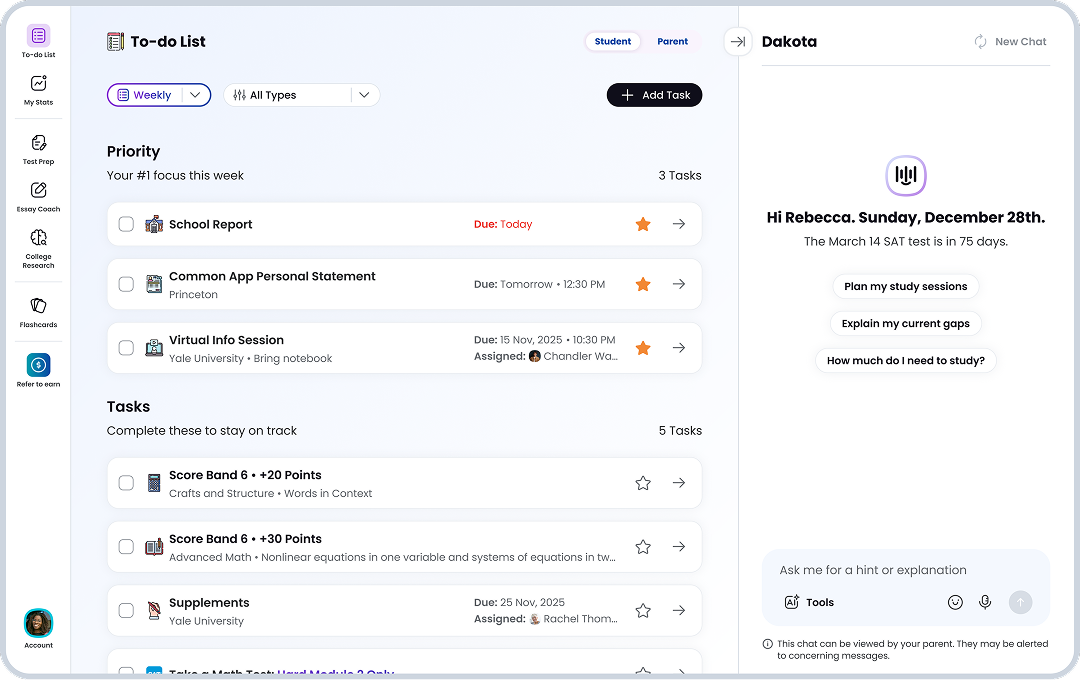
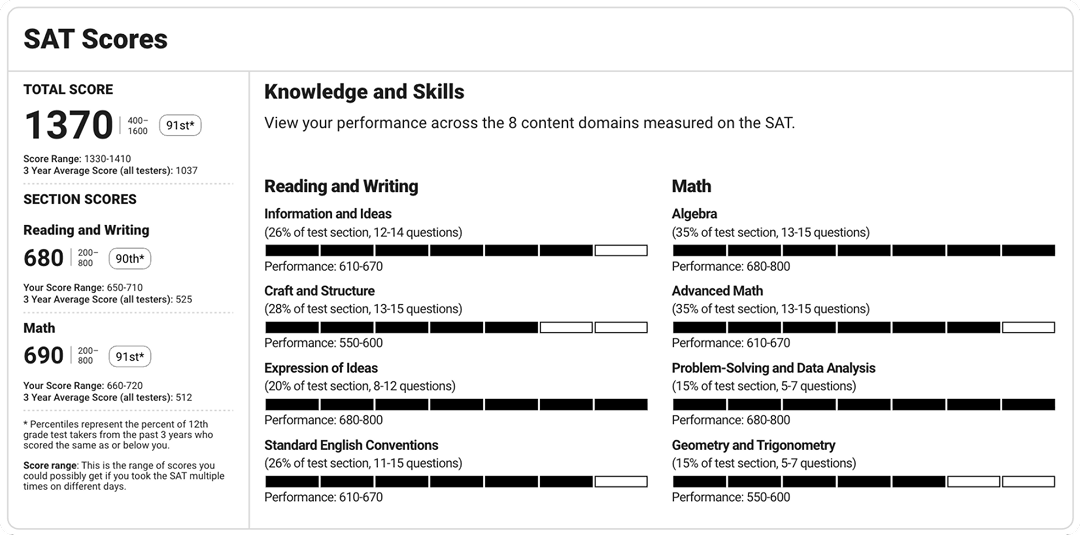
First, upload the results from the official SAT® or Bluebook practice test into Dakota. The score shows what happened; the response data helps Dakota see where it happened.
Then talk to Dakota about how the test felt. Explain where you ran out of time, which module felt unexpectedly difficult, when your concentration dropped, whether you felt anxious or tired, and which questions shook your confidence.
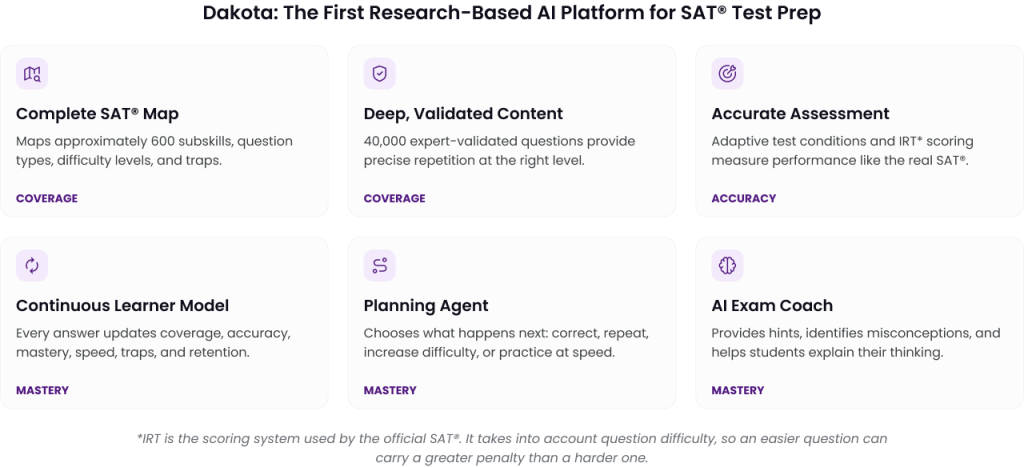
Dakota combines the test results with the student’s experience to further refine the plan. It identifies whether the remaining constraint is:
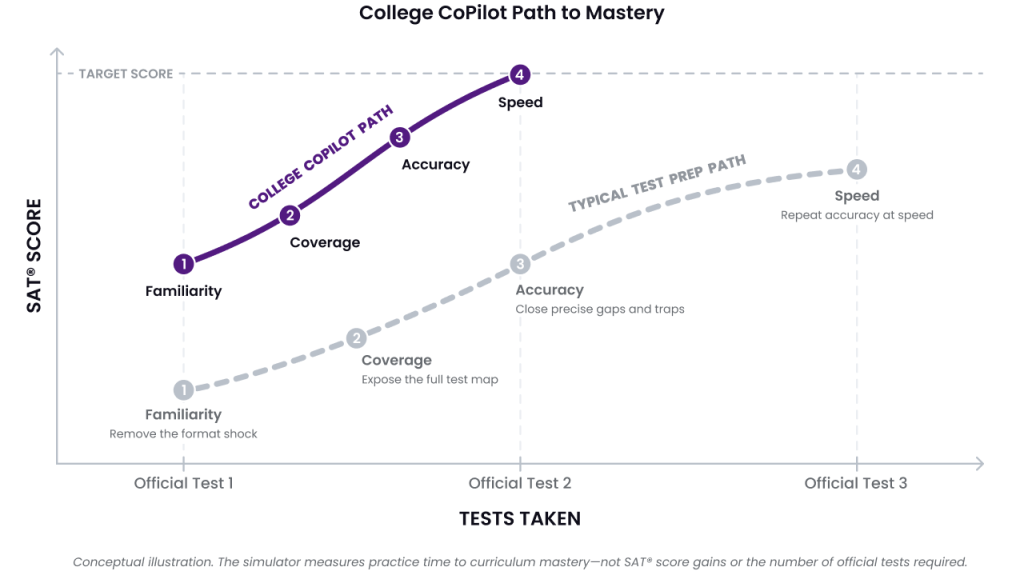
- Coverage: Have they encountered all tested skills and question types?
- Accuracy: Can they answer those questions correctly?
- Speed: Can they answer them correctly within the available time?
- Pace: Can they allocate that time effectively across the entire module?
- Mastery: Can they reproduce the performance after the learning has had time to stick?
Dakota then decides what the student should work on next, how much practice each weakness requires, and what must be maintained. A fresh full-length practice test confirms whether those improvements hold up under realistic timing and early-morning conditions.
Bank one high section, then the other
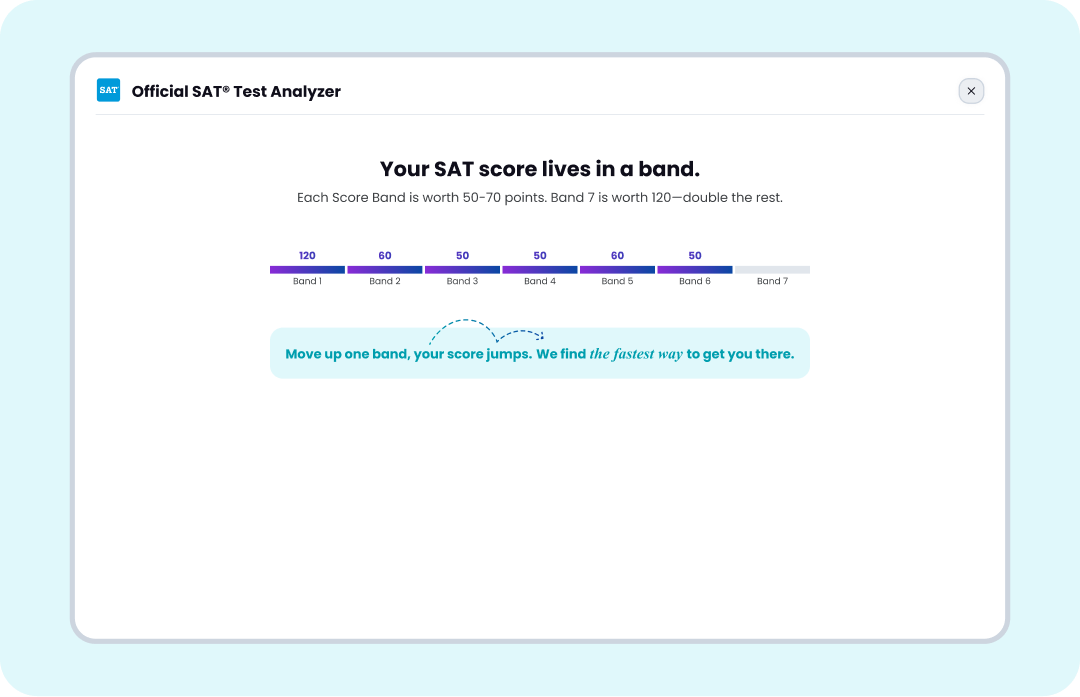
Instead of trying to add 10–20 points to both sections every time, the student can turn one section into a banked strength and then direct most of the next preparation cycle toward the other. The strong section is maintained, but it no longer consumes half the student’s study time. It’s better to focus on maximizing one score.
Where a college superscores, it combines the student’s highest Math score with their highest Reading and Writing score across different test dates.
For example, imagine a student scores:
- August: 760 Math and 690 Reading and Writing
- October: 740 Math and 750 Reading and Writing
Neither sitting reaches 1510. But the superscore combines the 760 Math score from August with the 750 Reading and Writing scores from October, producing a superscore of 1510.
That creates a much more manageable preparation strategy.
For many students, Math is the easiest section to bank first because its structures are relatively predictable. If a student secures a 760-plus Math score, Dakota can concentrate heavily on Reading and Writing accuracy, speed, and pace before the next official test.
If Reading and Writing are already stronger, reverse the order.
This does not mean ignoring either section on test day. The student should always maximize their entire SAT® score. It means using preparation time where it can produce the greatest additional score.
Not every college superscores, and policies can change. Always confirm the current testing policy at each target institution before building the final strategy.
Do not retake without evidence
Another SAT® date is not, by itself, a reason to sit the test again.
Register for the next official SAT® when:
- The previous results have been uploaded and analyzed.
- Dakota identifies a specific remaining score opportunity.
- The student has closed the relevant coverage or accuracy gaps.
- Accuracy now holds under speed and pacing pressure.
- The banked section has been maintained.
- A fresh 8 a.m. practice test confirms the improvement.
- The score will arrive before the relevant application deadline.
If the analysis, preparation and performance have not changed, the official score is unlikely to change meaningfully either.