How to Write the Essay Admissions Officers Remember.
To build this guide, Dakota analyzed hundreds of personal statements from students who were successfully admitted to Ivy-Plus colleges, looking for the patterns that made certain essays memorable rather than simply well written.
The strongest essays revealed how a student thinks, used specific details instead of broad claims, and gave the reader a clear sense of the person behind the application. Just as importantly, they avoided predictable structures, manufactured drama, and the polished “college essay voice” that can make very different students sound exactly the same. The guidance in this guide is built around what those essays consistently did well.
This is not a creative writing assignment. Some of the strongest essays come from ordinary moments examined closely. The goal is to find the experiences, habits, and contradictions that reveal something distinctive about you, then connect them through an idea that gives the essay depth.
The nickname test
Admissions officers read hundreds of essays, which means being impressive is not the same as being memorable. A useful test is to ask whether a reader could describe you to someone else after finishing your essay without falling back on a category such as “the strong student,” “the athlete,” or “the aspiring engineer.”
Could you become “the girl who makes playlists instead of birthday cards,” “the kid whose camera roll is mostly screenshots of things to look up later,” or “the runner who rewatches the same ten seconds of every race to work out what went wrong”?
That is the nickname test. You are not literally trying to invent a nickname for yourself. You are asking whether the essay contains an image, habit, preoccupation, or way of seeing the world that belongs unmistakably to you.
The best details are rarely the ones students initially think are important. They may be something you do every morning, an object you refuse to throw away, an argument your family has had for years, or something your friends constantly tease you about. These details work because they make a person visible.
Before you submit your essay, ask what a reader would remember about you several hours later. If the answer is a category, the essay probably needs more specificity. If the answer is something only you could have written, you are much closer.
The patchwork quilt
Think of your life as a collection of patches: scattered memories, habits, interests, and experiences that may not appear related at first.
A strong essay does not need to cover all of them. It chooses a few and stitches them together into a quilt.
Perhaps the same instinct that makes you reorganize the refrigerator every Sunday also appears in the way you approach a chemistry experiment. Perhaps your obsession with old maps has something in common with the questions you ask your grandfather. Perhaps rowing, fixing a broken radio, and tutoring a younger student all reveal the same tendency to stay with a problem longer than other people expect you to.
The stitch is not simply the activity. It is the underlying way of thinking, tension, value, or habit that keeps resurfacing.
This is why the job is excavation, not invention. You do not need to manufacture a dramatic identity for your college application. You need to look closely enough at your actual life to recognize the patterns already there.
Start with the material students usually dismiss as irrelevant: your camera roll, family stories, text threads, things your friends tease you about, recurring disagreements, unfinished projects, strange collections, routines, and interests that never made it onto an activities list.
Then ask what keeps resurfacing.
One warning: the recurring activity is often evidence of the theme rather than the theme itself. If rugby appears repeatedly, your essay does not necessarily need to be “about rugby.” Rugby may simply be the place where competitiveness, loyalty, fear, control, perfectionism, or dependence becomes visible.
Rugby is a patch. It is not automatically the quilt.
Tuesday morning, not the trip abroad
Students often assume an important essay requires an important event. Usually, the opposite is true.
A week abroad, a championship race, or a dramatic service trip may have mattered enormously to you, but unusual circumstances do not necessarily reveal your usual self. An admissions reader is ultimately trying to understand the person who might arrive on campus: how you behave around other people, what absorbs you, what frustrates you, what you pay attention to, and how you respond to the unexpected life lessons that happen during the course of a normal day.
That is why an ordinary Tuesday can provide better material than the most extraordinary week of your year.
Think about the way you argue with your brother, what happens when you are disappointed, what you would rather do, what you notice on the walk to school, or why you always volunteer for one particular job that everyone else avoids. Ordinary moments reveal patterns because they happen repeatedly.
The everyday is not the absence of a story. Very often, it is where the real story is hiding.
The space between truths
Many personal statements follow the same familiar arc: something was difficult, the student worked hard, succeeded, and emerged stronger.
There is nothing inherently wrong with that structure, but it often leaves the reader with very little to discover because the conclusion is obvious from the beginning.
More interesting essays tend to live in the space between two competing truths.
You want to win, but you are uncomfortable with what competition sometimes brings out in you.
You value independence, but slowly realize how much you depend on other people.
You want to build powerful technology while becoming increasingly uneasy about what that technology might do.
You love a family tradition and also resent the expectations attached to it.
You are proud of being dependable, yet beginning to wonder whether constantly being the reliable person prevents you from asking for help.
These tensions create depth because people are rarely defined by one clean lesson. We carry competing values, change our minds, behave inconsistently, and sometimes reach the end of an experience without having completely resolved what it means.
Your essay does not need to solve the contradiction. Often, recognizing it is more revealing.
When a draft feels too neat, ask yourself what values were actually in conflict, what you believed at the beginning that you no longer believe in quite the same way, and what remains unresolved. That unfinished space is often where the most interesting essay begins.
Craft: How Great Essays Work
Specificity
Specificity makes an essay memorable because it gives the reader something to see.
“I was nervous” tells us very little. Tell us what you did because you were nervous. Did you retie your shoe three times? Check a clock that had stopped working? Memorize the pattern in the carpet while someone else was speaking?
Likewise, “I learned a lot” is usually a placeholder for the sentence you still need to write. What changed? What did you start doing differently? What belief became harder to hold?
Whenever a sentence becomes abstract, ask whether you can replace the explanation with evidence.
The zoom lens
A useful way to think about the personal statement is as a camera moving between close-up and wide shot.
Begin close enough that the reader can enter a real moment: an image, a conversation, an object, an observation, or a small action. Once the scene has earned their attention, widen the lens and show why it matters.
Many weaker drafts begin with the wide shot. They explain the theme, announce the lesson, and summarize the significance before the reader has experienced anything.
A strong essay lets meaning emerge from the material rather than explaining everything in advance.
Think short documentary, not Wikipedia entry.
Voice: the car test
Your essay should sound like you at your most articulate, not like a thesaurus or a college brochure.
Read it aloud and imagine telling the story to someone you know well during a long car ride. Would you use these words? Would you make this joke? Would you really describe yourself this way?
If the answer is no throughout the essay, the problem is probably bigger than vocabulary. Go back to the story and tell it naturally before polishing it into application prose.
Parents and counselors should be particularly careful here. A beautifully edited sentence that no longer sounds like the student is not an improvement.
Opening and closing
The opening has one job: make the reader want the next sentence.
You can do that through an unusual observation, a moment of tension, an unanswered question, a surprising fact, or simply a voice that immediately feels alive. You do not need a cinematic gimmick.
The closing should do something different. Rather than summarizing everything the reader has just understood, it should leave them with an image, thought, or direction that gives the essay resonance.
A good ending often feels connected to the beginning without mechanically repeating it. The reader recognizes the image but understands it differently because of everything that has happened in between.
The 250-word test
Before fighting your way through 650 words, try writing the heart of the essay in roughly 250.
This forces you to identify what the essay is actually about. Which scene is essential? Where is the tension? What changes between the beginning and the end?
If you cannot find the essay at 250 words, adding another 400 rarely solves the problem. Once the central idea works at the shorter length, you can expand deliberately by adding texture, reflection, and carefully chosen scenes rather than filling space.
Word count
The Common App personal statement allows up to 650 words. Most essays need enough space to create a scene and develop an idea, so there is little advantage in being artificially brief.
The important rule is simpler: do not use words merely because you have them available.
Every paragraph should either deepen the reader’s understanding of you, move the story, complicate the idea, or earn the ending.
The four essentials — and why structure comes later
Students frequently become preoccupied with structure before they know what they are trying to say.
Do not begin by deciding that paragraph one will be the hook, paragraphs two and three will describe the challenge, paragraph four will contain the lesson, and paragraph five will wrap everything up. That structure may work, but imposing it too early often produces an essay that feels manufactured.
Find the material first.
Most strong personal statements eventually contain four things:
- An opening that creates genuine curiosity.
- At least one moment the reader can see or experience.
- A tension, contradiction, or question that gives the essay depth.
- A closing that leaves the reader with something memorable.
How you travel between those points depends on the story.
The subtle weave
A strong essay may focus almost entirely on one story. A more sophisticated one can sometimes introduce a brief second moment from a completely different part of the student’s life that reveals the same underlying pattern.
Imagine an essay about temporarily living with a grandmother while a parent changes jobs. The student writes about the lack of privacy, unfamiliar routines, and irritation of having no space that feels entirely their own. Gradually, the essay becomes about learning to tolerate discomfort without immediately trying to remove it.
Later, the student briefly recalls a school group project with someone whose working style drove them crazy. Their instinct was to take control, yet the other student’s unexpected idea eventually became the strongest part of the project.
The second scene changes how we interpret the first. Tolerance is no longer merely something the student endured at home. We begin to recognize a broader pattern in how they are learning to move through the world.
That is the subtle weave: two patches joined by the same stitch.
Use it sparingly. If the second story creates another theme, introduces too many people, or requires a paragraph of explanation, it is probably a detour rather than a weave.
Topics students worry they cannot write about
There are very few subjects that are automatically off-limits. The better question is not “Can I write about this?” but “What will the reader learn about me from the way I write about it?”
Some subjects appear so frequently in admissions essays that they require extra care.
Sports
Yes, you can write about sports.
The problem is not sports; it is predictability. The injured athlete who learns resilience, the captain who discovers leadership, and the team that loses before finally winning are familiar stories.
If the reader can predict the lesson from the topic, keep digging.
Perhaps the interesting part of your injury was jealousy when your replacement performed better than you. Perhaps you became fascinated by analyzing races — replaying footage, comparing splits, studying technique, and trying to pinpoint the exact moment something went wrong. Perhaps losing made you feel guilty, because winning wasn’t as important to you as being with your friends.
The game, race, injury, or season can provide the setting. The essay should reveal something underneath it.
Death, illness, and grief
These can produce powerful essays, but there is a key risk: the person who died or became ill can become the main character.
Admissions officers are trying to learn about the student. If most of the essay explains how extraordinary your grandmother was, they may want to admit your grandmother instead!
You do not have to prove the seriousness of your grief. Focus instead on the specific ways the experience changed your relationships, assumptions, behavior, or understanding.
Sometimes the most revealing detail is much smaller than the loss itself.
Service trips and volunteering
These essays become difficult when the student casts themselves as the person who arrived to help and left transformed by the people they helped.
That story has been written many times, and it can unintentionally flatten other people into props for the student’s growth.
If the experience genuinely matters, examine your assumptions rather than celebrating your generosity. What did you misunderstand before you arrived? Did your contribution matter as much as you expected? Was there unusual red tape you had to work through before you could help someone?
Humility and specificity make these essays much stronger.
Moving countries, schools, or homes
This is a hard topic to make interesting. It can work when the essay explores something more specific than “change was difficult but I adapted.”
What did moving alter about the way you speak, observe, make friends, define home, or understand yourself? What did you refuse to give up? What habits did you acquire without noticing?
The more unusual the consequence, the less generic the essay becomes.
The family circumstance is context. Your wider experiences are still the subject.
Divorce or family difficulties
These subjects can be meaningful, but remember that many kids come from divorced families. What makes yours unique?
The essay does not need to recount conflicts or disclose details you would rather keep private. Focus on what the experience reveals about you.
This essay should be a springboard to a bigger story and not focus on divorce. Perhaps you became the person who could read the temperature of a room before anyone spoke. Perhaps living between two homes made you unusually protective of routines. Perhaps you eventually realized that being the family peacekeeper came with a cost.
Again, the family circumstance is context. Your wider experiences are still the subject.
Mental health
Writing about mental health is tricky. You don’t know when someone is going to misinterpret what you say.
If you write about mental health, think carefully about what the essay adds to the rest of your application and whether you are comfortable sharing it.
The strongest versions are not medical histories. They focus on the student’s perspective, decisions, relationships, or changing understanding of themselves.
If circumstances significantly affected your grades or attendance, the Additional Information section may also be a better place to explain those facts directly rather than forcing the personal statement to carry both explanation and story.
Identity
Race, religion, culture, sexuality, nationality, class, and family background can all be meaningful subjects, but an essay about identity still needs specificity.
“Being between two cultures taught me to embrace both” is a conclusion shared by thousands of students. The interesting material lies in what being between those cultures actually looked like in your life.
Which food did you hide from your friends? When did you realize your parents and your classmates understood the same event differently?
Identity becomes memorable when it is lived rather than announced.
Academic interests
You can write about physics, history, computer science, or virtually any intellectual interest, but avoid turning the personal statement into a “Why Major?” essay.
The interesting question is not simply what you know. It is why your mind keeps returning to the subject.
Perhaps you collect obsolete scientific theories because you are fascinated by people being confidently wrong. Perhaps you build robots but increasingly find yourself thinking about what humans should refuse to automate.
Show the reader a mind at work.
Trauma
You never owe an admissions committee your most painful experience.
Students sometimes assume that the more serious the hardship, the more powerful the essay will be. That is not how personal statements work. Vulnerability can create intimacy, but disclosure is not the same as insight.
If writing about an experience feels exposing rather than revealing, choose something else. You can write an extraordinary essay about your father’s toolbox, your obsession with train timetables, or the Sunday argument over who loads the dishwasher.
The significance comes from what you notice and understand, not from how dramatic the event sounds.
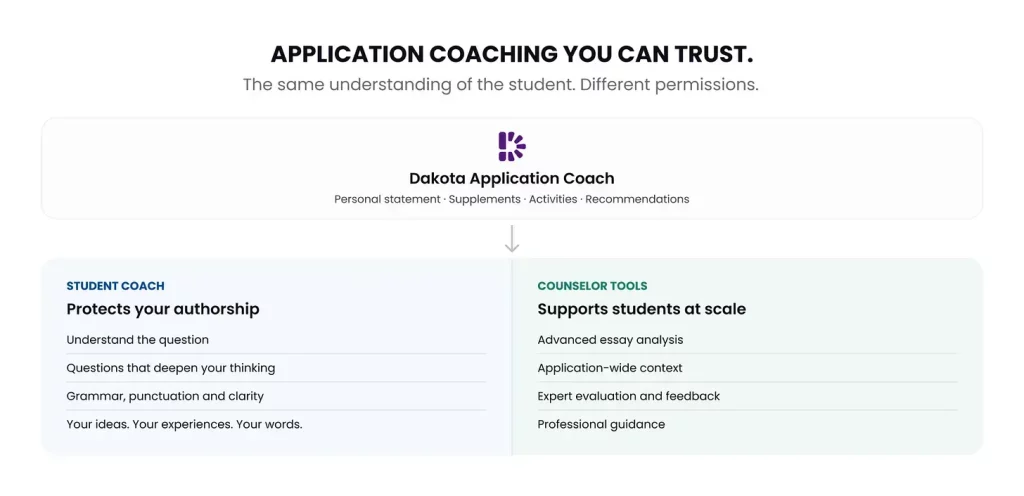
For parents and counselors: help them excavate, not author
The most useful adult in the essay process is not the person who knows how to rewrite the student’s sentences. It is the person who asks questions that help the student recognize material they cannot yet see.
Ask what part of the story they keep leaving out. Ask what their friends would say is unmistakably them. Ask where they felt two things at once. Ask whether a quality that appears in one story also appears somewhere completely different in their life.
Parents can be particularly helpful because they remember the small stories students have forgotten. Counselors and tutors can be particularly helpful because they can see patterns across the application that the student may not recognize.
But once the adult begins supplying the insight, the language, or the emotional conclusion, the essay starts to stop belonging to the student.
The goal is not to produce the most polished adult version of an eighteen-year-old. It is to help the student discover the most articulate version of themselves.
Before you submit
Ask yourself six questions:
- Is there one stitch connecting the important parts of this essay, and can I name it?
- Is there genuine tension, contradiction, or uncertainty somewhere in the story?
- Does the writing sound like me when I read it aloud?
- Is there at least one scene, image, or detail the reader can actually picture?
- Have I moved beyond the obvious version of this topic?
- What would someone remember about me after reading it?
If the last answer is still “hard-working student,” “good athlete,” “future doctor,” or another broad category, go back to the first question.
The best personal statement does not make you sound extraordinary.
It makes you difficult to replace with anyone else.