The first AI purpose-built AI for test prep, college research, and application coaching — working with students and counselors to help get into your dream school. Try Dakota free at collegecopilot.me
Getting into college is a set of connected high-stakes problems. You need to succeed academically and on standardized tests. Work out what you want from college. Find schools where you’ll thrive. Research majors, programs, and opportunities. Build a college list. And create an application that shows colleges who you really are.
Students have more tools than ever to help. Some are general-purpose AI tools that were never engineered specifically for college. Others are legacy college platforms built for an earlier era, with AI chatbots added on rather than AI engineered into the system from the ground up.
Dakota brings the intelligence of a great tutor, college counselor, and application coach into one AI built around the student.
We built three purpose-built workspaces for Test Prep, College Research, and Applications. Each was carefully engineered around a different problem students face — with its own data, models, agents, guardrails, and expertise.
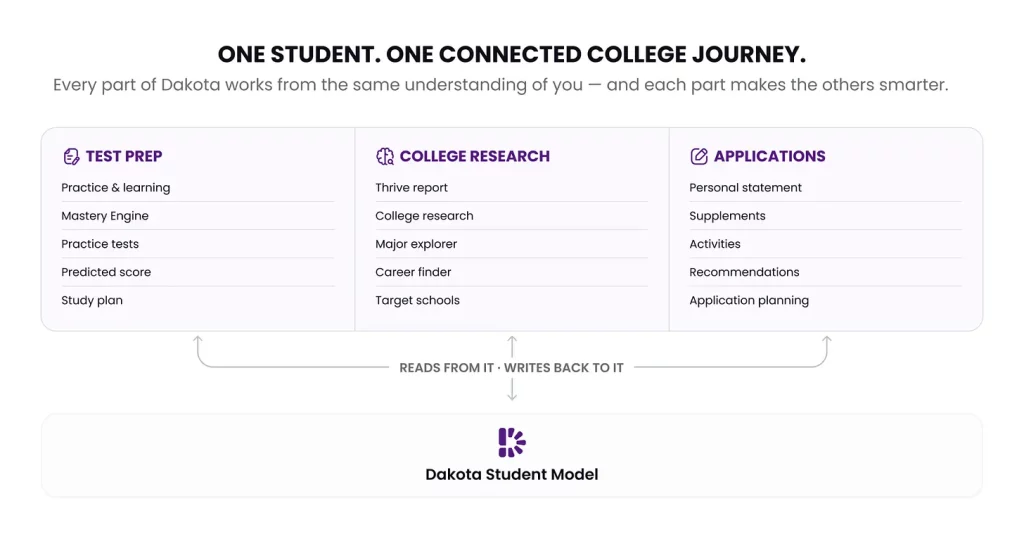
Every part of Dakota works from the same evolving understanding of you — and each part makes the others smarter.
What you discover in Thrive shapes your college research. Your research changes your target schools. Your target schools can change the SAT® score you’re working toward. And what you learn about yourself carries into your application. You don’t have to keep starting over and re-uploading information.
Test Prep: AI Engineered for Better Learning Outcomes
Most SAT® prep is built around a familiar loop: test the student, identify a weakness, give them more practice.
But knowing where a student is weak doesn’t tell you why they’re struggling or what they should do next.
Dakota was engineered around a much richer model of learning. Its Mastery Engine, Planning Agent, Metacognitive Agent, and Continuous Assessment use signals including subskill mastery, difficulty, speed, misconceptions, traps, response history, and retention to continually determine what each student needs next.
In our simulator using real student data, the Dakota Mastery strategy achieved 90% mastery in about 6 hours of practice, compared with about 28 hours for SAT Bluebook practice with the same content.
Read the Research and Methodology behind Dakota SAT Test Prep
Trusted College Research: Discover Where You’ll Thrive
Most college planning platforms pigeonhole students into a data box. Students are given rankings, acceptance rates, scattergrams, and filters around reach, fit and safety schools. They are often left feeling disincentivized before they’ve really worked out what they want from the next four years of their lives.
General AI models such as ChatGPT, Claude, and Gemini solve a different problem. They can research almost anything, but they weren’t purpose-built to help a teenager discover what matters to them and then investigate colleges through that evolving understanding. More importantly, their answers can be inaccurate or poorly grounded.
Dakota was engineered to solve both problems: understand the student deeply and ground college research in trusted evidence.
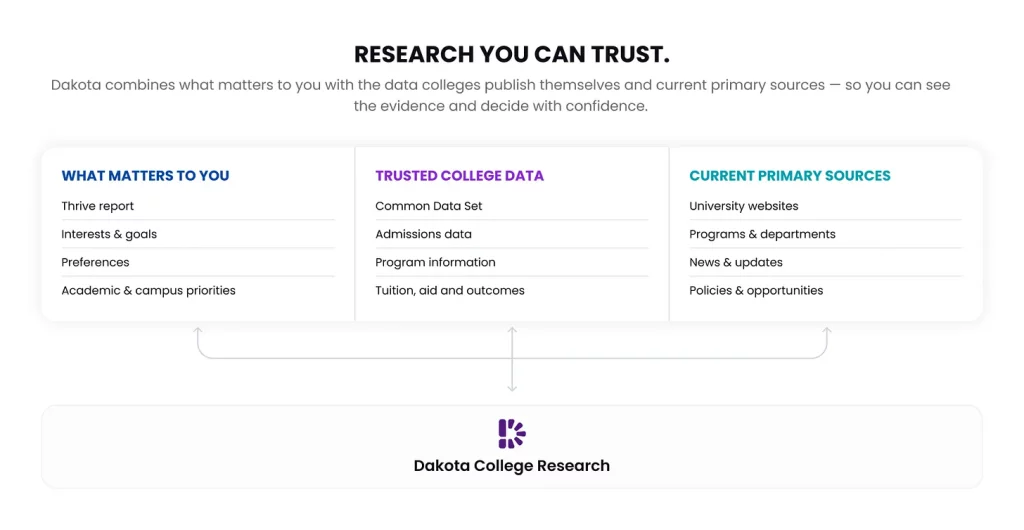
Its research layer combines Common Data Set and structured admissions data with current primary sources from universities, departments, programs, and policies. At the same time, Dakota carries forward what it has learned about the student — their interests, reactions, goals, and changing priorities.
So instead of simply asking:
Tell me about Northwestern.
the student can ask:
Given that I keep coming back to robotics, want hands-on engineering, care about entrepreneurship, and want an active campus community, what should I know about Northwestern?
Dakota can answer through both lenses at once: what is true about Northwestern and what matters to this particular student.
If a student keeps returning to hands-on engineering, Dakota can surface that pattern: You keep coming back to building and robotics — is that becoming more important than pure theory?
If they originally said they wanted a city but respond strongly to a close-knit campus community, Dakota can ask: “You said urban life mattered, but you seem drawn to this kind of campus — has your thinking changed?“
If entrepreneurship keeps appearing across different schools and majors, Dakota can point that out too.
Dakota’s short-term and long-term memory supports student metacognition. Dakota helps the student see their own patterns, test whether those priorities still feel true, and clarify what they want and why.
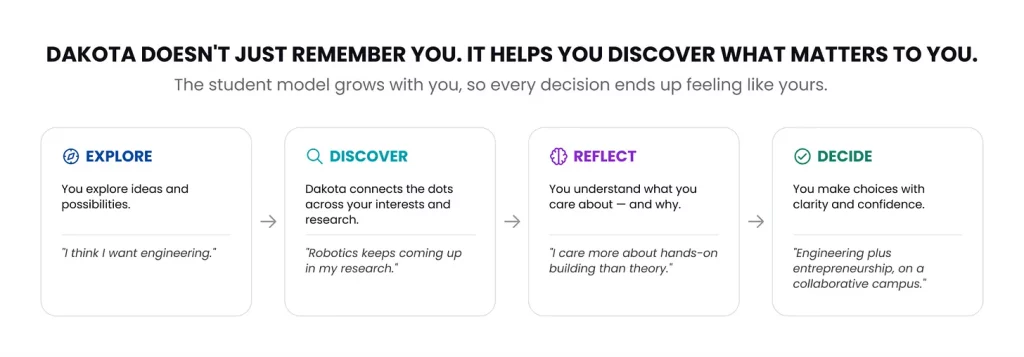
The Thrive Report builds a richer picture of the student — one that can evolve as they learn more about colleges and themselves.. Instead of asking only “What colleges match my stats?” Thrive asks a much richer question: Where will this student actually thrive?
It explores majors and academics, academic culture, campus life, location, weather, athletics, future goals, and the kind of environment the student wants.
This means the student is not reduced to a score, GPA, preferred major, and geographic radius.
Application Coach: A New Kind of Application Workspace
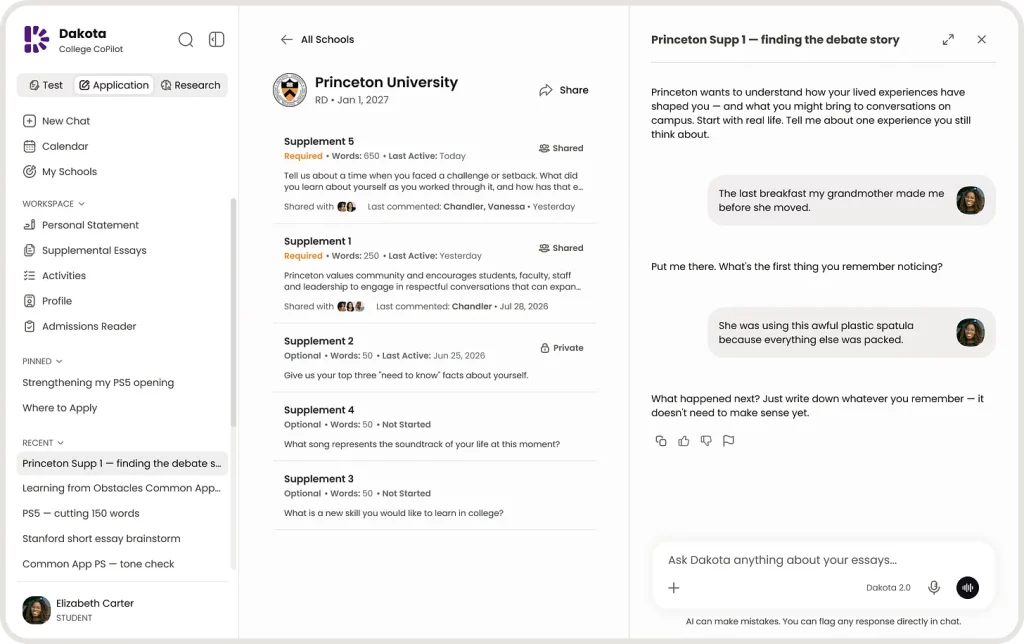
Dakota turns the chatbot into a persistent application workspace that understands the student, their application, and their progress over time. Students can ask Dakota anything as they work, while counselors, tutors, teachers, and parents can collaborate around the same application and context.
The Common App Fraud Policy defines fraud as intentionally presenting the substantive content or output of an AI platform as a student’s own original work.
That creates a problem with general-purpose AI. ChatGPT, Claude, Gemini, and other frontier models can brainstorm essay ideas, suggest stories, create outlines, rewrite paragraphs, and generate application prose — exactly the kinds of substantive AI contributions that can put a student on the wrong side of the policy if submitted as their own work.
Dakota’s student Application Coach is designed to comply with the Common App Fraud Policy. It helps students understand the question, asks questions that unlock further thinking, and improves grammar, punctuation, and clarity — without supplying essay ideas or generating application content for them.
Your words. Your ideas. Your experiences. Your perspective. Your story.
Applications are Collaborative
Students rarely apply to college alone. Dakota’s collaboration tools keep counselors, teachers, tutors, parents, and students working from the same application and context, with the right tools and permissions for each role.
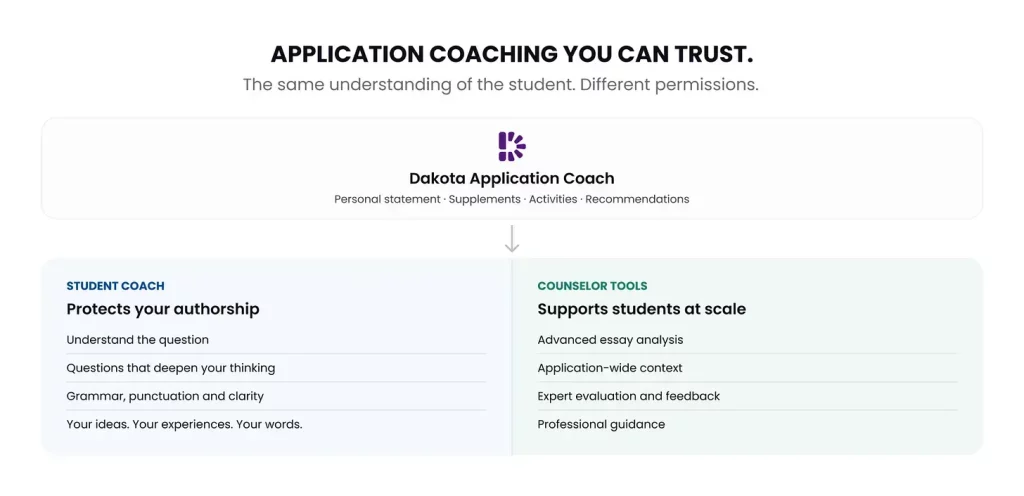
Trust Is Built In
Guardrails are built into every action Dakota takes. Dakota evaluates what it is being asked to do, checks its own proposed actions against its rules and permissions, and uses multiple layers of safeguards before acting.
Dakota is FERPA and GDPR compliant. See appendix.
You can try Dakota free with no credit card initially at collegecopilot.me
This blog was co-authored by Sofia Fenichell, founder of Dakota.Education and Joshua Lilly, Lead AI Engineer at Dakota.Education.
Dakota is built by a team that combines frontier AI research, production AI engineering, systems architecture, and deep education expertise. Dakota is a Google AI Accelerator company. You can read more about our team today at collegecopilot.me (or in the future at Dakota.Education).
Dakota.Education operates CollegeCopilot.me and will soon be releasing Dakota.Reading. Dakota is a native AI company and Google AI Accelerator company, and is one of the few companies to have express permission from Google to use generative AI with under-13s.