Author: Sofia

  • 98 Things Students Can Ask Dakota


    You don’t need to know the perfect prompt.

    Ask Dakota what to study next, why you keep getting something wrong, what your latest test tells you, which colleges fit you, what you still need to research, how to think more deeply about your application—or simply what you need to get done this week.

    Dakota remembers your test prep, scores, assignments, Thrive findings, college research, application work and deadlines. So every conversation can start with what Dakota already knows about you.

    Here are 98 things you can ask.

    Start Here: What Should I Do Next?

    Sometimes the hardest part is simply knowing where to start.

    1. “I have 30 minutes. What is the most useful thing I could work on right now?”
    2. “What are my three highest-priority tasks this week?”
    3. “Look across my SAT prep, college research and applications. What needs my attention most?”
    4. “What have I left unfinished?”
    5. “I’m overwhelmed. Put everything I need to do in priority order.”
    6. “What should I finish before my next meeting with my tutor or counselor?”
    7. “What did I make progress on this week, and what should I tackle next?”

    Workspace 1: Test Prep

    Understand My SAT Performance

    Dakota doesn’t just see a test score. It can look across your coverage, accuracy, speed, mastery, assignments and previous tests to understand what is actually holding you back.

    1. “Analyze my last 30 days of SAT work. What are the three biggest things holding back my score?”
    2. “Which Math skills have I still not covered?”
    3.  “Which Reading and Writing skills have I still not covered?”
    4.  “Which skills am I accurate at that are medium difficulty but still missing at hard difficulty?”
    5. “Which skills did I use to be good at but have started to forget?”
    6.  “Where am I getting questions right but taking too long?”
    7. “Which question types are slowing me down most?”
    8.  “I keep scoring around the same level. Is my plateau mainly coverage, accuracy, speed, mastery—or a combination?”
    9.  “Which three skills would give me the biggest opportunity to improve my score right now?”
    10.  “My Math score is much stronger than Reading and Writing. What is driving the difference?”
    11. “I’m already scoring highly in Math. What should I focus on to push my score higher?” 
    12. “What have I genuinely mastered?”
    13. “What looks mastered from one assignment but isn’t consistent enough yet?”


    Help Me Understand What I’m Getting Wrong

    A wrong answer is useful if you understand why it happened.

    1. “Review this question with me, but don’t give me the answer immediately.”
    2. “Give me one hint at a time until I can solve it myself.”
    3. “What was the SAT trying to test in this question?”
    4. “What trap did I fall for?”
    5. “Did I miss this because I didn’t know the skill, applied it incorrectly, rushed or made a careless mistake?”
    6. “I thought my answer was right. Help me work out where my reasoning went wrong.”
    7. “I know this grammar rule. Why do I keep missing questions that test it?”
    8. “Show me where to look in this passage without telling me the answer.”
    9. “I don’t understand this explanation. Explain the concept a different way.”
    10. “Is there a faster way to solve this Math question?”
    11. “Ask me to explain why each wrong answer is wrong before we move on.”
    12. “Which mistakes from this assignment keep repeating in my other work?”


    Practice Smarter

    Once Dakota knows what is wrong, it can help you practice the right thing rather than simply doing more questions.

    1. “Give me five questions on the skill I’m weakest at.”
    2. “I’ve mastered the medium questions. Give me hard questions now.”
    3. “Give me three more questions similar to the one I just missed.”
    4. “Give me an unfamiliar version of this question so I can prove I understand the skill rather than the example.”
    5. “Quiz me on boundaries and stop after every mistake so I can explain the rule.”
    6. “Give me a timed set targeting the questions I can answer correctly but too slowly.”
    7. “Create a short practice session around the three traps I fall for most.”
    8. “Mix skills I’ve recently learned with older skills I might be forgetting.”
    9. “Make the next question harder.”
    10. “Have I shown enough mastery of this skill to move on?”


    Prepare for Test Day

    Upload your Bluebook or official test results and then talk to Dakota about what actually happened. How a test felt matters too.

    1. “Analyze my latest Bluebook test using everything you already know about my SAT work.”
    2. “I’m not sure which part of the test hurt me most. Can you help me figure it out?” 
    3. “I felt rushed at the end of Reading and Writing. Was I actually taking longer on those questions?” 
    4. “I thought the second Math module went terribly. Was it really as bad as it felt?”
    5. “Which questions did I feel confident about but got wrong?”
    6. “Which questions did I feel confident about but got wrong? What did I misunderstand or what trap did I fall for?” 
    7. “What should I work on between this test and my next official SAT?”
    8. “My SAT is Saturday. What should I focus on this week—and what should I stop worrying about?”

    Workspace 2: College Research

    Understand Myself Through Thrive

    Before asking where you should go to college, understand the environments in which you are most likely to thrive.

    1. “Explain my Thrive Report to me.”
    2. “What does my Thrive Report say I need from a college environment?”
    3. “Which Thrive findings seem most important for my college search?”
    4. “What stands out most in my Thrive results?” 
    5. “Ask me questions about the parts of my Thrive Report I’m not sure I agree with.”
    6. “What should I pay attention to when I visit colleges based on my Thrive Report?”
    7. “Which parts of college life seem particularly important for me to investigate?”
    8. “Turn my Thrive findings into five questions I should ask myself when comparing colleges.”


    Build and Research My College List

    Dakota can connect what it knows about you with deep research into individual colleges.

    1. “Which colleges fit my Thrive Report particularly well—and why?”
    2. “Where does my current college list not line up with what my Thrive Report says matters to me?” 
    3. “What kind of college might be missing from my list?”
    4. “Compare Brown and Dartmouth for me based on what matters most to me.”
    5. “Compare these colleges on teaching style, curriculum, campus culture and student life.”
    6. “Research how this university is using AI in the subject I want to study.”
    7. “Research the undergraduate research opportunities available in my area of interest.”
    8. “Research entrepreneurship opportunities relevant to what I want to do.”
    9. “Research the athletic opportunities and requirements relevant to me.”
    10. “What should I investigate before I visit this college?”
    11. “What should I research about this university before I start thinking about its supplement?”
    12. “I’ve finished researching this college. What important questions have I still not answered?”

    Workspace 3: Application Workspace

    Help Me Think Through My Application Ideas

    Dakota does not decide what your story should be or write your application for you. It helps you think.

    Bring Dakota your experiences, reflections, research and drafts. Dakota can ask questions, help you examine your own ideas and make sure you are doing the thinking that produces an application that is genuinely yours.

    1. “Ask me questions to help me work out what I actually want to say in my personal statement.”
    2. “I’m thinking about writing about rowing. Help me think through what this experience actually means to me.”
    3. “I have three experiences I’m considering. Ask me questions about each one so I can work out what they reveal about me.”
    4. “What questions should I answer for myself before I start drafting?”
    5. “What does this application prompt actually want me to think about?”
    6. “Help me think through which of my own ideas best answers this prompt.”
    7. “Ask me questions that will help me explain why this experience mattered to me.”
    8. “What changed in how I thought, acted or understood myself after this experience? Help me work that out.”
    9. “Am I spending too much time describing what happened and not enough time thinking about why it mattered?”
    10. “What do you understand about me from what I’ve written?”
    11. “What important question about this story have I not answered yet?”
    12. “Where am I being vague about what I actually thought or felt?”
    13. “Does this reveal something about me that isn’t already obvious from my activities list?”
    14. “Am I repeating information from somewhere else in my application instead of adding another dimension?”
    15. “Does this sound like the way I normally express myself?”
    16. “I’ve researched this college. Ask me questions that will help me work out why these particular things matter to me.”

    Planning & Deadlines

    Keep Everything Moving

    College admissions generates tests, assignments, meetings, essays, research and deadlines across months.

    Dakota can help keep all of it connected.

    1. “What is due this week?”
    2. “What do I have due before my next counselor meeting?”
    3. “What has my tutor assigned me?”
    4. “Show me everything overdue.”
    5. “Add my SAT practice assignment to my To-Do list for Thursday after school.”
    6. “Remind me tomorrow to upload my Bluebook results.”
    7. “Move this assignment to Friday and update my plan.”
    8. “Schedule time for me to finish my college research before my counselor meeting.”
    9. “Show me my upcoming tutoring sessions, application deadlines and assignments in one place.”
    10. “I have three application deadlines coming up. Help me organize the work backwards from each deadline.”
    11. “What do I need to do today?”
    12. “I can spend an hour after school each day this week. Help me plan what to work on each day.”

    The Bottom Line

    Dakota is not another place to search for generic answers.

    It knows the work you have already done.

    It remembers your tests, assignments, mistakes, progress, Thrive findings, college research, application thinking and deadlines. You can ask a question in one workspace and Dakota can use what it has learned about you everywhere else.

    So you don’t have to keep rebuilding the context.

    And you don’t have to figure out the entire college journey at once.

    Sometimes the most useful question really is:

    “Dakota, what should I do next?”
  • 98 Things Tutors and Counselors Can Ask Dakota


    Dakota doesn’t replace a great tutor or counselor. It amplifies your value, gives you a deeper understanding of every student—and creates more time to act on it.

    “I asked Dakota to look across a student’s last 30 days of assignments and show me exactly where the recurring speed issues are. That is far more useful than simply knowing they ran out of time on one test.”

    — Chandler Waggoner, SAT/ACT tutor and college advisor

    98 Questions to Ask Dakota

    Workspace 1: Test Prep

    Prepare for the Next Session

    1. “Review Sally’s work since our session last week. Which assignments did she complete, and which did she leave unfinished?”
    2. “Compare Sally’s accuracy and pace before and after her last two Algebra assignments. What improved, and what still needs teaching?”
    3. “Tom has a 60-minute session today and his SAT is in 30 days. Which two Standard English Conventions subskills should we prioritize?” 
    4. “Create a 60-minute session plan for Leo: 15 minutes reteaching his weakest subskill, 25 minutes of guided practice and a 20-minute mastery check.”
    5. “Based on Ava’s last three assignments, what should I teach, practice with her and assign independently next?”
    6. “What has changed in Maya’s work since our last session that should change what I planned to teach today?” 
    7. “What should I ask Leo at the start of today’s session to quickly check whether he retained what we covered last time?” 


    Understand Past Performance

    Dakota can look across the learner model—not just at one test or assignment.

    1. “Analyze Daniel’s last 30 days across coverage, accuracy, speed and mastery. Identify the three biggest constraints on his score.”
    2. “Which SAT Math subskills has Priya not yet covered? Rank them by likely score impact.”
    3. “Across Jordan’s last five assignments, which traps recur most often in Advanced Math, and how many times did each appear?”
    4. “Sam runs out of time in the second Math module. Which question types are slowing him down the most, and how far above target pace is he?” 
    5. “Find the hard Reading and Writing questions Alex answers correctly but takes more than 90 seconds to complete. Group them by subskill.”
    6. “Which of Ella’s previously secure Geometry and Trigonometry skills have started to slip in her last 30 days of work?”
    7. “Maya has scored around 1320 on three tests. Is her plateau driven by coverage, accuracy, speed, mastery—or a combination? What are you seeing?” 
    8. “Jordan is scoring 760 in Math. Which subskills, traps or timing issues should we focus on if he is trying to reach an 800?”
    9. “If Tom could fix only three subskills before his next test, which would create the greatest score opportunity—and why? 
    10. “How did Leo do on his latest test? What improved, what should we focus on next, and which questions should we review in our next session?” 
    11. “Which Advanced Math skills does Maya answer correctly at medium difficulty but miss at hard difficulty?”
    12. “Which improvements in Priya’s recent work look like real progress, and which might just be a one-off?”


    Create Personalized Assignments

    This is where Dakota turns analysis into action.

    1. “Create a mixed review assignment for Sally that combines recently learned skills with older skills she may be starting to forget.” 
    2. “Review Tom’s Standard English Conventions performance from the last 30 days. Which subskills does he miss most? Create three hard questions for each subskill.”
    3. “Find the hard Reading and Writing questions Alex gets right but takes more than 90 seconds to answer. Create a 15-question timed assignment targeting those question types.”
    4. “Which Geometry and Trigonometry skills has Ella learned but not retained? Create three hard questions per skill to rebuild mastery.”
    5. “Compare Priya’s last two Bluebook tests. Create her next assignment around the three highest-priority skills to work on.” 
    6. “Create a 12-question high-difficulty Math assignment targeting the skills and traps Jordan most needs to work on next.” 
    7. “Prepare Sally’s Advanced Math assignment, schedule it to appear in her To-Do list after school and make it due before our next session.”
    8. “Create a 20-minute assignment for Maya that focuses on her highest-priority skills without overloading her before our next session.” 


    Turn Wrong Answers into Learning

    1. “Create homework for Daniel to review the mistakes from his latest Bluebook test that are most important to understand before our next session.” 
    2. “Have Priya review the mistakes from her latest test and sort them by what went wrong: didn’t know how, made a mistake, ran out of time, or was careless.” 
    3. “For each Standard English Conventions question Tom missed, ask him to explain why his choice was wrong and why the correct answer is supported.”
    4. “Review Maya’s missed Advanced Math questions one at a time. Give her one hint at a time and identify where her reasoning goes off track.”
    5. “Classify each of Sally’s 14 missed questions by domain, subskill, difficulty and error type.”
    6. “Create two similar hard questions for each recurring trap Daniel identified in his wrong-answer review.” 
    7. “For the questions Ella missed, which ones does she seem to understand but still get wrong, and which ones point to a real knowledge gap?”
    8. “Which errors could Jordan still not explain after guided review, and which ones should I teach directly?”
    9. “Which of Ava’s mistakes are new, and which are patterns she has made before?” 
    10. “What does Priya think caused each mistake, and does that match what her work shows?” 


    Use Dakota During a Session

    1. “Tom missed this boundaries question. Which punctuation rule is involved, and what diagnostic question should I ask him first?”
    2. “Explain this nonlinear equation to Sally in a different way; the algebraic explanation did not land.”
    3. “Show Alex a faster way to solve this hard Advanced Math question, and compare it with the approach he used.” 
    4. “Create one medium and one hard question using this same subskill so I can check whether Maya can transfer what she learned.”
    5. “Sally solved this hard question correctly. Make the next one harder so I can see whether she can apply the skill in a more challenging problem.” 
    6. “Give Jordan an unfamiliar version of this functions question that would challenge a student targeting an 800 in Math.” 
    7. “Tom knew the grammar rule but selected the wrong answer. Is this a knowledge problem or an execution problem?”
    8. “Using Maya’s history and today’s answers, has she shown enough mastery of quadratics to move on? What are you seeing?”
    9. “Priya is stuck on this question. What hint should I give her without giving away the answer?” 
    10. “Maya is getting frustrated with this problem. What should I ask or show her next without taking over the thinking?” 


    Extend Tutoring Between Sessions:

    1. “Sally has 25 minutes before school tomorrow. Which assignment should I have her complete based on the plan we made?”
    2. “Create a short review for Leo to reinforce what we covered in today’s session before we meet again.”
    3. “Have Daniel retry the questions he missed today later this week so I can see what he retained.”
    4. “At the end of Priya’s homework, ask her what still feels confusing and save those questions for our next session.”
    5. “What should Ava practice independently this week, and what should I wait to work on with her in our next session?”
    6. “If Leo gets stuck while working independently, help him work through it without giving him the answer and flag where he needed help for me.” 
    7. “Before our next session, summarize what Maya completed, where she struggled and what she asked Dakota for help with.” 


    Communicate with Parents

    1. “Create a parent-friendly report for Sally’s last 30 days covering assignments completed, coverage, accuracy, speed, mastery and next steps.”
    2. “Tom has remained around 1320 across three tests. Explain the plateau to his parent using concrete examples from his work.”
    3. “Explain to Jordan’s parents what is still holding him back in Math despite a 760 score, including timing on hard questions and recurring traps.” 
    4. “Show Priya’s parents three improvements that may not show up in her total score yet and two areas we are still working on.” 
    5. “Draft a five-sentence post-session update: what we covered, what Sally mastered, her homework, when it is due and our next focus.”
    6. “Compare Daniel’s baseline with his last 30 days and summarize for his parents where he has improved, where he is still struggling, and what that means for his next steps—using coverage, accuracy, speed and mastery.” 
    7. “Explain Maya’s next two-week plan without technical language: the goals, scheduled assignments and what we will focus on in tutoring.”
    8. “Draft a response to Ava’s parents explaining whether she is on track for her target score, what is improving, and what still needs work.” 
    9. “Draft a response to a parent who is concerned that their child is working hard but their test score has not improved yet.” 

    Workspace 2: College Research


    Understand the Student Through Thrive

    1. “Explain this student’s Thrive Report to me.”
    2. “What does this student need from a college environment to thrive?”
    3. “Which findings should we explore more deeply in our session?”
    4. “Which colleges best match this student’s Thrive Report—and why?”
    5. “Where does their current college list seem misaligned with what matters most in their Thrive Report?” 
    6. “Compare these two colleges for this student based on the factors that matter most in their Thrive Report.” 
    7. “Is there a type of college or campus environment we should add to their list based on their Thrive Report?”
    8. “Which parts of this student’s Thrive Report should carry the most weight as we build their college list?”  
    9. “What questions should I ask this student to understand which Thrive findings actually matter most to them?” 


    Conduct and Assign Better College Research

    1. “Research how this university is incorporating AI into the student’s intended subject.”
    2. “Research the undergraduate opportunities at this college that are most relevant to this student’s interests and goals.” 
    3. “Prepare me for my college-list session: summarize where the current list is strong, where there may be gaps, and which schools we should discuss.” 
    4. “Create an assignment for the student to investigate whether this university is a good fit for them.” 
    5. “Create a research assignment on the academic program they want to discuss in their supplement.”
    6. “What should this student investigate before writing their ‘Why Us?’ essay?” 
    7. “The student is drawn to this college for its small classes, collaborative culture and strength in their intended major. Research whether those impressions hold up and flag anything we should discuss.” 

    Workspace 3: Application Coach

    Help the Counselor Improve the Personal Statement

    1. “What are the three most important ways this student could improve their personal statement?”
    2. “What is the strongest idea in this personal statement, and what is competing with it?”
    3. “What is an admissions reader likely to learn about this student from the essay?”
    4. “Where is the student spending too much time describing what happened and not enough time reflecting on why it mattered?” 
    5. “Is the structure helping or weakening the story?”
    6. “Is this a personal statement—or a résumé disguised as an essay?”
    7. “Does this essay sound like the student?”
    8. “Where does the language feel generic or overly polished?”
    9. “What questions should I ask the student in our session to help them go deeper  in this personal statement?”
    10. “Compare these two drafts. What improved?”
    11. “Create a revision assignment based on today’s discussion.”


    Strengthen the Complete Application

    1. “Could this ‘Why Us?’ essay be sent to five other colleges?”
    2. “Does the supplement connect the university research to this particular student?”
    3. “What does the application currently communicate clearly about this student’s strengths, interests and character?” 
    4. “What important part of the student’s story or identity is still missing from the application?” 
    5. “Are the essays repeating what is already clear from the activities list instead of revealing something new about the student?” 
    6. “What are the two or three strongest themes an admissions reader is likely to take away from the application as a whole?” 
    7. “Do the different essays feel like they were written by the same student?” 
    8. “Looking across the essays, activities and academic profile, is anything inconsistent or left unexplained?” 

    Useful Platform Functions

    These are practical platform functions—not Ask Dakota or AI features.

    • Assign and track homework.
    • Schedule or reschedule sessions.
    • View every student on one calendar.
    • Message students between sessions.
    • Message parents and share reports.
    • See sessions, assignments, messages and progress in one place for each student.

    The Bottom Line

    Dakota does the analysis, remembers what happened and helps students keep moving between sessions. Tutors and counselors bring the judgment, relationships and coaching that turn that intelligence into progress.

  • How to Perfectly Time Your Official SAT® Tests


    Most students treat SAT® dates as interchangeable. They register because a test is approaching, take it to see what happens and repeat the process until they run out of time.

    That wastes official testing opportunities.

    Every SAT® should have a specific purpose. The first should capture a genuine baseline without being consumed by test-day shock. The next should bank one high section score. The following test—if needed—should bank the other.

    The objective is not to take the SAT® five times. It is to use the available dates strategically and finish in as few purposeful sittings as possible.

    Why conventional SAT® timing is too late

    The College Board generally recommends taking the SAT® in the spring of junior year and potentially retaking it in the fall of senior year. The Princeton Review offers similar advice, while PrepScholar typically recommends starting in junior fall.

    For students trying to maximize their scores, these timelines start too late.

    Junior spring (UK Year 12) collides with AP exams, school assessments, and the most demanding academic stretch of the year. Senior fall (UK Year 13) brings essays, applications and early deadlines. Even October of junior year (UK Year 12) misses the best preparation window: the summer after sophomore year (UK Year 11).

    The first planned SAT® should be August before junior year (August before UK Year 12). Students can prepare during the summer, test before school becomes demanding, and still have October and December available for focused improvement.

    Give every official SAT® a job

    These are opportunities, not a recommendation to take all five. A student may finish in August and October. Another may need December. Senior-year tests should be targeted top-ups, not the default plan.

    Official test Timeline Wasted opportunity Maximized opportunity
    Official SAT® 1 August before junior year (UK Year 12) Absorb the shock: Use the first official SAT® to discover what performing at 8 a.m. feels like. Remove the shock beforehand: Take two full Dakota or Bluebook tests at home at 8 a.m. Ask Dakota to maximize coverage and accuracy across both sections before test day.
    Official SAT® 2 October of junior year (UK Year 12) Repeat the same plan: Prepare broadly for both sections and hope the total score rises. Bank the first section: Upload the August results and ask Dakota to identify the section closest to the target. Focus on its remaining accuracy and speed gaps while maintaining the other section.
    Official SAT® 3 December of junior year (UK Year 12) Keep chasing the same section: Continue investing time in the score that is already strong. Bank the second section: Protect the first high section score while Dakota concentrates on accuracy, speed and pace in the other. Where colleges superscore, the two scores can complete the target total.
    Official SAT® 4 August before senior year (UK Year 13) Retake without a top-up strategy: Spend the summer trying to improve everything again. Target the top-up: Upload the previous results and tell Dakota exactly which section score needs to rise. Use the summer to address its remaining question types, accuracy problems and time pressure.
    Official SAT® 5 September or October of senior year (UK Year 13) Use the final date because it exists: Retake without evidence that the score is ready to move. Capture the final gain: Test only when Dakota and a fresh 8 a.m. practice test show a specific, achievable increase—and the score will arrive before the relevant application deadline.

    Remove the shock before August

    The first official SAT® should not be the first time a student has tried to perform at full speed early in the morning.

    Before the August test, take at least two fresh, full-length Dakota or Bluebook practice tests under realistic conditions:

    • Begin at 8 a.m.
    • Complete the test in one sitting.
    • Follow the official timing and breaks.
    • Use the same device and calculator planned for test day.
    • Do not pause, check answers, or extend breaks.

    A student who always practices after school, takes extra breaks, or pauses when tired has not reproduced test-day conditions. The resulting score may measure comfort rather than readiness.

    The practice tests absorb that shock. August can then capture a meaningful score.

    What happens between every official SAT®

    The preparation cycle between tests is always the same.

    First, upload the results from the official SAT® or Bluebook practice test into Dakota. The score shows what happened; the response data helps Dakota see where it happened.

    Then talk to Dakota about how the test felt. Explain where you ran out of time, which module felt unexpectedly difficult, when your concentration dropped, whether you felt anxious or tired, and which questions shook your confidence.

    Dakota combines the test results with the student’s experience to further refine the plan. It identifies whether the remaining constraint is:

    • Coverage: Have they encountered all tested skills and question types?
    • Accuracy: Can they answer those questions correctly?
    • Speed: Can they answer them correctly within the available time?
    • Pace: Can they allocate that time effectively across the entire module?
    • Mastery: Can they reproduce the performance after the learning has had time to stick?

    Dakota then decides what the student should work on next, how much practice each weakness requires, and what must be maintained. A fresh full-length practice test confirms whether those improvements hold up under realistic timing and early-morning conditions.

    Bank one high section, then the other

    Instead of trying to add 10–20 points to both sections every time, the student can turn one section into a banked strength and then direct most of the next preparation cycle toward the other. The strong section is maintained, but it no longer consumes half the student’s study time. It’s better to focus on maximizing one score. 

    Where a college superscores, it combines the student’s highest Math score with their highest Reading and Writing score across different test dates. 

    For example, imagine a student scores:

    • August: 760 Math and 690 Reading and Writing
    • October: 740 Math and 750 Reading and Writing

    Neither sitting reaches 1510. But the superscore combines the 760 Math score from August with the 750 Reading and Writing scores from October, producing a superscore of 1510.

    That creates a much more manageable preparation strategy.

    For many students, Math is the easiest section to bank first because its structures are relatively predictable. If a student secures a 760-plus Math score, Dakota can concentrate heavily on Reading and Writing accuracy, speed, and pace before the next official test.

    If Reading and Writing are already stronger, reverse the order.

    This does not mean ignoring either section on test day. The student should always maximize their entire SAT® score. It means using preparation time where it can produce the greatest additional score.

    Not every college superscores, and policies can change. Always confirm the current testing policy at each target institution before building the final strategy.

    Do not retake without evidence

    Another SAT® date is not, by itself, a reason to sit the test again.

    Register for the next official SAT® when:

    • The previous results have been uploaded and analyzed.
    • Dakota identifies a specific remaining score opportunity.
    • The student has closed the relevant coverage or accuracy gaps.
    • Accuracy now holds under speed and pacing pressure.
    • The banked section has been maintained.
    • A fresh 8 a.m. practice test confirms the improvement.
    • The score will arrive before the relevant application deadline.

    If the analysis, preparation and performance have not changed, the official score is unlikely to change meaningfully either.

  • The 7 Types of Vocabulary the SAT® Actually Tests


    Why Most SAT® Vocabulary Lists Get It Wrong


    Most SAT® vocabulary lists treat every word the same. We don’t. We built a bank of 2,000+ SAT®-relevant words and phrases by analyzing the kinds of vocabulary knowledge the digital SAT® actually tests—not simply collecting difficult words. You will find these words both in our words-in-context questions and in flashcards.

    We grouped them according to how vocabulary operates in SAT® context. That produced seven categories:

    Shades of meaning — 574 words (~27%)
    Words students broadly know, but where the SAT® depends on a finer distinction in degree, stance, certainty, tone, or scope.
    Argumentation words — 381 (~18%)
    Words that describe how claims, evidence, causes, and ideas relate. Misreading one can change the logic of an entire passage.
    Academic meanings — 255 (~12%)
    Familiar words that take on narrower or more technical meanings in academic, scientific, historical, or analytical writing.
    Commonly confused — 216 (~10%)
    Words that invite the wrong meaning because they resemble another word, contain a misleading root or prefix, or are easily confused with a similar word.
    Multiple-meaning words — 112 (~5%)
    Familiar words with several meanings, where the everyday meaning can interfere with the meaning required by the passage.
    Literary words — 328 (~15%)
    Vocabulary that appears more often in fiction, historical writing, literary criticism, and elevated prose than in everyday speech, but still appears in SAT® passages and questions.
    Phrases and expressions —282 (~13%)
    Multi-word expressions whose meaning depends on the phrase as a whole, rather than simply the individual words within it.

    The categories reflect the different ways vocabulary can affect meaning in SAT® context — from subtle distinctions between familiar words to academic meanings, logical relationships, and phrases that need to be understood as a whole.

    We then layered in difficulty, rarity, and teaching priority to determine which words matter most to teach and when. The goal is not to teach every word equally, but to focus students on the vocabulary knowledge most likely to improve performance.

    We also flag official SAT® vocabulary: words and phrases that appear in the College Board Educator Question Bank, or that we believe may have appeared on a past SAT® based on reported test content. This matters because the SAT® repeats vocabulary, even when the surrounding passage, context, or question changes.

    The result is not a vocabulary list designed to make students memorize thousands of definitions. It is a structured map of the vocabulary the SAT® uses, the contexts in which it appears, and the distinctions students need to understand.

  • Why Most SAT® Test Prep Fails


    Only 2% score 1500+. Here’s why months of preparation often fail—and how Dakota is different.

    About two million students take the SAT® each year. Only 2%—roughly 40,000 students—score 1500+, while 7% reach 1400+.

    More practice does not guarantee a higher score. Students must overcome format shock, cover the full test map, close precise accuracy gaps, and perform accurately at speed. College Board’s own research shows why practice alone rarely delivers large gains.

    More Practice Does Not Necessarily Mean More Points

    In 2017, College Board promoted a 115-point PSAT-to-SAT® increase after 20 hours of practice. In 2025, it clarified that roughly 60 points reflected normal academic growth—not the practice itself.

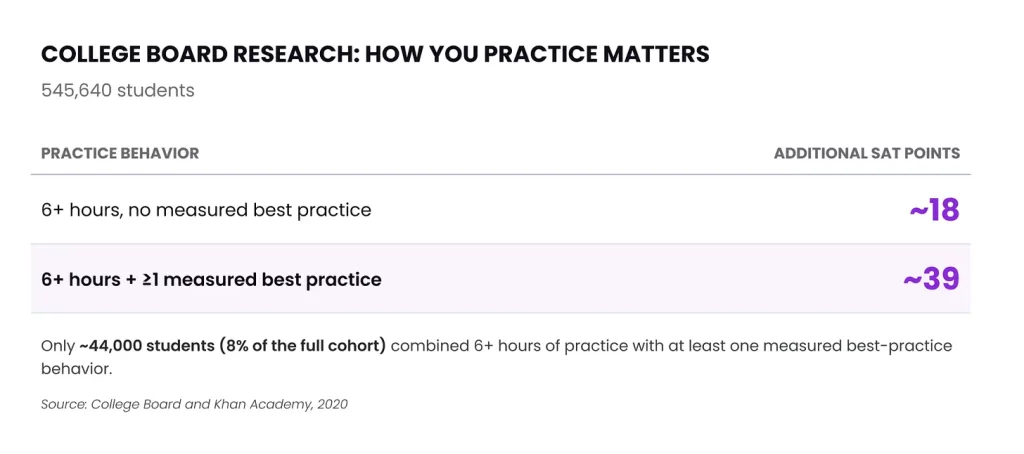
    Its larger 2020 study of 545,640 students associated six or more hours of practice with just 21 additional points—or 39 when students followed at least one best practice.

    We found no published College Board or comparable third-party study substantiating the 100- or 200-point gains commonly promised by adaptive test-prep companies. The problem is not effort. It is where that effort goes—and what happens after each mistake.

    Which Test Prep Strategies Are Most Likely to Plateau?

    Bluebook provides the best official benchmark, while topic practice reveals broad weaknesses. But neither builds the complete path to a high score.

    Common Test Prep Failures

    What students trusted What students say Most common failure
    Bluebook grinding “I’ve taken every Bluebook test. Why hasn’t my score moved?” Bluebook samples performance; grinding it does not build coverage.
    Bluebook grinding & 

    Adaptive test prep

    “The real SAT® had questions I had never seen before.” Most question banks are too shallow to prevent test-day surprises.
    Adaptive test prep “The platform says I mastered Algebra. But I got tons wrong!” Topic drilling is not mastery.
    Adaptive test prep “My practice scores were much higher than my real SAT® score.” Most platforms lack SAT®-style IRT scoring; easier misses can cost more.
    Adaptive test prep “Can I trust my predicted SAT® score?” Most predictions rely on too little learner data to be reliable.

    The Four Stages of SAT® Score Growth

    Students’ needs change as they improve:

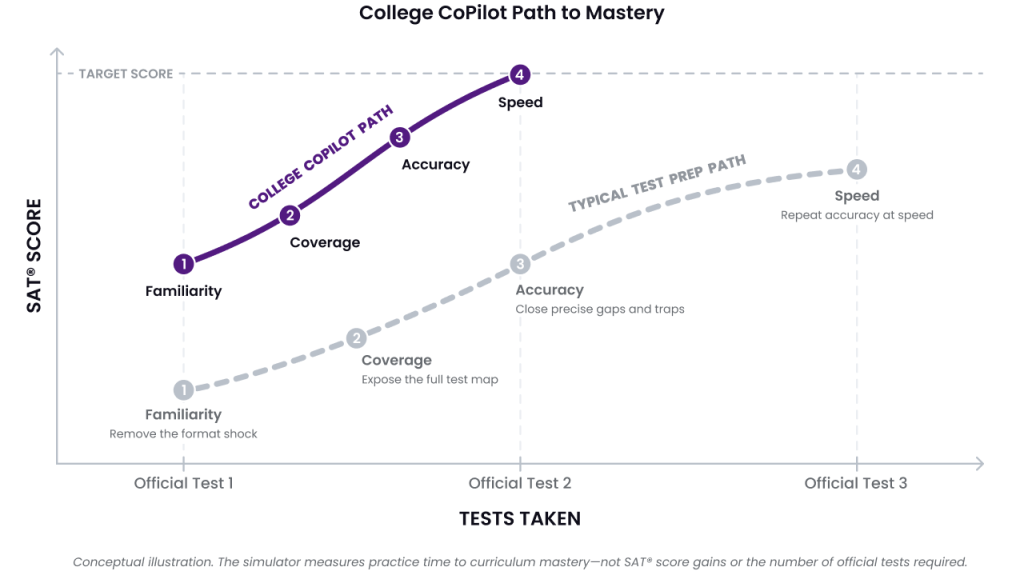
    • Familiarity: The first test is always a shock. Remove format shock before the first official sitting.
    • Coverage: Expose teens to the full range of question types before test day.
    • Accuracy: Actively close precise gaps, misconceptions and recurring traps.
    • Mastery: Create opportunities to repeat and demonstrate accuracy at speed under pressure.

    As students approach 1400–1500, the barrier shifts from unfamiliarity to mastery at speed.

    Reach Your Target With Fewer Official Tests

    College CoPilot replicates official SAT® conditions before test day, making the first official test a meaningful benchmark—not a practice run. Preparation can then target accuracy gaps and mastery under pressure.


    We built a simulator from real historical SAT® response and benchmark data to compare Dakota with the two strategies students use most: adaptive Topic Drilling and Bluebook Grinding—taking one full-length practice test after another. The same simulated students worked through the same 29-topic curriculum; only the way each strategy selected the next question changed.

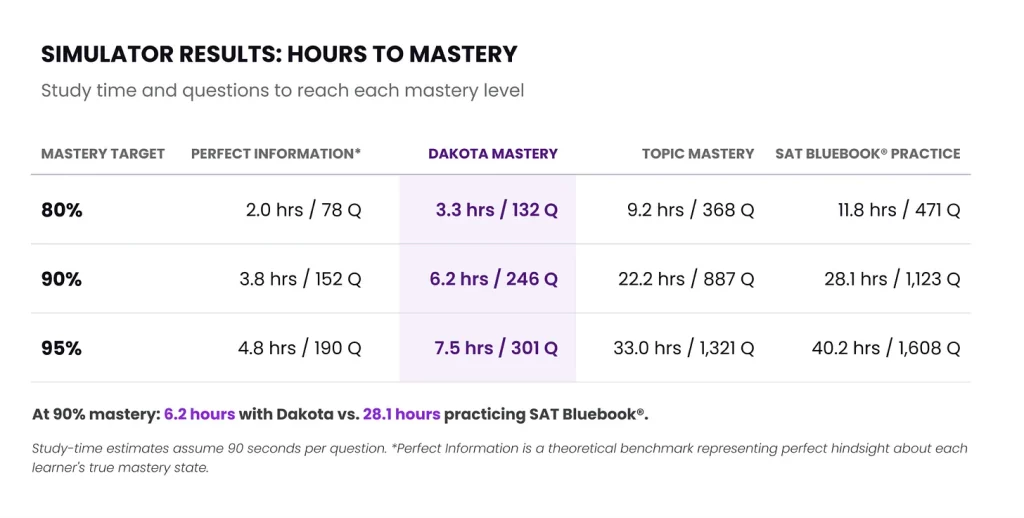
    Dakota reached 95% mastery in 7.5 hours, versus 33 hours with Topic Drilling and 40.2 hours with Bluebook Grinding. It preserved the repetition students needed while eliminating unnecessary practice.

    The simulation measured curriculum mastery, not SAT® score gains, and assumed 90 seconds per question.

    Dakota Is Different

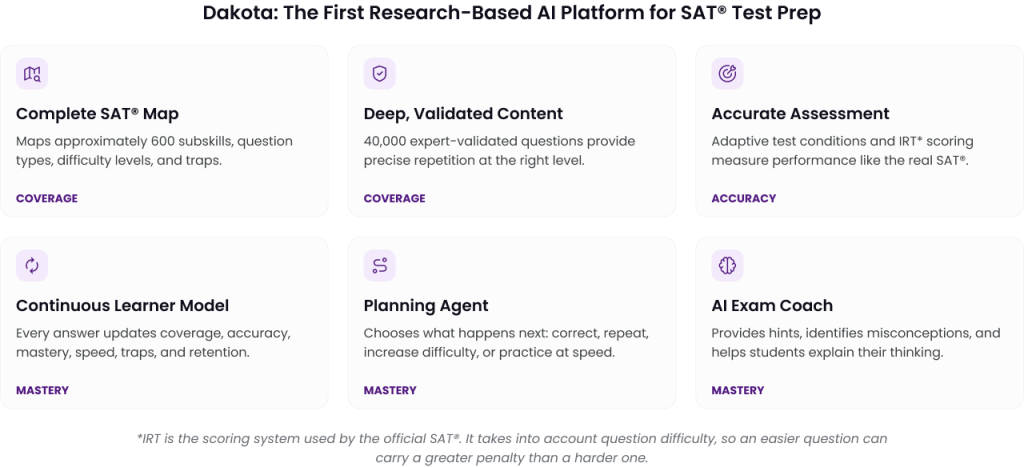
    Dakota combines SAT®-style adaptive testing and IRT scoring, 40,000 expert-validated questions, and algorithms informed by real student responses. After every answer, it tracks coverage, accuracy, mastery, speed, traps, and retention—then chooses the next best step, with an AI tutor available whenever students get stuck.

    More questions are not the answer. The right questions, in the right order, followed by the right learning behaviors, are.

    Dakota vs. Test-Prep Platforms

    Dakota connects all four stages—familiarity, coverage, accuracy and mastery—into one learning system.


    Dakota vs. Test-Prep Platforms

    Dakota connects all four stages—familiarity, coverage, accuracy and mastery—into one learning system.

    Stage What students need Dakota Score Smart Test Innovators OnePrep Khan Academy
    Familiarity Looks and feels like the real SAT® Yes Yes No No No
    Coverage Expert-validated and continuously updated questions Yes Yes Yes            
    (not updated)
    No No
    Coverage Depth across the full test map 40,000+ 5,000+ 1,700+ 4,000+ Limited
    Accuracy Tracks learning across 600 subskills and question types Yes No No No No
    Accuracy SAT®-style IRT scoring Yes No No No No
    Mastery Bluebook and official SAT® score import and analysis Yes Yes No No No
    Mastery AI exam coach for technique, traps and misconceptions Yes No No No No
    Mastery Planning agent for speed & accuracy.  Yes No No No No

    Based on publicly described product features as of August 2026. “Not publicly described” means we found no explanation of the capability on the company’s public product pages; it does not prove the capability does not exist. Sources: ScoreSmart, Test Innovators, OnePrep and Khan Academy.


    Start preparing with Dakota. 

  • Dakota, AI Engineered for Better Test Outcomes


    Dakota reached 90% mastery in about 6 hours for SAT® test prep. Achieving the same mastery levels using SAT® Bluebook questions took about 28 hours. Try Dakota free at collegecopilot.me


    Students spend hundreds of hours studying. But more time studying does not necessarily mean more learning. We saw this clearly in SAT® preparation.

    In one of the largest studies ever conducted on SAT® preparation, College Board and Khan Academy studied 545,640 students. Six or more hours of practice was associated with only about 18 additional SAT® points. When students combined six or more hours with at least one measured best-practice behavior, the gain was still only about 39 points.

    This is a far cry from the 100- or 200-point gains widely advertised on social media — claims that are not backed by comparable published data or research.

    So the question is not whether students can improve. It is about closing the gap between modest average gains and the much bigger results students need to get into their dream school.

    We know what great learning looks like. An expert tutor gets to know the student: what they know, why they’re struggling, what they need next, when to push harder, when to review, and whether the learning has actually stuck.

    But no tutor can do all of that continuously while tracking mastery across hundreds of subskills.

    Dakota can.

    Dakota combines a detailed understanding of the subject with a continuously evolving understanding of the learner — then uses both to decide what the learner needs next.

    And when we tested Dakota in a simulator modeled on real SAT® student-response and benchmark data, the difference was dramatic:

    In our simulator using real student data, the Dakota Mastery strategy achieved 90% mastery in about 6 hours of practice, compared with about 28 hours for SAT Bluebook practice with the same content.

    Same underlying curriculum. Same mastery target. But a vastly different outcome for the student. And when you’ve got to manage homework, athletics, college passion projects and just trying to be a teenager — getting the right kind of academic support on a high-stakes exam such as the SAT® is critical. And these tests matter far beyond college admissions: more than 25 states require the SAT® or ACT® as part of public high-school testing.

    Here is how it works.


    The Dakota Learner Model

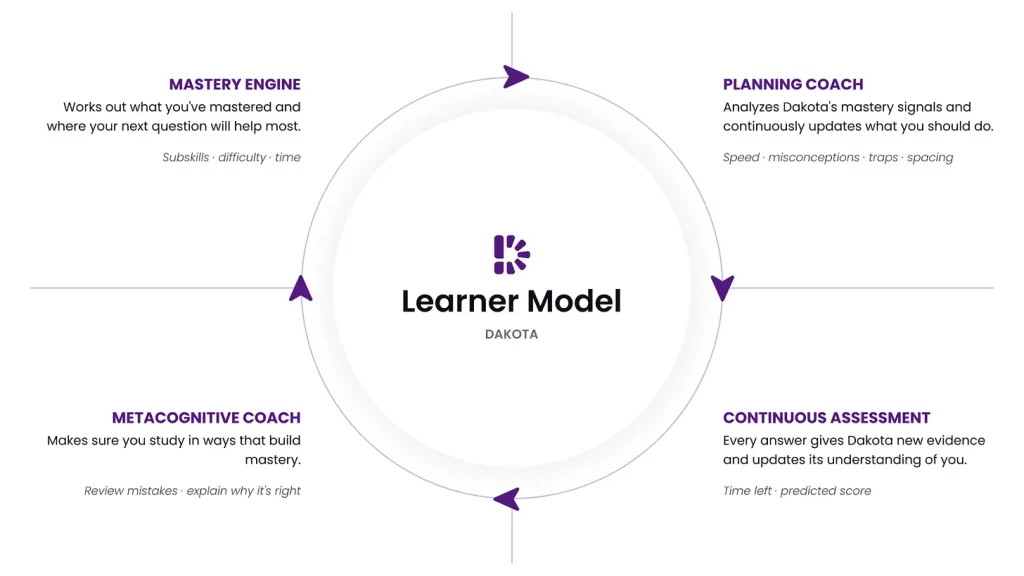
    At the center of Dakota is a continuously evolving model of each learner.

    Every question gives Dakota more information — not only whether the student got it right or wrong, but what they have mastered, how quickly they can use it, where they are struggling, which misconceptions or traps recur, and whether previous learning has stuck.

    Together, these create a continuous loop: Dakota understands the learner, decides what they need next, coaches them through the work, measures what changed, and updates again.


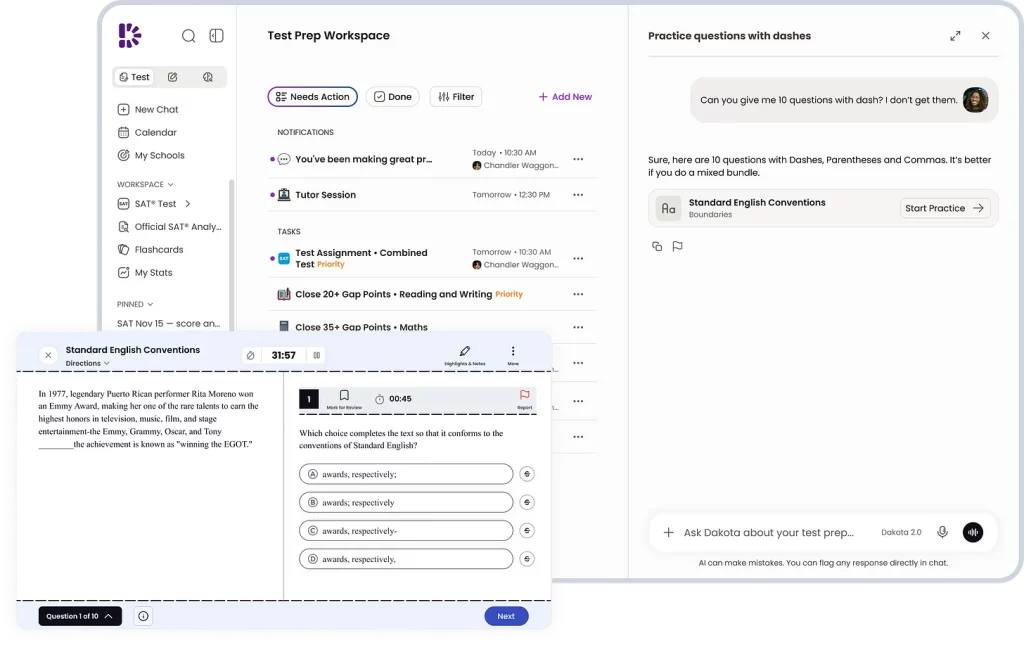
    From Chatbot to Learning Workspace

    The interface for AI is changing rapidly — from chatbots that answer questions to persistent, agentic workspaces that understand context and help users complete complex work over time. Like Claude, Dakota’s new interface is built around connected workspaces with agentic capabilities.

    Students can ask Dakota anything while they work — “Why do I keep getting these questions wrong?” “Am I on track for a 1500?” “Can you give me an assignment on the geometry I’m struggling with?” Their questions, goals, and preferences can inform Dakota’s recommendations and plan.

    If a student asks for a specific assignment and completes it, those results become new evidence of what they know, updating their mastery and what Dakota recommends next. The student can shape the direction while every new piece of work deepens Dakota’s understanding of them.

    A Richer Model Makes Better Decisions

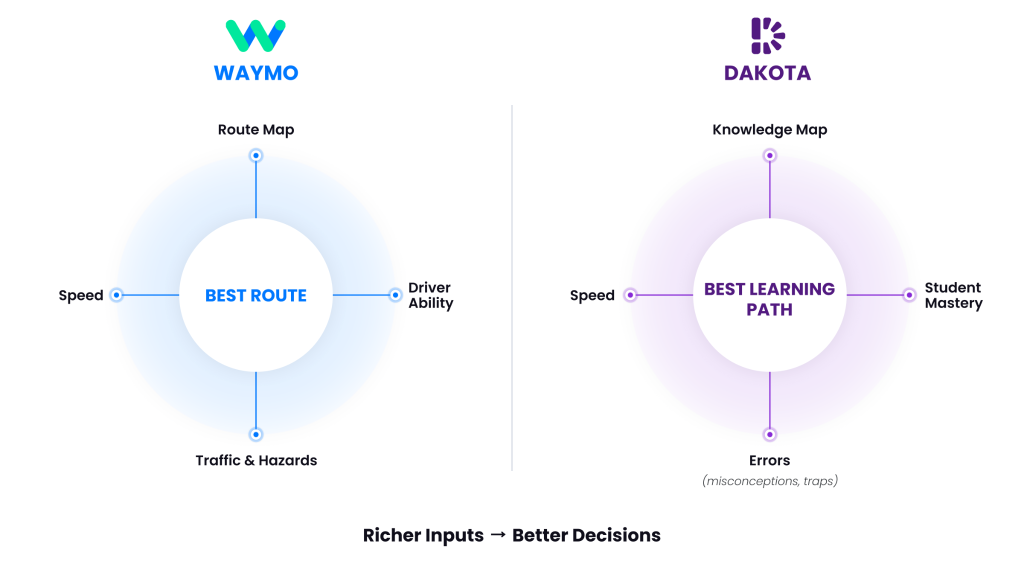
    Think about how Waymo made autonomous vehicles possible by going beyond Google Maps.

    Waymo makes decisions from a richer picture of the journey. It combines the road network with signals such as speed, traffic, accidents, closures, and hazards to determine the best route.

    Dakota applies the same principle to learning with richer inputs that continuously enable Dakota to make better decisions. AI provides the unlock that finally makes personalized learning work.

    Traditional adaptive learning uses limited signals — such as right-or-wrong answers and broad topic strengths — to decide what a student sees next.

    Dakota builds a much richer picture, combining a detailed map of what needs to be learned with subskill mastery, speed, misconceptions, traps, metacognition, goals, and time remaining.

    A wrong answer might reveal a missing subskill or expose a recurring misconception. A correct answer can take too long. And a skill mastered previously may need to be retrieved later to determine whether it has really stuck.

    This matters because accurate prediction depends on accurate, current information about the learner. Continuous assessment gives Dakota the evidence to understand how a student is progressing and how much work remains. And it helps Dakota continually update their predicted score.


    The College Board® Research – How You Study Matters

    The challenge of effective practice is visible in real student outcomes. College Board and Khan Academy’s 2020 analysis followed 545,640 students who took the SAT® , and practiced with Khan Academy Official SAT® Practice. .

    Students who practiced for six or more hours saw substantially different outcomes depending on how they practiced:

    Best-practice behaviors included progressing toward mastery, following personalized recommendations, and completing full-length practice tests.

    But only about 44,000 of the 545,640 students — roughly 8% of the full cohort — combined six or more hours of practice with best-practice behavior.

    The lesson is bigger than SAT® preparation: Effective learning requires the right work, at the right time, in the right way.

    But students have shown us that they won’t orchestrate it themselves. So, Dakota does it for them.


    We Tested How Much the Learning Path Matters

    We wanted to know how much the learning path itself matters. So we built a simulator modeled on real SAT® student responses and benchmark data.

    We gave the same simulated learners the same underlying curriculum and tested different strategies for deciding what they should practice next.

    The results were striking. Students achieved 90% mastery in about 6 hours with Dakota versus 28 hours practicing SAT® Bluebook questions.

    *Study-time estimates assume 90 seconds per question. **Perfect Information is a theoretical benchmark: what could happen if the learning strategy knew each learner’s true mastery state with perfect hindsight.


    At 90% mastery, Dakota required 246 questions. SAT® Bluebook practice required 1,123.

    Perfect Information is a benchmark that already knew exactly what every learner had mastered. It reached 90% mastery in about 3.8 hours. Dakota, on the other hand, didn’t have perfect information. It had to infer the learner’s state from their work, yet reached the same target in 6.2 hours.

    As the mastery target increased, the difference became even greater. Dakota reached 95% mastery in about 7.5 hours, compared with 40 hours of SAT® Bluebook practice.

    The experiment measures modeled mastery and learning efficiency, not SAT® score gains. But it demonstrates something fundamental:

    What a student is asked to do next can dramatically change how long it takes them to master the same material.


    Dakota Also Coaches You to “Learn How to Learn”

    Choosing the right question is only part of effective learning. Students also need metacognition or to learn how to learn.

    In practical terms, Dakota can prompt a student to review a wrong answer, understand the misconception or trap, explain why the correct answer is right, and later retrieve that learning again.

    These aren’t extra lessons for the student to manage. They’re built into the learning path. The student does the thinking. Dakota coaches the learning.


    Beyond SAT® Prep

    The same architecture extends beyond SAT® prep. In Reading, Dakota learns from how students read to continuously understand fluency, comprehension, vocabulary, and knowledge.

    The subject changes. The learner remains at the center.

    You can try Dakota free with no credit card initially at collegecopilot.me


    This blog was co-authored by Sofia Fenichell, founder of Dakota.Education and Matthew Simpson, Head of AI at Dakota.Education.

    Dakota is built by a team that combines frontier AI research, production AI engineering, systems architecture, and deep education expertise. Dakota is a Google AI Accelerator company. You can read more about our team today at collegecopilot.me (or in the future at Dakota.Education).

    Dakota.Education operates CollegeCopilot.me and will soon be releasing Dakota.Reading. Dakota is a native AI company and Google AI Accelerator company, and is one of the few companies to have express permission from Google to use generative AI with under-13s.

  • Meet Dakota: Your College CoPilot AI

    The first AI purpose-built AI for test prep, college research, and application coaching — working with students and counselors to help get into your dream school. Try Dakota free at collegecopilot.me


    Getting into college is a set of connected high-stakes problems. You need to succeed academically and on standardized tests. Work out what you want from college. Find schools where you’ll thrive. Research majors, programs, and opportunities. Build a college list. And create an application that shows colleges who you really are.

    Students have more tools than ever to help. Some are general-purpose AI tools that were never engineered specifically for college. Others are legacy college platforms built for an earlier era, with AI chatbots added on rather than AI engineered into the system from the ground up.

    Dakota brings the intelligence of a great tutor, college counselor, and application coach into one AI built around the student.

    We built three purpose-built workspaces for Test Prep, College Research, and Applications. Each was carefully engineered around a different problem students face — with its own data, models, agents, guardrails, and expertise.

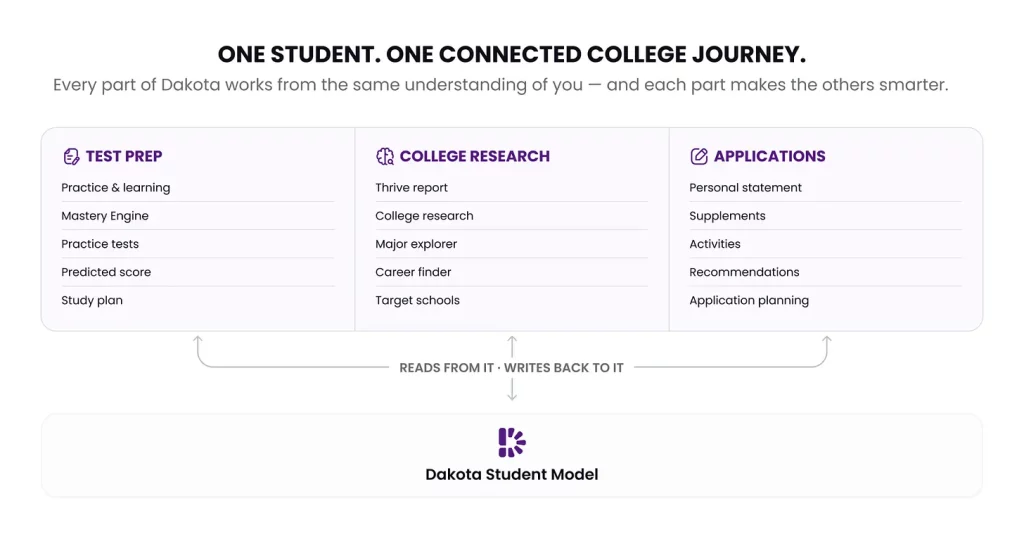
    Every part of Dakota works from the same evolving understanding of you — and each part makes the others smarter.

    What you discover in Thrive shapes your college research. Your research changes your target schools. Your target schools can change the SAT® score you’re working toward. And what you learn about yourself carries into your application. You don’t have to keep starting over and re-uploading information.


    Test Prep: AI Engineered for Better Learning Outcomes

    Most SAT® prep is built around a familiar loop: test the student, identify a weakness, give them more practice.

    But knowing where a student is weak doesn’t tell you why they’re struggling or what they should do next.

    Dakota was engineered around a much richer model of learning. Its Mastery Engine, Planning Agent, Metacognitive Agent, and Continuous Assessment use signals including subskill mastery, difficulty, speed, misconceptions, traps, response history, and retention to continually determine what each student needs next.

    In our simulator using real student data, the Dakota Mastery strategy achieved 90% mastery in about 6 hours of practice, compared with about 28 hours for SAT Bluebook practice with the same content.

    Read the Research and Methodology behind Dakota SAT Test Prep


    Trusted College Research: Discover Where You’ll Thrive

    Most college planning platforms pigeonhole students into a data box. Students are given rankings, acceptance rates, scattergrams, and filters around reach, fit and safety schools. They are often left feeling disincentivized before they’ve really worked out what they want from the next four years of their lives.

    General AI models such as ChatGPT, Claude, and Gemini solve a different problem. They can research almost anything, but they weren’t purpose-built to help a teenager discover what matters to them and then investigate colleges through that evolving understanding. More importantly, their answers can be inaccurate or poorly grounded.

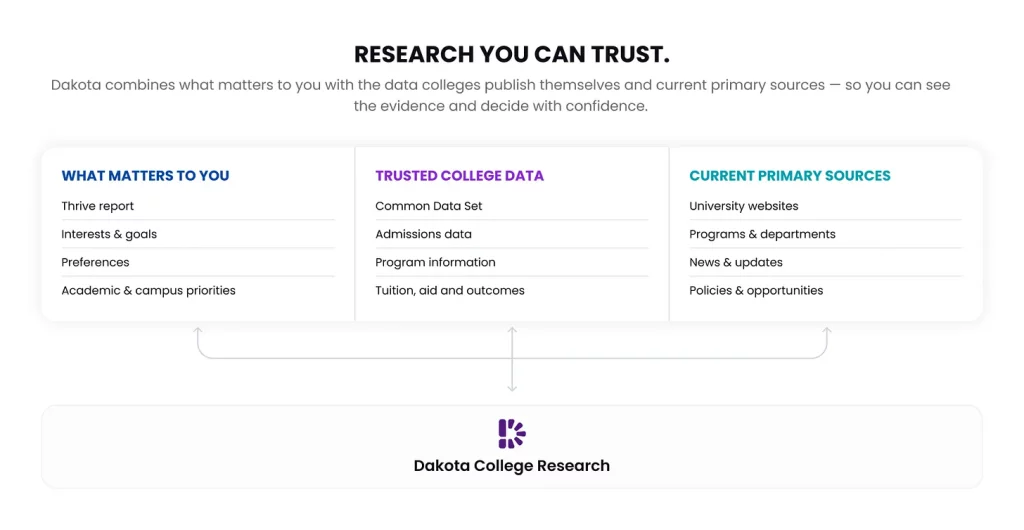
    Dakota was engineered to solve both problems: understand the student deeply and ground college research in trusted evidence.

    Its research layer combines Common Data Set and structured admissions data with current primary sources from universities, departments, programs, and policies. At the same time, Dakota carries forward what it has learned about the student — their interests, reactions, goals, and changing priorities.

    So instead of simply asking:

    Tell me about Northwestern.

    the student can ask:

    Given that I keep coming back to robotics, want hands-on engineering, care about entrepreneurship, and want an active campus community, what should I know about Northwestern?

    Dakota can answer through both lenses at once: what is true about Northwestern and what matters to this particular student.

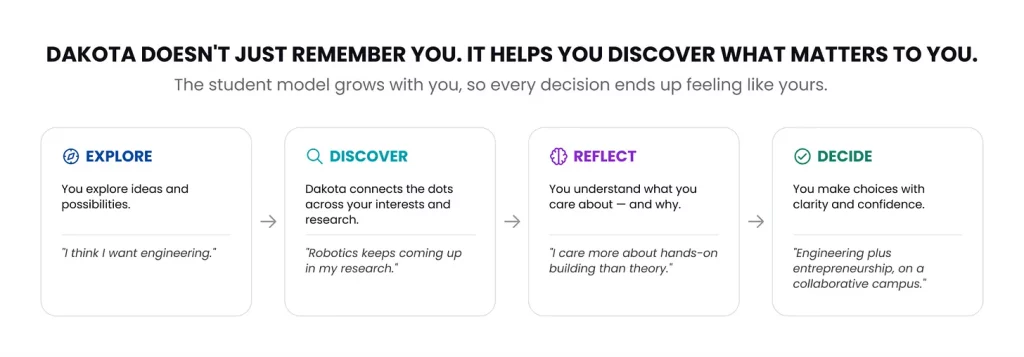
    If a student keeps returning to hands-on engineering, Dakota can surface that pattern: You keep coming back to building and robotics — is that becoming more important than pure theory?

    If they originally said they wanted a city but respond strongly to a close-knit campus community, Dakota can ask: “You said urban life mattered, but you seem drawn to this kind of campus — has your thinking changed?“

    If entrepreneurship keeps appearing across different schools and majors, Dakota can point that out too.

    Dakota’s short-term and long-term memory supports student metacognition. Dakota helps the student see their own patterns, test whether those priorities still feel true, and clarify what they want and why.

    The Thrive Report builds a richer picture of the student — one that can evolve as they learn more about colleges and themselves.. Instead of asking only “What colleges match my stats?” Thrive asks a much richer question: Where will this student actually thrive?

    It explores majors and academics, academic culture, campus life, location, weather, athletics, future goals, and the kind of environment the student wants.

    This means the student is not reduced to a score, GPA, preferred major, and geographic radius.


    Application Coach: A New Kind of Application Workspace

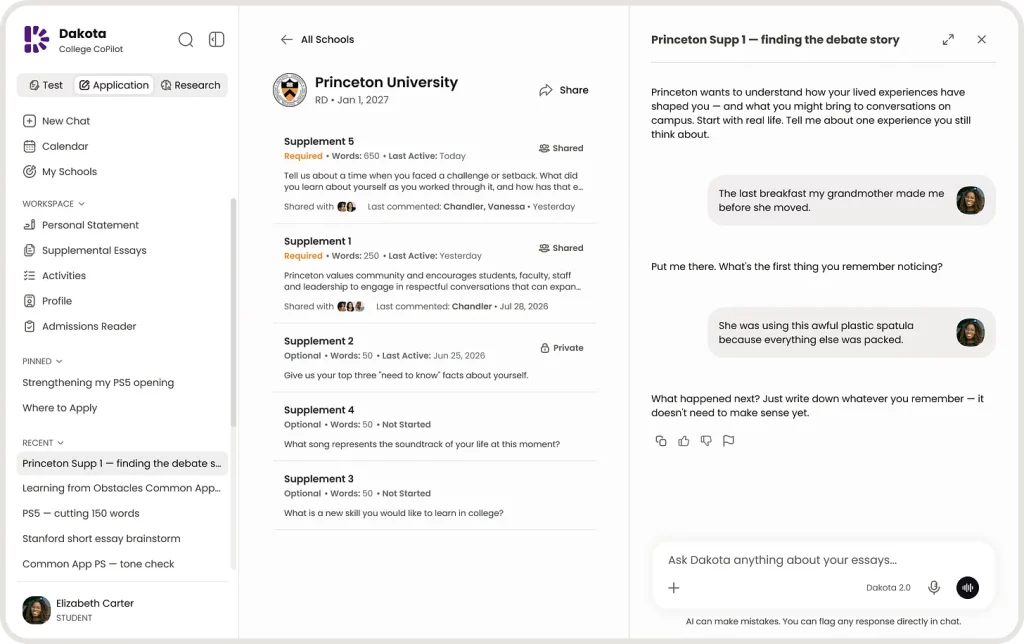
    Dakota turns the chatbot into a persistent application workspace that understands the student, their application, and their progress over time. Students can ask Dakota anything as they work, while counselors, tutors, teachers, and parents can collaborate around the same application and context.


    The Common App Fraud Policy defines fraud as intentionally presenting the substantive content or output of an AI platform as a student’s own original work.


    That creates a problem with general-purpose AI. ChatGPT, Claude, Gemini, and other frontier models can brainstorm essay ideas, suggest stories, create outlines, rewrite paragraphs, and generate application prose — exactly the kinds of substantive AI contributions that can put a student on the wrong side of the policy if submitted as their own work.

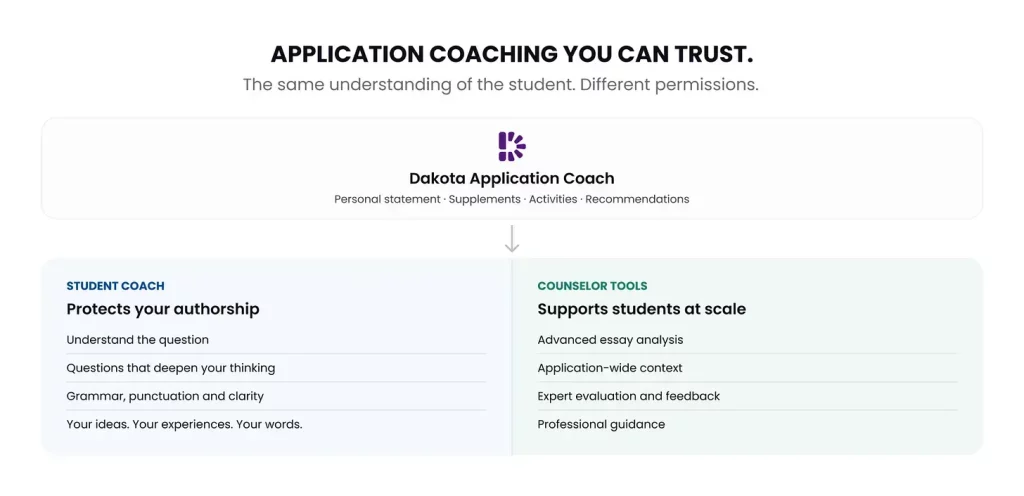
    Dakota’s student Application Coach is designed to comply with the Common App Fraud Policy. It helps students understand the question, asks questions that unlock further thinking, and improves grammar, punctuation, and clarity — without supplying essay ideas or generating application content for them.

    Your words. Your ideas. Your experiences. Your perspective. Your story.


    Applications are Collaborative

    Students rarely apply to college alone. Dakota’s collaboration tools keep counselors, teachers, tutors, parents, and students working from the same application and context, with the right tools and permissions for each role.


    Trust Is Built In

    Guardrails are built into every action Dakota takes. Dakota evaluates what it is being asked to do, checks its own proposed actions against its rules and permissions, and uses multiple layers of safeguards before acting.

    Dakota is FERPA and GDPR compliant. See appendix.

    You can try Dakota free with no credit card initially at collegecopilot.me


    This blog was co-authored by Sofia Fenichell, founder of Dakota.Education and Joshua Lilly, Lead AI Engineer at Dakota.Education.

    Dakota is built by a team that combines frontier AI research, production AI engineering, systems architecture, and deep education expertise. Dakota is a Google AI Accelerator company. You can read more about our team today at collegecopilot.me (or in the future at Dakota.Education).

    Dakota.Education operates CollegeCopilot.me and will soon be releasing Dakota.Reading. Dakota is a native AI company and Google AI Accelerator company, and is one of the few companies to have express permission from Google to use generative AI with under-13s.

  • Admissions Intelligence #9


  • Admissions Intelligence #7


  • The Hidden Logic in SAT Word Problems: Why Translation Beats Calculation


    Most students can do the math. They just can’t figure out WHAT math to do.

    The Real Problem With Word Problems

    Here’s a question that appears simple:

    A car rental company charges $45 per day plus $0.25 per mile driven. Maria rents a car for 3 days and her total cost is $168. How many miles did she drive?

    Ask a student to solve 3x + 12 = 27 and they’ll give you x = 5 in ten seconds. But wrap that same equation in a story about car rentals, and suddenly 60% of students either set it up wrong, don’t know where to start, or end up solving for a different part of the problem entirely.

    The SAT Math section includes 12-15 word problems. Students rarely fail these because they can’t do arithmetic or algebra—they fail because they can’t translate English into equations. The College Board knows this. That’s why roughly 25% of the math section tests your ability to decode verbal setups before you ever touch numbers.


    The Three Common Translation Patterns 

    Pattern 1: Fixed Cost + Variable Rate (Linear Relationships)

    What it looks like in English:

    • “A one-time membership fee of $X plus $Y per month”
    • “$X installation charge plus $Y per hour of labor”
    • “Base salary of $X plus $Y commission per sale”

    What it means in math: Total Cost = Fixed Amount + (Rate × Quantity)

    Real SAT Example:

    A streaming service charges a $12 monthly fee plus $4 per movie rented. Which equation represents the total cost, C, in dollars, for renting m movies in one month?

    The translation:

    “$12 monthly fee” → Fixed cost = 12
    “plus $4 per movie” → Rate = 4 per movie
    “m movies” → Quantity = m

    Equation: C = 12 + 4m

    Why students get it wrong: They see “$4 per movie” and write C = 4m, forgetting the fixed $12 fee entirely. Or they write C = 12m + 4, mixing up which number is the rate and which is the base.


    Pattern 2: Percent Increase/Decrease (Not What Students Think)

    What it looks like in English:

    • “Increased by 20%”
    • “Decreased by 15%”
    • “20% more than the original”

    What it DOESN’T mean: Add 20 or subtract 15

    What it means in math:

    • Increase by 20% → Multiply by 1.20
    • Decrease by 15% → Multiply by 0.85

    Real SAT Example:

    A store increases all prices by 25% on Monday, then decreases all prices by 25% on Friday. An item originally cost $80. What is its price after both changes?

    The translation:

    “increases by 25%” → Multiply by 1.25
    Monday price: 80 × 1.25 = 100

    “decreases by 25%” → Multiply by 0.75
    Friday price: 100 × 0.75 = 75

    Final aswer: $75

    Why studennts get it wrong: They think +25% and -25% cancel out to zero change. They expect $80 again. The trap is that percentages operate on different base amounts—the Monday increase is 25% of $80, but the Friday decrease is 25% of $100.


    Pattern 3: Rate × Time = Distance (And All Its Variants)

    What it looks like in English:

    • “Train A leaves at 60 mph; Train B leaves 2 hours later at 80 mph”
    • “Pipe A fills the pool in 4 hours; Pipe B fills it in 6 hours”
    • “Working together, how long does it take?”

    What it means in math: Rate × Time = Work Done (distance is just one type of work)

    Real SAT Example:

    Jason can paint a room in 6 hours. Maria can paint the same room in 4 hours. If they work together, how long will it take to paint the room?

    The translation:

    “Jason can paint a room in 6 hours” → His rate = 1/6 room per hour
    “Maria can paint a room in 4 hours” → Her rate = 1/4 room per hour

    “work together” → Add their rates
    Combined rate = 1/6 + 1/4 = 2/12 + 3/12 = 5/12 room per hour

    “how long to paint the room” → Time = Work ÷ Rate
    Time = 1 room ÷ (5/12 room/hour) = 12/5 = 2.4 hours

    Why students get it wrong: They average the times: (6 + 4)/2 = 5 hours. This makes intuitive sense but is mathematically wrong. Rates add, and times don’t average in combined work problems.


    A Complex Example: Two-Variable Systems

    The Question:

    A concert venue sold 450 tickets total. Adult tickets cost $30 and student tickets cost $18. The venue collected $11,340 in revenue. How many adult tickets were sold?

    The translation breakdown:

    What you’re solving for: Number of adult tickets sold

    Let a = adult tickets, s = student tickets

    The constraints:

    • “450 tickets total” → a + s = 450
    • “collected $11,340” → 30a + 18s = 11,340

    The solve:

    From equation 1: s = 450 – a

    Substitute into equation 2:
    30a + 18(450 – a) = 11,340
    30a + 8,100 – 18a = 11,340
    12a = 3,240
    a = 270

    Answer: 270 adult tickets

    Why students get it wrong: They set up a + s = 11,340 (confusing the count with the revenue) or 30a + 18s = 450 (confusing the revenue with the count). The numbers look similar enough that mixing them feels plausible.


    The Translation Errors That Cost Points

    Error 1: “Of” vs “More Than”

    “15% of 80” means 0.15 × 80 = 12

    “15% more than 80” means 80 × 1.15 = 92

    Students calculate 15% of 80 and then forget to add it back: they answer 12 instead of 92.

    Error 2: Reversing the Comparison

    “Team A scored twice as many points as Team B”

    If Team B scored x points, Team A scored 2x (not x/2)

    Students see “twice” and think “divide by 2” because that’s what you do when sharing something in half. But “twice as many” means multiply.

    Error 3: Not Converting Units

    “A car travels at 60 miles per hour for 30 minutes”

    Distance = 60 × 0.5 = 30 miles (not 60 × 30 = 1,800 miles)

    The rate is per hour but the time is in minutes. Students forget to convert 30 minutes to 0.5 hours.


    How College CoPilot Teaches Translation Skills

    When you’re working through a word problem and get stuck, the AI tutor doesn’t give you the answer—it asks you questions that help you figure out what the problem is actually asking for.

    Get stuck on setup?
    The tutor asks: “What are you solving for? What does each number in the problem represent?”

    Set up the equation wrong?
    The tutor points out what your equation actually says: “Your equation means the daily rate changes with miles driven. Does the problem describe it that way?”

    Translate a phrase incorrectly?
    The tutor highlights the specific phrase you misread: “The problem says ‘charges $45 per day’—that’s a rate. Where does that go in your equation?”

    Make the same mistake twice?
    The tutor reminds you: “We’ve seen this pattern before—when the problem says ‘increased by 20%,’ that means multiply by 1.20, not by 0.20. Try again.”

    The system tracks which translation patterns trip you up most (percent change, rate problems, comparison statements) and gives you more practice on those specific patterns until you recognize them instantly.

    It’s just good tutoring—questions instead of answers, pattern recognition instead of memorization, and targeted practice on your actual weak spots.


    The Bottom Line

    SAT word problems don’t test advanced math—they test whether you can recognize patterns hidden in English sentences and convert them to equations quickly.

    The students who excel at these questions aren’t necessarily better at algebra. They’re better at spotting the phrase “charges $X plus $Y per unit” and immediately thinking “fixed cost + variable rate = linear equation.”

    After working through targeted practice organized by translation pattern (not just difficulty), students stop reading every problem from scratch. They recognize the structure in the first sentence and know exactly what equation to build.

    Translation is a skill. Like any skill, it improves with practice that focuses on the specific step where errors happen: not the calculation, but the setup.


    Does your student struggle with word problems even though they know the math? Take a College CoPilot diagnostic to see which translation patterns they’re missing—then practice with an AI tutor that coaches them through the thinking process until pattern recognition becomes automatic.