Your Weekly Intelligence Brief |
||
|
||
|
||
 |
||
|
||
|
Your Weekly Intelligence Brief |
||
|
||
|
||
|
||
|
||
|
Getting into college is a rite of passage that takes a team of CoPilots — loving parents, counsellors, teachers, and tutors.
And starting Monday, you’ll be able to add Dakota, your AI CoPilot, to that team.
What did it take to build an AI that truly helps teens get into college? Three things:
-A team of expert human CoPilots who have built excellence — from leading universities, testing organisations, world-class schools, and global tutoring companies.
-Quality and precision — in both content and technology. When you’re dealing with a student’s future, accuracy isn’t negotiable.
-A passion for access. Most families can’t afford £200-an-hour tutors. And frankly, you’ll need that money for college.
Now, they’re bringing all that experience to College CoPilot — because your teenager’s future deserves people who’ve spent their lives getting it right.
You’re here because you want a better score. We’re here to show you exactly how to get it.
The SAT is built around 7 score levels. Each level tests different skills—and gets progressively harder. The key to gaining 200+ points isn’t more practice. It’s the right practice, at the right level.
Here’s how to get there:
Already have scores? Upload your official SAT score report or any Bluebook practice test.
Starting fresh? Take one of our full-length practice tests—built to match the real Bluebook experience.
Either way, this is where it begins.
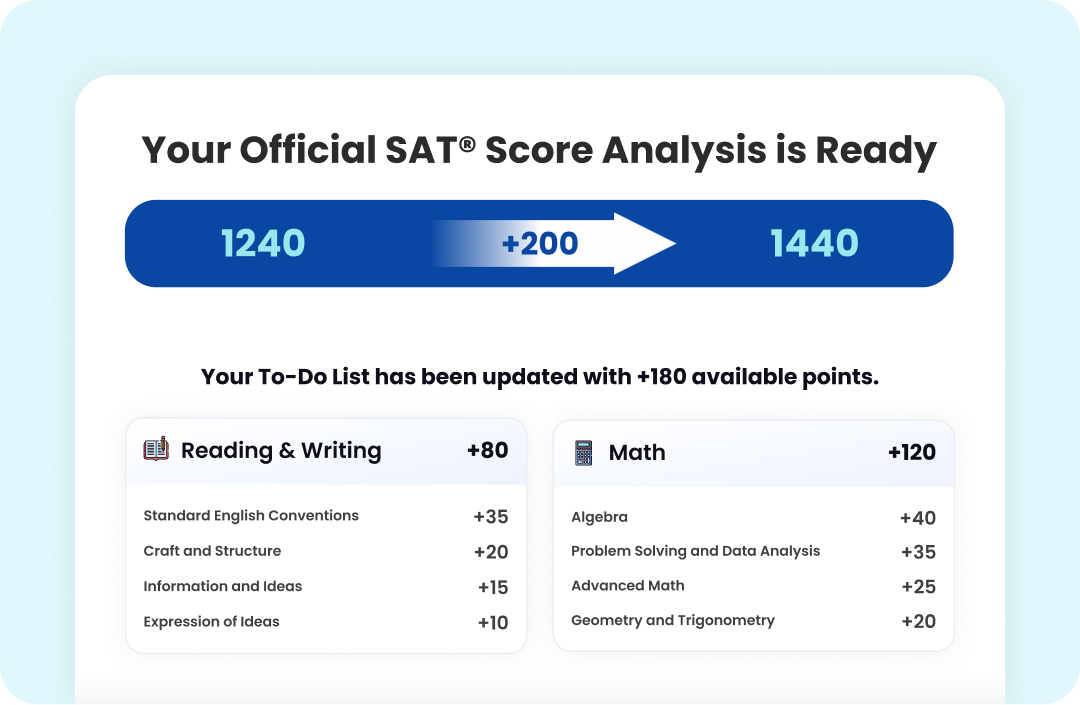
Our Analyzer breaks down your results by domain, skill, and difficulty level—aligned to the College Board’s own 7-band framework. You’ll see exactly where you’re losing points and what it takes to break into the next level.
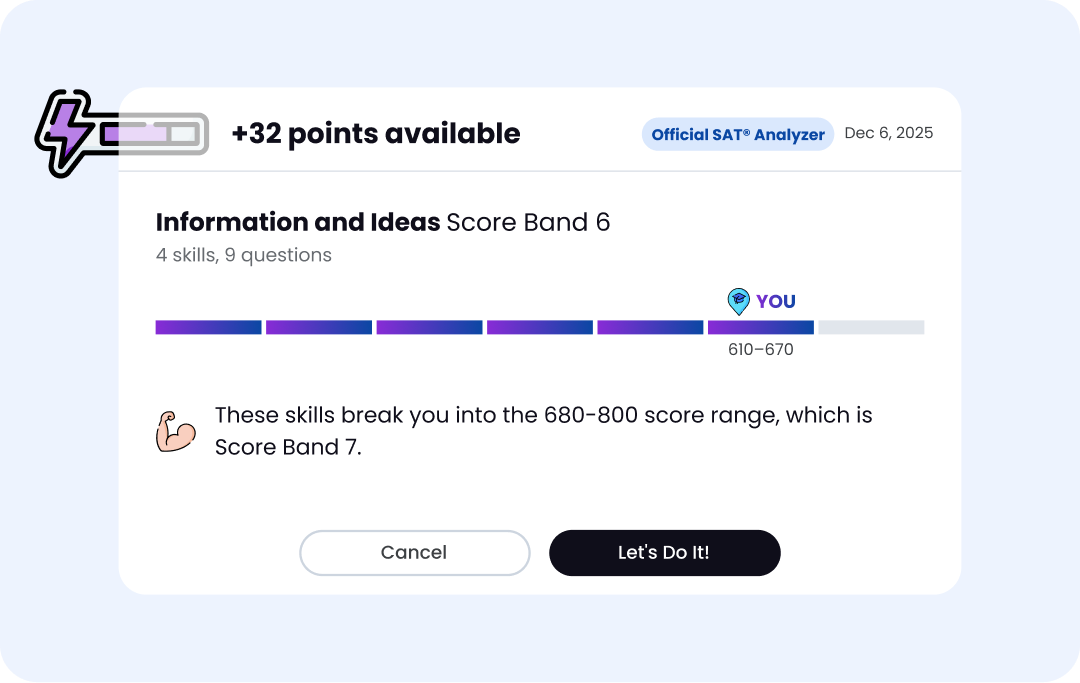
We turn your gaps into targeted practice. No random studying. No wasted time. Just focused reps on the skills that will actually move your score.
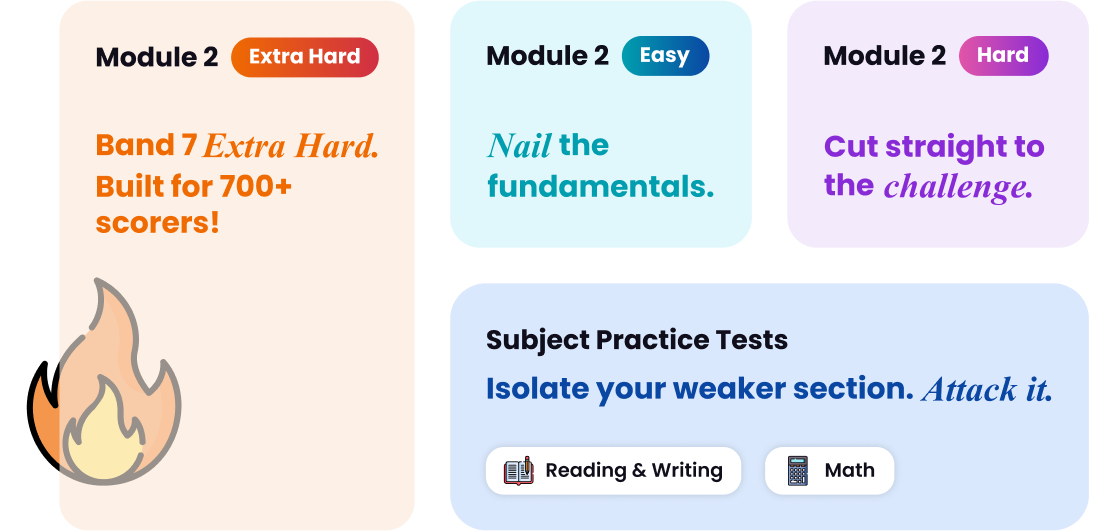
Don’t have time to sit a full practice test? Take a Module 2 only. Want to break into 1500+? Take a Band 7 Extra Hard test. English only. Math only. Only the tests you need. Exactly like the real SAT.
Ask Dakota for anything—voice or text—a Study Plan, when to use the Desmos calculator to save time, or grammar hints.
March SAT. One test. Hit your target. Move on.
No summer prep. No fall stress. No retakes. One-and-done is our goal.
Most colleges are trying to keep AI out of admissions essays. The University of Michigan’s Honors Program is requiring it.
Their 2026 LSA Honors prompt:
Use an AI text generator to write an essay on the topic “Why is the LSA Honors Program a good fit for me?” Submit the AI-generated essay unchanged. Then write your own essay analyzing it — where did the AI get it right, where did it get it wrong, and why?
For the third year, Michigan’s LSA Honors Program is handing students AI and saying: now show us you can think for yourself.
The conversation around AI in college admissions has centered on detection — can schools tell if a student used ChatGPT? Michigan reframed the question.
They’re not asking: Did you use AI?
They’re asking: Can you tell when AI is wrong — and why?
That’s what the workplace will demand from this generation.
The student has to read the AI essay closely, spot the generic claims, find where the logic is thin or the writing follows a formula — and articulate all of it in 750 words.
A 2025 Kaplan survey found that 50% of admissions officers view AI use in applications unfavorably. Most schools are still focused on prohibition and detection. Brown bans AI in applications entirely. BYU threatens to rescind admission. Yale calls it “application fraud.”
Michigan chose a different path: test the skill, not police the tool.
AI-generated essays aren’t bad because they’re “cheating.” They’re bad because they’re generic. A 2025 Cornell study found that AI essays sound competent but feel hollow — they lack the specifics and self-awareness that make a personal statement personal.
It’s about what kind of thinker your teen is becoming.
AI is already handling first drafts across industries. The analyst who accepts an AI-generated market summary without questioning its assumptions is less valuable than the one who catches the flawed reasoning. The lawyer who submits an AI-drafted contract without spotting the ambiguous clause is a liability.
Read carefully, evaluate whether it holds up, explain why it doesn’t — that’s what separates people who use AI as leverage from people who get replaced by it.
It’s also what the SAT measures. The ability to read dense, unfamiliar material and make precise judgments under constraint.
Michigan just made that connection explicit. The question is whether your teen is building that capacity now.
Every year, colleges report detailed admissions data through the Common Data Set—standardized, verified, and used by admissions offices themselves. It’s the source behind every credible ranking. And now it’s the source behind College CoPilot.
What SAT score do you need for Duke? What are your chances applying Early Decision? Is Northwestern generous with financial aid?
Accurate. Reliable. Straight from the source. All at your fingertips.
CDS data goes far beyond SAT scores. Here’s what you can find:
Everything you need to actually understand a school—not just get in.
Use real data to find schools that fit—academically, financially, culturally.
Duke vs. UNC. Northwestern vs. Michigan. See the actual numbers, not the marketing.
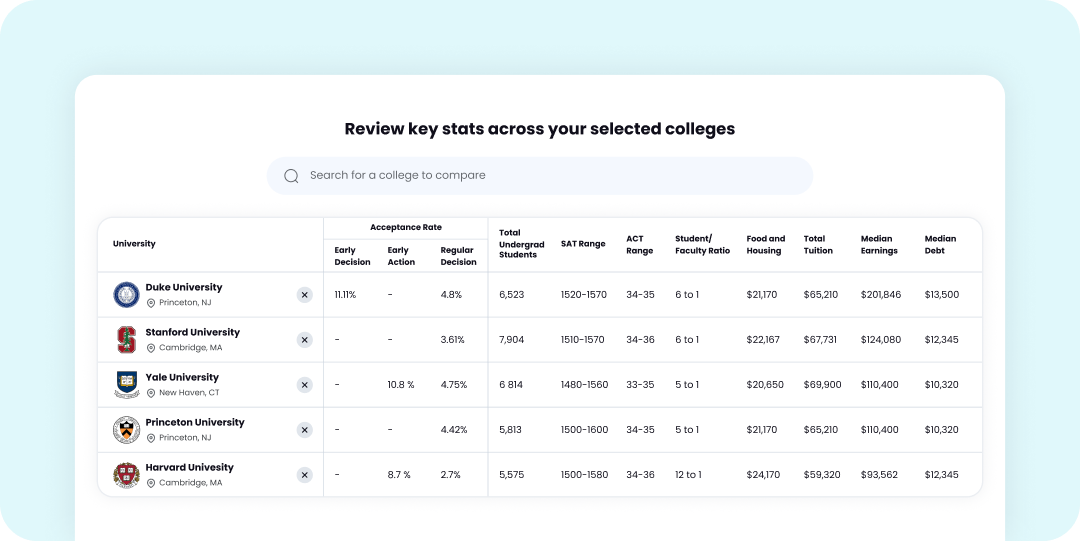
Which round gives you the best shot? What scores do admitted students actually have? Where is financial aid most generous?
“You need a 1480 for Duke. Now you know what to work on.”
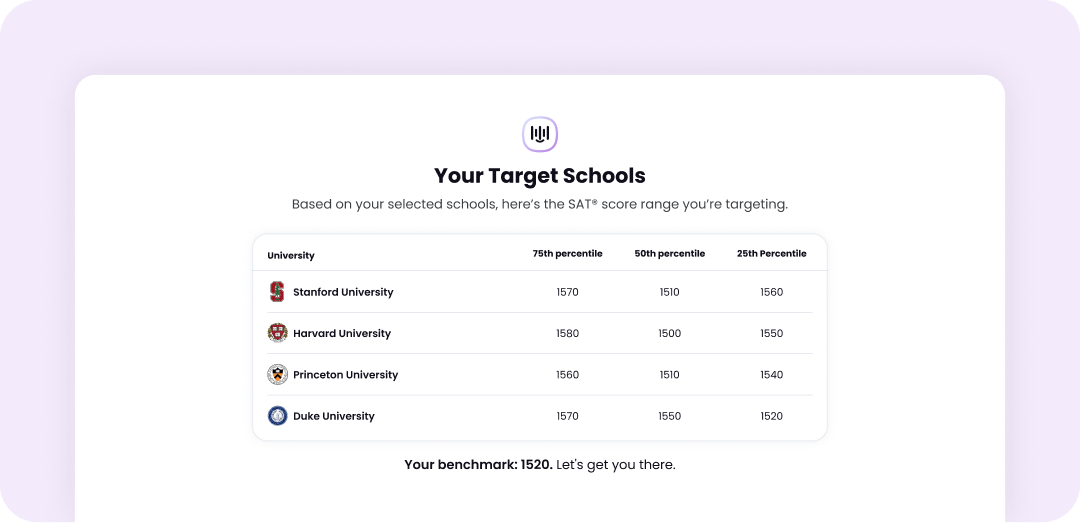
Data makes it real. Teens respond to stats.
When a student sees that the 50th percentile SAT at their dream school is 1510, it’s no longer abstract. They know what it takes. And that clarity drives action.
Discovering schools through data also sparks genuine interest. A teen might not care about “rankings”—but they might care that 85% of students live on campus, or that the school has a top-five program in their intended major.
Most importantly, it puts ownership in the student’s hands. They’re not being told what to do. They’re researching, discovering, and building their own list. That’s motivation you can’t manufacture.
This is one of the most important decisions of your life. We give you the data that cuts through the noise — all in one place.
And it’s free.
Want to go deeper? Our AI-powered Deep Research tool lets you explore programs, culture, and fit—so you’re not just chasing a name, you’re maximizing your chances of getting in.
College CoPilot. The Admissions Intelligence platform for your family.
Explore College Research here.
Reading comprehension sounds like the easy part of the SAT. It isn’t. “Find the main idea” sounds straightforward until you’re doing it at speed, with passages so dense you’ve lost the thread by the time you reach the question.
The SAT doesn’t test whether you’ve read the Iliad. It tests whether you can pull apart a 100-word passage about gene expression in 60 seconds and identify exactly which claim the data supports. That takes a specific kind of reading muscle. Reading more books won’t do it.
Bluebook practice tests contain these hard questions, but they’re buried inside Module 2, scattered across dozens of tests. You’d have to take every Bluebook to see them all, and even then you’d spend most of your time on medium-difficulty questions.
We extracted the hardest Module 2 reading questions and built one test around them. College CoPilot’s Hard Reading Test gives you the full range of top-level skills in a single sitting. Timed, same interface, and when you get one wrong, Dakota, our AI tutor, breaks down the passage and shows you exactly where your reading went off track.
Try them at collegecopilot.me.
Below are the six reading skills the SAT tests at the highest difficulty, with the key hint and trap for each.
This is the skill students assume they’re good at. “What is the passage mainly about?” feels like a freebie until the answer choices are four statements that are all technically true, but only one captures the central point rather than a supporting detail.
Key hint: After reading, ask yourself: what is the author’s single main point? Not what’s mentioned. Not what’s interesting. The one thing the entire passage is in service of.
The SAT trap: The wrong answers are details lifted directly from the passage. They’re accurate, they’re just not the main idea. Students pick them because they recognize the language and feel reassured. The SAT is testing whether you can distinguish the point from the evidence.
These questions ask you to find the specific quote or detail that supports a given claim, or to evaluate whether a piece of evidence strengthens or weakens an argument.
Key hint: Don’t look for the quote that sounds the most relevant. Look for the one that logically proves the claim. There’s a difference between a quote that’s related to the topic and a quote that actually functions as evidence.
The SAT trap: One answer choice will be on the same topic as the claim but won’t actually support it. It’ll feel right because it’s in the same territory. The SAT is testing whether you understand what “evidence” means, not association, but logical support.
These questions pair a passage with a graph, table, or chart and ask you to read the data either to complete a statement or to determine whether the data supports or weakens a claim.
Key hint: Read the axis labels and column headers before anything else. Students lose time and accuracy because they jump to the data without confirming what’s actually being measured.
The SAT trap: The wrong answers often describe a real trend in the data, just not the one the question is asking about. Or they reverse the relationship (saying something increased when it decreased). The passages are dense enough that students stop checking and rely on what they think they saw.
A second trap: the question asks whether data “supports or weakens” a claim. Students default to looking for support. Sometimes the correct answer is that the data weakens the claim, and students skip it because they weren’t looking for it.
The SAT doesn’t test obscure vocabulary anymore. It tests common words used in uncommon ways, often literary or academic uses that shift the meaning from what students expect.
Key hint: Substitute each answer choice back into the sentence and read it literally. The correct answer will preserve the author’s specific meaning. The wrong answers will be definitions of the word that are technically valid but don’t fit this particular use.
The SAT trap: The most obvious, everyday definition of the word is almost always wrong. Students see a familiar word, assume they know what it means, and pick the answer that matches their assumption rather than the context. The SAT is counting on autopilot.
These questions ask why the author wrote the passage, not what the passage says, but what it’s doing. Is it arguing? Comparing? Qualifying a previous claim? Introducing a counterexample?
Key hint: Ignore the content for a moment and focus on the moves. Is the author setting up a contrast? Building toward a conclusion? Responding to someone else’s argument? The answer is about the function, not the facts.
The SAT trap: The wrong answers describe what the passage is about rather than what the passage is doing. Students who read for content instead of structure will pick an answer that accurately summarizes the topic but completely misidentifies the purpose.
These questions give you two short passages and ask how they relate. Do the authors agree? Disagree? Does one qualify the other’s argument? Does one provide evidence for the other’s claim?
Key hint: Read each passage and write a one-sentence summary of its position before looking at the answer choices. Then compare the two sentences. The relationship should be clear before you engage with the options.
The SAT trap: The passages often agree on the broad topic but differ on a specific point or vice versa. Students who read quickly will see the shared subject and assume agreement, missing the subtle disagreement that the question is actually testing. The SAT wants to know if you can hold two positions in your head simultaneously and identify the precise relationship between them.
Grammar can be solved with rules. Reading comprehension can’t, which is exactly why it’s where most students plateau. The passages are dense, the time pressure is real, and the wrong answers are designed to reward surface-level reading.
The only way to get faster and more accurate is to practice these specific skills at the difficulty level where they actually appear. Not easier passages with obvious answers. The hard ones, where every answer choice looks plausible, and the difference comes down to precision.
That’s what the Hard Reading Test is for. Try it at collegecopilot.me.

At Yale, admissions officers first use academic data to confirm a student’s ability to do the work. For most applicants, the answer is yes — data simply opens the door to deeper review.
“At Yale we use data to essentially answer the preliminary question, ‘Is a student prepared to do the academic work at our institution?’ …for most students in our applicant pool, the answer to that question is yes, the student does have the preparation academically to do well at Yale. And then we turn to the rest of the application file.” — Jeremiah Quinlan, Yale
Committees read transcripts as narratives — focusing on course choices, rigor, and academic trajectory, rather than relying solely on a single GPA number.
“At Yale we use data to essentially answer the preliminary question, ‘Is a student prepared to do the academic work at our institution?’ …for most students in our applicant pool, the answer to that question is yes, the student does have the preparation academically to do well at Yale. And then we turn to the rest of the application file.” — Jeremiah Quinlan, Yale
Officers look for students who have stretched themselves, especially in their junior and senior years, rather than those who have stayed within their comfort zones.
“We’re looking for students who have challenged themselves in high school through rigorous courses…We’re not looking for perfection. We don’t have a rubric.” — Jeremiah Quinlan, Yale
“I wouldn’t be completely worried about a very difficult ninth grade year. We understand that students sometimes have a tough transition to high school and we are looking more closely at more recent grades.” — Jeremiah Quinlan, Yale
“I want to assure everyone that we admit plenty of students with Bs on their transcripts.” — Jeremiah Quinlan, Yale
Evidence of engaging in college-level or honors courses signals that a student has tested their limits and is ready for university-level rigor.
“Part of the evidence I think is seeing that a student has at least dabbled, if not more than dabbled, in some rigorous work that might be a proxy for college level work. So maybe that’s an honors level, maybe that’s a dual-enrollment course. Maybe that’s taking a course at a community college over the summer, maybe it’s AP or IB.” — Emily Roper-Doten, Brandeis
“We hear very loudly and clearly from our faculty that the performance in some of these AP and IB classes is incredibly predictive of how students do at Yale, particularly in introductory math courses.” — Jeremiah Quinlan, Yale
Each admissions officer knows their assigned high schools and reads files with an understanding of the local curriculum, grading culture, and available opportunities.
“We actually organize the world into different geographic portfolios…it’s their job to understand the high schools in their admissions territory and in their context.” — Jeremiah Quinlan, Yale
“There is someone responsible for reviewing the applications from the state of Michigan, and that individual understands the different context of a student applying from the Upper Peninsula or the suburbs of Detroit or East Lansing.” — Jeremiah Quinlan, Yale
Admissions teams rely on school-provided profiles to contextualize a student’s achievements — such as available APs, grading policies, or average test ranges.
“The school provides us a pretty good amount of detail in the school profile for what courses are offered, what the average GPA is at the school, the average number of APs is at the school. Sometimes school will offer us the average standardized test score for the school so that we can put that in context.” — Jeremiah Quinlan, Yale
For example, engineering applicants are expected to show readiness through strong coursework in math and physics.
“For my time at Olin, we were really looking for evidence of calculus. We wanted to see calculus in the high school experience because our curriculum sort of made an assumption that there was calculus there…We also were looking for physics. That’s one of the core sciences that engineering is built on.” — Emily Roper-Doten, Brandeis
While holistic review dominates, strong test scores can reinforce the story told by grades and coursework.
“If the testing is there, it has the potential for it to reinforce what we’re seeing. Maybe it backs up the type of preparation that we’re seeing in the classroom. Maybe it helps give context to something.” — Emily Roper-Doten, Brandeis
“You should take the tests. You would be keeping your options open by taking the SAT or the ACT…You won’t have the data you need to make a decision about submitting testing if you actually don’t have the scores.” — Jeremiah Quinlan, Yale
Yale’s data continues to show that SAT scores correlate most strongly with academic success in their classrooms.
“Turns out actually that the SAT or the ACT is the single best predictor of a student’s academic performance at Yale. And particularly the math SAT in persistence and some of our science majors.” — Jeremiah Quinlan, Yale
“If the testing is there, it is equally important as the transcript…But it does not tell the same story as the transcript can tell us.” — Jeremiah Quinlan, Yale
A 30 ACT may sit below Yale’s median, but if it’s 10 points higher than anyone from that student’s high school in years, it becomes an exceptional achievement in context.
“Students could look at our testing profile and say, ‘Okay, I’ve got a 30 ACT that is not above the median score that students at Yale will admit,’ but actually for the admissions committee…that 30 ACT could be 10 points higher than anyone has scored in that high school in years, and that score is actually transcendent.” — Jeremiah Quinlan, Yale
“We ground everything we do in context. Just like we review the transcripts with a contextual lens, we view the standardized testing with a contextual lens.” — Jeremiah Quinlan, Yale
The Personal Statement
From the Dartmouth Admissions Team
Showing admissions you are a fit
From the Dartmouth Admissions Team
How decisions are made
From the Dartmouth Admissions Team
How not to get in
From the Dartmouth Admissions Team