MIT asks for eight answers on its own application: four essays of about 100 to 200 words and four short responses of 40 to 50 words, plus an optional additional information box. MIT does not require the Common App personal essay and does not receive it. The eight required answers have a combined maximum of 1,000 words. Short means every sentence has to work. For each prompt below, we offer expert guidance on what each question is really testing and how to answer them.
What is MIT’s acceptance rate?
MIT’s overall acceptance rate was 4.6% for the Class of 2030. Its Early Action (EA) acceptance rate was 5.5%; Regular Decision (RD) was not reported.
- Overall: 4.6%
- EA: 5.5%
- RD: Not Reported
- SAT 25th percentile: 1520
- SAT 50th percentile: 1550
- SAT 75th percentile: 1570
What SAT score do you need for MIT?
MIT requires the SAT or ACT. The middle 50 percent of admitted students scored 1520 to 1570. A score in that range helps put your application in the pile to be read. It does not get you in. More applicants have perfect math scores than MIT has places. That is why the essays matter here.
When are MIT’s application deadlines?
Early Action: November 5th. Regular Action: January 15th. MIT’s Early Action is not restrictive and not binding. You can apply early elsewhere unless that school forbids it. MIT uses its own application, not the Common App, so the pieces are different: the MIT form, a secondary school report, two teacher letters, test scores, and an activities form with room for only four activities.
Does MIT have a “Why MIT” essay in 2026/27?
No. None of the eight prompts asks why you want MIT. The third essay comes closest, asking what problems you would want to tackle with an MIT education, and that is a question about the problems and about you. There is no prompt where listing MIT labs, professors or the Infinite Corridor earns anything. MIT’s own advice on its essays page is blunt: if you are spending your time strategizing about what makes you look best instead of answering honestly, you are doing it wrong.
MIT supplemental essay prompts 2026/27 and how to answer them
Prompts are quoted from MIT’s essays, activities and academics page, linked at the bottom. All eight are required. MIT does not receive your Common App personal essay so these eight answers plus four activities are everything MIT learns about you in your own words. Plan them as a set.
1. The field of study that appeals to you most right now (100 to 200 words)
The prompt. What field of study appeals to you the most right now? (Note: Applicants select from a drop-down list.) Reflect on what has led you to this interest.
What MIT is testing. Whether your interest has a history. The words “right now” and “reflect on what has led you” are the instruction. MIT does not admit by major, and it says so. The reader wants the path: what you did that pulled you toward this field, with evidence. A field chosen from a list, with a reason, is more honest than a lifelong calling.
How to answer. Name the field in the first sentence, since you picked it from a menu anyway. Spend the rest on two or three specific things you did, built, read or tested that moved you toward it, and what each one taught you. End with the question you still have. 200 words is three short paragraphs.
Avoid. “I have loved math since I was five.” A why MIT for this major essay, which is not what was asked. And naming a field because it sounds strong at MIT rather than because you have done anything in it.

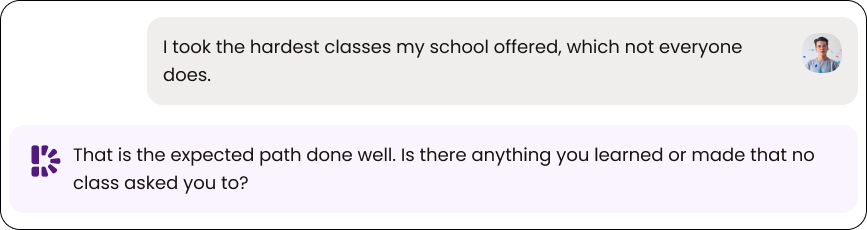
2. Something you did differently from what was expected (100 to 200 words)
The prompt. While some reach their goals following well-trodden paths, others blaze their own trails achieving the unexpected. In what ways have you done something different than what was expected in your educational journey?
What MIT is testing. Initiative. Whether you have ever made a choice about your own education that nobody required. The scale does not matter. Teaching yourself something your school did not offer, taking a course at a community college, dropping a track everyone expected you to follow, or building something outside any class all answer it.
How to answer. One choice, stated in the first sentence, with what the expected path was. Then what you did instead and what it cost or risked. Then what came of it, including the parts that did not work. The reader is looking for agency, not success.
Avoid. Reframing a normal achievement as a trail you blazed. A choice your parents or school made for you. And the hardship story, which belongs in essay 4 if anywhere.
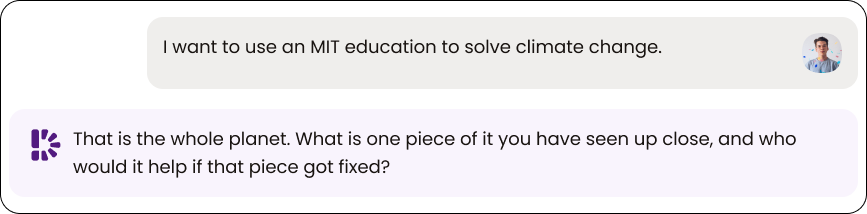
3. The problems you want to tackle and the impact you aim to make (100 to 200 words)
The prompt. How have your personal and academic experiences influenced the types of problems you would want to tackle with an MIT education and the impact you aim to make on your community?
What MIT is testing. Whether your ambitions are attached to something you have seen. The prompt runs from experiences to problems to impact, in that order. MIT’s stated mission is to use science and technology in service of the nation and the world, and this is the prompt that checks whether you mean it. The reader wants a type of problem, not a career, and a community you can name.
How to answer. Start with the experience, personal or academic, where you met the problem up close. Spend about 80 words on it. Then name the type of problem it points to, as narrowly as you can. Then the impact and the community, in plain words. Keep MIT to one clause. The prompt asks what you would do with an MIT education, not why MIT.
Avoid. Changing the world. Problems so large that nothing specific can be said about them. And turning this into the “Why MIT” essay that MIT chose not to ask for.
4. A situation or challenge you did not expect (100 to 200 words)
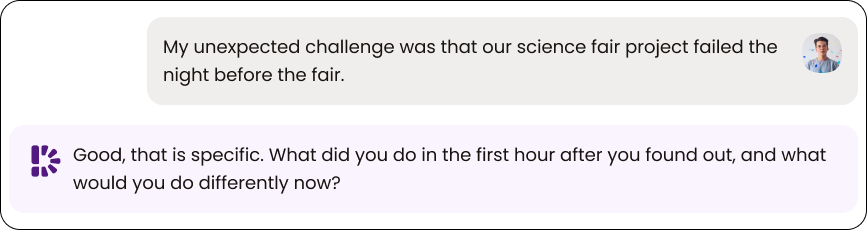
The prompt. How did you manage a situation or challenge that you didn’t expect? What did you learn from it?
What MIT is testing. How you behave when a plan fails. MIT’s own description says it wants to know how you handle things, not how big the thing was. The prompt has two parts, how you managed it and what you learned, and the second is where the answer lives. A small surprise handled honestly beats a large one described vaguely.
How to answer. State the situation in two sentences. Spend the middle on what you actually did, including the first thing you tried that did not work. Spend the last 60 words on what you learned, stated as something you now do differently. “Managed” asks for your actions, not your feelings.
Avoid. Choosing the biggest hardship you can think of because it seems expected. A story where the challenge simply ended. And a lesson stated as a trait, “I became more resilient,” instead of a behavior.
Short responses: how the four work together
40 to 50 words is two sentences. MIT says these are designed to get to know you better, and it means it. The four together form a quick portrait. Plan them so each comes from a different part of your life and each holds a concrete noun. Do not write four tiny essays with a thesis. Answer the question and stop.
One warning. Readers can tell when a detail was chosen to seem interesting rather than because it is true of you. A plain true answer beats a clever invented one every time. MIT says the same thing on its own page.
5. What you do just for fun (40 to 50 words)
The prompt. What do you do just for fun?
What MIT is testing. Whether there is a person behind the application. Choose something you do for fun, even if it’s also on your activities list. Focus on the part you enjoy, not the awards or results. The reader wants the thing with no award attached.
How to answer. Name it in the first sentence. Use the second for one detail that shows you actually do it. If it is small and ordinary, that is the point.
6. Someone you admire (40 to 50 words)
The prompt. Who is someone you admire, whether you know them personally or look up to them from afar? Tell us why.
What MIT is testing. What you value, through who you chose. The person matters less than the reason. A parent, a teacher, a coworker or a public figure all work if the why is specific.
How to answer. Name the person, then one specific thing they do or did that you admire, not a trait. “She rebuilt the engine herself” says more than “she is hardworking.”
7. A topic you could talk about for hours (40 to 50 words)
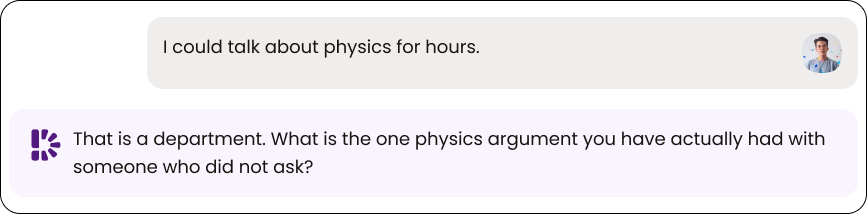
The prompt. What’s a topic, academic or non-academic, that you could talk about for hours?
What MIT is testing. Enthusiasm with detail. The thing you explain too long at dinner. “Academic or non-academic” is a real invitation. The reader wants to feel the hours.
How to answer. Name the topic, then one specific sub question inside it that you would get to by the second hour. The sub question is what proves you could actually talk for hours.
8. Generalist or specialist (40 to 50 words)
The prompt. MIT values both “generalists” with varied interests and “specialists” who focus deeply on one or a few passions. Which do you think best describes you, and why?
What MIT is testing. Self knowledge. MIT says it values both, so there is no right answer. The reader wants you to pick one honestly and give a reason that matches the rest of your application. If your activities form shows one thing done deeply, “generalist” will not land.
How to answer. Pick one in the first sentence. Use the second for the evidence: the pattern in how you spend your time that proves it. If you are in between, say which way you lean and why.
The additional information box
MIT adds one open text box for anything else it ought to know. Use it only for something that explains your application and fits nowhere else: a gap in your transcript, a circumstance that shaped your choices, a project that needs two sentences of context. Do not use it for a ninth essay. If nothing needs explaining, leave it empty.
Before you write: map the whole application
MIT reads your eight answers, your four activities and your coursework form as one file, and it never sees your Common App essay. That changes the job. Whatever story carries your 650 words elsewhere reaches MIT only if you rebuild it inside one of these prompts at 100 to 200 words. Each answer should add something the others do not. Repeating an interest is fine. Repeating the same evidence wastes space.
Write down the four activities you will list. Then give each MIT answer one thing that list is missing.
As you draft and revise, keep your responses in your own voice and make sure they reflect your own experiences and thinking.
Want help connecting the pieces? Dakota, in College CoPilot’s Application Coach, uses what you have already shared to spot repetition and ask the question you have not answered. The writing stays yours.