Duke requires two essays, each with a 250-word limit—”Why Duke” and Communities—and offers three optional prompts, of which you may answer one or none. Across these, you can write up to 750 words. Short means every sentence has to work. With only two required Duke-specific essays, each one needs to add something distinct. For each prompt below, we offer expert guidance on what each question is really testing and how to answer them.
What is Duke’s acceptance rate?
For the Class of 2030, Duke’s overall acceptance rate was 4.7%, and its Early Decision (ED) acceptance rate was 11.9%. Duke has not published a separate Regular Decision (RD) rate for this class.
- Overall: 4.7%
- ED: 11.9%
- RD: Not Reported
- SAT 25th percentile: 1510
- SAT 50th percentile: 1550
- SAT 75th percentile: 1570
What SAT score do you need for Duke?
Duke is test optional for 2026/27 and says applicants without scores are not at a disadvantage. If you submit, the middle 50 percent of enrolled students scored 1510 to 1570. A score in that range helps put your application in the pile to be read. It does not get you in. More applicants have perfect scores than Duke has places. That is why the essays matter here.
When are Duke’s application deadlines?
Early Decision: November 2nd. Regular Decision: January 4th. Early Decision at Duke is binding. If you are admitted, you withdraw your other applications and enroll. You apply to either Trinity College of Arts and Sciences or the Pratt School of Engineering. Duke also accepts an optional Glimpse video of 60 to 90 seconds with its own deadline about a week after each application date, and it does not accept separate résumés.
Does Duke have a “Why Duke” essay in 2026/27?
Yes, and it is required. Duke’s own name for what it wants is “demonstrated knowledge.” Its FAQ says demonstrated interest, meaning visits, emails and meetings with your regional officer, is not a plus factor. What counts is showing in the essay that you understand Duke and why it matches you. Guidance is below.
Duke supplemental essay prompts 2026/27 and how to answer them
Prompts are quoted from the Essays tab of Duke’s Apply page, linked at the bottom. Duke’s What We Look For page lists the quality of thought and expression in the essays as one of five primary factors, and tells applicants to craft the short writing as carefully as the personal essay.
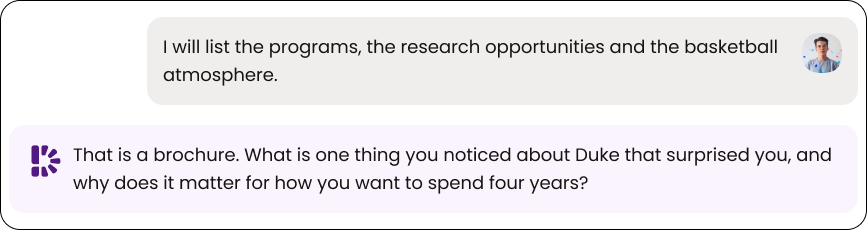
1. “Why Duke” (250 words, required)
The prompt. What is your impression of Duke as a university and community, and why do you believe it is a good match for your goals, values, and interests? If there is something specific that attracts you to our academic offerings in Trinity College of Arts and Sciences or the Pratt School of Engineering, or to our co-curricular opportunities, feel free to include that, too.
What Duke is testing. What you know about Duke and how it connects to you. The prompt has two parts. First, your impression of Duke as a university and a community. Second, why it matches your goals, values and interests. The academic detail is marked “feel free,” which makes it optional. Most weak essays skip the impression and go straight to a list of programs.
How to answer. Open with an impression in your own words: what you noticed about Duke and how you noticed it, not a line from the website. Then connect two or three specifics to things you already do or want. If one is academic, from Trinity or Pratt, make sure it is real and tied to your own work. End with the match stated plainly. About 80 words on the impression, 170 on the match.
Avoid. Listing facts to prove you researched. Duke’s word is knowledge, and knowledge shows in how you connect the facts to yourself, not in how many you name. Basketball as the whole answer. And writing only about one program and skipping the “university and community” half the prompt asks for first.
2. Communities (250 words, required)
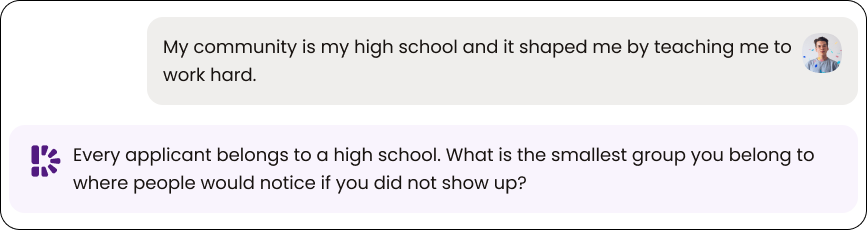
The prompt. We all belong to communities defined by place, faith, family, culture, interests or shared experience. Tell us about a community that has shaped who you are, any way it has set you apart, and what you’ve learned from being part of it that you hope to bring to Duke.
What Duke is testing. Three things named in the prompt: how the community shaped you, how it set you apart, and what you hope to bring to Duke. The “set you apart” part is what makes Duke’s prompt different from many other community prompts, and it is the part many students skip. It can mean how being part of the community shaped your perspective or made you different from your peers. Either can be an honest answer, including if that difference came with a cost.
How to answer. Pick one community small enough to describe concretely, and show what you actually do in it. Spend about 100 words on that. Spend 75 on how it set you apart, honestly. Spend the last 75 on what you bring to Duke, as a specific habit or skill rather than a promise. All three clauses, in order, each answered in plain words.
Avoid. Leaving out how the community set you apart. Choosing a community so large that your role in it stays vague. Listing service hours instead of explaining what the community means to you. Repeating the same story as your personal essay, which Duke reads alongside this.
3. Optional: answer one of three, or none (250 words)
Duke’s condition is exact. Answer one of these only if it adds something meaningful that is not already addressed elsewhere in your application. Check your personal essay, your Communities essay and your activities list first. If a part of your background, a way you disagree with people, or a current excitement is missing from all three, write the matching essay. If you would be retelling your personal essay, skip it. Skipping is a choice Duke explicitly allows, and a weak optional essay is worse than none.
3A. Viewpoints and experiences
The prompt. We believe a wide range of viewpoints and experiences is essential to maintaining Duke’s vibrant living and learning community. Please share anything in this context that might help us better understand you and your potential contributions to Duke.
What Duke is testing. Whether there is a perspective in your file that the reader has not seen yet. “Anything in this context” is wide on purpose. The reader wants one viewpoint or experience, shown, and what it lets you contribute.
How to answer. One aspect, one scene, one contribution. Spend about 120 words on the scene, the rest on what it changed in how you see things and what you would bring to a room because of it. Do not leave the contribution for the reader to infer.
Avoid. Repeating the Communities essay. The list of identities with no scene underneath. And the phrase “diverse perspective,” which is the prompt handed back.
3B. Difference of opinion
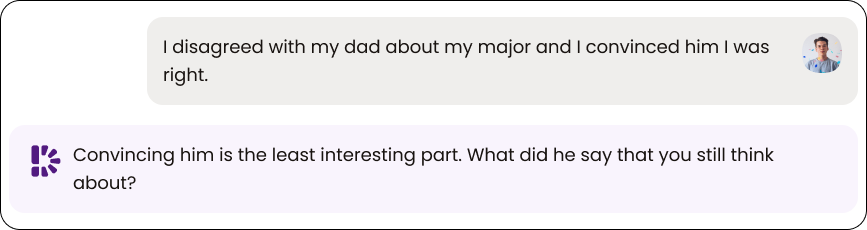
The prompt. Meaningful dialogue often involves respectful disagreement. Provide an example of a difference of opinion you’ve had with someone you care about. What did you learn from it?
What Duke is testing. How you handle disagreement with someone whose relationship you want to keep. “Someone you care about” rules out a debate opponent or a stranger online. The reader is watching how you engaged and what moved, not whether you won.
How to answer. State the disagreement in one sentence. Describe the exchange, including the moment it got uncomfortable and what the other person said that you had not weighed. End with what you learned, which can be small. You still disagree, but you understand why someone you respect holds the other view.
Avoid. A position paper on the issue. A disagreement you won cleanly. And one where the other person is a straw man.
3C. Something you are excited about
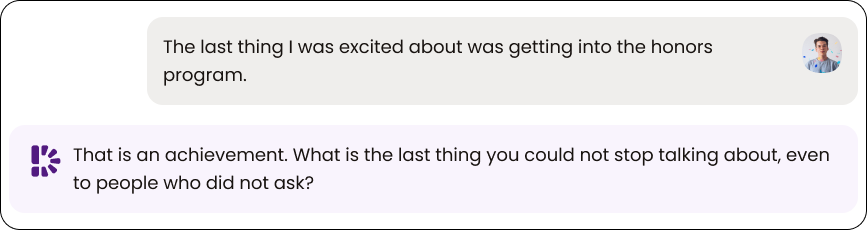
The prompt. What’s the last thing that you’ve been really excited about?
What Duke is testing. What you are like when you are not trying to achieve anything. “The last thing” means something recent, not your life’s passion. The reader wants to see what the excitement consists of.
How to answer. Name it in the first sentence. Spend the rest showing the excitement in action: what you did about it, who you told, what you still want to know. Small and recent beats large and old.
Avoid. Substituting an achievement for the excitement. Your intended major, which reads as strategy. And invented enthusiasm. Readers can tell when a detail was chosen to seem interesting rather than because it is true of you.
Before you write: map the whole application
Your personal statement, activities list and the Duke essays are read as one file. Each piece should add something the others do not. Repeating an interest is fine. Repeating the same evidence wastes space. Think of the reader as someone who has already read everything else in your file before they reach the Duke questions. Duke’s own test for the optional essay, whether it adds something not addressed elsewhere, is a good test for all of them.
Write down what the reader already knows about you from the Common App. Then give each Duke essay one thing that list is missing.
As you plan and draft, keep your writing in your own voice and make sure they reflect your own experiences and thinking.
Want help connecting the pieces? Dakota, in College CoPilot’s Application Coach, uses what you have already shared to spot repetition and ask the question you have not answered. The writing stays yours.