Yale asks for five short pieces and no “Why Yale” essay. The whole supplement is under 900 words. Short means every sentence has to work. For each prompt below, we offer expert guidance on what each question is really testing and how to answer it.
What is Yale’s acceptance rate?
Yale’s overall acceptance rate was 4.2% for the Class of 2030, according to the Yale Common Data Set, and its Single Choice Early Action (SCEA) acceptance rate was 10.9%.
- Overall: 4.2%
- SCEA: 10.9%
- SAT 25th percentile: 1480
- SAT 50th percentile: 1540
- SAT 75th percentile: 1560
What SAT score do you need for Yale?
Yale requires the SAT or ACT for 2026 to 27. The middle 50 percent of admitted students scored 1480 to 1560. A score in that range helps put your application in the pile to be read. It does not get you in. More applicants have perfect scores than Yale has places. That is why the essays matter here.
When are Yale’s application deadlines?
Single Choice Early Action: November 1, 2026. Regular Decision: January 2, 2027. Single Choice means no other private college early.
Does Yale have a “Why Yale” essay in 2026 to 27?
No. Yale dropped it in the August 2026 application update and cut the short takes from four to three. Admissions officers said most “Why Yale” answers just repeated Yale’s website.
So there is no prompt where listing Yale programs or professors earns anything. If you write the words “at Yale,” check that the sentence still answers the question.
Yale supplemental essay prompts 2026/27 and how to answer them
Prompts are quoted from Yale’s essay topics page, linked at the bottom. QuestBridge applicants answer only the first two.
1. Academic areas (choose up to three)
The prompt. Students at Yale have time to explore their academic interests before committing to one or more major fields of study. Many students either modify their original academic direction or change their minds entirely. As of this moment, what academic areas seem to fit your interests or goals most comfortably? Please indicate up to three from the list provided.
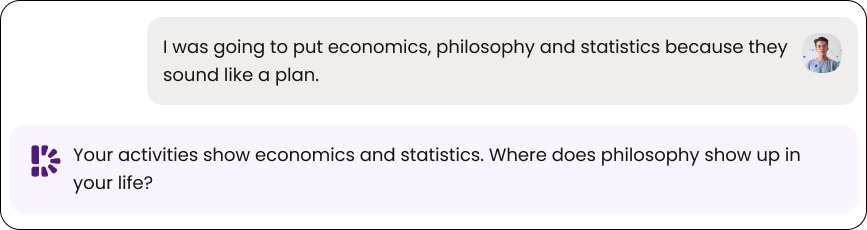
What Yale is testing. Coherence, which just means that the parts of your application agree with each other. Your three picks sit right next to your transcript, your activities list and your 200 word answer, and the reader checks whether they match. A mismatch is not a disaster, but it is a question, and you have 200 words in the next box to answer it.
How to answer. Pick the areas where your evidence already lives, in your classes and your activities, rather than the ones that sound serious. Two honest choices beat three padded ones. Do not choose a field because you think it is less competitive. Yale does not admit by major, and the reader has seen that move many times.
2. A topic or idea that excites you (200 words)
The prompt. Tell us about a topic or idea that excites you and is related to one or more academic areas you selected above. Why are you drawn to it? (200 words or fewer)
What Yale is testing. Whether you can think about one specific thing in public. This is the most important piece of the whole supplement. It is the only place Yale gets to watch your mind at work rather than hear about it. The question is not what you like. It is how you think about it.
The test for your topic. Can you state it as a question someone could disagree with? “Climate change” fails that test. “Why cheap carbon offsets almost never retire real emissions” passes it. The difference matters because a cause is something you support, a field is a subject you study, and an idea is one specific thing you are curious about and could turn out to be wrong about. Yale is asking for the third one.
How to answer. Your first sentence names the idea. The middle of the answer shows what you have actually done with it: a dataset you pulled, an argument you lost, an experiment you ran on your kitchen table. The last two sentences say what you still do not know. Aim to spend about 120 of your 200 words on the idea itself and about 30 on how you found it. Most drafts get this backwards. They spend 150 words on how the student first got interested and 50 on the idea, and the result is an origin story. Yale does not need the origin story. It needs the idea.
Avoid. Naming a Yale professor or a Yale course. The moment you do that, you have stopped writing about the idea and started writing a “Why Yale” essay, which is the one essay Yale just removed.
Short takes (Common App and Coalition only): plan all three together
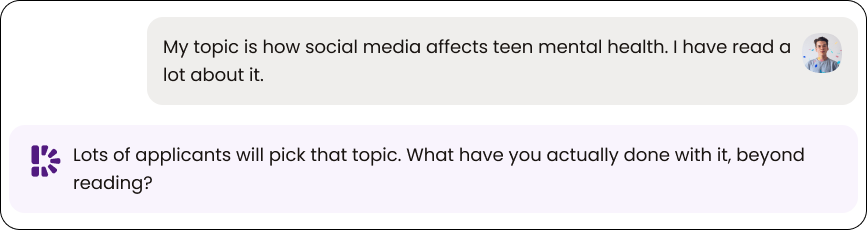
200 characters is one sentence and a fragment, so there is no room to warm up. Yale reads the three short takes together, which means they form a portrait of you whether you plan it or not. Plan it. Each answer should contain a concrete noun, something a reader can picture: a bus route, a sourdough starter, your little brother’s math homework. Each should come from a different part of your life, so the three together show three sides of you rather than the same side three times. Do not start any of them with “I would” or “I hope to.” Those words spend characters and say nothing.
One warning. Readers can tell when a detail was chosen to seem quirky rather than because it is true of you. A plain true detail about your actual life beats an invented odd one every time.
3. A course, a book, or a piece of art (200 characters)
The prompt. If you could teach any college course, write a book, or create an original piece of art of any kind, what would it be?
What Yale is testing. Whether you have a thesis. A thesis is a point of view, and it is the difference between a topic and an argument about that topic. “A history of protest music” is a subject. “Why protest songs stop working once they get popular” is a course, because it makes a claim someone could argue with.
How to answer. Give the title, then one clause that states the argument. If it connects to the academic areas you picked, good. If it deliberately does not, that is fine too, as long as it is something you actually think about. Count characters before you paste, and remember that spaces count.
4. One aspect of yourself you hope to grow (200 characters)
The prompt. What is one aspect of yourself that you hope to grow or develop during college?
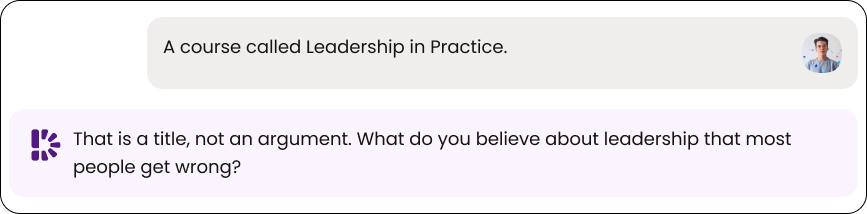
What Yale is testing. Whether you can see yourself clearly. This is not an invitation to be humble and it is not a place for a hidden boast. Yale wants to see that you can name something about yourself that is not finished yet, and say it plainly without turning it into an achievement.
How to answer. Name a behavior, not a trait. “Confidence” is a trait and it tells the reader nothing. “Asking my question while the room is still full instead of in the hallway after” is a behavior, and naming that exact moment proves you have watched yourself do the other thing. Do not spend your characters explaining how you have already fixed it. The question is about college, which has not happened yet.
5. Something not included anywhere else (200 characters)
The prompt. What is something about you that is not included anywhere else in your application?
What Yale is testing. Whether there is more to you than the application can hold. The reader already has your grades, your activities and your personal statement. This box is for what those cannot show. That is why a summary of your activities is the wrong answer by definition. Yale has already read that list.
How to answer. Start by listing what the reader already knows about you from the rest of the application. Then look for the thing that never made it in because it has no hours, no title and no award: a responsibility at home, a skill you taught yourself, a habit your friends would name first if someone asked them to describe you. That is the answer, and it usually takes less than a minute to find once you know where to look.
How to choose the 400 word essay
Common App and Coalition only. Choose one of the three prompts below. 400 words or fewer.
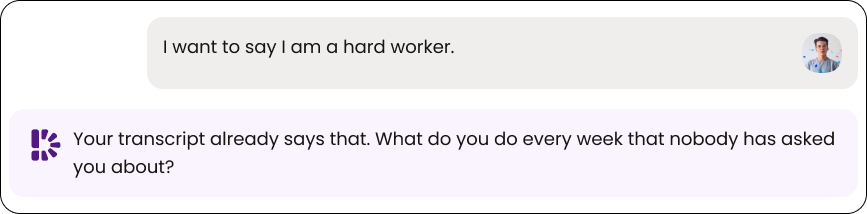
Choose by evidence, not by which prompt sounds most impressive. The right prompt is the one where you can write a scene: a real conversation, a real obligation, a real moment when something changed. A claim is a sentence like “I learned to listen.” A scene is the moment it happened, with who was there, what was said, and what you did next. If all you can write for a prompt is claims, pick a different one.
Yale’s own guidance says the 400 word essay should not retell your Common App essay. The reader has both.
Option A: a discussion with someone who held an opposing view
The prompt. Reflect on a time you discussed an issue important to you with someone holding an opposing view. Why did you find the experience meaningful?
What Yale is testing. How you handle disagreement, not whether you won. The reader is not grading your position on the issue. They are watching what you do when someone pushes back: whether you listen, whether you can repeat the other person’s argument fairly, and whether anything moved. You can lose the argument and still write a great essay.
How to answer. Pick a disagreement that made you think more deeply about the issue. That could be your view, or it could be your understanding of why a reasonable person holds the other one. “Changed” can be small. Maybe you still disagree, but you stopped thinking the other person was foolish. Give the other side its best argument in their own words, not a weak version you can knock down. Include the moment you felt uncomfortable, because that is usually where the meaning is. You are allowed to end the essay still disagreeing.
Avoid. Turning the essay into a position paper. A position paper argues that you are right about the issue. This essay is about what happened between two people. If most of your sentences are about the topic and not about the conversation, you have written the wrong essay and should start again. Be especially careful with hot political topics. Written as advocacy, they read as a speech, and the reader is not grading your politics.
Option B: a community you feel connected to
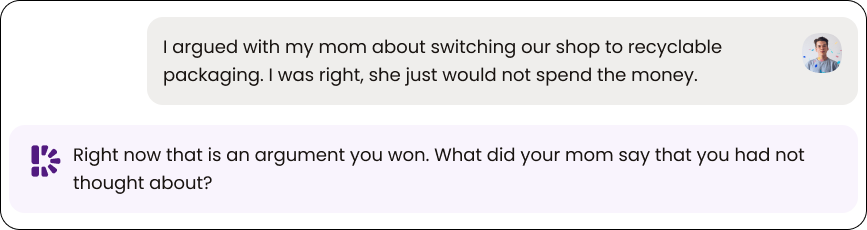
The prompt. Reflect on your membership in a community to which you feel connected. Why is this community meaningful to you? You may define community however you like.
What Yale is testing. What belonging costs you and what it gives you. Yale says you can define community however you like, so take that seriously. A small community with real obligations beats a big one with a mission statement. A mission statement is how a group describes itself. An obligation is the specific thing people expect you to do, and that is what makes a community real on the page.
How to answer. Pick one obligation you hold in that community, something the other members count on you for, and one moment when you met it or missed it. For example, you are the person who unlocks the pool at 5am for the swim team, and this is about the one morning you overslept. Build the essay around that single interaction rather than giving a tour of everything the group does. Make sure the reader sees what other people gave you, not only what you gave them. Belonging runs both ways.
Avoid. Two traps. The first is the service record, where you list everything you did for the group. That tells the reader what you contributed and nothing about what the community is like from inside it. The second is making yourself the hero of everyone else’s story. If every other person in the essay exists to be helped by you, the reader learns about your ego, not your community.
Option C: an element of your personal experience
The prompt. Reflect on an element of your personal experience that you feel will enrich your college. How has it shaped you?
What Yale is testing. Whether an experience actually changed how you see the world, or whether it is just something that happened to you. This is the broadest of the three prompts, which makes it the easiest to write badly. The strong version does not just tell the story. It tells the reader what you notice now that you did not notice before.
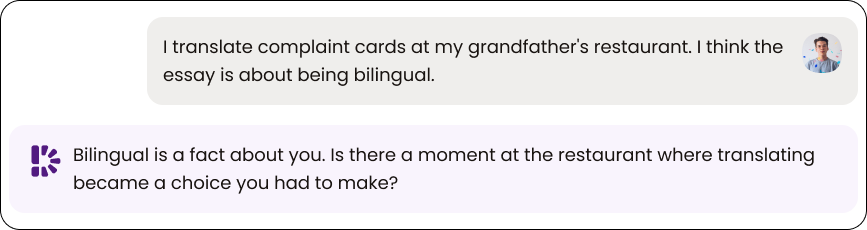
How to answer. Start with a constraint or a responsibility rather than a trait: a job, translating for your family, a move, a role you did not choose. Then show one specific way it changed how you see things or how you make decisions. The question asks how it shaped you, so the essay has to show a before and an after. Save the “enrich your college” part for one sentence at the end, and make that sentence about what you now bring to a room, not about what you plan to do for Yale.
Avoid. Big statements about who you are with no story underneath them. A sentence like “Being an immigrant taught me resilience” is a claim, and the reader cannot check it. The morning you handled the pharmacy call for your mother because nobody else in the house spoke English is a scene, and the reader can see it. Also avoid promising to transform the campus. Nobody believes it and it takes the focus off you.
Before you write: map the whole application
Your personal statement, activities list and the five Yale pieces are read as one file. Each piece should add something the others do not. Repeating an interest is fine. Repeating the same evidence wastes space. Think of the reader as someone who has already read everything else in your file before they reach the Yale questions.
Write down what the reader already knows about you from the Common App. Then give each Yale piece one thing that list is missing. As you plan and draft, remember to check Yale’s AI policy.
Want help connecting the pieces? Dakota, in College CoPilot’s Application Coach, uses what you have already shared to spot repetition and ask the question you have not answered. The writing stays yours. Follow Yale’s current rules on AI assistance.