Your Weekly Intelligence Brief |
||
|
||
|
||
|
||
 |
||
|
||
|
Your Weekly Intelligence Brief |
||
|
||
|
||
|
||
|
||
|
||
|
Your Weekly Intelligence Brief |
||
|
||
|
||
|
||
|
||
 |
||
|
Your Weekly Intelligence Brief |
||
|
||
|
||
 |
||
|
||
|
Your Weekly Intelligence Brief |
||
|
||
|
||
 |
||
|
||
|
Grammar is the section of the SAT where you can score 100%. It’s about mastering Levels 5 and 6 so completely that you sail through them without dropping a single point. The students who break 1500 are the ones who never get an easy or medium grammar question wrong.
You need to memorize the rules and practice them until they are automatic. There are six broad grammar topics that matter most.
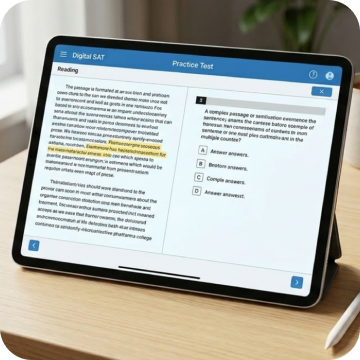
Bluebook practice tests won’t give you enough practice to ensure zero mistakes. Most grammar questions are medium difficulty. But they seem hard because grammar is not formally taught in schools. And you’ll only see a handful of hard ones per test. Bluebooks do not offer enough repetition to build speed or consistency.
College CoPilot’s Hard Grammar Test is built entirely from the grammar questions that appear on the SAT. Timed, so you can build accuracy under speed. When you get one wrong, Dakota, our AI tutor, walks you through the rule and why that answer choice was designed to fool you.
Check your score report. If you’re losing points on Standard English Conventions, this is the fastest fix.
The 6 Rules: A Study Guide
Below are the six rules with a real SAT example and key hint for each. We’ve grouped them into two categories:
–Boundary questions: where does one idea end and another begin?
–Form, Structure & Sense questions: errors you can’t hear.
A nonessential clause is an aside. You can remove it without changing the core meaning of the sentence. It must be punctuated on both sides with matching marks: two commas, two dashes, or two parentheses. Mixing punctuation is always wrong on the SAT.
When two independent clauses are joined by a coordinating conjunction (for, and, nor, but, or, yet, so), you need a comma before the conjunction.
“That” introduces essential information and never takes a comma. “Which” introduces nonessential information and always requires a comma.
These rules separate strong students from top scorers because the mistakes are logical, not audible.
An opening phrase must logically describe the subject that immediately follows it. If it doesn’t, the modifier is dangling. The SAT tests this with participial phrases, appositives, and prepositional phrases.
The subject and verb must agree in number, regardless of how much material sits between them.
When a sentence describes multiple past events, the tense must reflect their sequence. If one past event occurred before another past event, the earlier one requires the past perfect: “had + verb.”
Let’s go for 200+ points. One and done.
Try our Hard Grammar Tests at collegecopilot.me.
Each band tests different skills—and they build as you move up. Understanding this is the key to gaining 200+ points.
Band 4 Reading asks you to find evidence that supports a straightforward claim. Band 7 asks you to find evidence that supports or refutes a claim in early college-level texts, holding two opposing ideas in mind simultaneously.
Band 4 Algebra asks you to solve a simple linear equation in one variable. Band 7 asks you to solve systems of linear equations in two variables with symbolic representations and variable constants.
Same test. Harder thinking.
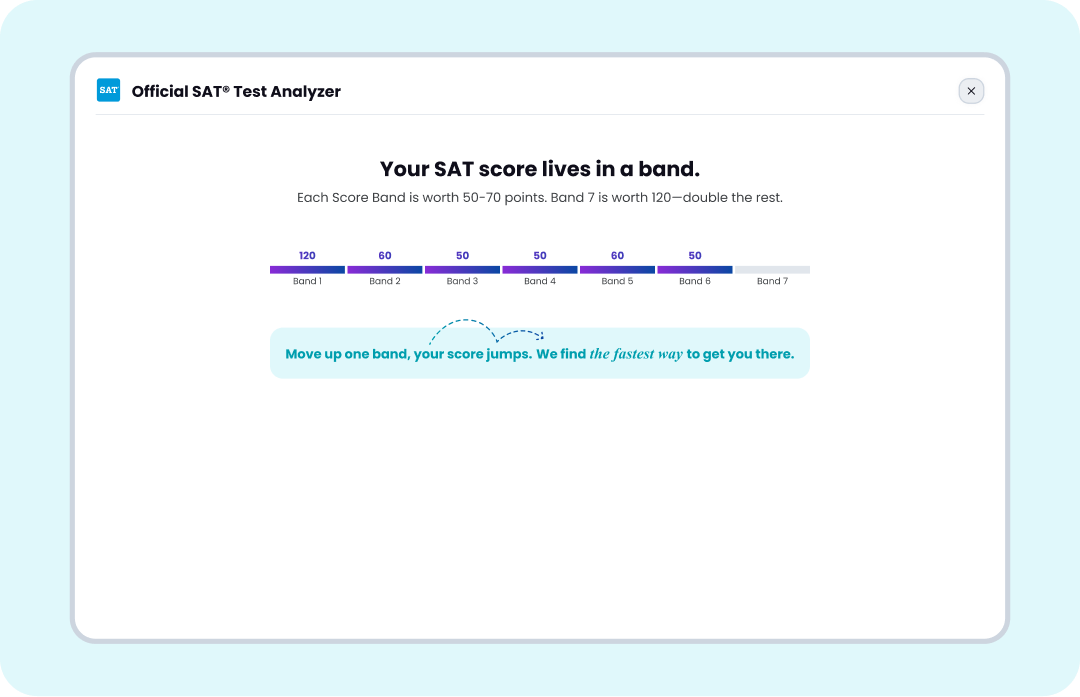
Most practice tests mix all difficulty levels together. A student aiming for 1500+ ends up spending half their time on Band 3-4 questions they’d never miss. That’s not practice. That’s busywork.
This is what your official score report looks like. The bars represent a Score Band Level from 1-7.
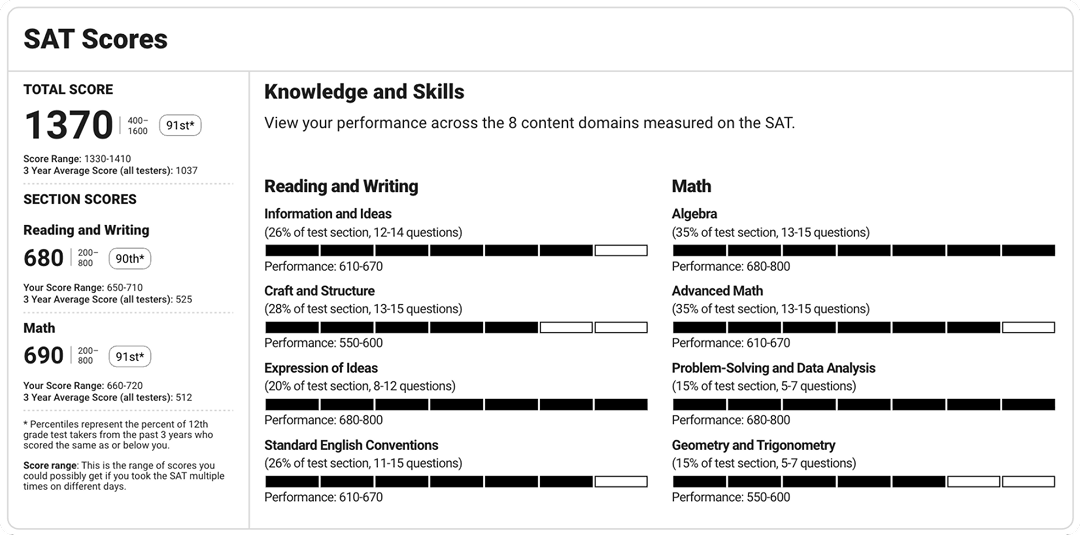
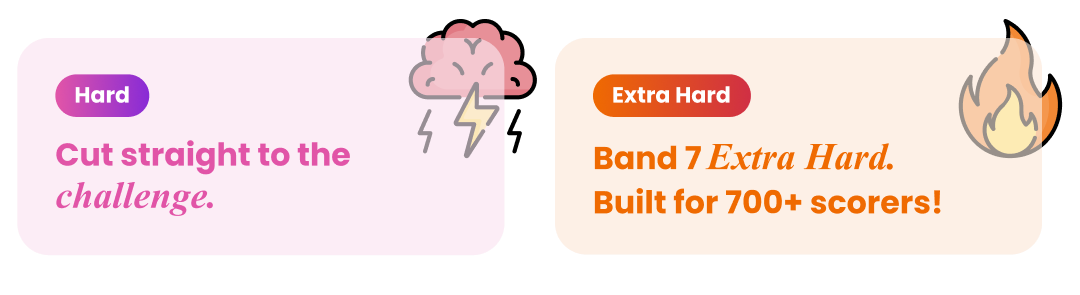
To crack 1500, you need to master both Band 6 and Band 7 questions. Band 6 Hard questions are where good scores become great. Band 7 Extra Hard questions are where great scores become elite. Miss a few at these levels and you’re stuck in the 1400s. Nail them and you break through.
That’s why we built Band 6-only and Band 7-only tests. No filler. Every question at the level that actually moves your score. Practice where it counts.
Built with former College Board® and ACT® experts.
While headlines about artificial intelligence in higher education tend to focus on bans, plagiarism scandals, and hand-wringing, Brown University has spent the past nine months doing something far more interesting: building an institution-wide AI infrastructure from the ground up — and appointing the leadership to steer it.
For families navigating the college admissions landscape, Brown’s approach signals an important shift in where elite education is heading. The university isn’t treating AI as a problem to manage. It’s treating it as a core institutional capability.
In July 2025, computer science professor Michael Littman stepped into a newly created position: Associate Provost for Artificial Intelligence. The role covers AI education, research, and responsible practices, with a charge that extends into operations and external engagement — a remit that Littman himself believes is unusually broad.
“Other institutions have hired people to look after one or two of these areas, but I don’t know of any others that are unifying all of them in a single role,” he told Brown’s newsroom shortly after starting. He reports directly to Provost Francis J. Doyle III and leads a cross-university coordinating committee that connects academic initiatives with administrative functions.
Littman is no bureaucratic hire. He previously served as Division Director for Information and Intelligent Systems at the National Science Foundation, where he oversaw $200 million in annual research funding and co-authored the 2023 update to the U.S. AI Research and Development Strategic Plan. He won the AAAI Outstanding Educator Award in 2024. And he earned his PhD at Brown in 1996, making his return to College Hill both a homecoming and a statement of intent.
One of the most provocative ideas to emerge from Littman’s early work is a direct challenge to how universities grade student work. Referencing the book Teaching with AI, which his committee read together, Littman laid out a striking argument: if AI can produce C-plus or B-minus work on virtually any assignment, then perhaps that level of output simply isn’t good enough anymore.
“Maybe a B-minus is the new F,” Littman said. “So now we have all this headroom above that where the student and the AI can work together to produce something better.”
For Brown families, this raises a question worth thinking about — even if the university itself hasn’t posed it yet. Brown is famous for its flexible grading culture: the Satisfactory/No Credit option, no failing grades on transcripts, and a philosophy that encourages intellectual risk-taking over grade anxiety. If AI raises the baseline of what constitutes acceptable work, what does that eventually mean for a system built around generous definitions of “satisfactory”?
To be clear, Littman hasn’t called for changes to Brown’s grading system, and the university hasn’t publicly connected his comments to S/NC policy. But the underlying tension is real: when the floor of competence rises, the institutions that have historically given students room to experiment may need to rethink what that room looks like.
In late 2025, Brown rolled out university-wide access to AI tools — a move that puts practical technology directly into students’ hands rather than leaving them to cobble together their own subscriptions.
Students now have free access to Google Gemini Chat and NotebookLM through their Brown accounts, cleared for the university’s highest data safety classification. The Office of Information Technology also launched Transcribe, an AI-powered transcription tool built internally through Brown’s AI Sandbox project, which Littman noted performs better and costs significantly less than commercial alternatives.
“We think these tools are extremely relevant to the business of universities,” Littman told the Brown Daily Herald. “They shouldn’t just be available to people on campus who have their own personal resources to pay for them.”
The OIT is also developing Librechat, a service that will consolidate multiple large language models into a single chatbot interface, giving students and faculty access to several AI models through a single Brown-managed platform.
In July 2025, the National Science Foundation awarded Brown a $20 million grant to lead a new national AI institute focused on developing trustworthy AI assistants for mental and behavioural health applications. The AI Research Institute on Interaction for AI Assistants (ARIA) brings together researchers from Brown, Dartmouth, Carnegie Mellon, NYU, UC Berkeley, and several other institutions.
Led by Brown computer scientist Ellie Pavlick, ARIA aims to build AI systems capable of context-aware, sensitive interactions with people — particularly those in states of distress. The work addresses what Pavlick calls the hardest open problems in AI today: understanding cause and effect, modelling internal human states, and building systems transparent enough to earn trust.
“Any AI system that interacts with people, especially those who may be in states of distress or other vulnerable situations, needs a strong understanding of the human it’s interacting with,” Pavlick said.
Littman makes a compelling case that AI literacy is no longer a tech skill — it’s a research skill that cuts across every discipline. In his Q&A with Brown’s newsroom, he gave a vivid example: particle physicists are now generating more data per second than they can possibly store, so they’re using AI to filter in real time for what’s scientifically interesting. The same pattern is emerging in biology, public health, economics, environmental science, and beyond.
This is where Brown’s open curriculum becomes a genuine strategic advantage. A student could combine cognitive science and computer science, which is exactly the intersection where the ARIA mental health institute operates. They could study how AI reshapes public policy through Brown’s new data science master’s programme, which focuses specifically on AI governance. They could explore what AI means for the humanities through the Cogut Institute’s “Models-Scale-Context” lab. Brown isn’t siloing AI into the computer science department. It’s threading it through neuroscience, engineering, applied math, public health, philosophy, and the arts.
“AI enables people to do science more effectively,” Littman said. “We need people to be educated about what the possibilities are in AI, how it can be used, what kind of questions it can answer, and what it can’t answer.”
Perhaps the most important signal for families came in Littman’s comments about the job market. He was candid: AI chatbots are already well-suited to do the kind of work companies expect from new hires, and some employers are slowing entry-level hiring as a result.
His answer was constructive. “Institutions like Brown need to find a way to help their graduates leapfrog over these entry-level positions and start contributing at a higher level,” he said.
He described current AI as having “broad competence” but still lacking “deep insight.” That distinction matters. The students who thrive in the next decade won’t be the ones who can use AI tools because everyone will be able to. They’ll be the ones who understand what questions to ask, what the limitations are, and how to apply AI responsibly within a specific domain. That’s exactly what an interdisciplinary education at a place like Brown is designed to produce.
Brown’s AI strategy reflects a broader truth about where top universities are heading: the schools that will best prepare students for the next decade aren’t the ones banning AI — they’re the ones teaching students to use it critically, creatively, and responsibly.
For prospective applicants, Brown’s investment in AI infrastructure, research leadership, and classroom integration is worth noting. It suggests an institution that sees AI fluency not as a threat to liberal education, but as an essential part of it.
Your Weekly Intelligence Brief |
||
|
||
|
||
|
||
|
||
|
||
|
Your Weekly Intelligence Brief |
||
|
||
|
||
 |
||
|
||
|
Three platforms are getting attention for SAT prep: Khan Academy, Google Gemini, and College CoPilot.
Khan is free but thin. Gemini is free but broken. College CoPilot costs $100/month—but actually works.
Khan Academy has been the College Board’s official SAT partner for years. The videos are solid for foundational concepts. But the practice platform hasn’t kept up with the Digital SAT.
Best for: Students below 1200 who need basic concepts first.
Google launched SAT practice in Gemini in January 2026, partnering with Princeton Review. Free full-length tests sound great—until you actually use it.
Best for: Best for: Students who can fact-check every question and explanation themselves.
College CoPilot takes a different approach. Instead of giving you more practice and hoping something sticks, it shows you exactly where your points are hiding—and builds a plan to get them.
Upload Your Scores. See Your Gaps in Seconds.
Our Official SAT Score Analyzer is designed to work with your real results—official SAT scores or Bluebook practice tests. Drop them in and our Analyzer instantly shows which question types are costing you points—by domain, skill, and score band. No cold start. No guessing.
Stuck? Dakota’s Up.
Talk through any question—text or voice. Short, precise help. No walls of text. Just clear explanations until it clicks.
$100/month. Less than one hour of private tutoring.
Upload your official SAT or Bluebook scores. Get your Gap Report in seconds. See exactly what’s costing you points—then practice only what moves your score.
Built by former College Board and ACT leaders. The only expert team for a high-stakes test.
Be one-and-done.
Start Your Free Trial Here