Your Weekly Intelligence Brief |
||
|
||
|
||
|
||
|
||
 |
||
|
||
|
Your Weekly Intelligence Brief |
||
|
||
|
||
|
||
|
||
|
||
|
||
|
Applying to college is not a single project. It is a multi-year process that runs across junior and senior year—tests, coursework, essays, applications, visits, recommendations—all with different timelines and dependencies.
Most students and families underestimate how much coordination this requires.
College CoPilot gives you an AI-powered To-Do List managed by Dakota, your personal college copilot—with full visibility for parents, tutors, and counselors.
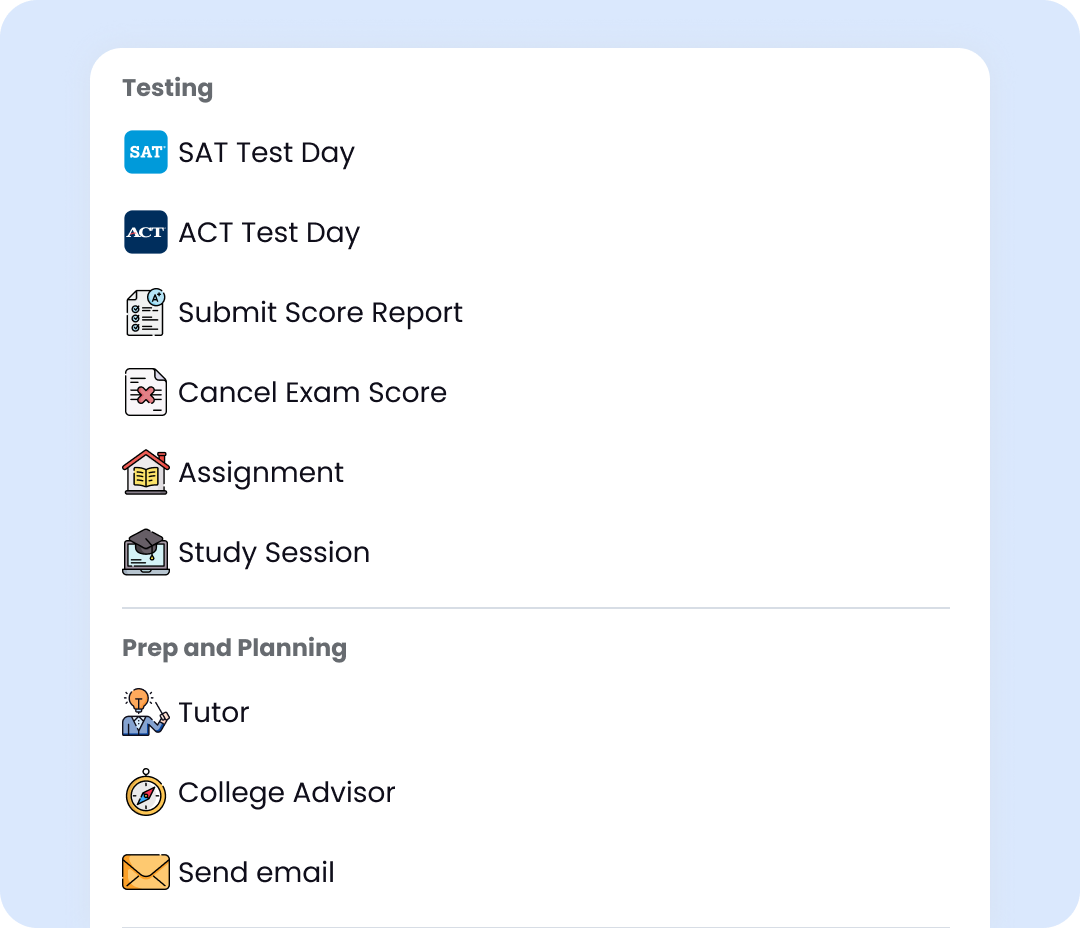
Standardized testing is not just about sitting one exam. It involves planning test dates, preparing in stages, deciding when to retake, and managing score submissions.
Dakota keeps this visible and actionable:
-Days remaining until each test
-Targeted practice based on your score band level—not generic advice
-Score submission deadlines by school
Dakota tells you what matters months in advance so you can plan accordingly.
Data makes it real. Teens respond to stats.
When a student sees that the 50th percentile SAT at their dream school is 1510, it’s no longer abstract. They know what it takes. And that clarity drives action.
Discovering schools through data also sparks genuine interest. A teen might not care about “rankings”—but they might care that 85% of students live on campus, or that the school has a top-five program in their intended major.
Most importantly, it puts ownership in the student’s hands. They’re not being told what to do. They’re researching, discovering, and building their own list. That’s motivation you can’t manufacture.
The application includes far more than most families expect.
Beyond student responses, it requires reports, evaluations, and updates completed by schools and teachers—on different schedules.
Dakota maps every required component to your To-Do List:
-Track what’s outstanding
-Assign responsibility
-Monitor progress
-Follow up when needed
Nothing depends on memory or informal reminders. Dakota remembers so you don’t have to.
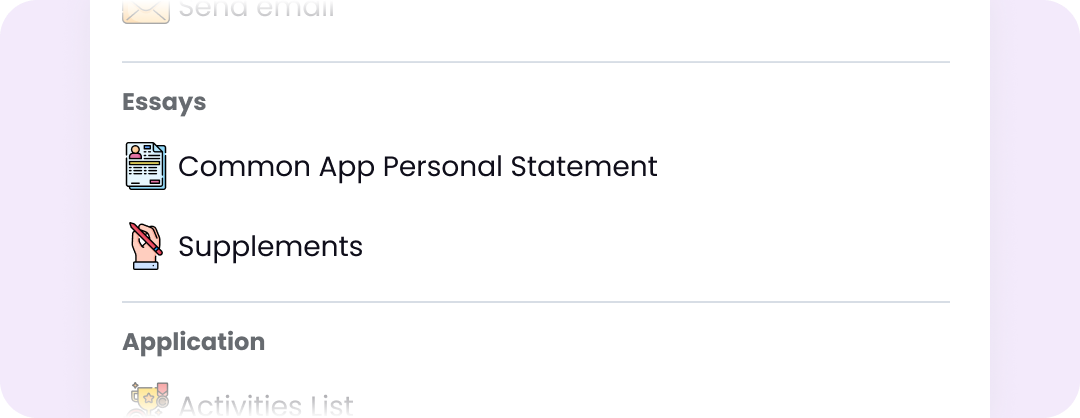
Strong applications are built through multiple drafts and sustained feedback.
In practice, this usually happens across documents, emails, and messaging apps—making version control and accountability difficult.
Dakota organizes your essays in one place:
-Review the same drafts
-Leave comments in context
-Turn feedback into tasks
-Track revisions and approvals
The writing process becomes organized and transparent. And if you’re stuck, ask Dakota.
Engagement with colleges now happens through virtual events, campus visits, interviews, and follow-up communications.
Managing this across multiple schools quickly becomes complex.
Dakota keeps these activities in one timeline—plan attendance, prepare in advance, maintain consistent engagement. Need to know what questions to ask on a campus visit? Ask Dakota.

Most students rely on several adults during the process. Without a shared view, information is fragmented and responsibility is unclear.
Your To-Do List is command central.
Parents, tutors, and counselors can see progress, add guidance, and set expectations. You remain accountable. They stay informed. Everyone aligned.
Dakota keeps the whole team on the same page.
Dakota isn’t a chatbot bolted onto a planner. Dakota lives inside your To-Do List.
Ask about tasks, deadlines, priorities, what to practice next, how to approach an essay, what a school is looking for. Voice or text, anytime.
Dakota gives you guidance in context—when you’re making decisions, not after.
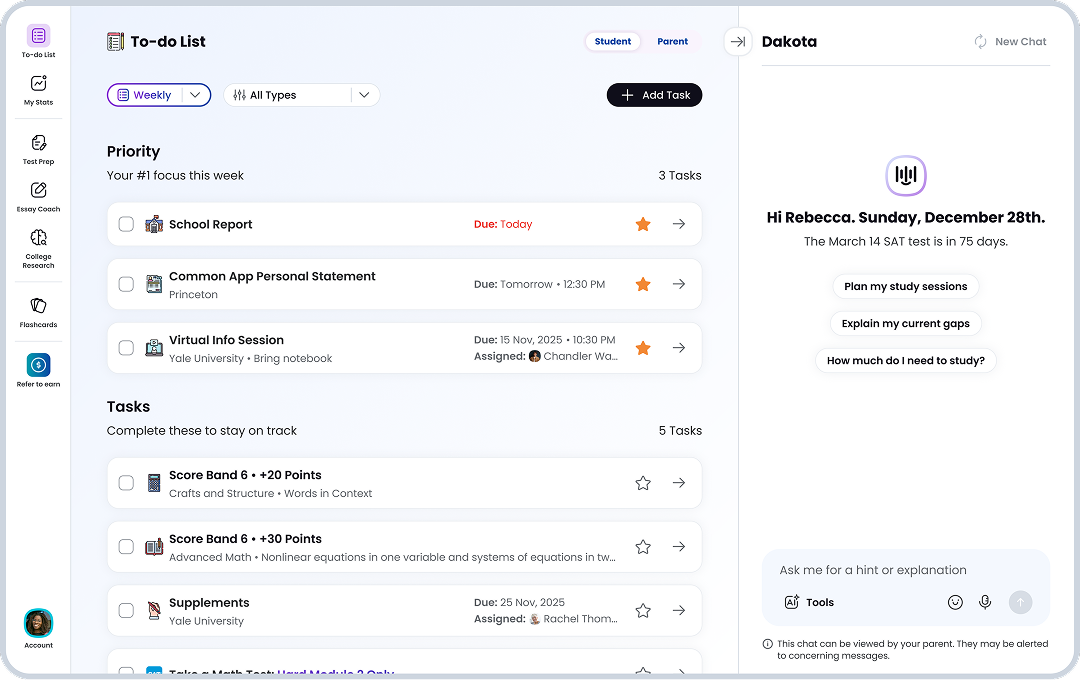
This is not a generic planner.
It is an AI-powered To-Do List purpose-built for one of the most complex projects you’ll face before university. Dakota helps you learn to plan, coordinate, and follow through—with real consequences and real support.
The digital SAT has two sections: Reading & Writing and Math.
Here’s what your teen is up against.
Short, single-paragraph passages with one question each. Module 1 is the same for everyone. Module 2 adapts based on Module 1 performance.
Vocabulary and grammar make up nearly 40% of the Reading & Writing section. Both are trainable with daily practice.
95 seconds per question — about 40% more time per question than the ACT. A built-in Desmos graphing calculator is available for all questions.
Approximately 70% of SAT Math comes from algebra and advanced math. The reference sheet only covers geometry formulas — algebra, statistics, and trig formulas must be memorized.
Each section is scored 200–800. Total score range: 400–1600. There is no penalty for wrong answers — always answer every question.
The test is adaptive by module: Module 1 performance determines whether your teen gets a harder or easier Module 2. If you don’t perform well on Module 1, and are given Module 2 Easy, your score is capped at around 1300.
Try a full-length adaptive practice test at collegecopilot.me.
Your Weekly Intelligence Brief |
||
|
||
|
||
|
||
 |
||
|
||
|
Superscoring allows colleges to consider a student’s strongest section scores across multiple test dates rather than relying on a single test sitting.
It applies to both the SAT and the ACT. What varies is how colleges use superscoring within their admissions process.
Superscoring does not mean:
Superscoring affects how scores are reviewed, not whether another test improves the outcome.
Colleges do not apply superscoring in a single, standard way. Policy differences shape how retakes are evaluated and how much they matter.
Most colleges follow one of five approaches to superscoring.
Retesting is more likely to be worth considering when:
Retesting is less likely to change the outcome when:
Here’s how more than 200 colleges approach superscoring.